“She represents the firm values of Birth Hope and Death — which we must all eventually live by — despite all the talk — talk of string and wire — of our present — effect ridden society”
-Katharine Hepburn on Frances Rich1
Early Life and Education
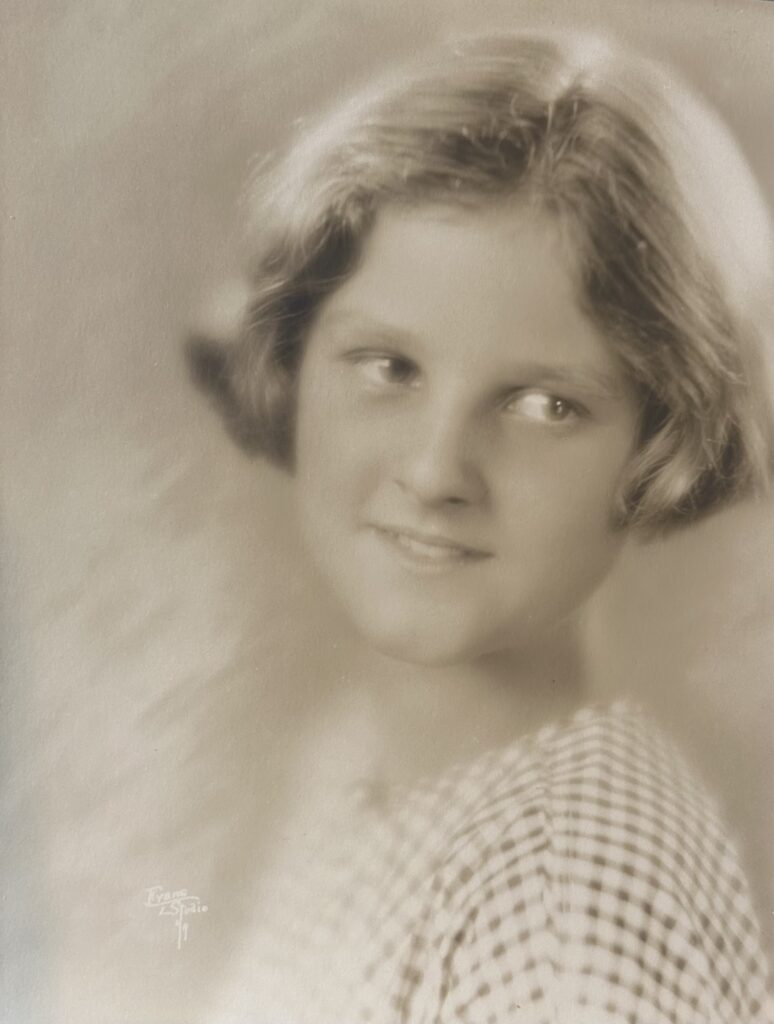
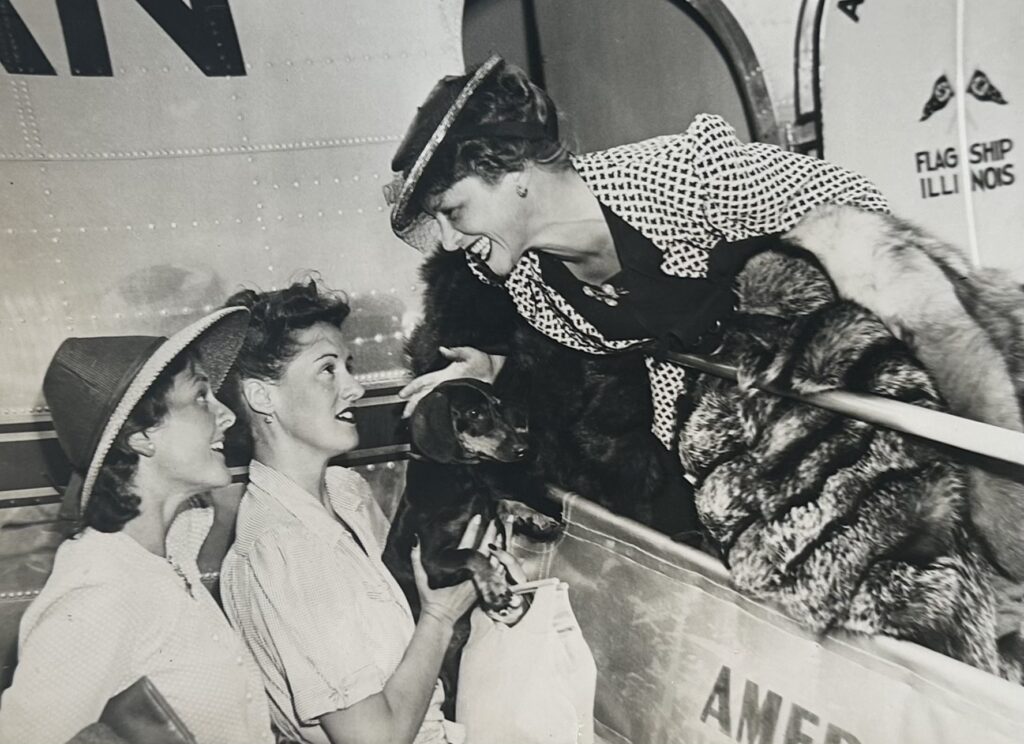
Irene Frances Lither Deffenbaugh was born in 1910 in Spokane, Washington, to her mother, Irene, and her father, Elvo Elcourt Deffenbaugh. When Frances was three, Irene married Charles Henry Rich, who adopted her, and with whom Irene had a second daughter, Jane Rich. Although this marriage was similarly short-lived, it brought Irene, Frances, and Jane to Hollywood, where Irene, now supporting herself and her two children, found work as a film extra. In the 1920s, Irene’s career as a silent film actress began to soar. With her sculpted features and aristocratic demeanor, Rich leaned into the roles of society women and became a beloved role model for women in the United States and abroad.
Her mother’s acclaim gave Frances many opportunities throughout her childhood. She graduated from the Hollywood School for Girls, a private day and boarding institution for the daughters of the elite and wealthy, in 1925. Irene then sent Frances to the Santa Barbara Girls School, another lauded college preparatory school, after a brief stint of study in Switzerland. When it came time for Frances to think about college, Irene urged her to go east, feeling Frances was missing a sense of it in her life and education. Frances, however, was not sure where she should apply. But the Riches had a neighbor whose sister was Martha Wilson, a Smith graduate from the class of 1895. Wilson pressed Frances to apply: “You really should try Smith. I certainly would like you to go there, and I would speak to them, tell them that you’re a decent child.”2
Frances at Smith
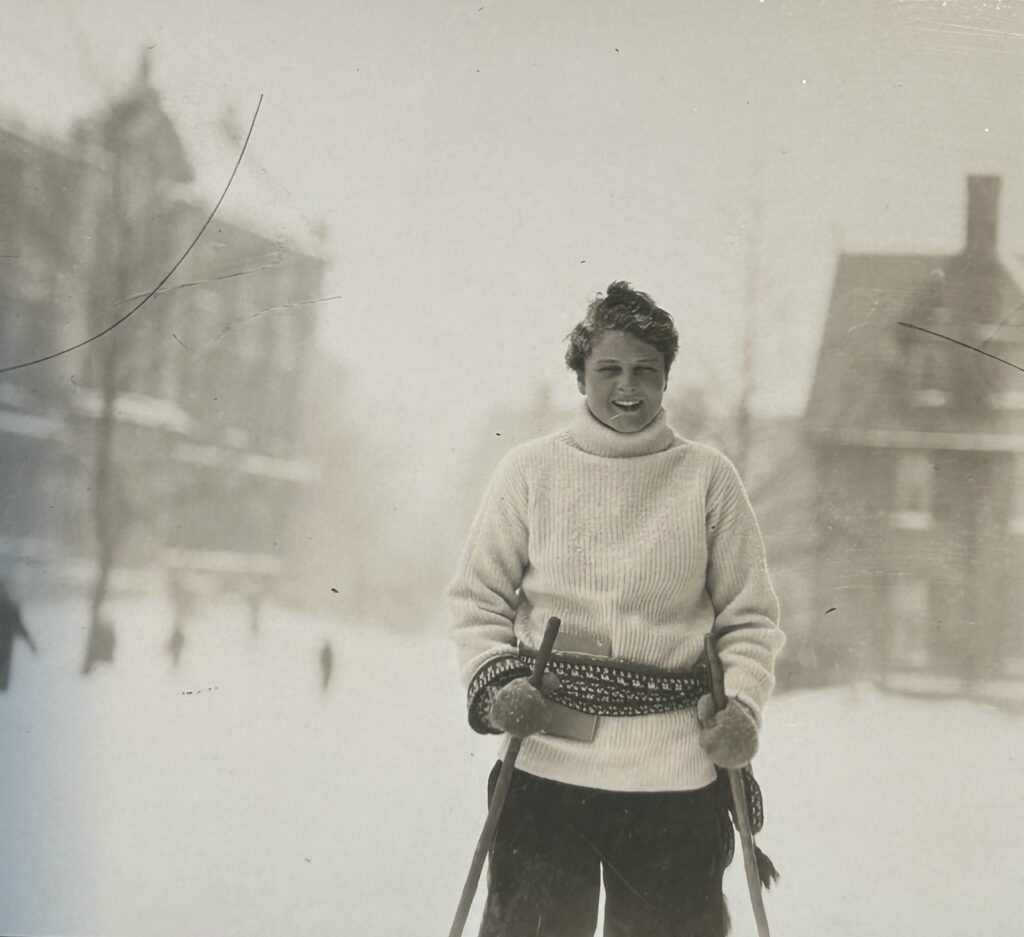
Frances arrived at Smith College in the fall of 1927. The journey from her home in Hollywood took her five days, during which she hauled her “enormous wardrobe trunk” across the country. She lived in Dickinson House, 75 West, and finally 91 Elm Street—houses that have long since been condemned and demolished. Northampton’s climate came as one of the many culture shocks of the East to Frances: “I remember putting on all my ski clothes and going to class. I had a very proper little first year English teacher whom we all liked, Miss Agnew, she ended up later in the Music Department. I arrived in class wearing a ski cap with a tassel and a huge thing around my neck and I don’t know what all, and there was about one inch of snow outside. She said, ‘Miss Rich, don’t you think you’re overdoing it just a little bit?’”3
At Smith, Frances recalled that she “played at first quite a bit.” In her first two years, she traded studying for weekends of fun with her many friends at Williams and Yale. But her beloved advisor, Mary Ellen Chase, the namesake for Chase House, kept her on track. On campus, she was involved in many aspects of extracurricular life. She was a part of Smith’s student government, directed bicycle traffic, played Petruchio in her senior class’s production of Taming of the Shrew, and was head of the grass cops, a group dedicated to enforcing dress codes, smoking bans, and, of course, preventing people from walking on the lawns. While capitalizing on the broad course offerings at the liberal arts college, Frances felt most drawn to modeling. Her sculpted heads of other students attracted attention, and she was encouraged by the art department faculty to pursue sculpture. She graduated in 1931 with a degree in English literature.
Postgrad Life
Frances left Smith without a clear path forward. During the summer after graduation, she received a $20 ticket for reckless driving (roughly $426.48 in 2026).4 With her allowance spent, she turned to work in Hollywood and on Broadway, often under John Ford, a key filmmaker of Hollywood’s Golden Age, to pay it back. Frances made her Broadway debut in Sam N. Behrman’s play Brief Moment. In 1933, through John Ford, acclaimed sculptor Malvina Hoffman discovered Frances, who returned with the artist to Paris for two years of study. Upon her return to the United States, Frances established her own studio in New York. In 1937, she traveled to Cranbrook Academy of Art in Bloomfield Hills, Michigan, where she met Swedish sculptor Carl Milles. Under Milles’ mentorship, Frances worked on central pieces of her early career, including the Army-Navy Nurse Monument in Arlington National Cemetery and the bas-reliefs at the Union Building of Purdue University. It was also in this period that Frances forged connections with pivotal people in her life. Among these were other Cranbrook students, such as designer Charles Eames, and figures from the entertainment world, such as actress Kate Hepburn. William J. Mann, a biographer focused on Hollywood’s Golden Age, describes the world these women and their friends occupied as “upper-class bohemian.”5 He also notes the intimacy of the bond the two women shared: they frequently traveled abroad together and spent summers at Frances’ Palm Springs house, where Kate often posed for Frances. As with many of the other women in this community who were not conventionally married wives and mothers, speculation has and continues to swirl around the true nature of Frances and Kate’s relationship.
Time with the WAVES
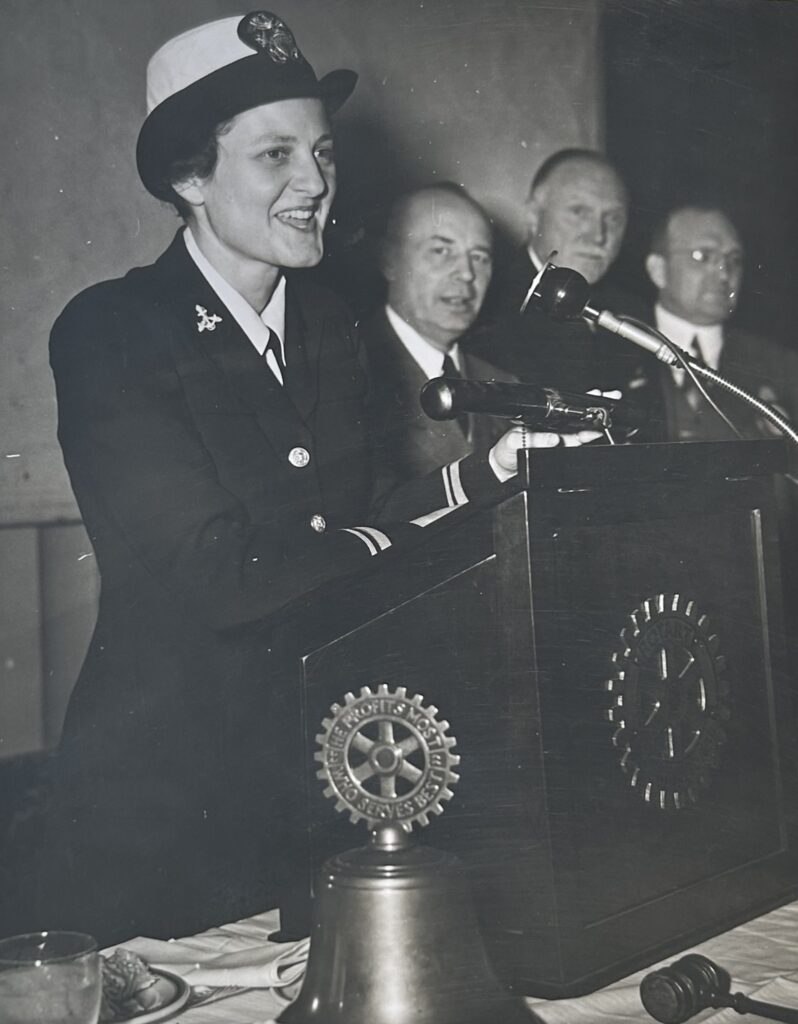
When WWII broke out in Europe, Frances gave up her budding career in sculpture to join the war effort. She became an engineer-illustrator at Lockheed Martin, producing technical drawings of aircraft components. But Frances was not satisfied with this level of participation, and ultimately found her place with the Women Accepted for Voluntary Emergency Services (WAVES). This program was established on July 30, 1942, to free men in the Navy from stateside work so they could join the fight abroad on “sea duty.” Mildred McAfee, president of Wellesley College, was named the program’s director. According to historian Kathleen Ryan, in joining the WAVES, “The women sought out military work because it offered them certain freedoms and opportunities they would not have in their ‘normal’ lives: travel, an escape from expectations to get married and have children, and a way to see something aside from home.”6
Frances was among these women intrigued by what the War offered, recalling that: “Then the next thing I heard one fine morning was that, of all places, my own college campus was going to be the home of the first women in the Navy Officer Training School and that did it. I just thought, ‘I can’t bear it. It would be at my Smith College and I’d love to go in the Navy, it would be a fascinating experience.’”7 So Frances returned to her alma mater for a second time to attend officer training at the U.S. Naval Midshipmen’s School. The Navy took over three dormitories, including Capen House, where Frances stayed, as well as classrooms and the Northampton Hotel. Drilling and physical education took place on the athletics fields. Frances graduated from the first class of officers in Northampton and rose to the rank of Lieutenant Commander. She served as an assistant to McAfee and a Director of V-Mail.
Sculpture Full-time
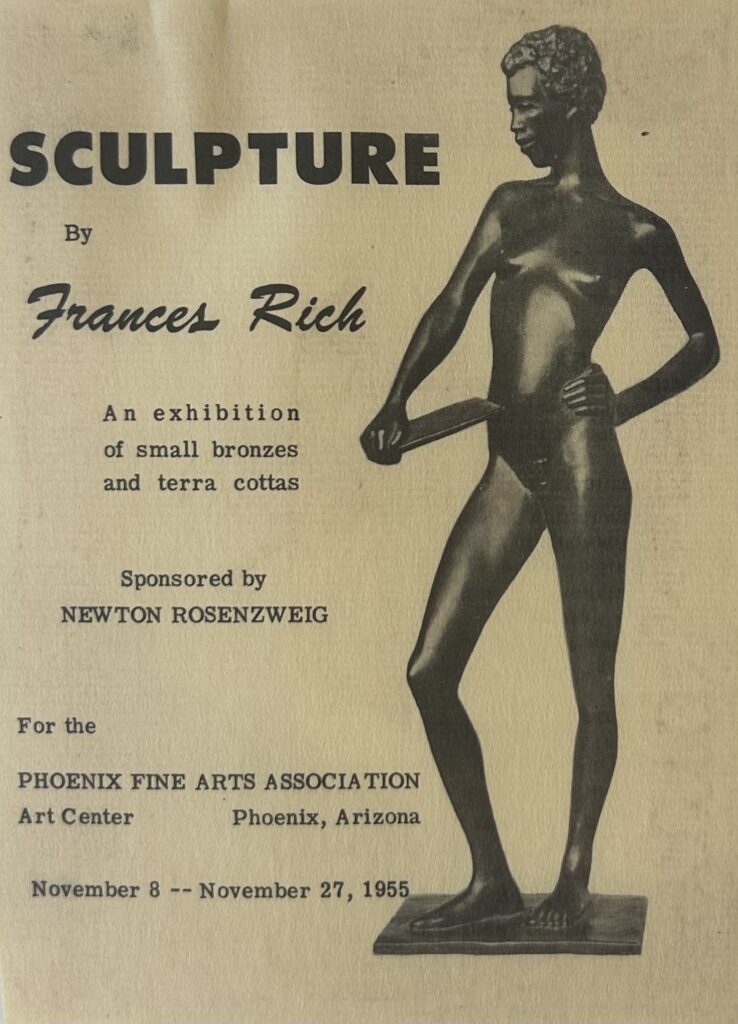
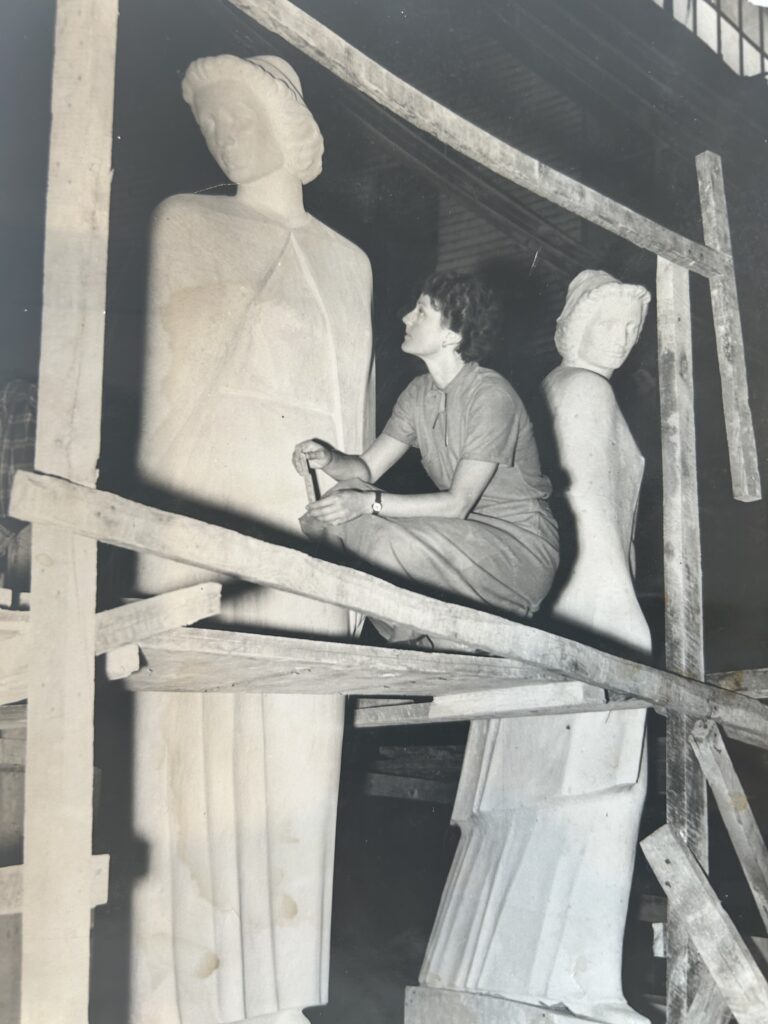
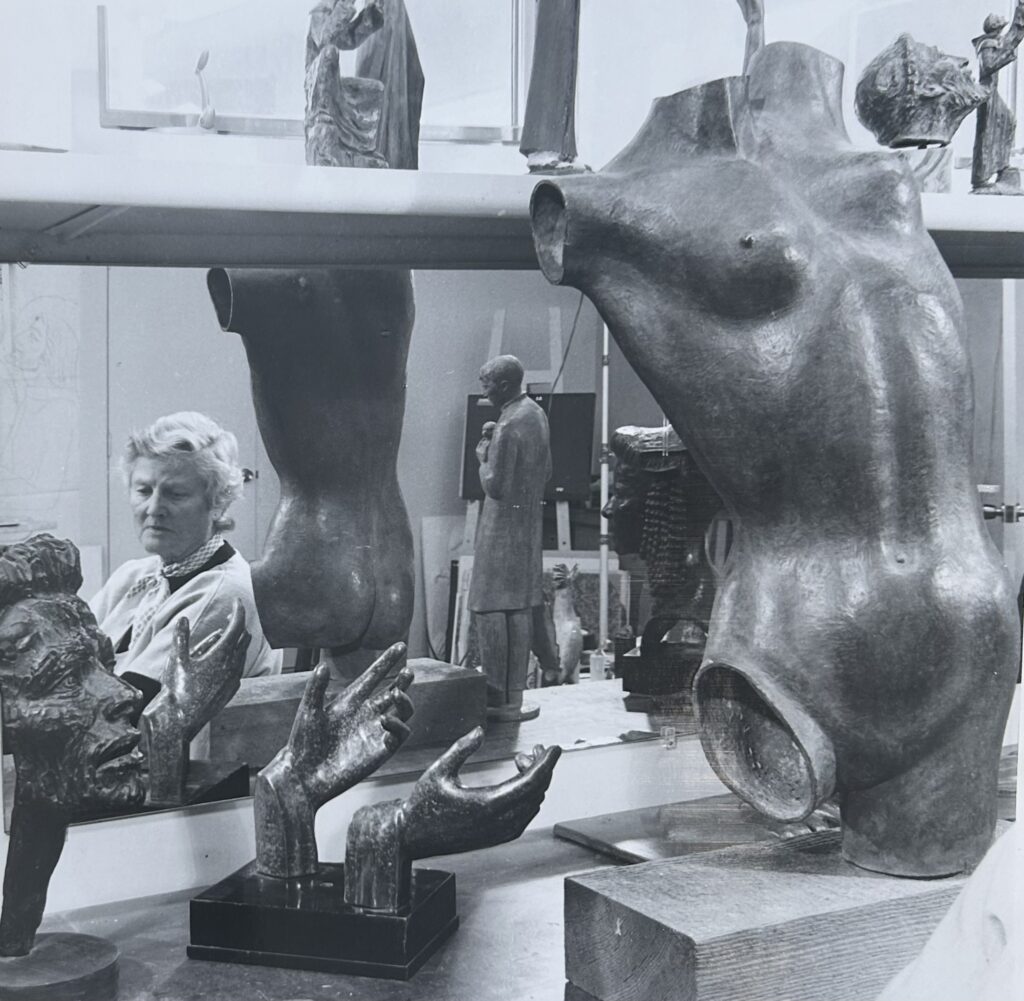
While Frances had always loved art, she did not dedicate herself to sculpture as her ultimate career until 1950. Her first “one-man” show opened in 1953 in Santa Barbara, showcasing Frances’ skill and breadth of work—sculpture largely focused on the beauty and form of the human figure. Despite not identifying as religious, Frances’ work often took on secular themes and characters. She completed many iterations of her celebrated St. Francis of Assisi (including the one behind the President’s House at Smith) and many Madonnas.
In 1950, Frances built her career upon a tradition of American women sculptors who had begun to establish themselves 100 years earlier. However, the work of these women, despite populating museums and cultural institutions around the world, remains largely ignored: “Historical texts discuss male artists to such an extent that women have largely been left out of the narrative, not based on their not being proficient artists, skilled at their craft, or classically trained just as their male counterparts, but because art historical canon is so driven by the male perspective that unfortunately women are moved to the sidelines…”8
Among the various art media, sculpture is often associated with masculinity, especially because of the physical strength required to work with heavy materials like clay and wax. This particular association has posed many challenges for women sculptors, who face sexism at all levels of the art world, from museum visitors, potential clients, exhibition curators, and other artists, and it often shows in their reflections on their own work: “I don’t think that I personally will have contributed anything terribly startling. I’ve done some things that are sincere and I have a few feelings about great people like ‘St. Francis.’ Or in my Army-Navy Nurse, I’ve tried to portray a quality I love, which is compassion with strength, I don’t know if these creations are going to last and seem like much in the future. I just haven’t any idea, but that’s all I can do, I’m just doing the things that mean something to me.”9 Instead of falling into the hegemonic art canon narrative, we owe it to women artists like Frances to recognize and celebrate their achievements and how their work has changed our understanding of what it means to be an artist.
Discussion Questions
- How could Irene’s stardom have influenced opportunities for Frances in the art world?
- How does Frances’ experience embody the close communities of and kinship between women at Smith in the early twentieth century?
- Why might Frances’ experiences in childhood and at Smith have led her to join the WAVES?
- How have conceptions of art as a career changed since Frances began hers in the 1950s? How have they stayed the same?
Further Research
- Frances Rich papers at Smith College Special Collections
- Smith Centennial Study Oral History Project records at Smith College Special Collections
- Armitage, Merle. The Sculpture of Frances Rich, Manzanita Press, 1974.
- To learn more about the history of the Smith Grass Cops, see the capstone project of Emma Merchant ‘24: https://emmartmerchart.itch.io/grass-cop-love
- To learn more about close connections between women at Smith in the early twentieth century, see the capstone project of Roan Lord ‘25: https://sites.smith.edu/affectionatewomen/
Secondary Sources
Mann, William J. KATE: The Woman Who Was Hepburn. New York: Henry Holt and Company, 2006. William Mann’s work focuses on LGBTQ+ life in Hollywood’s Golden Age. His biography of Hepburn includes details about her close relationship with Frances based on interviews with Frances herself. Mann provides insight into the rich social world of these women and the changing ideas of women in the public eye.
Ryan, Kathleen M. “‘I Didn’t Do Anything Important’: A Pragmatist Analysis of the Oral History Interview.” The Oral History Review, Vol. 36, No. 1, (2009): 25-44. In this article, Ryan reflects on her experience conducting oral history interviews with women veterans from WWII, analyzing how and why these women often seem to diminish their accomplishments in service when speaking about their own experiences. Ryan emphasizes how these women navigate complex social expectations in male-dominated spaces such as the Army and Navy.
Ausherman, Maria. Masters of Shape: The Lives and Art of American Women Sculptors. California: Goff Books, 2022. Ausherman explores the careers and lives of understudied women sculptors from the 19th and 20th centuries. This book provides context on the obstacles women sculptors have faced in the art world and their impact on the art form more broadly, including the work and life of Malvina Hoffman, whom Frances studied under from 1933 to 1935.
Bibliography
- The Sculpture of Frances Rich: Frances Rich Retrospective Exhibition. California: Palm Springs Desert Museum, 1969. ↩︎
- Frances Rich Oral History Transcript, 1971, Box 67.14, Folder 24, Smith Centennial Study Oral History Project records 1897-1979, Smith College Special Collections, Northampton, MA. ↩︎
- Ibid. ↩︎
- “Inflation Calculator.” Federal Reserve Bank of Minneapolis, https://www.minneapolisfed.org/about-us/monetary-policy/inflation-calculator.
↩︎ - Mann, William J. KATE: The Woman Who Was Hepburn. New York: Henry Holt and Company, 2006, 310. ↩︎
- Ryan, Kathleen M. “‘I Didn’t Do Anything Important’: A Pragmatist Analysis of the Oral History Interview.” The Oral History Review, Vol. 36, No. 1, 2009, pp. 25-44. ↩︎
- Frances Rich Oral History Transcript, 1971, Box 67.14, Folder 24, Smith Centennial Study Oral History Project records 1897-1979, Smith College Special Collections, Northampton, MA. ↩︎
- Ausherman, Maria. Masters of Shape: The Lives and Art of American Women Sculptors. California: Goff Books, 2022, 19. ↩︎
- Frances Rich Oral History Transcript, 1971, Box 67.14, Folder 24, Smith Centennial Study Oral History Project records 1897-1979, Smith College Special Collections, Northampton, MA. ↩︎