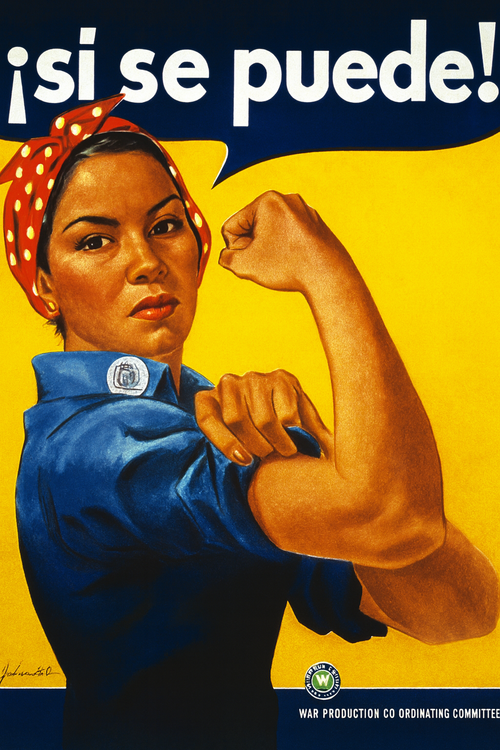
Art has always been a powerful tool for social change. Across media, artistic expression has the ability to change hearts and minds, and legislation. We can see social protests throughout history using artistic media in public space to communicate grievances, group identity, and desires for change, particularly by marginalized groups who have limited access to more formal recourse. Art can amplify marginalized voices, foster community, and illuminate injustices. Symbolic representations, such as slogans or illustrations, allow audiences to identify with the message while maintaining a clear, concise image of the movement. This allows activists to build solidarity, challenge power structures, and crucially, cement their image in public and historical memory.
In the United States, since the colonial era, posters have been the most prolific and iconic form of visual protest art, aided by technological advancements of mass production.1 However, many other forms of artistic protest are prevalent, including political cartoons, photography, and murals, each bringing its own strategic value. This chronological exhibit will explore posters and banners created to promote a variety of social movements throughout American history: the Suffrage movement, the Black Power Movement, second-wave feminism, anti-AIDS organizing, and, most recently, pro-democracy protests.
As you read, consider…
- How can we see social movements of today using art and creating visual culture as part of their resistance?
- To what extent can visual art influence the historical memory of social movements? How do these images become iconic?
- What similarities and differences are present across visual cultures of different social movements?
Suffrage Movement – early 1900s
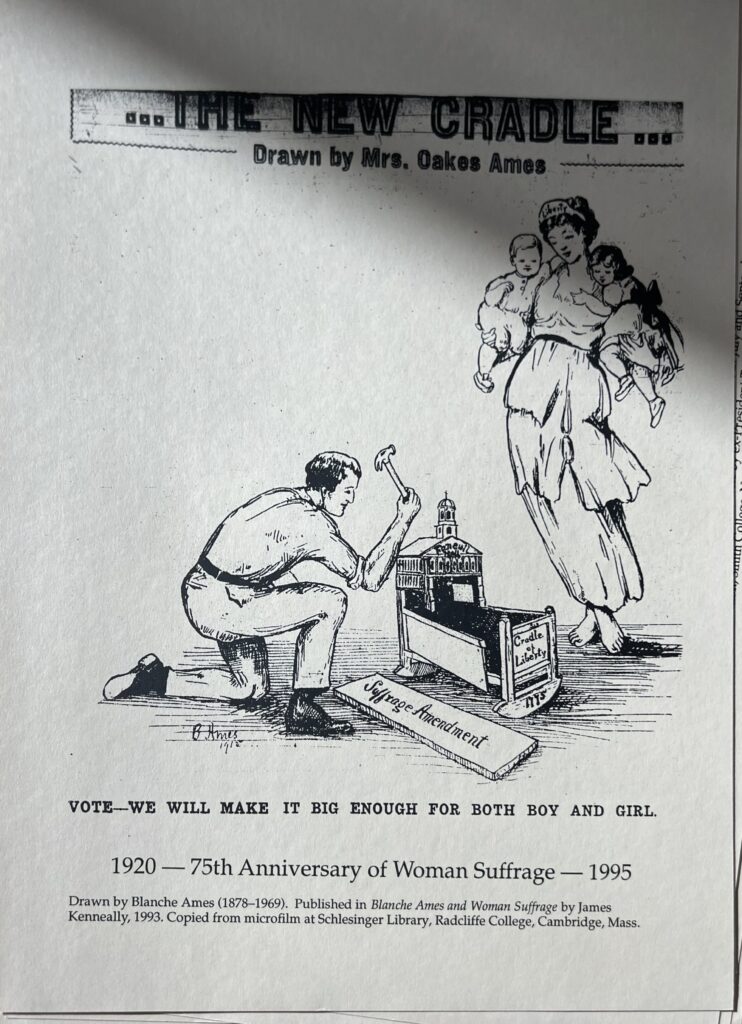
Reproduction of a suffrage poster drawn by Blanche Ames Ames in 1912, 1995. Ames Family Papers, Sophia Smith Collection.
The Suffrage movement employed a highly strategic visual brand that spanned various media, including postcards, political cartoons, buttons, sashes, placards, and illustrated posters, as seen above. This 1912 illustration by suffrage cartoonist Blanche Ames Ames (1878-1969) depicts a Lady Liberty figure holding two young children, who can be seen as the future of the nation, while a man builds “the new cradle” to accommodate the suffrage amendment, making the vote “big enough for both boy and girl” of future generations. In many mainstream newspapers at the time, political cartoons mocked suffragists and their protest by depicting them as masculine, undesirable, foolish, and even cruel or uncaring about their womanly, domestic duties.2
To counter this rhetoric, suffragists promoted an image that often emphasized their duality as women: they could both maintain an orderly household while fighting for the cause, championing the future of the nation on two fronts. However, suffragists were careful not to assert that women were doing it all alone; we can see in this illustration that men were depicted as essential to family care and obtaining the vote. The allyship of men was not taken for granted. Given that men were the gatekeepers to constitutional protections for women’s suffrage, the imagery of the suffrage movement does not condemn men’s wrongs against women but instead appeals to their sympathy.
Black Power Movement – 1960s
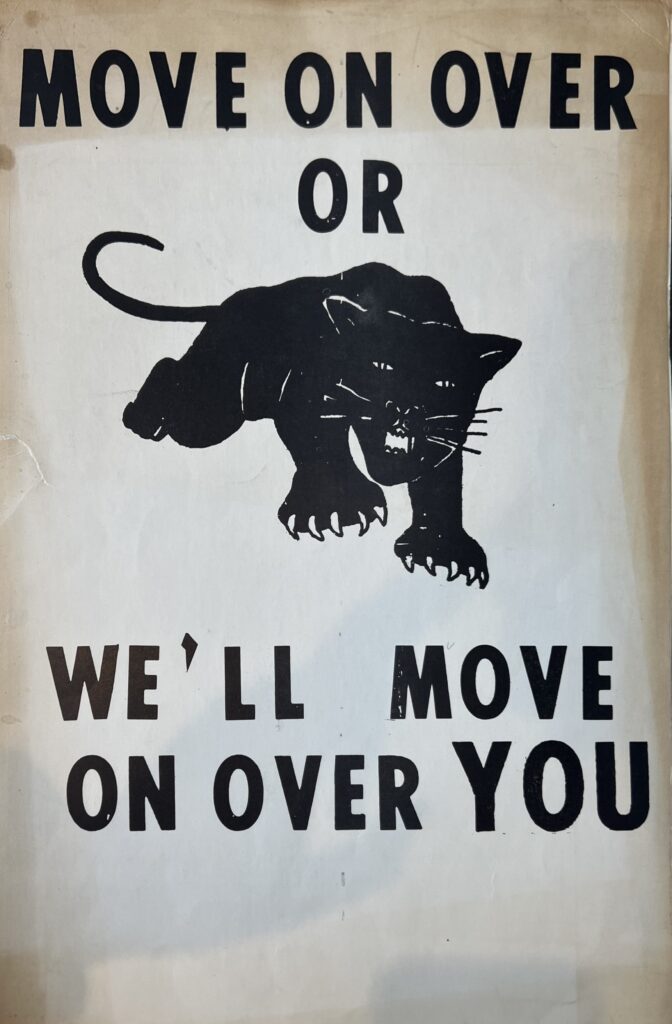
Black Panthers poster, 1960s. Dorothy Pitman Hughes Papers, Sophia Smith Collection.
Unlike the imagery of the suffrage movement, the visual design of the Black Power movement and the Black Panther Party does not attempt to accommodate white audiences; it directly challenges their perceptions of Black people. The Black Panthers had a strong iconography that was essential to their messaging, including the iconic black panther logo seen above. The Panthers understood that their intended audience got most of their information from visual sources. Thus, they crafted a strong set of symbols across images, dress, and texts. This visual culture employed the iconic crouching panther seen above, a raised fist symbol, and their dress included black berets and leather jackets.3
This poster above has only the iconic panther and a minimal slogan, creating a coherent and potent message: we will achieve our goals of Black sovereignty and equality, with or without you. There is no room for confusion or error. This clarity remains present throughout the visual culture of the Black Panther Party as they emphasize the visibility of Black people and their struggles, and simultaneously present a curated image of strength, community, and determination to the public, and crucially, in the media.4
Second Wave Feminism – 1970s
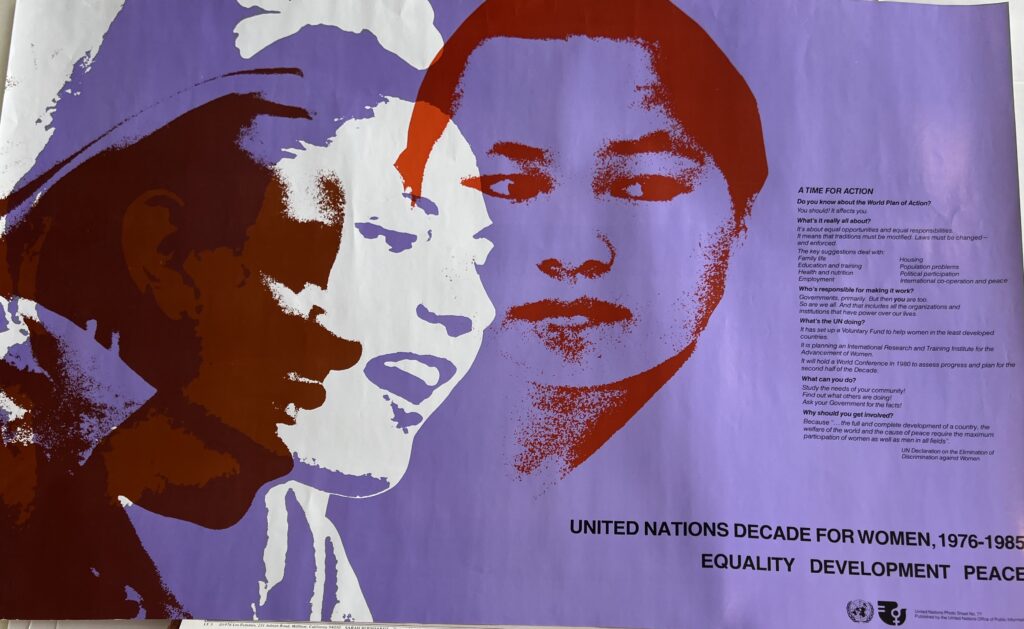
United Nations Decade for Women, 1976-1985 poster. Susan Rubin collection on International Women’s Year and subsequent conferences, Sophia Smith Collection.
1975 was designated as International Women’s Year by the United Nations, beginning the annual celebration of International Women’s Day on March 8th, and ushering in the United Nations Decade for Women from 1976 to 1985.5 This poster, created by the UN Office of Public Information, promotes the international event and calls viewers’ attention to the plans created at the first conference on the status of women in 1975. These plans called for legislation reform to protect the equality and safety of women across the globe. This poster reinforces the message of unity across varied international communities by depicting multiple overlapping faces of women of different ethnicities. Diversity of the feminist movement is highlighted here, underscoring the importance of united, global action. The text on the right involves a call to action, addressing the reader directly; the audience is invited to identify with the plurality of diverse women presented in this poster and to engage in their shared fight.
This dual emphasis on diversity and unity was key to the visual culture of the second-wave feminist movement.6 This can be seen even on a smaller scale with the recurring use of the Venus symbol throughout this movement’s messaging, representing shared inalienable womanhood; despite other factors that can divide us, all women share struggles under the patriarchy. The Venus symbol can also be seen in the logo of the International Women’s Year (bottom right of the poster), as well as an equal sign and a dove, demonstrating the layered goals of equality and safety for women.
LGBTQ+ & AIDS Justice – 1980s
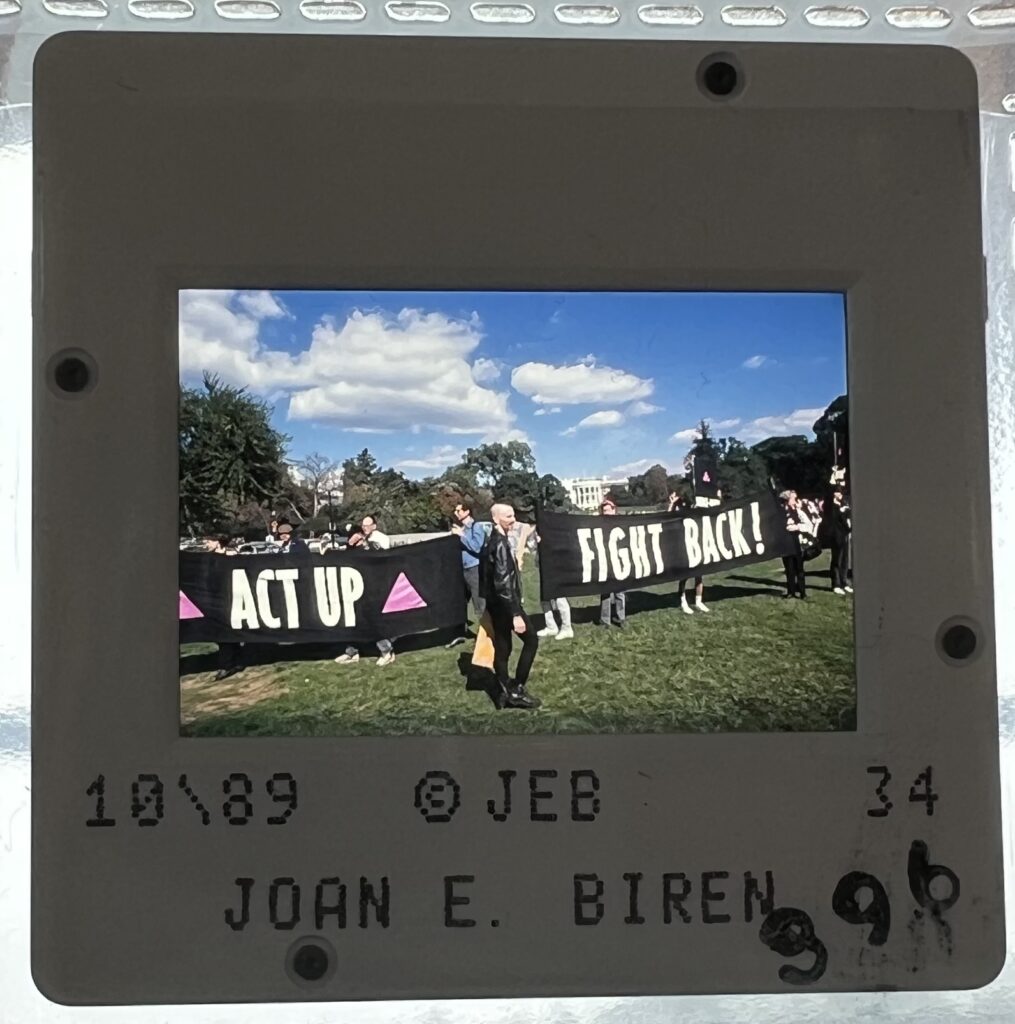
Image of ACT UP protest in D.C. in Summer 1989. Joan E. Biren Papers, Sophia Smith Collection.
This slide photograph was taken by photographer Joan E. Biren (or JEB), who is well known for her documentation of social justice movements and lesbian life in the United States over the last 40 years. Above, we see a protest for LGBTQ+ justice in Washington, D.C., that employs symbolic imagery from the activist group ACT UP. The AIDS Coalition to Unleash Power (ACT UP) was founded in 1987 in New York City as a grassroots, direct-action collective fighting to end the AIDS pandemic.7 As an organization, ACT UP became well known for its protest imagery often made by Gran Fury, the collective’s art group. Some of their most iconic symbols include the pink triangle (seen above), often seen with the text “Silence=Death,” which clearly refers to the lack of public discussion and action in the face of the community devastation caused by the AIDS crisis. The pink triangle is associated with the Holocaust, where Nazi forces designated homosexuals in concentration camps with a pink triangle patch, just as Jews were designated with the yellow star. Gran Fury chose to use abstract yet precise language to reach broad audiences.8 This image of the pink triangle has become iconic and is now associated with ACT UP and its AIDS advocacy. The image above also features a well-known slogan of ACT UP’s protest strategy: the phrase “Fight Back!” Again, drawing on abstract yet clear language, ACT UP was known for the phrase “ACT UP, fight back, fight AIDS,” directly communicating their position with no room for confusion.9
The protest photograph above very distinctly displays the message of ACT UP, emphasizing the strength, resilience, and determination of the LGBTQ+ community despite the tragedies they’ve endured, both calling to the current (at the time) AIDS crisis and historical persecution during World War II. Since their cause of LGBTQ+ justice was highly controversial at the time, ACT UP employed strategic, consistent messaging to control their image in the media and public opinion, creating iconic, highly recognizable visuals that remain relevant today.
Democracy Organizing – 2010s
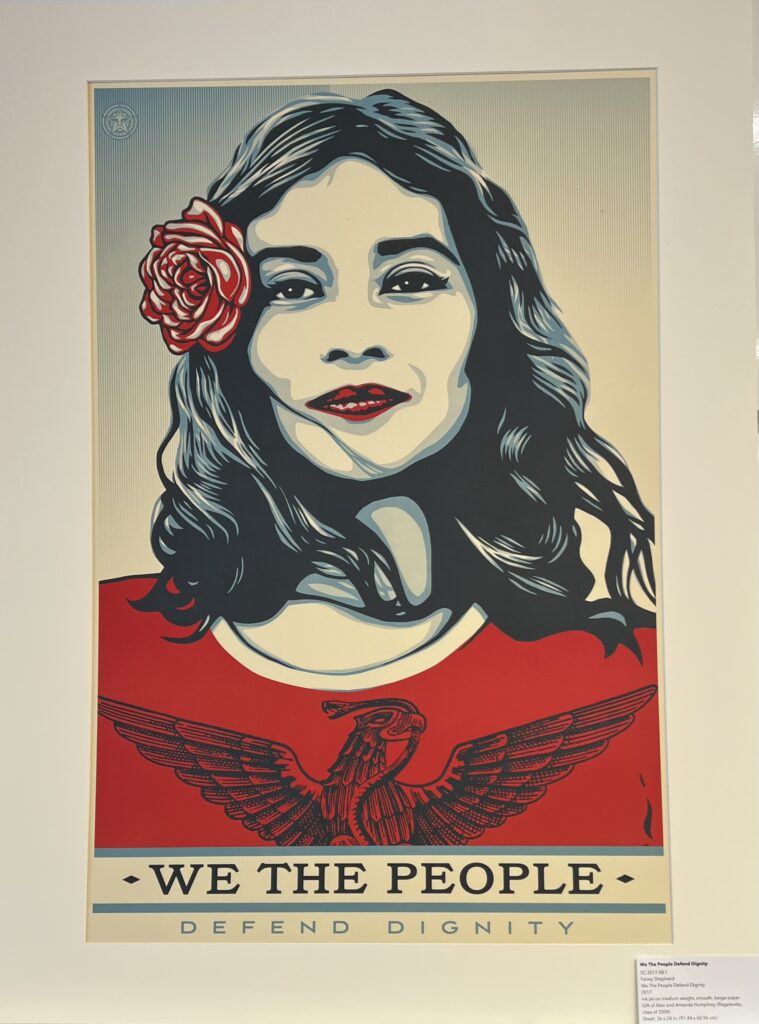
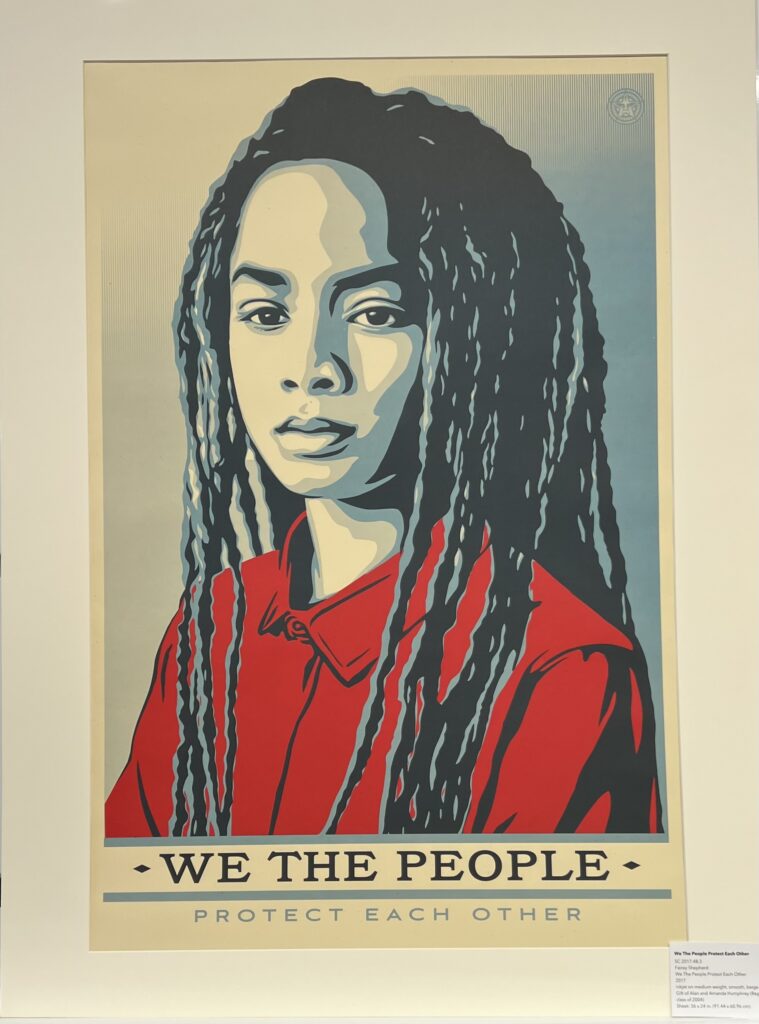
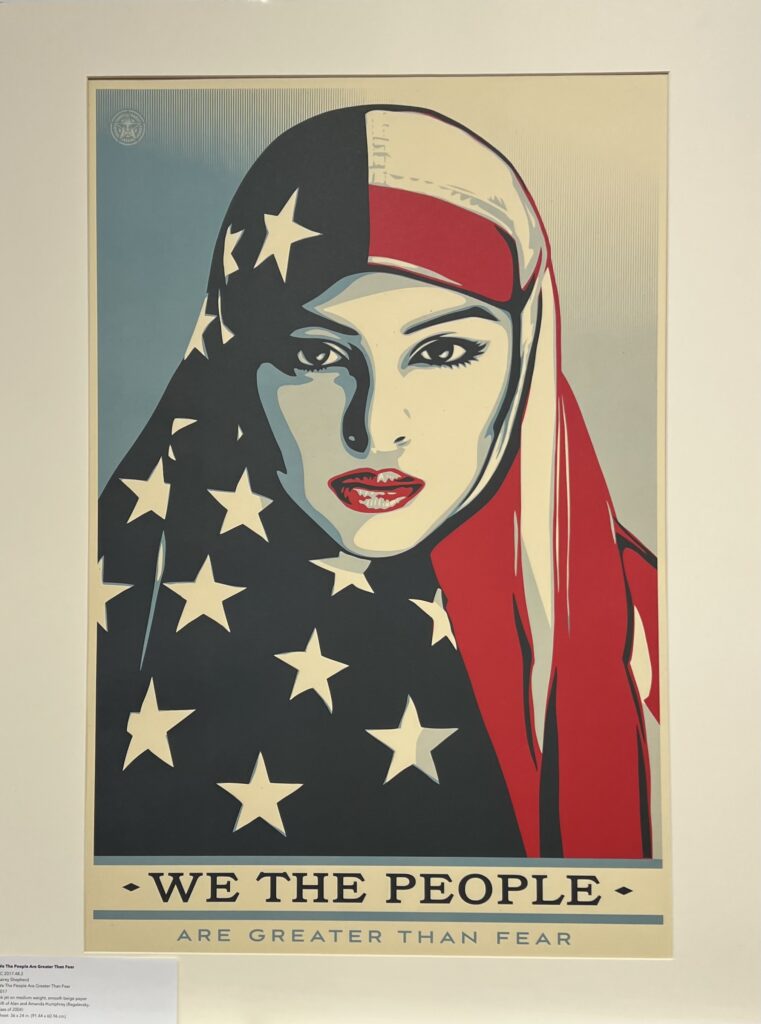
We The People series – selections by Shepard Fairey. Smith College Museum of Art.
The “We The People” series was a national nonpartisan campaign in 2017 dedicated to demonstrating the diversity of American identity through public art, largely spurred by the election of President Trump in 2016. This campaign was crowdfunded through Kickstarter but commissioned by the Amplifier Foundation, a nonprofit design lab that supports grassroots social movement organizing through art.10 In collaboration with other well-known activist artists Ernesto Yerena and Jessica Sabogal, Shepard Fairey created these three posters: We The People Defend Dignity, We The People Protect Each Other, and We The People Are Greater Than Fear (seen above left to right). The grassroots nature of these works and this series more broadly is represented in the works as they were available in this large poster format, but also as free, downloadable images on the Amplifier website for people to print at home and use as their own protest signs – further emphasizing the US as a people united who will not be divided.
These posters embody the diversity of America by depicting three distinctly oppressed (both historically and currently) groups of women in particular: a Latina woman, a Black woman, and a Muslim woman. However, all three figures are still wearing red, white, and blue while looking defiantly back at the viewer. Through these works, Fairey makes visible the diversity of the US while reiterating the unity that binds us as a democratic nation. Other social movement artists before Fairey are characterized by several of these same motifs of diversity, unity, and determination; he and the fellow commissioned artists drew inspiration from visual cultures that we can see developing in the above images.
Despite the variety of social justice causes represented in this exhibit, we can see that art continues to be a critical tool for social change. It provides a unique outlet for activists to express themselves and their messages, and allows for strong emotional identification with the ideas represented therein. Its utility for historical and contemporary social movements cannot be understated, and must be considered for activists organizing today.
Annotated Bibliography
Kopetzky, Abigail. “Imagery of the American Suffrage Movement: The Strategic Implementation of Traditional Gender Roles.” URJ-UCCS: Undergraduate Research Journal at UCCS 15, no. 2 (2022). https://urj.uccs.edu/index.php/urj/article/view/577.
Kopetzky discusses the imagery of the suffrage movement, particularly in cartoons and postcards from around 1900 to 1920, which illustrates a calculated use of gender roles to shape public opinion in their favor. The dominant image put forth by suffragists depicts women who care about gaining the right to vote, but also who care for their families and maintain a proper home. Kopetzky argues that this was in large part to contradict the image of suffragists that circulated throughout political cartoons in this era that depicted the women as masculine, undesirable, and foolish, or rather as cruelly abandoning their households and families to protest in the streets. Conversely, suffrage-made imagery often emphasizes the beauty of the suffragist figure as well as her homemaking prowess. This article examines the details of these contrasting images from outside and inside the suffrage movement in the early 20th century.
McDonnell, Terence. “Manipulation and the Media: ACT UP, Protest Art, and Legitimacy.” Conference Papers – American Sociological Association, August 16, 2003, 1–15. 15921959.
In this paper, McDonnell conducts a historical archival analysis of the art and graphics used by the protest group ACT UP (AIDS Coalition to Unleash Power) in the 1980s and 1990s. ACT UP was a highly influential organizing group for whom protest art was crucial and defining. McDonnell argues that ACT UP used art strategically in terms of media representation and to control the reception of their message in the public sphere. He likens the use of protest art to propaganda, claiming that social movement organizations carefully use and create visual culture to increase the resonance of their message for a mass audience.
Ongiri, Amy Abugo. Spectacular Blackness: The Cultural Politics of the Black Power Movement and the Search for a Black Aesthetic. University of Virginia Press, 2009. http://ebookcentral.proquest.com/lib/smith/detail.action?docID=3443990.
Beginning this book with an examination of the visual culture of the Black Power Movement, and particularly the Black Panther Party, Ongiri explores the revolutionary imagery they employed in the context of other revolutionary movements of the 1960s. She writes that the Black Panthers knew that their public presentation was crucial to the movement, beginning with their visibility in mainstream discourse. This self-presentation was intended to evoke images of revolutionaries, yet at the same time elicit personal identification between the visual representation of the organization/movement and the viewer. Again, the media was essential to this image; the Party strategically organized media coverage of both their community action as well as their political activism, as is reflected in their public imagery.
Quinn, Julianne. “A Picture Is Worth A Thousand Words: The Visual Culture of Twentieth Century Feminism in the United States.” Union College, 2015.
In Chapter Four of her thesis, Quinn discusses the visual culture of the Second Wave Feminist movement of the 1960s-1980s. She outlines the political and contextual history of this movement, and then conducts a visual analysis of the signs and symbols employed by organizers and designers. For this movement, the visual was highly important for framing the protest; since it was a contentious and highly mocked topic in the public sphere, feminists were careful to produce acceptable yet compelling images. Quinn argues that this imagery strongly emphasized the diversity and unity within the movement, making different kinds of women visible in their fight for justice. Like the suffragists before them, feminists directly challenged dominant narratives about women and their place in society, but adjusted for their modern media.
Reed, T. V. The Art of Protest: Culture and Activism from the Civil Rights Movement to the Present. University of Minnesota Press, 2019. https://doi.org/10.5749/j.ctvb1hrcf.
Reed examines the role of the arts throughout social protest movements, conducting a comparative analysis of the artistic, political, and cultural aspects of the movements. He argues that the arts have been a significant factor in protest movements and that movements in fact need strategic art to be successful in our current age. Reed discusses social movements as sites for the production and reception of cultural texts, such as visual art, and how they create and reinterpret social realities. The book’s chapters are organized by different direct-action movements through American history, using the Civil Rights Movement as a master frame. Each chapter discusses the historical context of the movement, its use of artistic and visual strategies, and how the protest legacy has persisted into our contemporary moment.
For further inquiry:
At Smith College:
1. Suffrage collection in the Sophia Smith Collection
2. Peace collection in the Sophia Smith Collection
3. Joan E. Biren papers in the Sophia Smith Collection
4. Works by the Guerrilla Girls at the Smith College Museum of Art
… amongst many other collections from activists whose papers are housed in the Sophia Smith Collection
Outside resources:
1. Tamiment Library Poster and Broadside Collection at New York University
2. Yanker Poster Collection at the Library of Congress
3. Poster Collection at the Hoover Institution Library & Archives at Stanford University
Footnotes:
- Ralph Young, Make Art Not War: Political Protest Posters from the Twentieth Century (NYU Press, 2016), https://doi.org/10.2307/j.ctt1cc2n65. ↩︎
- Abigail Kopetzky, “Imagery of the American Suffrage Movement: The Strategic Implementation of Traditional Gender Roles,” URJ-UCCS: Undergraduate Research Journal at UCCS 15, no. 2 (2022), https://urj.uccs.edu/index.php/urj/article/view/577. ↩︎
- “Black Power in Print: Iconography of the Black Panther Party,” Curationist, accessed March 12, 2026, https://www.curationist.org/editorial-features/article/black-power-in-print:-iconography-of-the-black-panther-party. ↩︎
- Amy Abugo Ongiri, Spectacular Blackness: The Cultural Politics of the Black Power Movement and the Search for a Black Aesthetic (University of Virginia Press, 2009), http://ebookcentral.proquest.com/lib/smith/detail.action?docID=3443990. ↩︎
- “Conferences | Women and Gender Equality,” United Nations, accessed March 11, 2026, https://www.un.org/en/conferences/women. ↩︎
- Julianne Quinn, “A Picture Is Worth A Thousand Words: The Visual Culture of Twentieth Century Feminism in the United States” (Union College, 2015). ↩︎
- “ACT UP NY | End AIDS!,” accessed March 11, 2026, https://actupny.com. ↩︎
- “Gran Fury,” Gran Fury, accessed March 11, 2026, https://www.granfury.org/about. ↩︎
- Terence McDonnell, “Manipulation and the Media: ACT UP, Protest Art, and Legitimacy.,” Conference Papers – American Sociological Association, August 16, 2003, 1–15, 15921959. ↩︎
- “We The People,” Amplifier, July 13, 2020, https://amplifier.org/campaigns/we-the-people/. ↩︎