NATO’s “Double-Track Decision:” The Deployment of Cruise and Pershing II Missiles
Throughout the Cold War (roughly 1945-1989), both the United States and the Soviet Union sought to rapidly expand their nuclear arsenals. Each side developed missiles capable of facilitating nuclear strikes— some of the most powerful being medium and intermediate-range ballistic missiles (reaching targets of 500-5,000 miles away).2 With just a single push of a button, entire cities could be destroyed, and millions of lives could be taken in just an instant. Understandably, as these arsenals grew, so did public anxiety. Many people around the globe began to fear and anticipate a nuclear war— a clash that could potentially wipe out civilization itself.
On December 12th, 1979, amid alarm caused by the Soviet Union’s placement of its SS-20 surface-to-surface Saber missile system in the Eastern Bloc, NATO drafted the “Double-Track Decision.”3 The SS-20 enabled the Soviets to control three independent nuclear warheads at once, resulting in a level of destruction “11 times that of the atomic bomb dropped on Hiroshima.”4 Due to fears of annihilation, European NATO nations began negotiations with the Soviet Union to destroy all intermediate-range ballistic missiles (Track One). An agreement would also entail the destruction of the United States’ mid-intermediate-range arsenal. However, the decision stipulated that if a disarmament solution was not reached within four years, the United States would deploy 108 of its new MGM-31B Pershing II Missiles, along with 464 BGM-109 Ground-Launched Cruise Missiles, to “modernize” NATO and Europe’s nuclear arsenal.5 Because of rising tensions between the countries—bolstered by the Soviet invasion of Afghanistan in the following years—the negotiations of Track One fell through. As a result, NATO turned to Track Two, and the deployment of Cruise and Pershing II missiles to Europe was set to begin in the fall of 1983.6
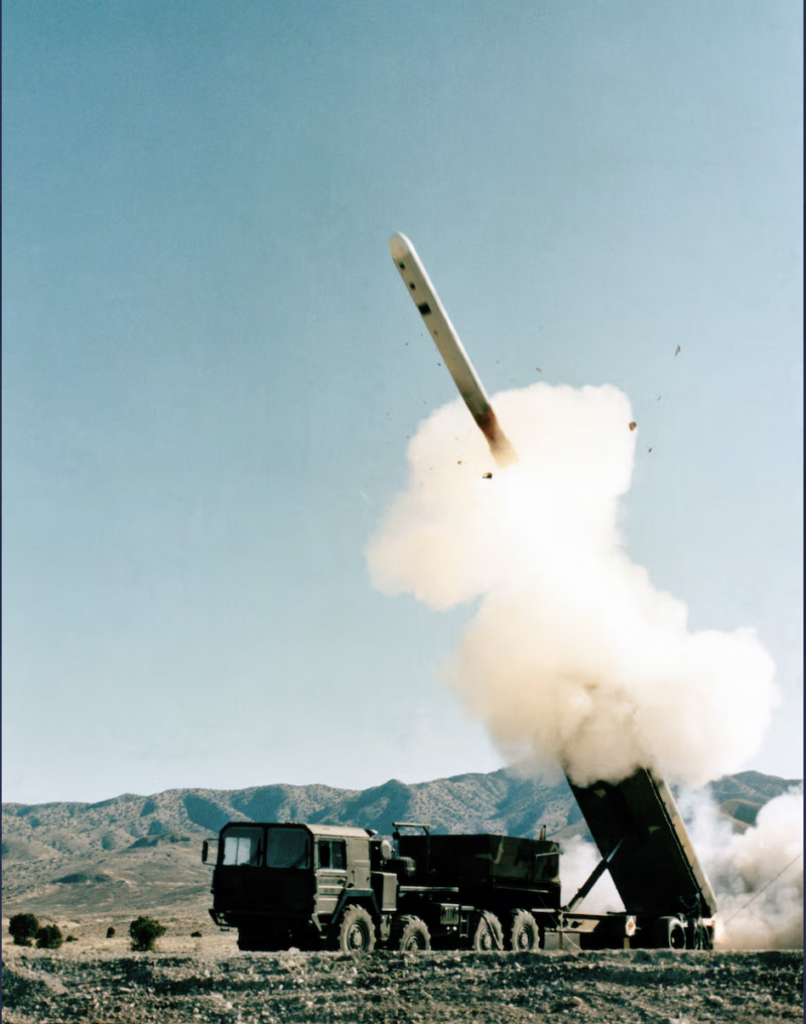
The BGM-109 Ground Launched Cruise Missile was a “mobile, ground-to-ground cruise missile.” Cruise missile have complex guidance systems, allowing them to pinpoint specific targets with high-accuracy.7
Image from The National Museum of the United States Air Force.
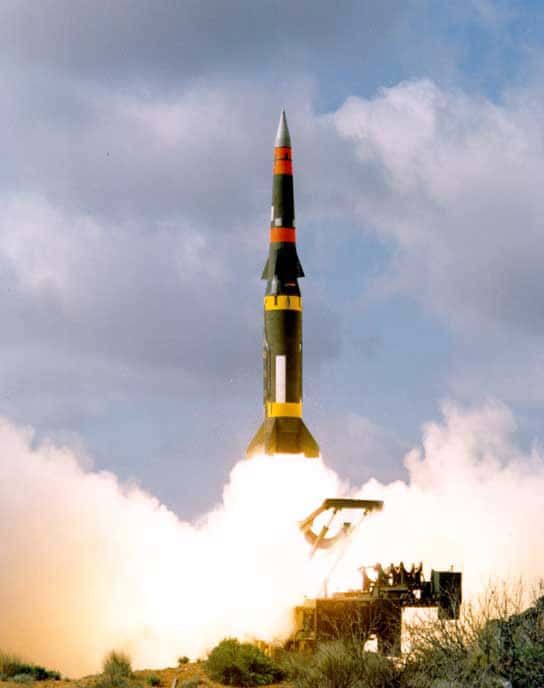
The MGM-31B Pershing II Missile is a “medium-range, road-mobile, solid fueled ballistic missile.”
Pershing II missiles “carried a single, variable-yield thermonuclear warhead with an explosive force equivalent to 5-50 kilotons of TNT.”8
Image from the National Air and Space Museum.
A Global Peace Movement and its Intersections with Feminist Concerns
Throughout the world, people were outraged by the outcome of the “Double-Track Decision,” viewing it only as an escalation of the arms race. More highly destructive and deadly weapons were to be deployed. While movements and protests emerged all across the globe, feminist circles played a large role in organizing protests and means of resistance.9 Feminists championed ideology that was starkly opposed to nuclear warfare— including maternalism and non-violence. Maternalism was associated with women’s capacities for reproduction and ethics of care, emphasizing responsibility toward the protection of life and future generations.10 Nuclear warfare and its potential to annihilate humanity stood as a direct contradiction to nurturing and life-sustaining values. A future of disarmament would center ideologies that push for responsibility and duty towards peace. Feminist non-violence was concerned with critiquing patriarchal, masculine beliefs that enable domination, aggression, and military strength as necessary tools of political power.11 These beliefs were embedded in global militarism, but also were reflected in everyday structures of violence, including violence against women. 12 By linking militarism with gendered systems of violence, activists viewed nuclear weapons as the ultimate expression of a violent patriarchal order— one that had the capability to destroy bodies, environments, and communities. These sentiments justified the need for a women-only, women-led anti-nuclear movement. Furthermore, many saw protest and political discourse to not be enough. A direct means of civil disobedience was what was needed to make real change.13 This viewpoint thus led to the popularization of Women’s Peace Camps around the world— encampments that were set up on land adjacent to military bases where activists could physically challenge the presence of nuclear arms while embodying alternative values of peace, care, and non-violent resistance.14
The Women’s Encampment for a Future of Peace and Justice in Seneca, NY
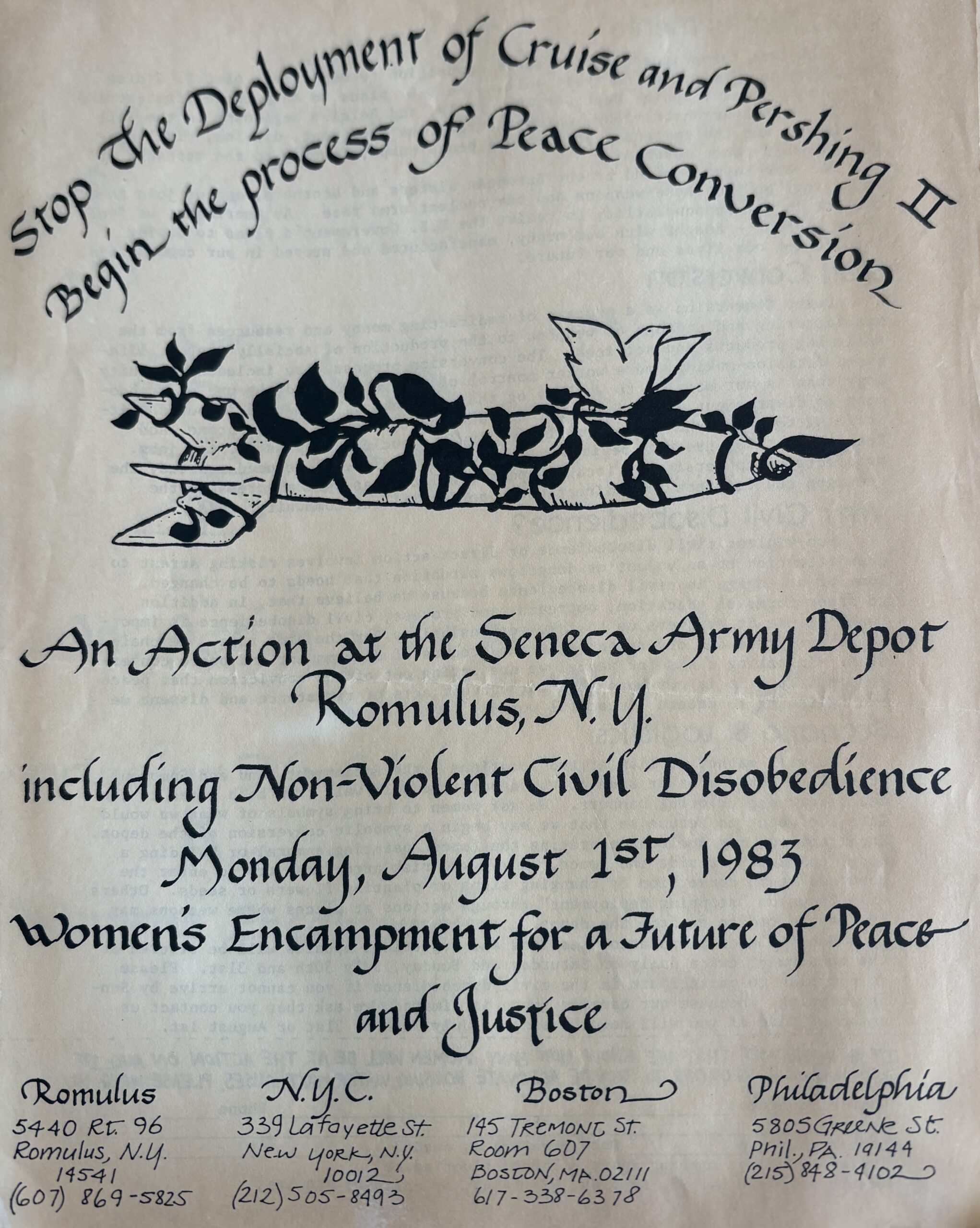
A particular plan for resistance emerged in Northeastern America, targeting the Seneca Army Depot in Seneca, New York. It was suspected that this facility held the missiles that were set for deployment. At a Global Feminist Disarmament Conference in June of 1981, the “seeds for a Women’s Peace Camp in Seneca were planted.”15 Several organizing groups were involved, such as the Women’s International League for Peace and Freedom, alongside smaller, more local ones, including but not limited to, Spinsters Opposed to Nuclear Genocide (SONG), The Women’s Resistance Exchange (WRE), and The Upstate (New York) Feminist Peace Alliance. Feminists and women opposed to nuclear arms thus purchased fifty-one acres of land outside of the depot.16 These groups were intent on spreading information about the deployment, and the “methods and legal implications of civil disobedience.”17 On August 1st, 1983, around 2,000 women assembled on the land, forming the Women’s Encampment for a Future of Peace and Justice.
“We say no to the threat of global holocaust, no to the arms race, no to death. We say yes to a world where people, animals, plants and the earth itself are respected and valued.”18
From a flyer and call for donations from The Women’s Encampment for a Future of Peace and Justice, 1983.
The ideology of feminist groups can be seen in the flyers, infographics, and art created by those organizing and present at the Seneca Encampment.
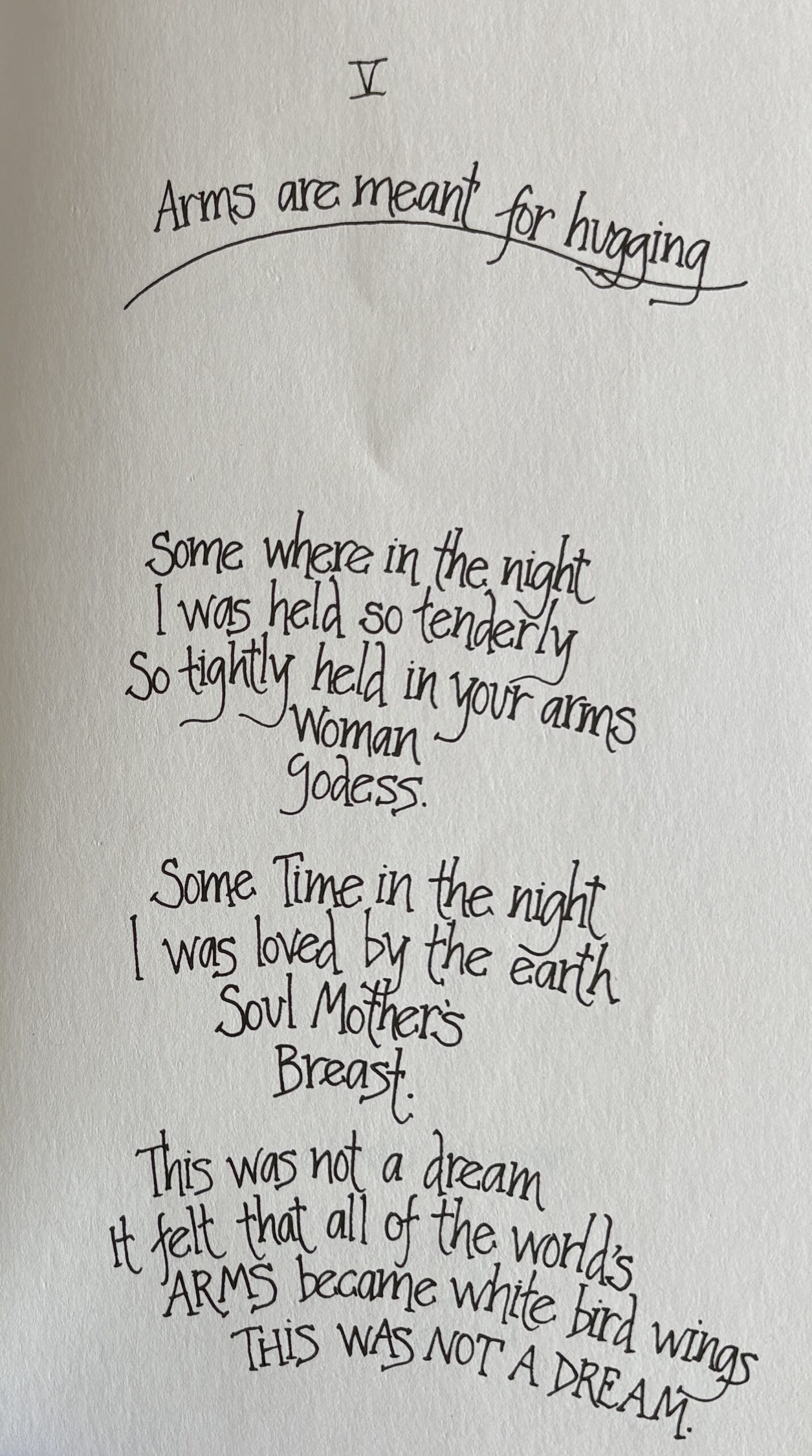
A Poem Titled “Arms are meant for hugging” from a Zine showcasing art and poetry created in the Seneca Encampment. Unknown author. The Theresa Carr Papers. The Sophia Smith Collection.
Art, poetry, and music were instrumental in sharing feminist anti-nuclear sentiments. Note this poem’s use of the phrases “Woman Goddess” and “Soul Mother’s Breast–“ reflecting sentiments of maternalism. It emphasizes that peace is “not a dream,” showing how members of the movement strongly believed in this envisioned future.
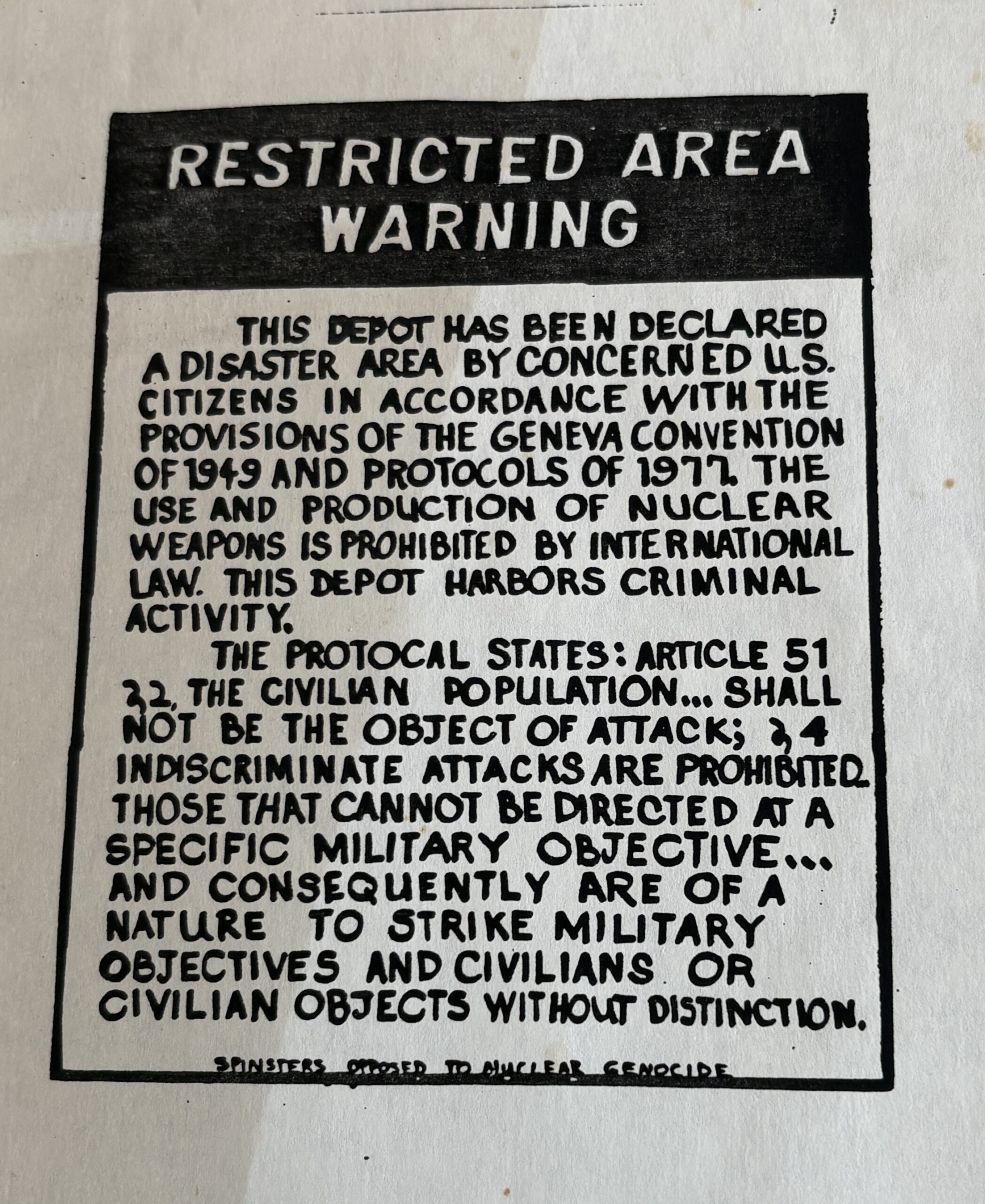
Graphic created by SONG. The Theresa Carr Papers. The Sophia Smith Collection.
This graphic depicts the Depot as a “disaster” and “criminal,” citing the Geneva Conventions and their protocols regarding the production of nuclear weapons. It highlights the extensive research and knowledge done and held by the organizing groups, demonstrating how deeply informed they were about the history of nuclear warfare and the policies surrounding it.
Campers participated in “non-violent” organizing through several means. Webs of yarn were woven through fences, symbolizing feminist unity and solidarity. “Weaving the web” became a popular phrase, displaying the intersections of feminist concerns and disarmament, while also reflecting the movement’s global reach.19 Posters and artwork were placed along the roads and entrances to the depot. There were also several instances of activists climbing the fences and entering the depot grounds.20
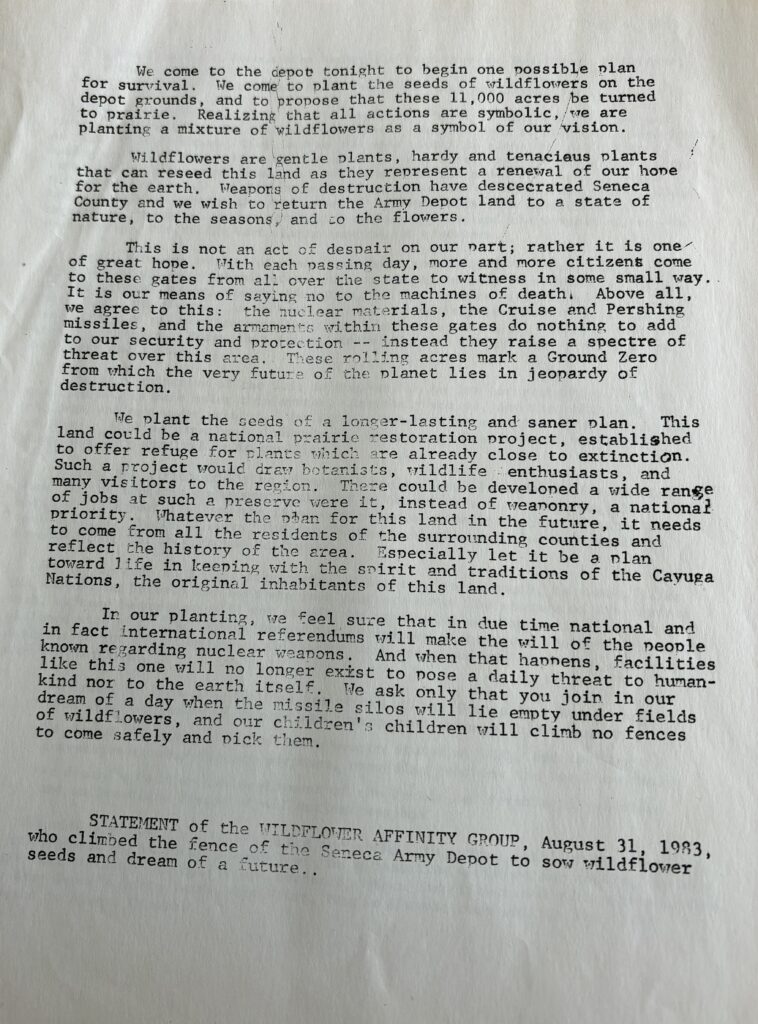
Document detailing a plan to trespass on Depot Grounds. The Theresa Carr Papers, August 31st, 1983. The Sophia Smith Collection.
This document mentions a plot to climb the fence and enter the Seneca Army Depot. The plan was to plant wildflowers, “a symbol of our vision.”
This action is focused on hope for the future, planting seeds to create a space where “facilities like this one will no longer exist to pose a daily threat to human-kind nor to the earth itself.”
Notably, there were multiple arrests at the Seneca Encampment. Fifty-two individuals were arrested for disorderly conduct during a march, and another forty-five for trespassing. Over the summer of 1983, 144 arrests were recorded in connection to the encampment.21 The actions of these women should not be diminished.
The press and members of the public frequently labeled the women present at the Seneca Encampment as “queers,” “commies,” and other demeaning stereotypes that depicted the activists as “hysterical.”22 These sentiments contributed to their efforts being viewed as non-serious, a perception further reflected in later scholarship and discourse on the Peace Movement, where their influence is not as widely discussed in relation to broader, global protests.
Though the deployment of Cruise and Pershing II Missiles to Europe went through as scheduled, the efforts and actions of those at the Seneca Encampment brought attention towards the implications of nuclear weapons. In 1990, the camp transitioned to “The Women’s Peace Land” and continued as a center for feminist anti-nuclear and peace activism.23
Discussions Questions:
- How do the archival materials illustrate the complexity of political organizing? Rather than simply developing and spreading an ideology, organizing also requires extensive research, knowledge of history and policy, and consideration of the potential consequences of protest and civil disobedience. How does this complexity relate to what we see in other social or political movements?
- In today’s context, particularly in light of the recent military strikes against Iran, how relevant are the concerns raised by feminist antiwar groups? Are the questions they posed about militarism, state power, and the human consequences of war still shaping public debate today?
- What role does art, poetry, and music play in creating an emotional or affective response to political movements? The poetry and graphic displayed above, created at the Seneca Encampment, are examples of how creative expression can help communicate political ideas and mobilize participants.
Places for Further Research:
- At Smith:
The Theresa Carr Papers, The Sophia Smith Collection
This collection includes images, documents, flyers, infographics, and recordings of the encampment. Notable are the correspondences between Carr and other organizing leaders.
Link: https://findingaids.smith.edu/repositories/2/resources/1214
- The Seneca Women’s Encampment for a Future of Peace and Justice Collection at The UMASS Archives
This collection was donated and is maintained by the attorney of The Women’s Peace Encampment, Alaine T. Espenscheid. It holds legal records and documents concerning health and safety, water, food, and sanitation.
Link: http://findingaids.library.umass.edu/ead/mums839
- The Digital Archive of the Women’s Encampment for a Future of Peace and Justice: A Herstory Project
This digital collection was put together in 2018. It provides access to digitized photographs, documents, and promotional material related to the camp. It also contains a few-dozen oral histories of those involved in organizing the camp, as well as those who were present. Link: http://peacecampherstory.blogspot.com/2018/07/herstories-videographers.html
Secondary Sources (annotated):
- Costello, Cynthia, and Amy Dru Stanley. “Report from Seneca.” Frontiers: A Journal of Women Studies, vol. 8, no. 2, 1985, pp. 32–39. JSTOR, https://doi.org/10.2307/3346051.
This article includes first-hand testimonies from the camp, notably from Cynthia Costello and Amy Dru Stanley. Their reflections give insight into the “lived-realities” of activists. As campers not only protested and resisted in the encampment, but lived there for several months, these testimonies provide information about the internal dynamics present, additionally illuminating some of the artistic demonstrations (speeches, theater productions, etc.) It speaks more to the diversity of women present, something that was out of the scope of this site.
- Krasniewicz, Louise. Nuclear Summer: The Clash of Communities at the Seneca Women’s Peace Encampment. Cornell University Press, 1992. JSTOR, http://www.jstor.org/stable/10.7591/j.ctt207g747.
This source offers insight into local, public perception of the Seneca Encampment. The movement was not always well-received, and subsequently, counter-protest broke out in the nearby town of Waterloo. Some of the popular criticisms are discussed in this book, particularly concerning the white, middle-class “elite” status of activists. Though some opposition is demeaning and perpetuates harmful stereotypes, some arguments are important to consider as it is true that most camp participants were well-educated, financially stable, white women. Afterall, the ability to uproot your life and dedicate yourself to an encampment is a possibility only available to a select few.
- Managhan, Tina. “Shifting the Gaze from Hysterical Mothers to ‘Deadly Dads’: Spectacle and the Anti-Nuclear Movement.” Review of International Studies, vol. 33, no. 4, 2007, pp. 637–54. JSTOR, http://www.jstor.org/stable/20097964.
This source provides broader commentary on the feminist movement within anti-nuclear protest. It highlights international efforts, including the encampments at Greenham Common, in the UK and at Comiso, in Italy. Correspondence and shared organizing between these groups and the Seneca Camp were instrumental in forming the international “web” of Women’s Peace Camps. Anti-nuclear concerns were, after all, global. Additionally, the “universality” of solidarity within global feminism is explored and expanded upon in this source.
Footnotes:
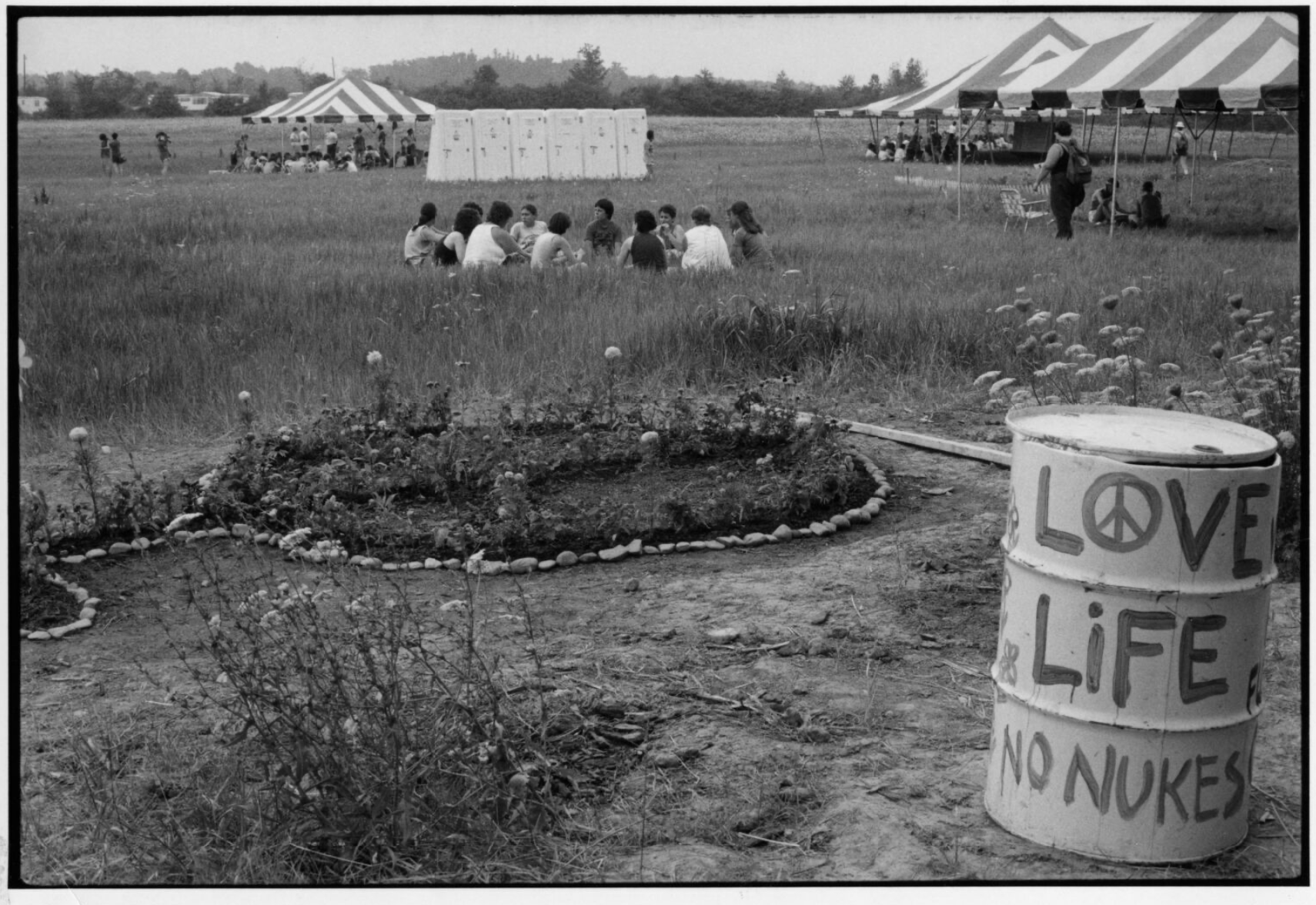
- Clover, Nancy A. View of groups at the Women’s Encampment for a Future of Peace and Justice; at right a trash can with “Love, Life, No Nukes” is visible. 1983. ↩︎
- Westwood, James T. “Future Intercontinental and Theater Missile Systems.” Naval War College Review, vol. 37, no. 1, 1984, pp. 83–92. JSTOR, http://www.jstor.org/stable/44636409. Accessed 13 Mar. 2026. ↩︎
- Bosen, Ralf. “NATO Foiled Soviets with Cold War Double-Track.” Dw.Com, Deutsche Welle, 12 Dec. 2019, www.dw.com/en/nato-thwarted-the-soviets-with-its-cold-war-double-track/a-51615211. ↩︎
- Ibid. ↩︎
- Ibid. ↩︎
- Ibid. ↩︎
- “General Dynamics/McDonnell Douglas BGM-109G Gryphon.” National Museum of the United States Air Force, www.nationalmuseum.af.mil/Visit/Museum-Exhibits/Fact-Sheets/Display/Article/196000/general-dynamicsmcdonnell-douglas-bgm-109g-gryphon/. Accessed 12 Mar. 2026. ↩︎
- “Pershing II.” Pershing II | National Air and Space Museum, airandspace.si.edu/collection-objects/missile-surface-surface-pershing-ii/nasm_A19910037000. Accessed 12 Mar. 2026. ↩︎
- Eschle, Catherine. “Gender and the Subject of (Anti)Nuclear Politics: Revisiting Women’s Campaigning against the Bomb.” International Studies Quarterly, vol. 57, no. 4, 2013, pp. 713–24. JSTOR, http://www.jstor.org/stable/24014644. Accessed 13 Mar. 2026. ↩︎
- Ibid, 174. ↩︎
- Ibid, 174. ↩︎
- Ibid, 175-76. ↩︎
- Costello, Cynthia, and Stanley, Dru Amy “Report from Seneca.” Frontiers: A Journal of Women Studies, vol. 8, no. 2, 1985, pp. 32–39. JSTOR, https://doi.org/10.2307/3346051. Accessed 13 Mar. 2026. ↩︎
- Ibid, 33-34. ↩︎
- Ibid, 33. ↩︎
- Resource Handbook: Women’s Encampment for a Future of Peace and Justice , p. 9. WEFPJ, Seneca, NY, 1983. Barnard Center for Research on Women
https://bcrw.barnard.edu/archive/militarism/womens_encampment_handbook.pdf ↩︎ - Costello and Stanley, 34. ↩︎
- Flyer and Call for Donations for WEFPJ, Women’s Encampment for a Future of Peace and Justice, Seneca, NY, 1983.
Barnard Center for Research on Women. https://bcrw.barnard.edu/archive/militarism/womens_encampment.pdf ↩︎ - Costello and Stanley, 38. ↩︎
- Ibid, 38-39. ↩︎
- “About 300 Women, Many of Whom Spent the Summer… – UPI Archives.” UPI, UPI, 5 Sept. 1983, www.upi.com/Archives/1983/09/05/About-300-women-many-of-whom-spent-the-summer/8859431582400/. ↩︎
- Costello and Stanley, 37 ↩︎
- “Reflections on the Women’s Peace Encampment: 30 Years Later.” Rehumanize, Rehumanize, 16 Oct. 2021, www.rehumanizeintl.org/post/2013/11/19/reflections-on-the-womens-peace-encampment-30-years-later. ↩︎