This was the front page of the New York Times, on December 23rd 1935, and the biggest story of the day. To understand why a family leaving the U.S. for England was such a big deal, we have to start three years earlier….
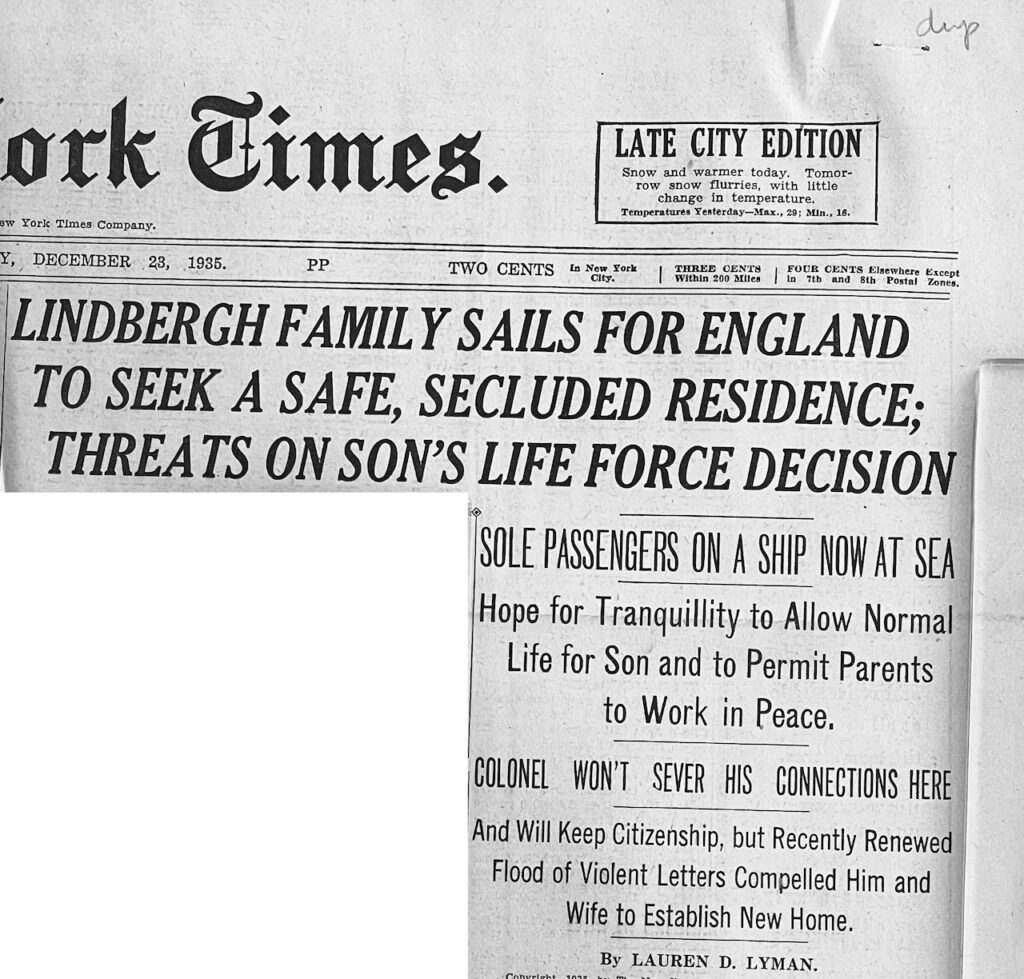
A clip from the front page of The New York Times, December 23 1935. Anne Morrow Lindbergh Papers, Box 25, Sophia Smith Collection, Smith College, Northampton, Mass.
Before 1932 Anne Morrow Lindbergh and her husband Charles Lindbergh were already among the most prominent Americans of their era. Charles Lindbergh, became famous for his record-breaking solo flight across the Atlantic in 1927, and returned from Europe an American hero. He married Anne Morrow, daughter of a prominent US Senator and the first female president of Smith College. On March 1st 1932, their son (at the time their only child) was kidnapped from their home, sparking a manhunt, intense press coverage and rampant public speculation. There was a ransom note left, and many attempts to get in contact with the kidnappers. The child was tragically found dead on May 12th 1932 a few miles from where he was taken, it was decided that he had likely died during or soon after the kidnapping.
In 1935 Bruno Richard Hauptmann, a carpenter and German immigrant was put on trial for the crime. He was convicted and executed in 1936. His trial was dubbed “the trial of the century” and garnered high media attention and public speculation.
This influx of press impacted both the trial and the Lindberghs themselves. In December 1935, after Hauptmann’s conviction and in anticipation of his January 17th 1936 execution date, Anne, Charles, and Jon (their second son, born after the kidnapping) left the U.S. for England. Their trip was characterized as an ‘exile’ by some, and a ‘fleeing’ by others, but all attributed to the family’s need to escape the media attention around the case and impending execution.
The news was broken by the New York Times, on December 23rd 1935 by the journalist Lauren D. Lyman, who the Lindberghs trusted and had published about the crime in the previous years. The family told Lyman the story on the condition that he would publish it once they were a day’s journey from land.1 This story was considered so important that it won Lyman the Pulitzer prize in journalism that year. The mass press coverage of the kidnapping and murder was largely sympathetic, however these stories, published from December to January 1935-36 proved more controversial.
In the days following the Lindberghs’ removal to Europe, stories like the ones below were run in newspapers across the U.S. Most of the anger seemed to be around the perceived cowardice of the act, and hurt pride that the U.S. wasn’t considered safe enough for the family. These events also sparked calls to cut down on criminal activity and fears of ‘social evils.’
We Shall not get far by simply moving against the many outstanding expressions of our lawlessness. As a matter of fact, they all issue out of the prevailing American disrespect for the law
Rev. Dr. Minot Simons, paster of All Souls Unitarian Church
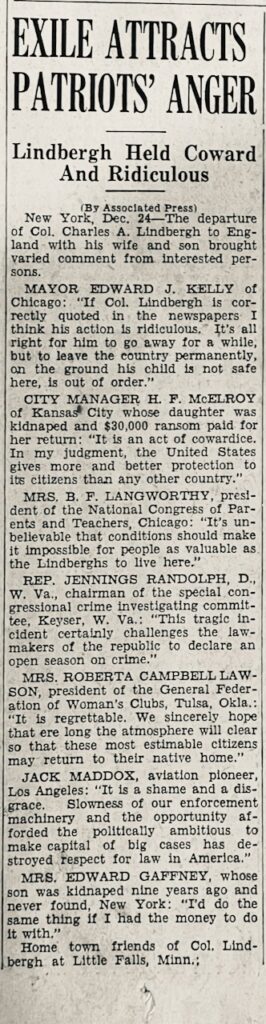
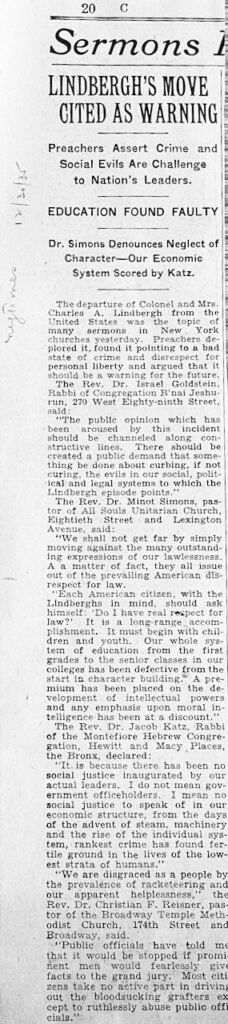
(left) An article from the front page of the Bergen Evening Record, Hackensack N. J. December 24th 1935, Anne Morrow Lindbergh Papers, Sophia Smith Collection, Smith College, Northampton, Mass. (right) An article from the New York Times December 30th 1935, Anne Morrow Lindbergh Papers, Sophia Smith Collection, Smith College, Northampton, Mass.
It is an act of cowardice. In my judgement the United States gives more and better protection to its citizens than any other country
City Manager H. F. McElroy
The turbulence of the press coverage and the events of the trail are also reflected in Anne Lindbergh’s personal papers. In correspondence to her mother sent from England after her arrival, she begins by saying “The press seems to have left us alone” and adding that now she and her husband think it’s safe to talk on the telephone, however “though not discuss plans or anything, naturally, about the case over the telephone.”2 Indicating that while she felt distanced from the press in the UK, Anne remained acutely aware that letting anything slip over the phone or correspondence could be in the papers soon after.
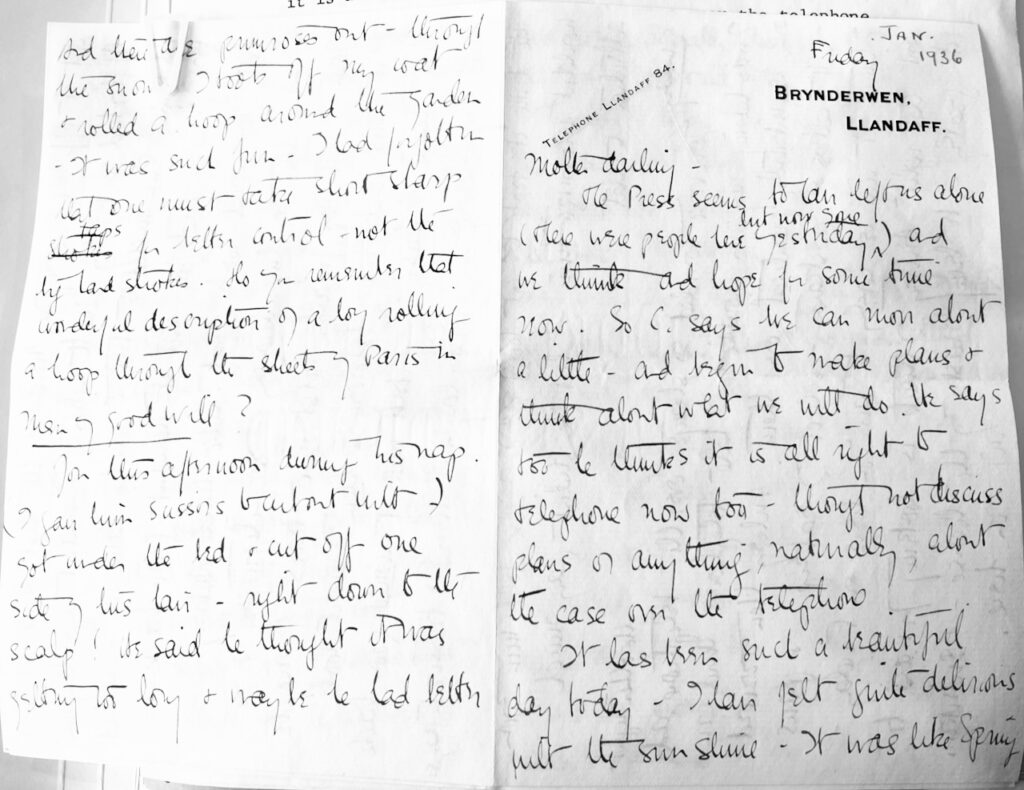
Letter from Anne Lindbergh to her mother, dated January 1936. Anne Morrow Lindbergh Papers, Box 44, Sophia Smith Collection, Smith College, Northampton, Mass.
The amount of press also impacted the trial proceedings and some have argued led to a miscarriage of justice. During the case, it was recorded that more than one hundred and thirty cameramen tried to take images at the trial, and the judge’s attempts to ban taking images of the witnesses was often ignored. This disruption of trial proceedings is what influenced the American Bar Association to officially ban courtroom photography in 1937.3 In the 1985 the British journalist and author, Ludovic Kennedy published a book arguing that Hauptmann was innocent and blaming the press for “[branding] Hauptmann as the Lindbergh baby’s kidnapper and murderer from the moment of his arrest so that almost no one in America was given the opportunity to consider a contrary view.”4 At this point in my research, I don’t have an opinion on if Hauptmann was guilty or not. However considering the pressure of public attention fueled by the constant press coverage, there was certainly an incentive to get the case wrapped up successfully and quickly.
These documents and events, though nearly a hundred years in the past, may feel familiar when compared to how high-profile trials and true crime culture exist today. The Lindbergh case and the press coverage around it were acknowledged as anomalous at the time. The demand was so great that during the initial time after the kidnapping, “sales of newspapers went up about 20 percent, meaning millions of extra copies and a great deal of windfall revenue.”5 This wave of coverage quickly spread from the papers to other forms of media.
In Anne’s papers she saved four books that came out on the kidnapping case, three of which came out in 1932, the year it happened. One example is pictured below, titled “The True Story of the Lindbergh Kidnapping” published in 1932. The book was marketed on the back cover as “the story of the most abhorrent crime of all time!” and promised readers the true account of what happened. The authors weave their narrative over two hundred pages, with chapter titles such as “The Crime That Shook the World!”, “Clews-Clews-Clews!” and “Kidnap Epidemic!” Other books published at this time (such as “The Great Lindbergh Hullabaloo”) took a similar sensationalizing tone and dramatic treatment of the case.6 It also influenced fiction, with elements of the case inspiring Agatha Christie’s Murder on the Orient Express which came out in 1934.
This is a phenomenon that has continued to our current age. True crime is a popular genre of movies, podcasts, books, etc. After any high-profile (or low-profile!) case that happens, we can expect multiple pieces of media dissecting it in the following years. The Lindbergh Kidnaping and trial of Bruno Hauptmann may be far in the past, but they feel eerily prescient today.
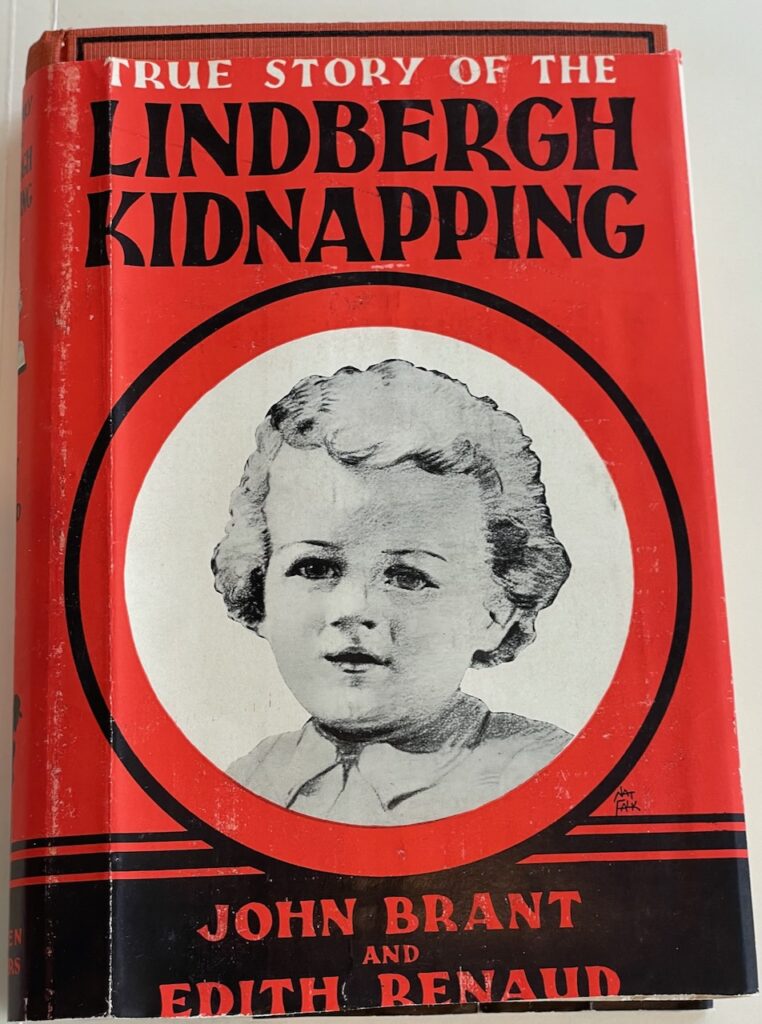
The cover of “The True Story of the Lindbergh Kidnapping” by John Brant and Edith Renaud, Kroy Wen Publishers, inc. 1932. Anne Morrow Lindbergh Papers, Sophia Smith Collection, Smith College, Northampton, Mass.
Discussion Questions:
- How does coverage of this case compare to modern true crime media, or press coverage of crimes?
- Do you see high media attention on trials as a mostly positive or negative force? How can it lead to both justice and injustice?
- Both during the Lindbergh case and now, there is a large profit motivation for people to make media related to crime and trials, do you think this should change?
- Should we as the public be supporting this genre of media, considering the impact on its subjects? Like the Lindbergh family’s decision to flee the country, or arguably, Hauptmann’s conviction?
Annotated Sources:
Ross, Walter S. The Last Hero: Charles A. Lindbergh. New York: Harper & Row, 1968. https://archive.org/details/in.ernet.dli.2015.58029/mode/2up
This book provides a detailed account of Charles Lindbergh’s life including the events of the Kidnaping and Trial. As the title suggests, it takes a clearly sympathetic approach, and can be helpful in understanding the kind of hero-worship with which Lindbergh was regarded. This admiration and public approval impacted how this case went and the media attention it garnered.
Kennedy, Ludovic. The airman and the carpenter : the Lindbergh kidnapping and the framing of Richard Hauptmann, Viking Penguin, 1985 .https://archive.org/details/airmancarpenterl00kenn/page/164/mode/2up
This book takes a closer look at the case against Richard Hauptmann, and as you can tell from the title argues that he was wrongfully convicted. This provides a different perspective to accounts closer to the events, as this modern crime journalist reevaluates the case. The author pulls from Anne’s diary and letters (with her permission), which is a useful comparison as I look at the same materials.
GARDNER, LLOYD C. The Case That Never Dies: The Lindbergh Kidnapping. Rutgers University Press, 2004. http://www.jstor.org/stable/j.ctt5hjfjh.
This book is the most recent I found, which is helpful in that the author is far more removed from their own experience and emotions around the event, compared to the other sources. This author pulls from FBI and New Jersey State Police records, which became available around 2004 and provides a different perspective on the events. This is also the only book that attempts to tell the story from the perspective of someone other than the Lindberghs and the police, like the experiences of Betty Gow, the nursemaid of the baby who was in the house when it happened and faced widespread public scrutiny without the same resources as the Lindberghs.
Further Research:
The books mentioned above are good places to start to learn more about this case. This case is closely connected to the history of the FBI, and they have resources available about it (an informational article). There have also been several biographies of Anne Morrow Lindbergh published which detail more about her life. Such as Susan Hertog’s Anne Morrow Lindbergh: Her Life (New York, 1999). If you are interested in how the case is coming up today, there was an article in Vanity Fair a month ago titled “Why the Lindbergh Baby Kidnapping Case Still Haunts After Nearly 100 Years” that is interesting (thanks to Becca Keyel for telling me about this!).
- Ross, Walter S. 1964. The Last Hero: Charles A. Lindbergh. Harper & Row Publishers. https://archive.org/details/in.ernet.dli.2015.58029/mode/2up . 222 ↩︎
- Letter from Anne Lindbergh to her mother, dated January 1936. Anne Morrow Lindbergh Papers, Box 44, Sophia Smith Collection, Smith College, Northampton, Mass. ↩︎
- Sellers, David A. “The Circus Comes to Town: The Media and High-Profile Trials.” Law and Contemporary Problems 71, no. 4 (2008): 181–99. http://www.jstor.org/stable/27654689. 187. ↩︎
- Kennedy, The airman and the carpenter : the Lindbergh kidnapping and the framing of Richard Hauptmann, 2 ↩︎
- Ross, The Last Hero: Charles A. Lindbergh, 199 ↩︎
- Brant, John and Renaud, Edith. The True Story of the Lindbergh Kidnapping. Kroy Wen Publishers inc. 1932. Anne Morrow Lindbergh Papers, Sophia Smith Collection, Smith College, Northampton, Mass ↩︎