The United States has a long history of benefitting off of the exploitation of various populations, through mass colonization and enslavement. This has been passed down through tradition from European colonization1. As a result of this history and the continued abuse of marginalized communities that were historically exploited, race and privilege functions in a hierarchical manner.
The oppression of marginalized communities through capitalistic and political means internally in the United States mirrors the neocolonial forms of domination the United States weaponizes to maintain a system of white supremacy and exploitation. In this way, reproductive healthcare access is able to be transformed into financial coercion
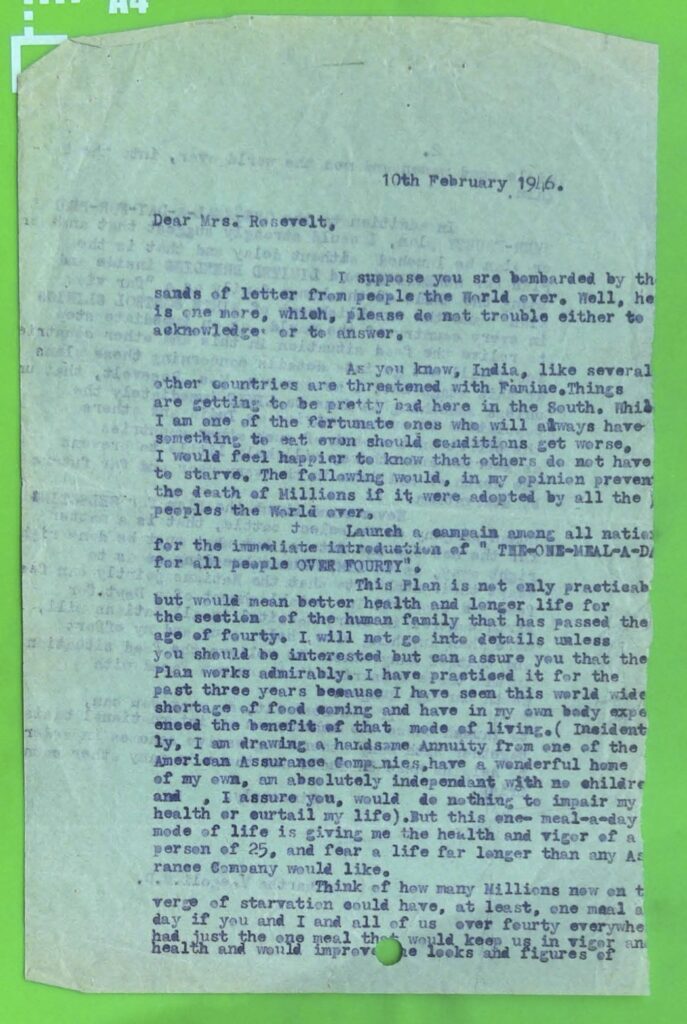
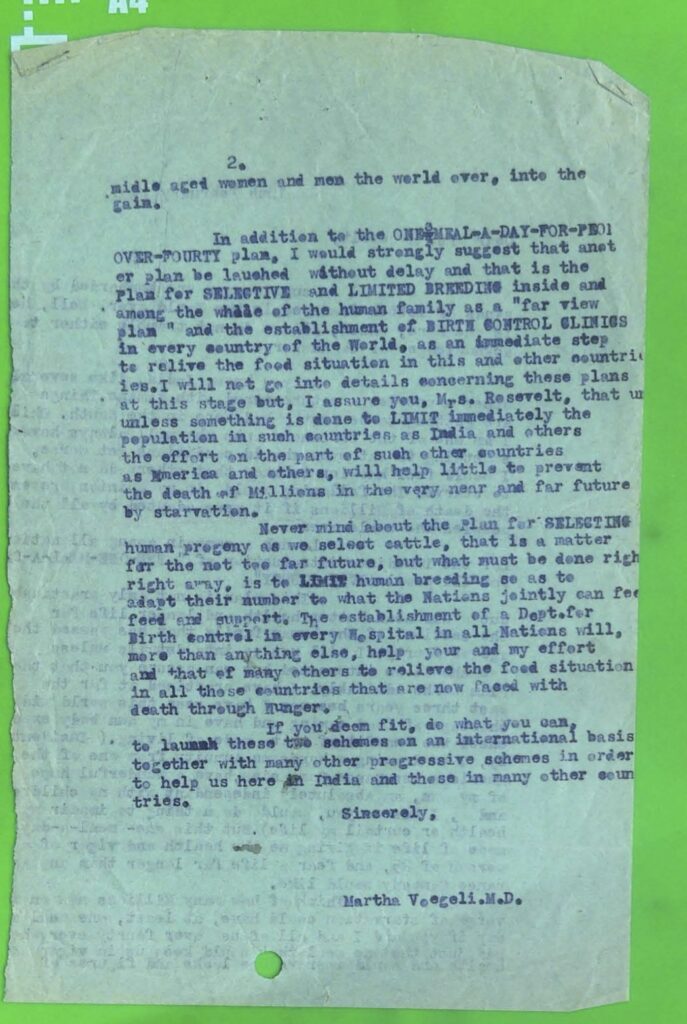
This letter was written by Martha Voegeli, a Swiss doctor who practiced for several years in India. Some of her more well-known work includes the above practices, the “one-meal-a-day” plan and birth control for men in low-income communities. Her letter is written to Eleanor Roosevelt, with the express purpose of the United States intervening into Indian affairs.
While Voegeli’s birth control method is reversible, her language about Indian people even pre-independence (1947) is indicative of the eugenics-based mindset present in the conversation about famine. Her references to people as cattle and claiming a need for “selective breeding” in people like with livestock is representative of the way caste and class politics play into eugenics, as Voegeli focuses on low-income populations in India. The phrase “countries such as India” contributes to this thought process as well.
Even though Voegeli’s work preceded the conversation about sterilization abuse in the United States2 and the forced sterilization of millions of Indian women3 by two decades, her letters provide insight into how the United States wields control over its own people and foreign populations by weaponizing food and money.
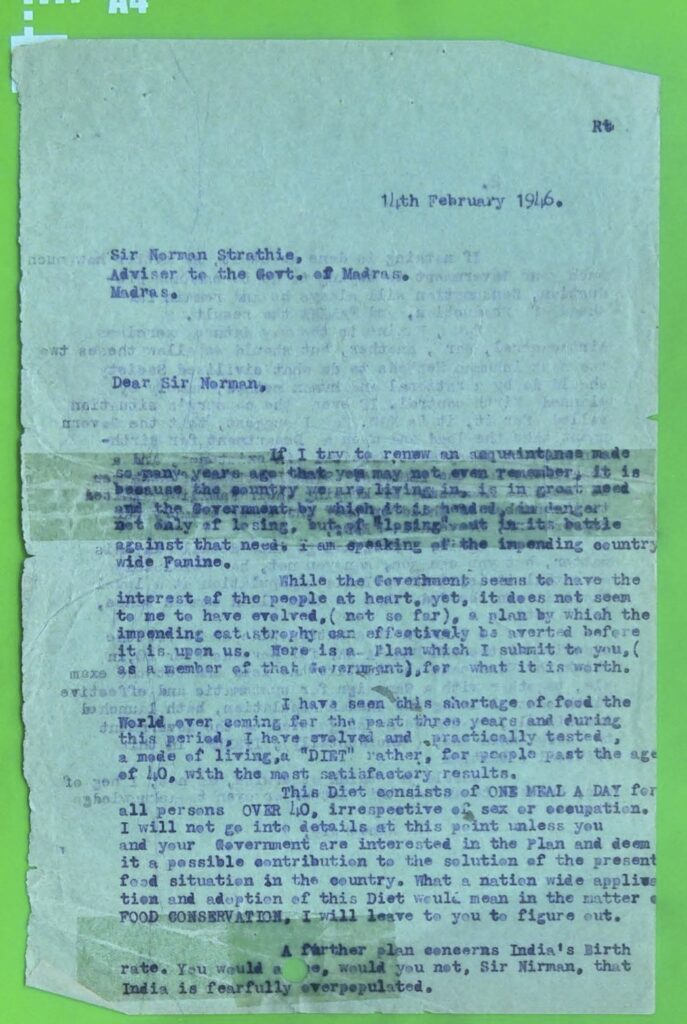
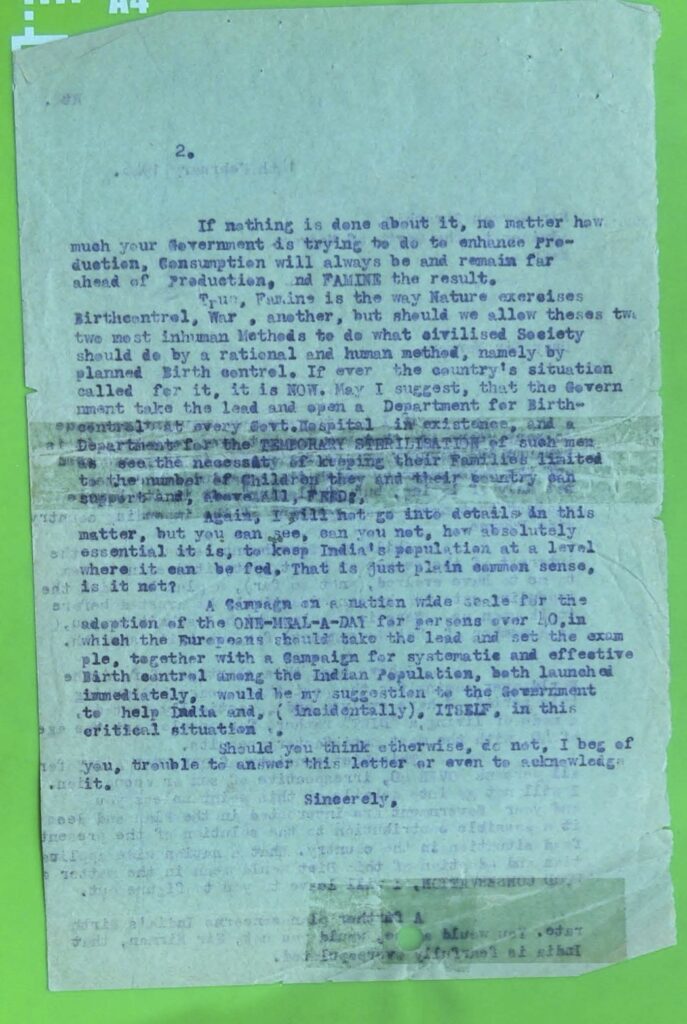
This letter by Martha Voegeli details the same plan as written to First Lady Eleanor Roosevelt, but instead to an official of the Indian state Chennai (previously named Madras).
Voegeli’s communication not just with American governmental officials, but Indian governmental officials, is an indication of the domination the United States exercises over foreign governments. Additionally, it is an indication of how the United States continues a legacy of colonization.
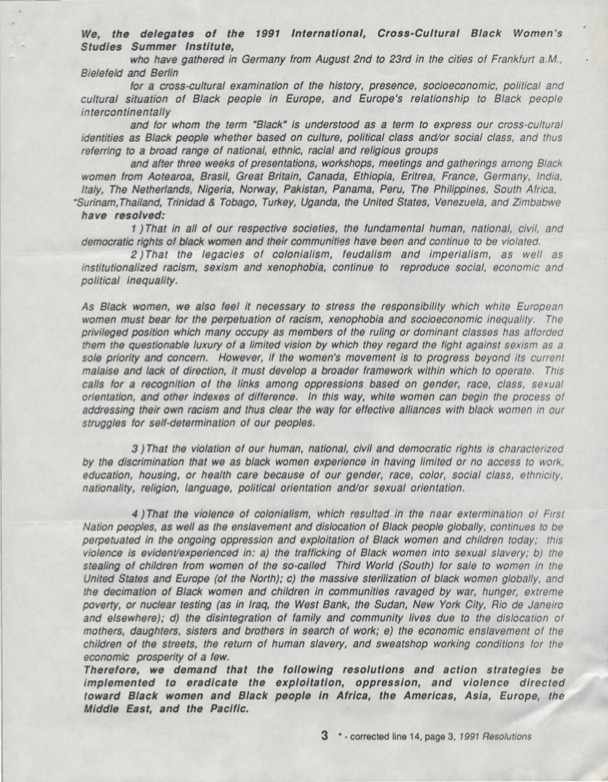
This is an introduction to the 1991 resolutions at the Cross Cultural Black Women’s Studies Summer Institute with the purpose of addressing global racial oppression of Black women and demanding action be taken by countries around the world.
The Institute’s recognition of how colonization is still in effect in Black communities around the world is a clear demonstration of the US’s continued legacy of colonization, as it benefits from the system of enslavement through capitalism4.
Systems of subordination and imperialism, whether they are overseas or on American soil, are intertwined. India’s mass sterilization was occurring at the same time as American discussions of feminism began to bring up coercive sterilization in Black and Indigenous communities. India’s abuses occurred under the false pretense of population control, while the US’s occurred under a stereotype of hypersexuality5.
DISCUSSION QUESTIONS
- How do the US’s patterns of control over certain populations reflect through the modern government’s foreign affairs?
- Martha Voegeli’s letters indicate a long history of outside influences affecting Indian sterilization practices. How does this relate to US influence elsewhere? What does it tell us about the US government’s view on reproductive rights as human rights?
ANNOTATED BIBLIOGRAPHY
- Allen, Robert L. 2005. “Reassessing the Internal (Neo) Colonialism Theory.” The Black Scholar 35 (1): 2–11. doi:10.1080/00064246.2005.11413289.
- Allen reviews characterizations from Black activists of the Black community in the United States acting as a pseudo-internal colony. The US treats its marginalized populations, specifically the Black community, as subordinates through economics and power dynamics typically seen in colonies. Additionally, the incarceration system in the United States functions as a tool for oppression and subordination.
- Connelly, Matthew. “Population Control in India: Prologue to the Emergency Period.” Population and Development Review 32, no. 4 (2006): 629–67. http://www.jstor.org/stable/20058922.
- Between the years of 1965-1967, as a form of attempting population control, the Indian government coerced 29 million women to get intrauterine contraceptive devices (IUDs) as a result of food shortage. However, Connelly points out that motivations also came from attempting to control the “quality” of populations, pushed not just by the United States and Britain but upper-caste Hindus. The United States government provided financial aid for sterilization and had a hand in the family planning programs in India.
- Volscho, Thomas W. “Sterilization Racism and Pan-Ethnic Disparities of the Past Decade: The Continued Encroachment on Reproductive Rights.” Wicazo Sa Review 25, no. 1 (2010): 17–31. http://www.jstor.org/stable/40891307.
- Volscho briefly discusses the sterilization abuse present within the United States during the 1900s, but mainly focuses on vulnerabilities within different American communities in the 2000s to sterilization abuse through the lens of stereotypes affecting the image of Black and Indigenous women. After analyzing a 2004 study, Volscho finds that Indigenous and Black women are at a higher risk for sterilization, even after controlling for age and children. Volscho finishes by pointing out the faults in focusing only on pro-life and pro-choice, as reproductive injustices affect women of color differently.
ADDITIONAL READING
- Jackson, Marissa. “‘Neo-Colonialism, Same Old Racism: A Critical Analysis of the United States’ Shift toward Colorblindness as a Tool for the Protection of the American Colonial Empire and White Supremacy.’” Berkeley Journal of African-American Law & Policy, ahead of print, 2009. https://doi.org/10.15779/Z38K338.
- Jadhav, Apoorva, and Emily Vala-Haynes. “Informed Choice and Female Sterilization in South Asia and Latin America.” Journal of Biosocial Science 50, no. 6 (2018): 823–39. https://doi.org/10.1017/S0021932017000621.
- Pegoraro, Leonardo. 2015. “Second-Rate Victims: The Forced Sterilization of Indigenous Peoples in the USA and Canada.” Settler Colonial Studies 5 (2): 161–73. doi:10.1080/2201473X.2014.955947.
NOTES
- Thomas W Volscho, “Sterilization Racism and PanEthnic Disparities of the Past Decade: The Continued Encroachment on Reproductive Rights,” Wicazo Sa Review 25, no. 1 (2010): 17–31, https://doi.org/10.2307/40891307. ↩︎
- Thomas W Volscho, “Sterilization Racism and PanEthnic Disparities of the Past Decade: The Continued Encroachment on Reproductive Rights,” Wicazo Sa Review 25, no. 1 (2010): 17–31, https://doi.org/10.2307/40891307. ↩︎
- Matthew Connelly, “Population Control in India: Prologue to the Emergency Period,” Population and Development Review 32, no. 4 (2006): 629–67, http://www.jstor.org/stable/20058922. ↩︎
- Robert L. Allen, “Reassessing the Internal (Neo) Colonialism Theory,” The Black Scholar 35, no. 1 (March 2005): 2–11, https://doi.org/10.1080/00064246.2005.11413289. ↩︎
- Thomas W Volscho, “Sterilization Racism and PanEthnic Disparities of the Past Decade: The Continued Encroachment on Reproductive Rights,” Wicazo Sa Review 25, no. 1 (2010): 17–31, https://doi.org/10.2307/40891307. ↩︎