Foundations of Quaker Relief Work
Amidst doctrinal infighting in American Quakerism and the entrance of the United States in World War I, the American Friends Service Committee (AFSC) emerged as an alternate path to service for Friends and conscientious objectors.1 On April 30th, 1917, members of the Five Years Meeting, Friends General Conference, and Philadelphia Yearly Meeting met to create “a central clearing house for peace policies.”2 With overwhelming demand for youth action, these leaders sought to carve out an avenue for “voluntary constructive service for young men” that would “conscientiously serve humanity.”3 The AFSC was officially founded in August of 1917 as part of the American Red Cross’s civilian department.
Throughout the founding of the AFSC, Russia’s political and social landscape changed dramatically. With the February Revolution of 1917 came the end of the Russian monarchy and establishment of the Russian Provisional Government. That summer, the first group of Friends set sail to Russia amidst intense internal turmoil. After negotiations with the Russian Provisional Government and a brief delay to confirm the party had no political motivations, AFSC relief workers joined the British Friends in Samara and worked across Russia’s Volga and Ural regions.4 Political and material conditions in the country continued to worsen, and the Provisional Government fell that November following the Bolshevik Revolution.
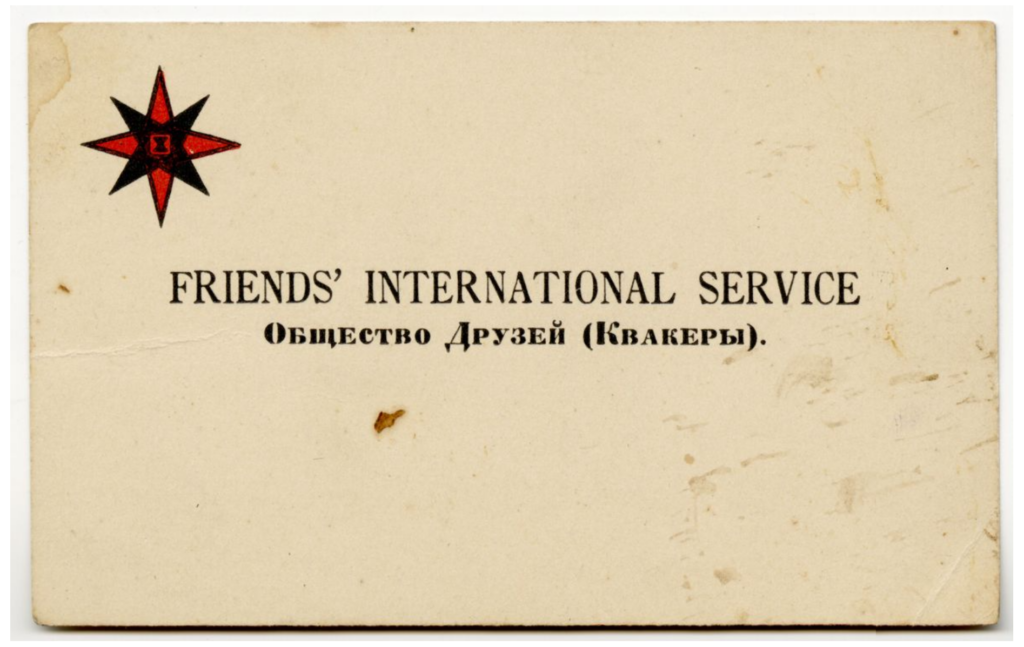
Organizing funding and support from the American Red Cross and State Department, Friends provided food, clothing, and medicine to Russia’s vulnerable populations. Following the revolutions, subsequent civil war, international blockades, and years of crop failure beginning in 1916, this region became the epicenter of the Great Famine of 1921–1922.5 The AFSC in Russia began to show concern for famine conditions as early as 1918, with American Quaker Anna Haines seeking grants from the American Red Cross to assist in Buzuluk that March.6 As the crisis came to a head, AFSC relief workers came to Russia to assist in the country’s most devastated regions.
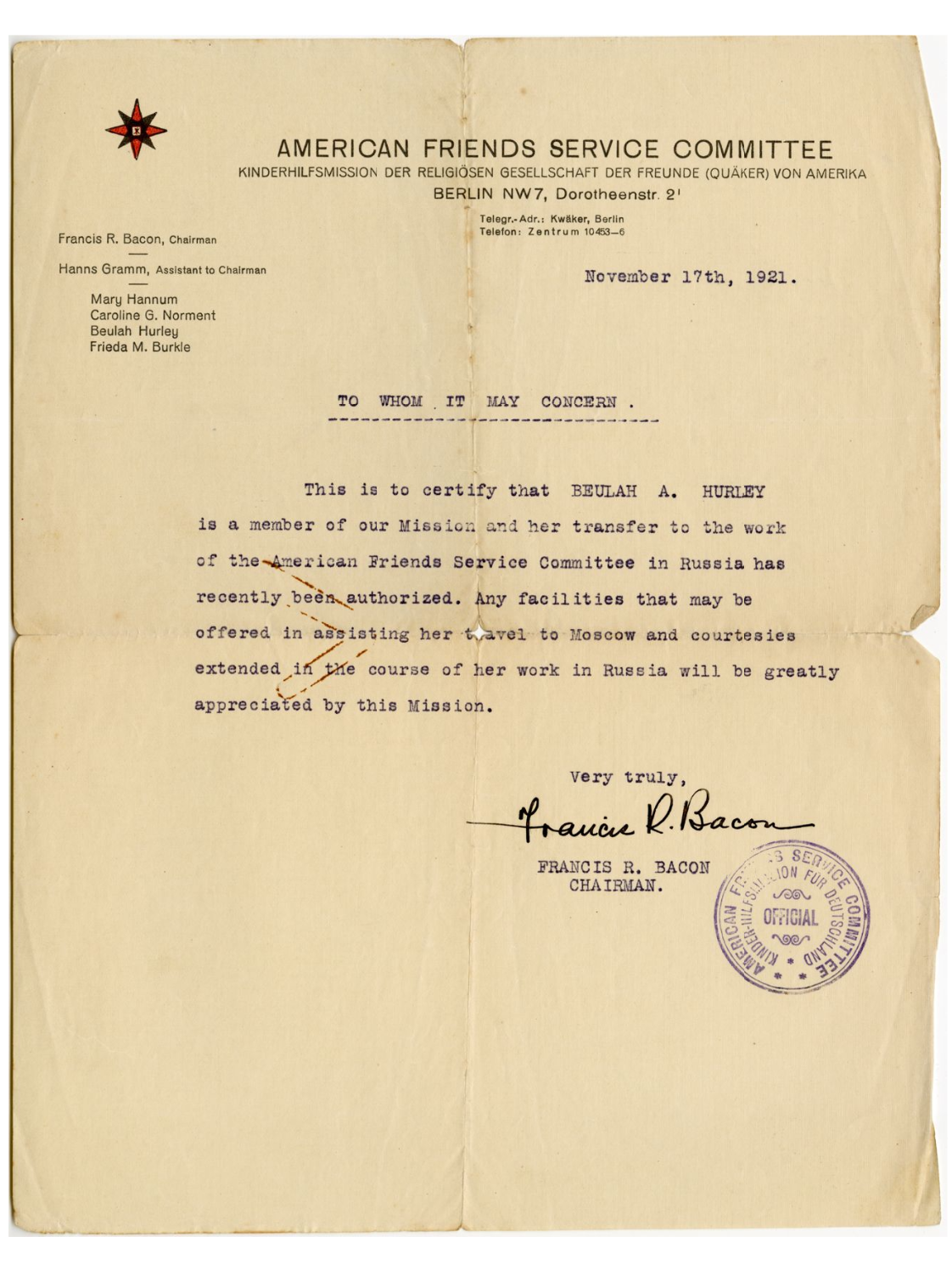
Beulah Hurley was one of these relief workers. After working with the AFSC across Europe beginning in 1918, Hurley joined the unit in Russia in 1921. In the document below, Hurley’s transfer is authorized by chairman Francis R. Bacon. Hurley arrived in Russia that December. Writing to her parents soon after her arrival, Hurley found an “Unbelievable mixture of tragedy and comedy” in Buzuluk. Despite worsening conditions and increasing cases of typhus among her fellow relief workers, Hurley wrote: “we are really… far more comfortable than I dreamed of being.”7
Despite the AFSC’s insistence on their relief work being a purely humanitarian project, the organization still faced scrutiny from the US government and public. Towards the end of 1920, the Friends’s support from the American Red Cross grew uneven as relations between the Red Cross, US, and Russia became more complicated.8 The AFSC fundraised in the United States for the Russian relief effort, but feared the risk of accepting donations from groups charged with being pro-Bolshevik.9 However, the AFSC found more success with appeals to the working class and labor organizations.10
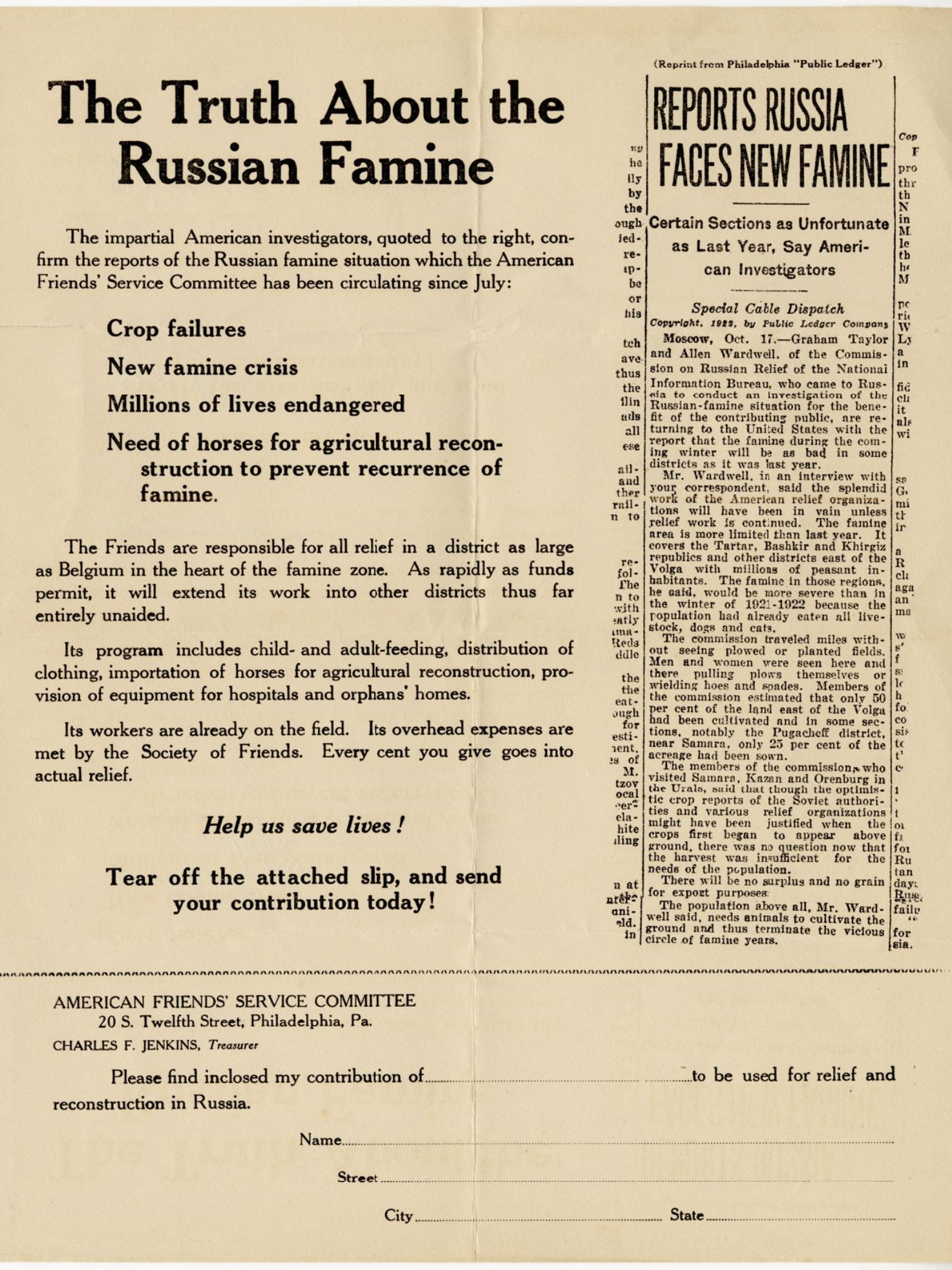
Pamphlets like the one shown here provide information on the famine in Russia to an American audience. In this text, the AFSC emphasizes the impartiality of their sources, reminding the audience that supporting famine relief was a politically neutral action. They further present support for relief work as not funding large, government groups. Rather, “every cent you give goes to actual relief.” The AFSC asks readers to “help us save lives” through small but critical community contributions.
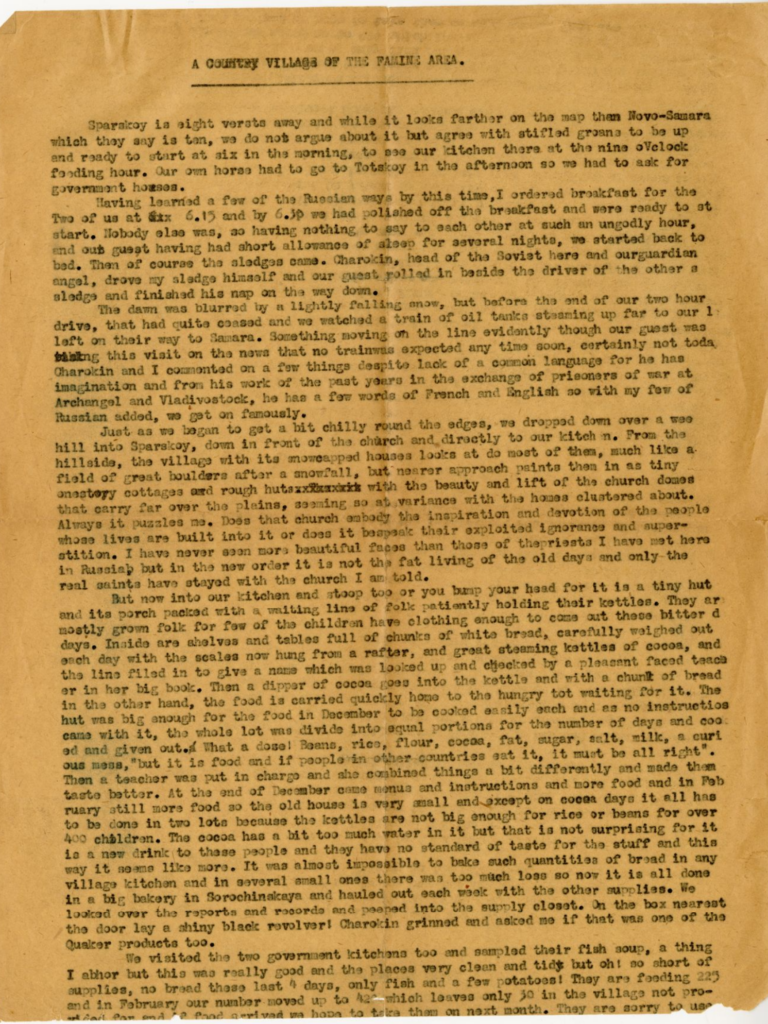
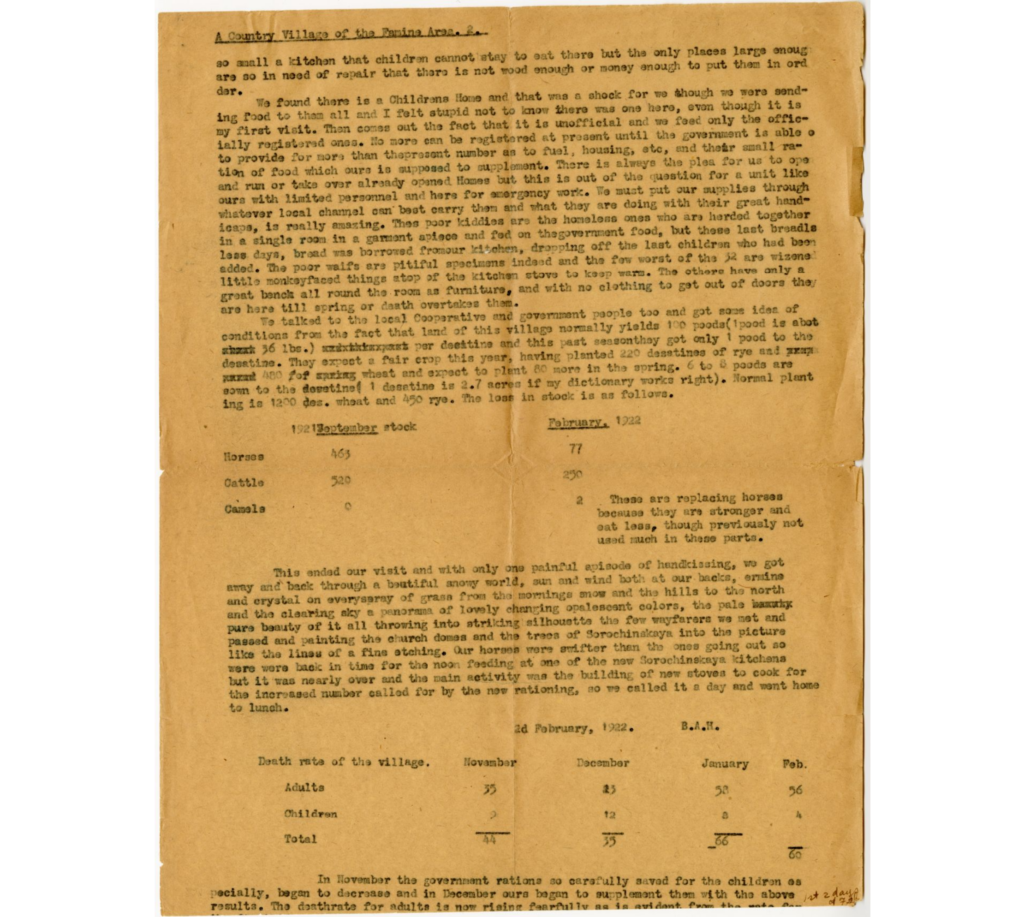
Click on the above images for an up-close look at Hurley’s Essay.
Beulah Hurley Waring’s correspondence and writing from her time in Russia emphasize the humanitarian focus of the Friends over political concerns. In frequent letters to her family back home, Hurley details her day-to-day life in Russia, the lives of her fellow relief workers, the logistics of their work, and the conditions of the famine. In the following essay, Hurley describes her work in the village kitchen preparing meals for local people. Hurley is shocked to learn of another Children’s Home, not registered with the government and therefore not one the AFSC had been informed of. Hurley’s desire to further staff and assist the home is upended by the AFSC’s limited supply and personnel. As she notes, they must rely on local channels to send their supplies. Hurley speaks to locals about the famine conditions and the drop in crop yield over the past year.
As Hurley concludes, she provides the reader with with a sketch of the landscape. Despite the political tensions and immense suffering present in the region and Russia as a whole, Hurley—like many of the Friends—located the “pure beauty” and humanity surrounding her.
Discussion Questions
- How might the AFSC’s status as a religious organization affect its perception by the American, Russian, and later Soviet governments? As a proponent of religious pacifism in particular, what internal tensions might have emerged among relief workers in such war-torn environments?
- What do you think about this pamphlet: is it politically neutral and purely informative? Is the humanitarian stance of the AFSC a political stance itself? Think about today: how is humanitarian work, especially when done by small organizations, perceived politically by the public?
- Look closer at Beaulah Hurley’s essay: with only a fragment of it provided, who might you imagine its intended audience was? Did Hurley write for other Quakers, the broader American public, or other relief groups? How does your understanding of her essay change depending on who it was directed towards?
Secondary Sources
Aiken, Guy. “A Service of Love in War Time: A Vignette.” Pennsylvania History: A Journal of Mid-Atlantic Studies 84, no. 3 (2017): 386–91. https://doi.org/10.5325/pennhistory.84.3.0386.
Aiken’s work discusses the book A Service of Love in War Time written by Haverford professor and Quaker Rufus Jones about the AFSC during World War I. Aiken’s piece provides important context surrounding the AFSC’s formation, and brings attention to the role of Quaker faith in the organization’s development. i
Forbes, John. “American Friends and Russian Relief: 1917-1927 (Part I).” Bulletin of Friends’ Historical Association 41, no. 1 (1952): 39–51. https://doi.org/10.1353/qkh.1952.a394974.
Forbes provides a ccomprehensive discussion of the political tensions and suspicions directed towards the AFSC from the American and Russian governments. Forbes gives further context for how the famine emerged in Russia and what conditions looked like.
Frost, J. William. “‘Our Deeds Carry Our Message’: The Early History of the American Friends Service Committee.” Quaker History 81, no. 1 (1992): 1–51. https://doi.org/10.1353/qkh.1992.0004.
Frost’s work adds an even greater depth of context to the tensions between the AFSC and the American government. Frost also explains the relationship between the AFSC and Conscientious Objector status. He gives further attention to the religious beliefs behind the AFSC and questions notions of pacifism and political neutrality.
Further Research
Haverford College Quaker & Special Collections
- The Beulah Hurley Waring papers are largely digitized and available to view online.
- See the American Friends Service Committee lantern slides of World War I relief work for images of Russia during the AFSC’s first years abroad.
Swarthmore College Friends Historical Library and Peace Collection
- For more first-hand accounts of Quaker women in Russia, see the Rebecca Timbres Clark Papers.
- General information on the work of AFSC in Russia can be found in the American Friends Service Committee Reference Files.
References
- Guy Aiken, “A Service of Love in War Time: A Vignette,” Pennsylvania History: A Journal of Mid-Atlantic Studies 84, no. 3 (2017): 387. ↩︎
- William J. Frost, “‘Our Deeds Carry Our Message’: The Early History of the American Friends Service Committee,” Quaker History 81, no. 1 (1992): 9. ↩︎
- Ibid. ↩︎
- John Forbes, “American Friends and Russian Relief: 1917-1927 (Part I),” Bulletin of Friends’ Historical Association 41, no. 1 (1952): 41. ↩︎
- Ibid. ↩︎
- “Minutes of Executive Meeting held at Andriefka on Sunday March 10th, 1918,” American Friends Service Committee Reference files. Friends Historical Library, Swarthmore, Pennsylvania. ↩︎
- Beulah Hurley Waring letter to William W. Hurley, Dec. 12, 1921. Haverford College Quaker & Special Collections, Haverford, Pennsylvania. ↩︎
- Forbes, 43. ↩︎
- Ibid., 44. ↩︎
- Ibid. ↩︎