A is for Arvin
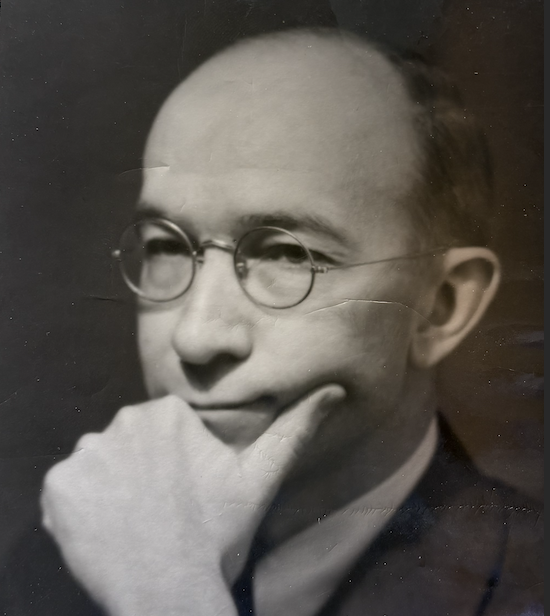
Photograph of Newton Arvin by Eric Stahlberg, 1946. Newton Arvin Papers, Mortimer Rare Book Collection.
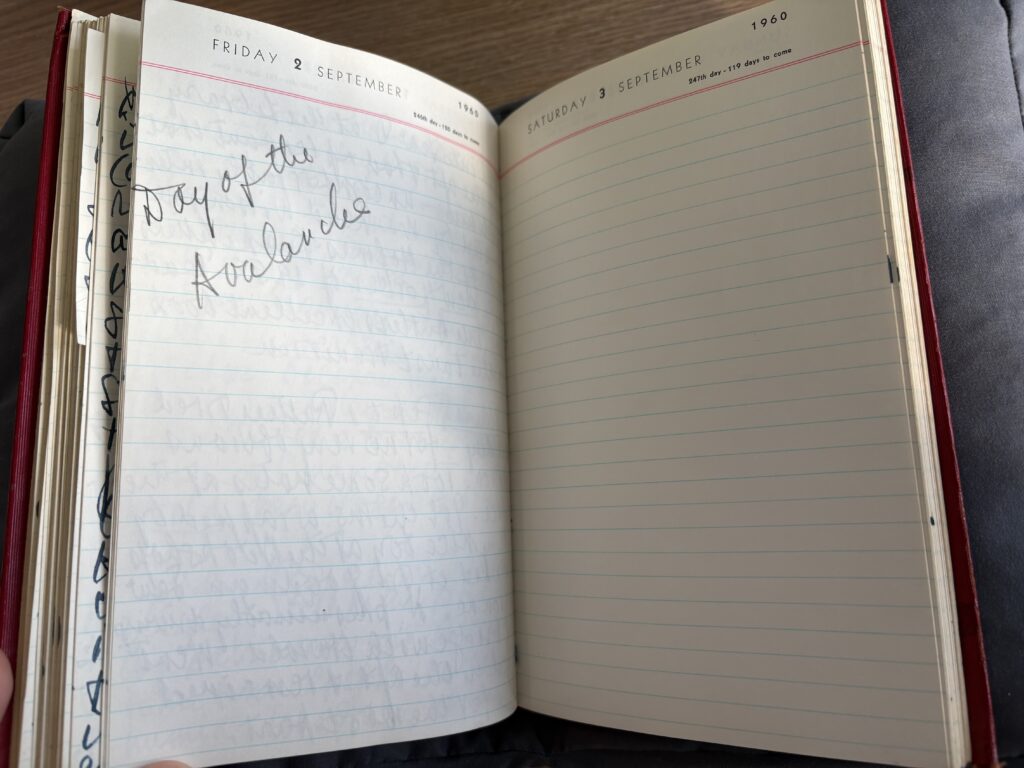
On September 2, 1960, police ransacked the home of a widely acclaimed Smith Professor, Newton Arvin (born Frederick Newton Arvin), in search of obscenity. They found magazines in Arvin’s room and office, under distributor titles like One and MANual, full of photographs of semi-nude male body builders and models, and some pornographic film. But the most intimate find was to be made after the initial raid. Nestled in Arvin’s closet were stacks of leather bound books. As the officer’s tore through, they added each volume to the pile of incriminating material as an after thought. But upon opening the covers, it was clear. These were meticulously detailed and painfully honest diaries– diaries in which Arvin marked each of his sexual encounters with an “X”.
To the officers, looking to arrest homosexuals and pornography possessors (both considered criminals during this period), the X marked new targets to persecute. But the sexual encounters Arvin had are a single strain in these diaries, which in tandem with his published literary corpus, create the portrait of a man who was as talented as he was reclusive, as beloved as he was, at times, self-destructive. Far from perfect, but far from dangerous to anyone other than himself. Soon after the arrest, newspapers took the story and ran. Arvin’s most intimate secrets became national news almost overnight. The New York Times declared, in the article 2 Smith Teachers Held in Vice Case:1
The police said that Arvin, noted for his biographies of Nathanial Hawthorne and Herman Melville, was charged with being a lewd person and that both he and Mr. Spofford were accused of possession of obscene photographs.
The New York Times, September 4, 1960
Edward “Ned” Spofford, was a classics instructor at Smith and a close friend of Arvin’s in the years leading up to the police investigation, who was also gay and in possession of “obscene” materials. At first it seemed that the journals might have been what pointed the police towards Ned, but with the swiftness of Spofford’s arrest, it soon became clear that, under duress, Arvin had named names.2
What can get overshadowed in this story is Arvin’s humanity, especially as he failed to protect friends and loved ones, and the varied reaction Smith College students and faculty had to the decision the College would eventually make in quietly disavowing those involved. These reactions would foreshadow a growing interest in an individual’s right to privacy over a perceived right for the state to extinguish a “moral” threat. Marking the pivotal mainstream shift to resist McCarthyist thought, the 1960s would go on to form a foundational era for many liberation movements, including gay liberation. Reflecting on Arvin’s story, we can come to see what it means to live without legal protections and what it means to be “obscene,” beyond a flat legal label.
Why were the officers so concerned with “obscenity” from the start? Why is it important to remember the story of these caught professors, and specifically figures like Arvin, who may not be easy heroes? And what does it mean to fight for and protect personal liberty and privacy?
Arvin
His Journal Entries of Life, Love, and Literature
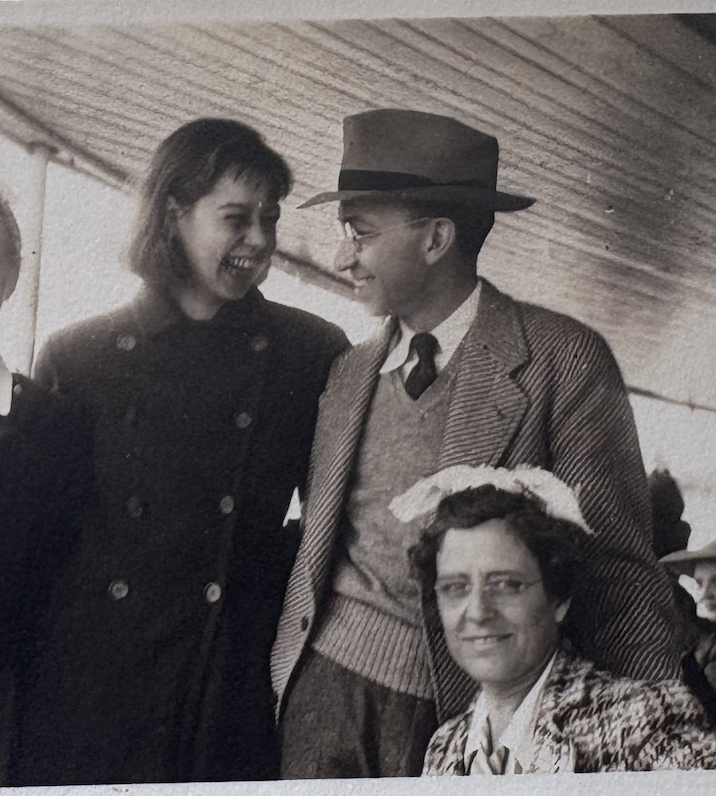
Photograph of Carson McCullers and Newton Arvin, 1940. Newton Arvin Papers, Mortimer Rare Book Collection.
Born in Valparaiso, Indiana on August 23, 1900, Arvin came into this world eight months after the 20th century turned. At thirteen, his mother gifted him a “Daily Reminder” journal, and he acquired a habit of tracking each day of his life in entries, ranging in length from whole pages to a single word, until 1960.3 A voracious reader and writer, Arvin’s lengthier entries are elegantly phrased and his first drafts of essays are astonishingly polished, an aptitude that would land him a spot at Harvard, and later, a professorship at Smith College. These journals are largely how we know today what Arvin did, felt, and experienced, especially as major historical events occurred, like World War I and II and the first and second red scares.
When Arvin first arrived in Northampton, expecting to teach only a couple of semesters at Smith College, he couldn’t have predicted how long he would stay nor what would occur. Arvin became apart of not only literary circles, but in the 1930s, would get involved in a local group studying communist politics, and his personal writings mark a need to use his talents to push back against larger cultural trends, also apparent from his reflections on becoming a literary critic, at a time when literary criticism was barely recognized. However, as Arvin truly entered his thirties, he become altogether more aware of how he was perceived, and would marry one of his students, Mary Garrison, in 1932 in an attempt to “fix” his homosexuality. She would file for divorce in January of 1940.4
In his life, Arvin would publish four acclaimed biographies: Hawthorne (1929), Whitman (1938), Herman Melville (Winner of the National Book Award, 1950), and Longfellow: His Life and Work (1963). His abilities and constant energy to keep writing, and the reputation of his work that would later precede him, led to several important relationships with notable people in literary and political circles, including but not limited to: David Lilienthal, Head of Atomic Divisions in the 1940s and 50s, who started as a boyhood friend but remained a companion into adulthood, Sylvia Plath, who Arvin taught during her undergraduate degree, Van Wyck Brooks, Arvin’s mentor and a pioneering American literary critic, Carson McCullers, novelist and Arvin’s partner in mischief-making at Yaddo (an artists retreat in Saratoga Springs), and Truman Capote, who he fell in love with and with whom Arvin would exchange frequent letters for the rest of his life. Despite having many friends and peers that adored him and his work, Arvin would always struggle with shame around love and sexuality, particularly that he had the “wrong” kind of feelings but was powerless to change them. He was hospitalized during particularly intense periods of depression, many after suicide attempts caused by the isolation experienced while hiding his sexuality. In these moments, the journals reflect Arvin’s state in the absence of entires, especially after the final one he would ever make, on that fateful day, September 2, 1960, which he dubs the “Day of the Avalanche”.
Why was it so hard to feel accepted even in the community Arvin did find? And what does it mean, emotionally and ethically, to interact with these diaries knowing what the police used them for? Would you donate your diary/diaries to an archive? Why or why not?
Arrests
Obscenity Cases and News of the Smith College Smut Scandal
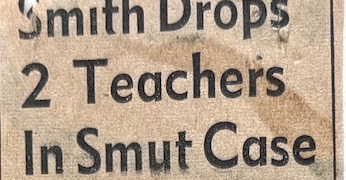
The Boston Herald, March 9, 1961. Smith College Archives collection regarding Newton Arvin, Smith College Archive.
By making people overfamiliar with indecency, so the argument went, obscenity inured them to its impropriety and ultimately weakened their judgment, paving the way for an ugly, vulgar world devoid of legitimate standards of taste and judgement.
Rochelle Gurstein, The Repeal of Reticence, 179.
Alfred Kinsey’s studies on human sexuality were published in the early 1950s, and their impact on public understandings of homosexuality in America would began the slow progress towards declassifying homosexuality as an illness. With a majority of the participants of the study in the middle of the Kinsey scale (ranging from 0 to 6, 0 being completely homosexual, 6 being completely heterosexual) many found this completely challenged mainstream ideas of homosexuality as a sad and rare perversion at best and, at worst, a morally corrosive disease. Along side this, Penicillin made syphilis and other sexually transmitted diseases curable, and art of the 1920s and 1930s explored sexuality more brazenly. In the early 1950s, there was a specific trend of novels portraying gay characters in a sympathetic light, as Truman Capote does in his first novel, published in 1948, Other Voices, Other Rooms. 5
Mainstream backlash to these progressive strides came in the form of obscenity cases and conspiracy. John Regan and Gerald Crowley, the officers that arrested Arvin, were interested in making “porno” arrests to add to an image of politicians and police departments dedicated to “cleaning up their cities.”6 Postmaster General Arther Summerfield was a key player in allowing for many novels, magazines, photographs, and various other media to be considered obscene enough to ban, in his “war on smut.”7 A common unsubstantiated reason for harsher obscenity crack downs was that the spread of obscene material was corrupting children. In 1960, a group called Citizens for Decent Literature met and were outraged to hear “that mail-order obscenity was reaching a million children a year.”8 After a Supreme Court ruling in Roth v. US, a case that determined that possession and distribution of obscene material was not protected under one’s first amendment rights, the persecution ramped up. What the law particularly declared as illegal was distribution, which included both commercial distribution and allowing others to view obscene material, even if all parties were of consenting age, consented to see it, and paid no money nor had any “lewd” relations.9 An essential aspect of these crack downs became publicity and the prolonged shaming that could come with an initial arrest, no matter the outcome of the trial.
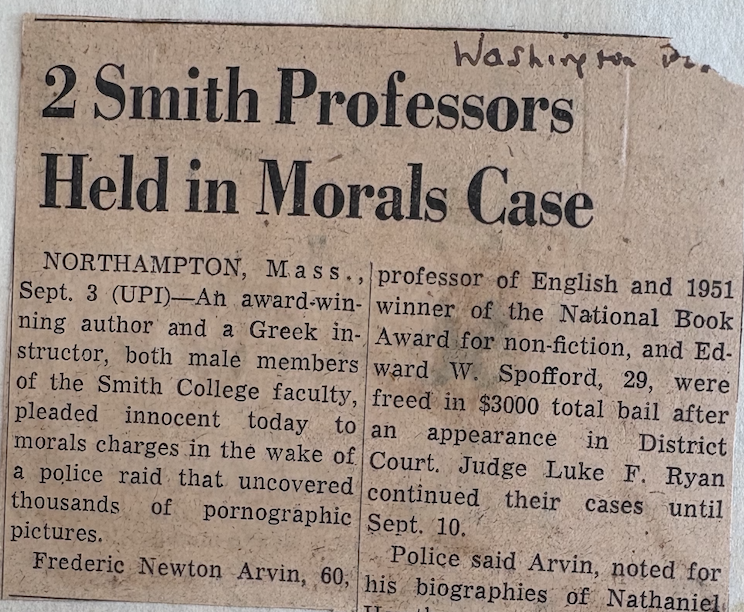
On Monday August 29, 1960, five men, including Arvin, Spofford, and Joel Dorius, another Smith faculty member whose home was later raided, met at 45 Prospect Street – Arvin’s lodging for over a decade – to view his and Dorius’s collections. Because Arvin admitted to the event under duress, five adult men viewing homoerotic imagery became the basis for a conspiracy that alleged the men were involved in an organized “interstate smut ring.”10
Arvin’s case would come to a close on September 20th, 1960, he made no plan to appeal the charges against him, that he was “lewd and lascivious in speech and behavior,” relenting to an 1000 dollar fine and a suspended one-year sentence in the House of Corrections.11 Ned Spofford and Joal Dorius would go on to appeal their cases. Spofford eventually being acquitted in 1962 by the state Supreme Court, as the evidence used against him was “seized without a search warrant”.12 By this point, the damage had been done. The New York Times, the Evening Star, the Chicago Daily Tribune, and many more publications ran editorials emphasizing the “lewd” charges, The Springfield Union even running an editorial titled “College Trustees Acted Wisely” as Smith College proceeded to retire Arvin and refuse to reinstate Dorius or Spofford in their former positions.13 The community and sense of safety the men cobbled together was beyond shattered.
The very fact that [Spofford and Arvin] were friends incriminated them. Anything each knew about the other could be used as a weapon by Reagan. Any feeling each had for the other would only add to the picture of a depraved conspiracy.
Barry Werth, The Scarlet Professor, 200.
Do you notice differences or similarities in the wording of these headlines to those in recent news articles? What wording stands out to you and why? What is the stated goal of these publications and how does that measure up to what we see from them?
The Affair
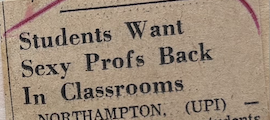
Student and Faculty Response
Morning Eagle-Tribune Clipping, “Students Want Sexy Profs Back In Classrooms,” March 9, 1961. Smith College Archives collections regarding Newton Arvin, Smith College Archive.
During the fallout, the then president of Smith College, Thomas C. Mendenhall had to field a barrage of letters from students, faculty, and the board of trustees. Each, individually, had a different idea of the just and humane way to handle the scandal, whether to prioritize the welfare of the college’s reputation or the welfare of the men at the center of “the Affair”. Across the spring semester, the Trustees met and discussed the decision of what to do with Dorius and Spofford, already having decided to retire Arvin, to which he made little protest, but implored in a letter to Mendenhall on September 29, 1960:
The general question for American colleges and universities of what is to be the treatment of individuals similarly arrested and tried seems to me far more important than that of my merely personal future.14
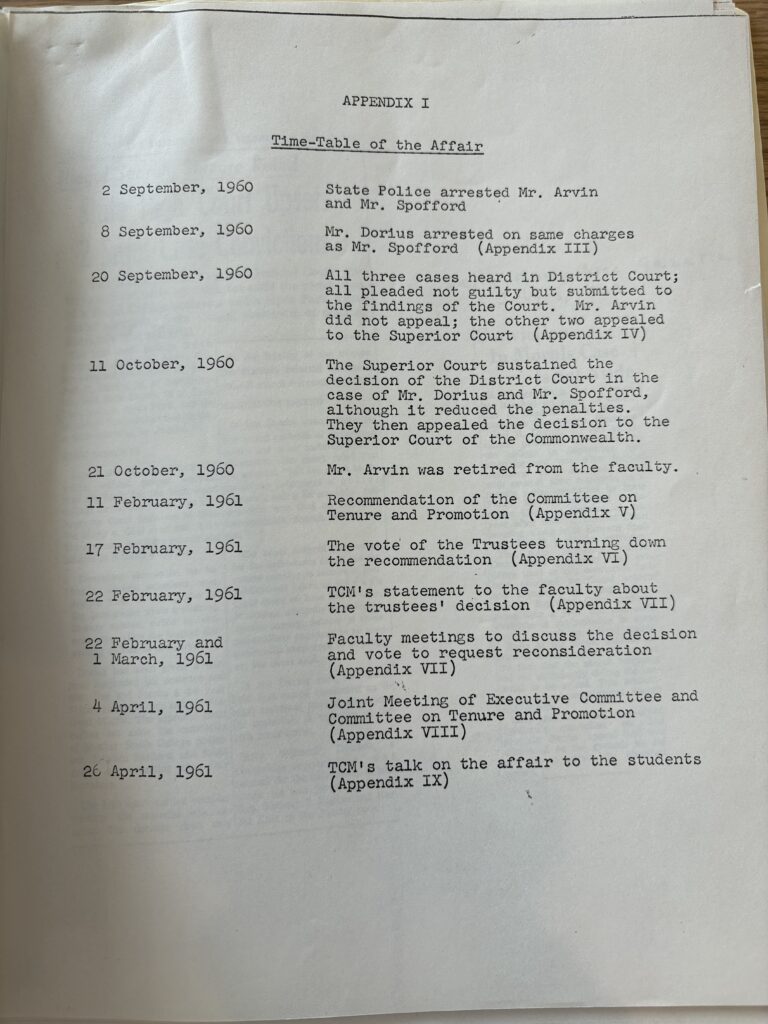
It seemed Arvin was aware that, while his trial might have been finished, there was an immediate importance for Spofford, Dorius, and every persecuted person not to lose hope. Nevertheless, the “statement to the faculty” on February 22, 1961, also included informing the editor of the Sophian, Smith College’s newspaper, who would announce the Trustees’ decision not to reappoint Dorius and Spofford to the school as a whole. After the announcement of the Trustees’ decision, many students wrote to express their dissatisfaction and The Sophian ran a letter signed by 16 students titled “We Accuse” stating:
We accuse all those who overtly or tacitly accept the Trustees’ decision of not recognizing the fact that the only relevant issue involved should be whether or not these men are capable of upholding the academic level of this college.15
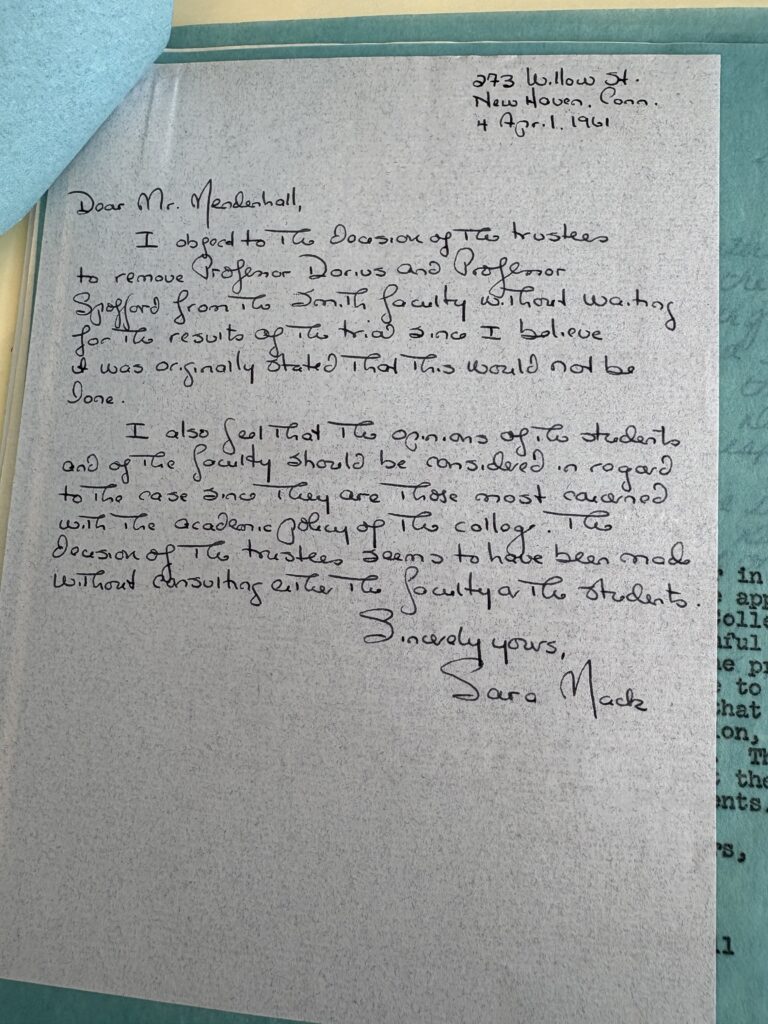
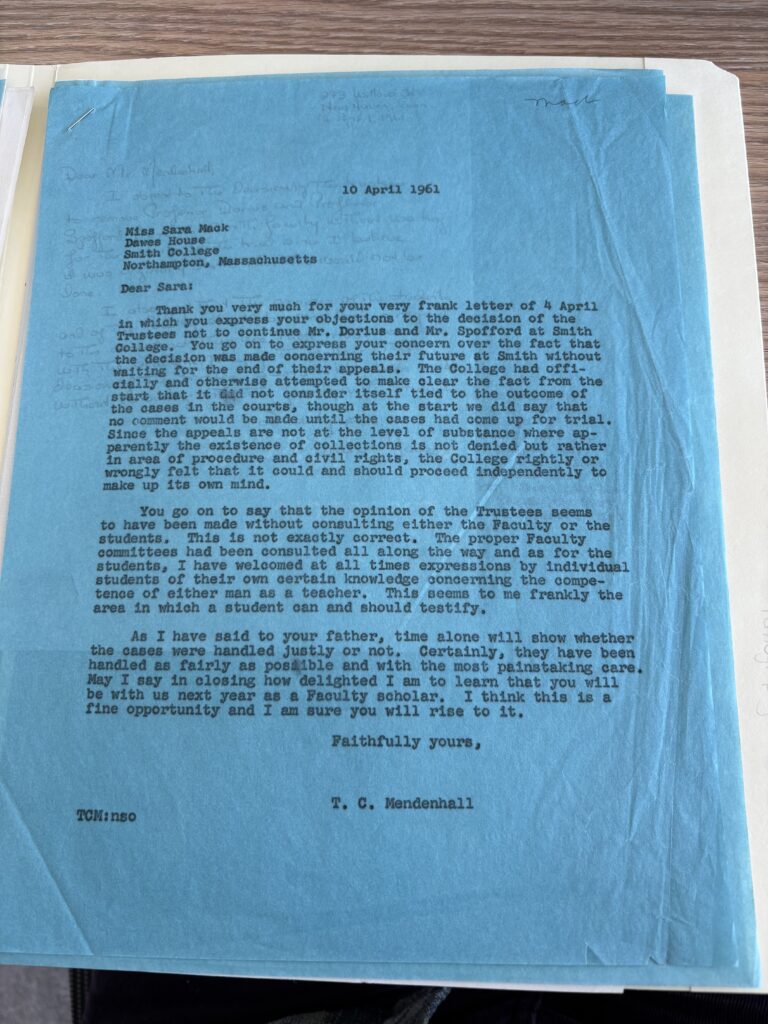
Transcription of Letter from Sara Mack
273 Willow St.
New Haven, Conn.
4 April, 1961
Dear Mr. Mendenhall,
I object to the decision of the trustees to remove Professor Darius and Professor Spofford from the Smith faculty without waiting for the results of the trial since I believe it was originally stated that this would not be done.
I also feel that the opinions of the students and of the faculty should be considered in regard to the case since they are those most concerned with the academic policy of the college. The decision of the trustees seems to have been made without consulting either the faculty or the students.
Sincerely yours
Sara Mack
Transcription of Letter from Thomas C. Mendenhall
10 April 1961
Miss Sara Mack
Dawes House
Smith College
Northampton, Massachusetts
Dear Sara:
Thank you very much for your very frank letter of 4 April in which you express your objections to the decision of the Trustees not to continue Mr. Dorius and Mr. Spofford at Smith College. You go on to express your concern over the fact that the decision was made concerning their future at Smith without waiting for the end of their appeals. The College had officially and otherwise attempted to make clear the fact from the start that it did not consider itself tied to the outcome of the cases in the courts, though at the start we did say that no comment would be made until the cases had come up for trial. Since the appeals are not at the level of substance where apparently the existence of collections is not denied nut rather in area of procedure and civil rights, the College rightly or wrongly felt that it could and should proceed independently to make up its own mind.
You go on to say that the opinion of the Trustees seems to have been made without consulting either the Faculty or the students. This is not exactly correct. The proper faculty committees had been consulted all along the way and as for the students, I have welcomed at all times expressions by individual students of their own certain knowledge concerning the competence of either man as a teacher. This seems to me frankly the area in which a student can and should testify.
As I have said to your father, time alone will show whether the cases were handled justly or not. Certainly, they have been handled as fairly as possible and with the most painstaking care. May I say in closing how delighted I am to learn that you will be with us next year as a Faculty scholar. I think this is a fine opportunity and I am sure you will rise to it.
Faithfully yours,
T. C. Mendenhall
Far from the reticent ladies horrified by their professors’ actions, and far from the ladies the Trustees might have been expecting, these students considered it their responsibility to defend their teachers’ right to be who they were. While letters from students, parents, and faculty commending the College’s decision were present, there were also those from parents and Northampton community members questioning this chosen course of action. Furthermore, members of faculty were hardly unanimous in their opinions on morality or law, but few actively supported the decision. While the wider public might only have seen the united front against Arvin, Spofford, and Dorius from the papers, cracks were there, and they began to show through.
Whatever our opinions on the rightness of the Board’s decision, all of us, I hope, would agree that every possible step must be taken to prevent such an open break between Faculty and Trustees in the future. Certainly much of my time and thoughts over the last few weeks have been towards this end.
T. C. Mendenhall, Memorandum to the Trustees and the Faculty on the Affair, March 16, 1961
Arvin died a little over two years after the morals case, on March 23, 1963. Dorius relocated to San Francisco, teaching at the San Francisco State College until his retirement. Spofford joined him in 1970, and left for Stanford in 1974, retiring in 1988.16
What was the effect of the student response? Why might the college’s decision mattered not only to Arvin, Spofford, and Dorius, but to their students and colleagues? What about their response surprises you? What mirrors what you see in other eras, including current one, on college campuses?
Discussion Questions:
- What does it mean for media to be “legally obscene” in the 1950s, 60s, and today? And what kinds of changes have occurred, legally, socially, and politically, to redefine the term “morally reprehensible”?
- Why do you think these men decided to keep “obscene material” knowing that it was against the law? What importance might it have carried for them while living under the legal system they did?
- What did you expect student reactions to be to the moral case, and how did the historical context and archival sources surprise, confirm, or complicate that expectation?
For Further Research Please Consider:
- The Newton Arvin Papers at Smith College, housed in the Mortimer Rare Book Collection: https://findingaids.smith.edu/repositories/3/resources/1347
- Smith College Archives concerning Newton Arvin, Smith College Arc: https://findingaids.smith.edu/repositories/4/resources/288
- “Newton Arvin at Yaddo” https://www.smith.edu/libraries/libs/ssc/yaddo/arvin1.html
- Yourgrau, Tug, dir. The Great Pink Scare. 2006; Independent Lens. https://www.pbs.org/independentlens/documentaries/greatpinkscare/
Recommended Secondary Sources:
Gurstein, Rochelle. The Repeal of Reticence: A History of America’s Cultural and Legal Struggles over Free Speech, Obscenity, Sexual Liberation, and Modern Art. Hill & Wang, 1996.
If you are interested in learning about the history of obscenity in America, this text was a valuable resource in the creation of the “Arrests” section of this website. Chapter 7 is especially significant in covering the creation of obscenity law, the pushback, and the cases that marked and informed cultural shifts. Understanding what “obscenity” has generally meant in the wider American consciousness can bring into perspective what those observing the morals case might have thought, felt, and valued, whether they were for or against harsher policing of obscenity.
Johnson, David K. The Lavender Scare. The University of Chicago Press, 2004.
A book that contributes to scholarly overviews of the McCarthy era by arguing that the persecution of “security risks” (widely understood as a coded term for gay people) in the government during this period was just as, if not more, rampant than persecution of communists or communist sympathizers. Recent queer studies have shed light on many primary sources from the 1950s and 60s, and how jargon may interfere with a complete understanding of what is actually discussed in these documents when coming in with a modern perspective. A useful resource that provides general context for queer acceptance or lack of acceptance during this time period, either from certain political individuals or institutions.
Werth, Barry. The Scarlet Professor. Anchor Books, 2002.
Published in 2001, this is the only comprehensive book-length biography of Newton Arvin. Provides meticulous detail and interpretation of what Arvin was experiencing during his formative time as a literary critic and when he faced the trial towards the end of his life. Provides further context into Edward Spofford and Joel Dorius’s stories, tracking Arvin’s further relationships.
Kunzel, Regina. “Placing Newton Arvin in Queer History.” Nathaniel Hawthorne Review 44, no. 1–2 (2018): 82–89. https://www.jstor.org/stable/10.5325/nathhawtrevi.44.1-2.0082.
A differing perspective on Arvin’s place in queer history and literary thought, especially concerning narratives of oppression that do not end in resistance. Adds to the conversation of how involved Arvin was in the queer community of his time and what it means to center queer people who don’t exemplify health or ambivalence towards queer activist causes. Questions the place of shame and trauma in queer stories beyond eventual triumph.
Bibliography
- “2 Smith Teachers Held in Vice Case,” The New York Times, September 4, 1960: “https://timesmachine.nytimes.com/timesmachine/1960/09/04/99792659.html?pageNumber=54 ↩︎
- Barry Werth, The Scarlet Professor, Anchor Books, 2004. pp 193-224. ↩︎
- Newton Arvin Papers, Mortimer Rare Book Collection, Box 16, Folder 1. ↩︎
- Werth, 52-79. ↩︎
- Johnson, David K. The Lavender Scare. University of Chicago Press, 2004. pp 41-64. ↩︎
- Werth, 194. ↩︎
- Werth, 172. ↩︎
- Werth, 174. ↩︎
- Werth, 172-176. ↩︎
- Sklar, Stacey M. “Scandal At Smith College: The Newton Arvin Case,”(Bachelor’s Honors Thesis, Amherst College) pp 15. Smith College Archives collections regarding Newton Arvin, Box 664.1. ↩︎
- “2 Smith Profs Seized with Lewd Photos,” The Chicago Daily Tribune. Smith College Archives collection regarding Newton Arvin, Smith College Archive, Box 665, Folder 21.
Unattributed News Clipping, “Four Are Fined in Morals Probe at Northampton,” Smith College Archives collection regarding Newton Arvin, Smith College Archive, Box 665, Folder 21. ↩︎ - “Former College Faculty Member Wins Acquittal,” Hampshire Gazette, March 1 1962. Smith College Archives collection regarding Newton Arvin, Smith College Archive, Box 665, Folder 21. ↩︎
- “College Trustees Acted Wisely,” The Springfield Union. Smith College Archives collections regarding Newton Arvin, Smith College Archive, Box 665, Folder 21. ↩︎
- Letter to Mendenhall from Arvin, dated September 29, 1960. Smith College Archives collections regarding Newton Arvin, Smith College Archive, Box 665, Folder 10. ↩︎
- “We Accuse,” The Sophian, March 7, 1961. Smith College Archives collections regarding Newton Arvin, Smith College Archive, Box 665, Folder 21. ↩︎
- Werth, 302. ↩︎