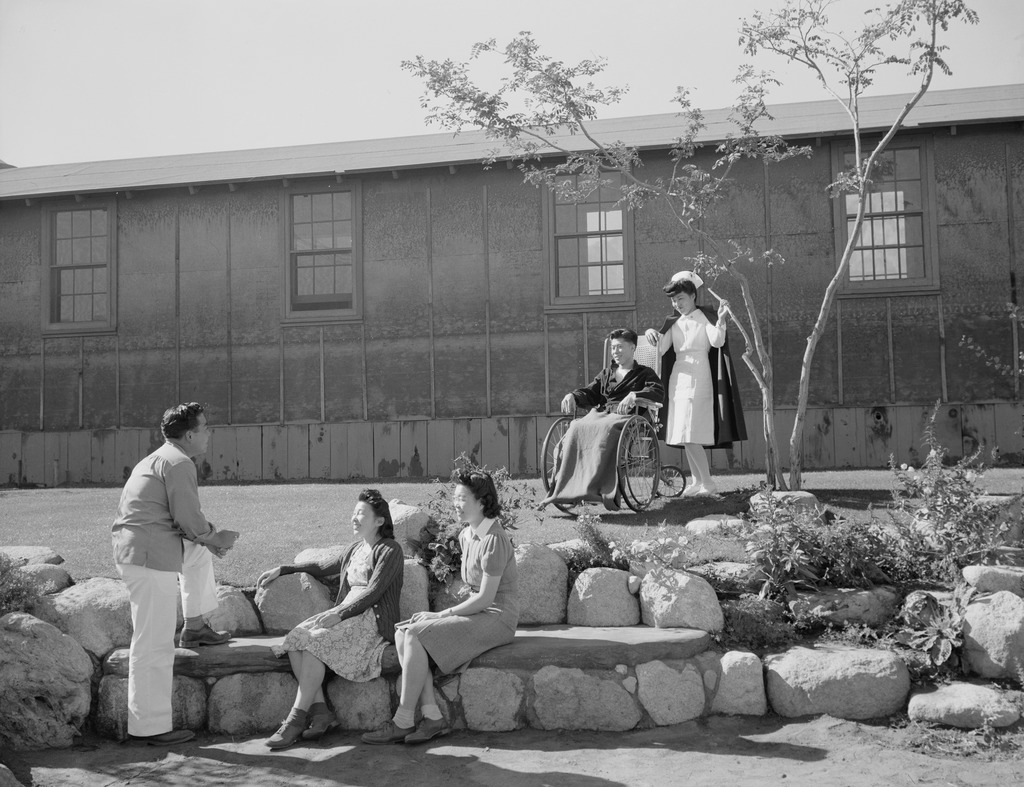
Just two months after the bombing of Pearl Harbor, Franklin Roosevelt signed Executive Order 9066 into law, making it possible for the government to create a military exclusion zone on the western coast of the United States “from which any or all persons may be excluded.”1 Starting in April of 1942, all Japanese Americans living within this military exclusion zone were forcibly removed to temporary “assembly centers” in anticipation of their eventual relocation to more long-term “relocation centers” several months later.
One-third of America’s doctors enlisted in the military during the second World War,2 resulting in a major shortage of physicians. In response, many hospitals were willing to pay their doctors a lot more than the government-run camps were. As a result, many of the doctors who worked in the camps were incarcerees themselves.3 After the army forced all Japanese American physicians to shut down their practices in the spring of 1942, the WRA distributed these physicians as evenly as possible across the assembly and relocation centers.4 This meant that many Japanese American physicians and their families (most of whom lived in the Bay Area prior to the war) were separated from their friends, neighbors, and patients. Initially, one Japanese American doctor was placed in charge of each of the assembly center hospitals,5 but upon relocation to the more permanent WRA camps, administrative roles were transferred to white physicians, with incarcerated medical professionals often supervised by much less experienced nurses and doctors.6 This caused considerable tension between white and Japanese American health care workers in the camps.
The conditions in both the temporary assembly centers and the more long-term relocation centers were conducive to a wide array of diseases. Many of the War Relocation Authority (WRA) camps were located in areas with extreme conditions. The incarcerees at camps located in the Rockies were subject to severe dust storms that often caused them to suffer from ailments like hay fever, asthma, and “valley fever” (coccidioidomycosis).7 The tarpaper barracks that served as their living quarters were no match for the harsh temperatures, which regularly surpassed 100 degrees in Arizona (where the Poston and Gila River camps were located) and dropped to thirty below zero in Wyoming (home to the Heart Mountain camp).8 These extreme temperatures were especially dangerous for the very young and the very old, with an increased infant mortality rate arising as a result of excessive heat.9 In addition to the hazards posed by climate, the camp facilities were completely insufficient and frequently neglected by the US government. Because the WRA used recycled oil pipes to construct the camps’ water systems, water supplies were often contaminated. Inadequate food supply led to nutritional deficiencies, and improper food handling caused many epidemics of food poisoning.10 The structure of the camps themselves was highly conducive to the spread of communicable diseases, and vaccinations were a high priority as soon as the incarceration was announced, with doctors working hard to inoculate thousands of Japanese Americans against diphtheria, typhoid, smallpox, and whooping cough. Unfortunately, only a small percentage of the population was vaccinated before the evacuation, and inoculation continued to occur at the temporary assembly centers as well as the WRA camps.
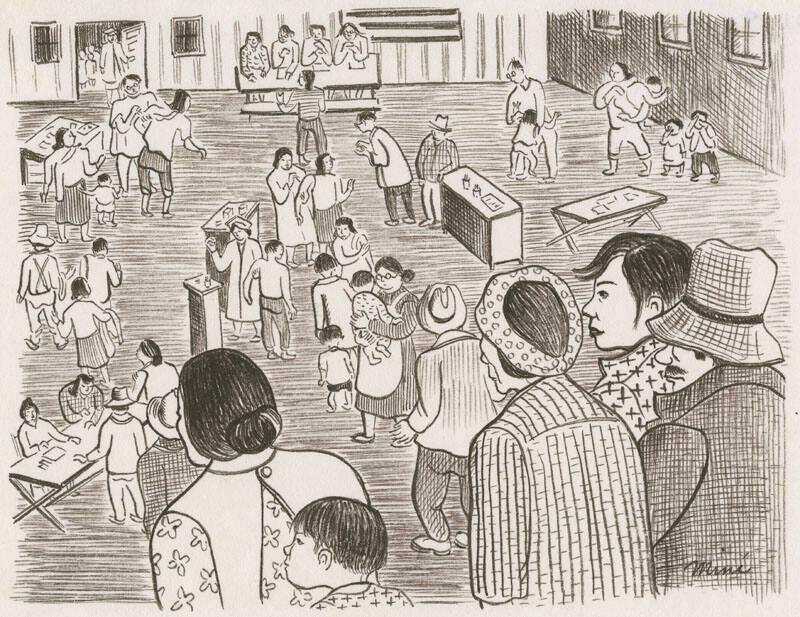
The camp hospital facilities were often inadequate. Many hospitals were not even fully built by the time that the relocation centers opened–the first baby born in the Topaz camp was delivered on a dining hall table in the laundry hall that was serving as a temporary infirmary.11 Basic medical supplies took months to arrive, if they ever did at all. The situation was so dire that surgeons at multiple hospitals resorted to using their fellow evacuees’ sewing supplies to stitch up patients’ wounds.12 Delays in procuring necessary medical equipment affected care dramatically–for example, when Paul Nakahara’s mother became ill, the camp hospital did not have access to any x-ray equipment, and the chief medical officer there refused to let her get an x-ray at the nearest town hospital, telling Nakahara that she would just have to wait until the equipment arrived. By the time it did, her condition had worsened, and she died a year later.13
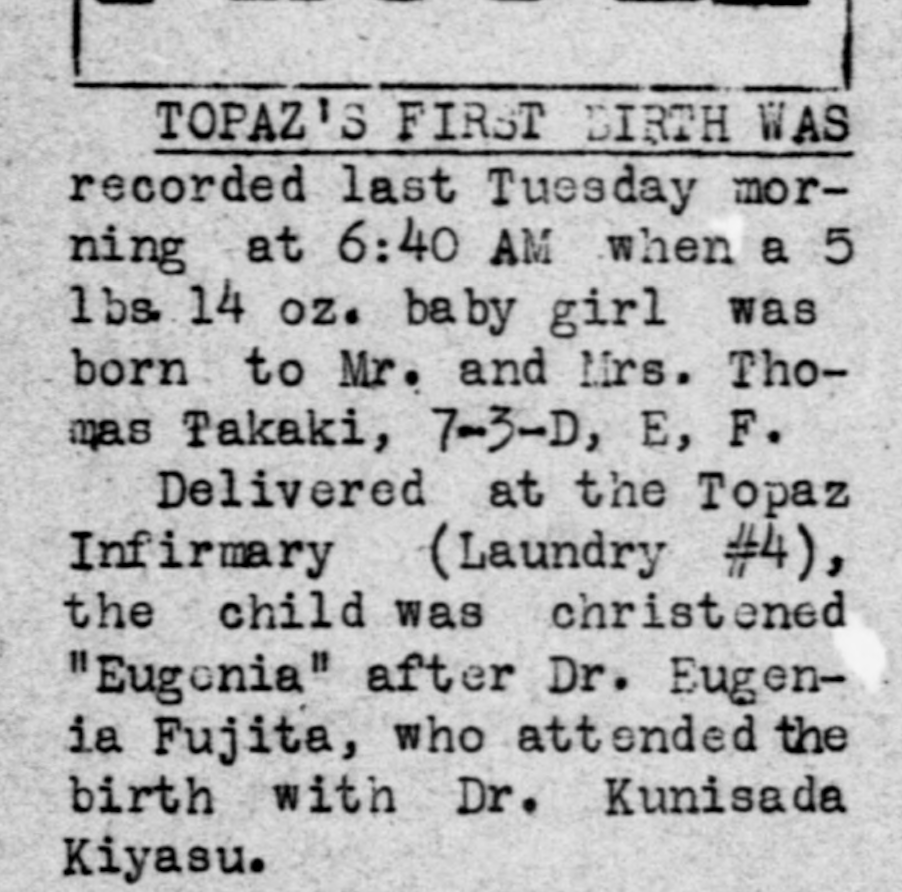
As indicated by the story of Eugenia Takaki (the first baby born in Topaz),14 the army had not prepared the camps to provide obstetrical care when they opened. Eugenia’s story is one of many–at the Tanforan assembly center (San Bruno, California), incarcerees tore a laundry room door off its hinges for a woman to deliver her child on, and at the Marysville assembly center (Marysville, California), a doctor asked his brother to construct a delivery table out of scrap wood.15
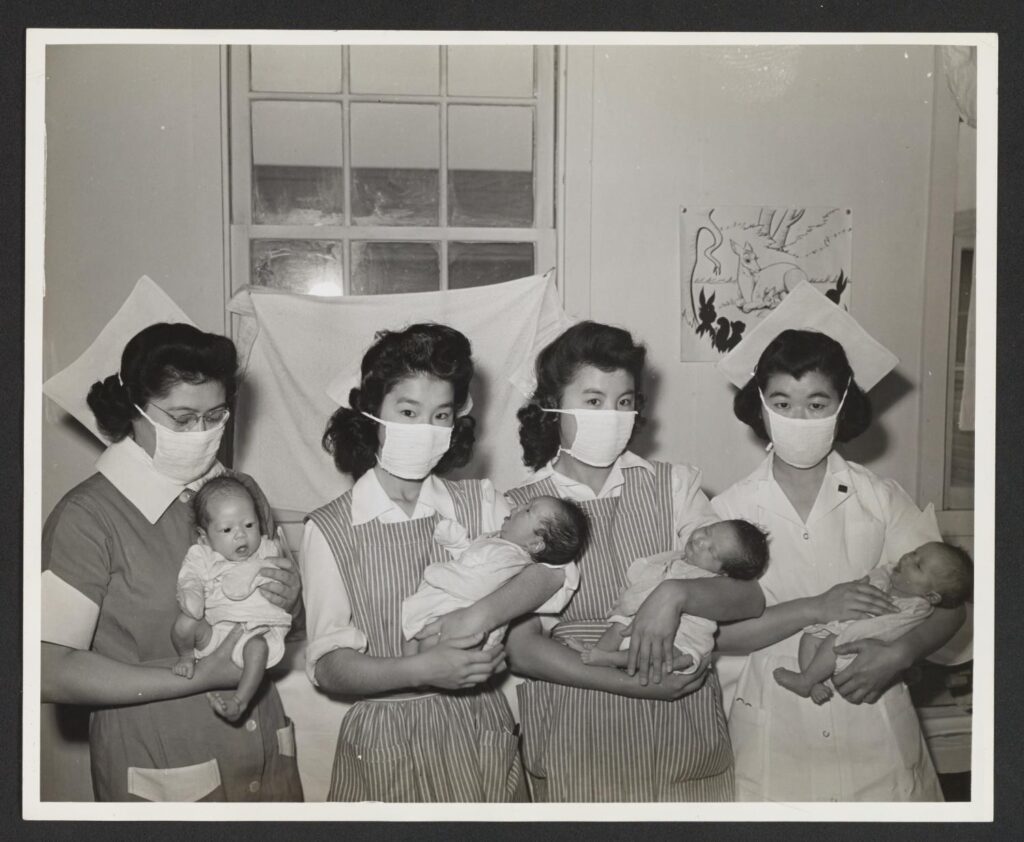
Staffing was a constant issue, particularly when incarcerated healthcare workers began to leave the camps and seek work elsewhere. The controversial loyalty questionnaire administered in 1943 paved the way for incarcerees to relocate to areas outside of the west-coast military zone, and many doctors and nurses elected to work in hospitals outside the camps. When second-generation Japanese Americans (Nisei) were permitted to join the army in February of 1943, many health care professionals (male and female) signed up,16 both as soldiers and members of the Army Medical Corps.17 The staff shortage was so critical after these departures that by mid-1944, there were only four doctors working at Poston (the largest of the WRA detention camps). The quality of care suffered dramatically under these conditions: for example, when Mabel Ota went into labor, Poston’s only obstetrician (Dr. Wakamatsu) had collapsed from exhaustion and did not come to treat her until twenty-eight hours after she arrived. Ota likely should have received a c-section, but no anesthesiologist was available, and her daughter, Madeline, suffered significant brain damage from the forceps the doctor used to deliver her.18
![Excerpt from the post-war testimony of Mabel Takaki Ota which reads: "Poston was a very hot, dusty and desolate place. There was not a single blade of grass because the hastily built barracks were placed on freshly plowed soil. Clouds of dust rose with every step taken and when the wind blew the dust was so heavy it became difficult to see. The dust would blow into the barrack rooms though the cracks in the walls and between the floorboards.
We were very busy preparing the camp. Fred was assigned as general manager of Community Enterprises and I became Head Librarian. Fred's job was to open stores, barber shops, beauty shops, etc.--whatever was needed in a community. I opened crates of discarded books sent to camp and set up a public library.
By the latter part of 1942 the administration began encouraging people to leave camp if they could find a sponsor. Fred was offered a job in New York by the Quakers as as'st manager of Cooperative Distributors, a mail order house. He left camp but I stayed behind because I was pregnant and expecting a baby in [redacted]. The baby arrived a month early--after 8 months gestation on [redacted].
When I arrived at the hospital, a nurse checked me in. She stated the Dr. had delivered 3 babies and had collapsed so he had returned to his barracks for a much needed rest. There was only on O.B. Dr. for the entire camp. The nurse checked me infrequently. At one time she said that I was bearing down incorrectly. I had long, long hours of labor. I must have looked ghastly because my sister came to visit me in labor and left the room abruptly. Later she told me that I looked so awful that she went outside to vomit. After 28 hours of labor, the nurse became concerned and sent for the Dr. Dr. Wakamatsu examined me and said: 'Your baby's heartbeat is getting very faint. I will have to use forceps to deliver the baby and I will have to give you a local pain killer because we do not have an anesthesiologist. We can't wait any longer because we do not have a resuscitating machine to revive the baby.'
I remember many details in the delivery room. After using the scalpel to cut me he picked up the forceps. I thought it looked like the ice tongs used by the iceman when he delivered a block of ice--only the ends were long and flat--not curved and pointed. After much pulling he finally got the baby out. She gave one very faint cry and I though she was not red but white. She was rushed to the incubator and I did not see her for three days. I was told that she was too weak to be moved."](https://sites.smith.edu/arx340-sp26/wp-content/uploads/sites/1271/2026/03/mabelpage2-815x1024.jpg)
![Excerpt from the post-war testimony of Mabel Takaki Ota which reads: "When I saw her I noticed a large scab on the back on her head. She has a bald spot there to this day. Madeline is a developmentally disabled person. She is mentally retarded and has grand mal epilepsy.
When she was 3 years old she was admitted to the Children's Hospital for 1 week on tests and observation/ Dr Lyttle, then head of the hospital, stated that it appeared she had suffered brain damage. He told me: 1. To have another child and 3. That Madeline's development would depend on the kind of education to which she was exposed.
My second daughter, Candice, was born [redacted]. A husband and wife physicians team were by obstetrician-surgeon. Through their expert care and constant attendance during labor and delivery, my second daughter was born safely in a Los Angeles hospital.
Candice, school teacher, and now Mrs. Gary Funakoshi, has two sons, Brent 8 1/2 and Keith, 7 years old. At the time of Brent's birth when Candice went into labor, the Dr. informed us that she was not dilating properly so he must perform an emergency Caesarean section/ The birth was successful. Her second son was also born by Caesarean operation.
Many, many time I have wished that Madeline could have been born by Caesarian 0peration. She may then have been a normal whole person. Madeline has attended private schools for exceptional children and is now attending a private sheltered workshop. We have paid monthly fees for her education for over 30 years.
The second tragedy in our lives was the early death of my father, Suezo Kawashima. My father had been a diabetic since his 30s but with insulin injections and careful and selective diet, he was living a normal life--working 6 days at the grocery store and spending the 7th at church or working in his yard. He always raised vegetables because they were essential to his diet.
At Poston, there were no special diets available to anyone. We all ate whatever was shipped into camp. Everyone at the same meals prepared in the block kitchen and served in the mess hall. Many times our meals consisted solely of starches: bread, potatoes, rice, macaroni.. Later, as the evacuees began to cultivate and grow their own vegetables, we did get better balanced meals.
After Madeline's birth, I had planned to join Fred in New York as soon as possible. However, the Dr. informed me that I must wait until Madeline was stronger--until she was at least 6 months old."](https://sites.smith.edu/arx340-sp26/wp-content/uploads/sites/1271/2026/03/mabelpage3-813x1024.jpg)
Excerpt from the post-war testimony of Mabel Takaki Ota about the delivery of her daughter, Madeline. July 7, 1981. Courtesy of the Sasha Hohri Collection, Densho. https://ddr.densho.org/ddr-densho-352-361/.
Transcript of excerpt from Mabel Takaki Ota’s testimony
Poston was a very hot, dusty and desolate place. There was not a single blade of grass because the hastily built barracks were placed on freshly plowed soil. Clouds of dust rose with every step taken and when the wind blew the dust was so heavy it became difficult to see. The dust would blow into the barrack rooms though the cracks in the walls and between the floorboards.
We were very busy preparing the camp. Fred was assigned as general manager of Community Enterprises and I became Head Librarian. Fred’s job was to open stores, barber shops, beauty shops, etc.–whatever was needed in a community. I opened crates of discarded books sent to camp and set up a public library.
By the latter part of 1942 the administration began encouraging people to leave camp if they could find a sponsor. Fred was offered a job in New York by the Quakers as as’st manager of Cooperative Distributors, a mail order house. He left camp but I stayed behind because I was pregnant and expecting a baby in [redacted]. The baby arrived a month early–after 8 months gestation on [redacted].
When I arrived at the hospital, a nurse checked me in. She stated the Dr. had delivered 3 babies and had collapsed so he had returned to his barracks for a much needed rest. There was only on O.B. Dr. for the entire camp. The nurse checked me infrequently. At one time she said that I was bearing down incorrectly. I had long, long hours of labor. I must have looked ghastly because my sister came to visit me in labor and left the room abruptly. Later she told me that I looked so awful that she went outside to vomit. After 28 hours of labor, the nurse became concerned and sent for the Dr. Dr. Wakamatsu examined me and said: “Your baby’s heartbeat is getting very faint. I will have to use forceps to deliver the baby and I will have to give you a local pain killer because we do not have an anesthesiologist. We can’t wait any longer because we do not have a resuscitating machine to revive the baby.”
I remember many details in the delivery room. After using the scalpel to cut me he picked up the forceps. I thought it looked like the ice tongs used by the iceman when he delivered a block of ice–only the ends were long and flat–not curved and pointed. After much pulling he finally got the baby out. She gave one very faint cry and I though she was not red but white. She was rushed to the incubator and I did not see her for three days. I was told that she was too weak to be moved.
When I saw her I noticed a large scab on the back on her head. She has a bald spot there to this day. Madeline is a developmentally disabled person. She is mentally retarded and has grand mal epilepsy.
When she was 3 years old she was admitted to the Children’s Hospital for 1 week on tests and observation/ Dr Lyttle, then head of the hospital, stated that it appeared she had suffered brain damage. He told me: 1. To have another child and 3. That Madeline’s development would depend on the kind of education to which she was exposed.
My second daughter, Candice, was born [redacted]. A husband and wife physicians team were by obstetrician-surgeon. Through their expert care and constant attendance during labor and delivery, my second daughter was born safely in a Los Angeles hospital.
Candice, school teacher, and now Mrs. Gary Funakoshi, has two sons, Brent 8 1/2 and Keith, 7 years old. At the time of Brent’s birth when Candice went into labor, the Dr. informed us that she was not dilating properly so he must perform an emergency Caesarean section/ The birth was successful. Her second son was also born by Caesarean operation.
Many, many time I have wished that Madeline could have been born by Caesarian 0peration. She may then have been a normal whole person. Madeline has attended private schools for exceptional children and is now attending a private sheltered workshop. We have paid monthly fees for her education for over 30 years.
The second tragedy in our lives was the early death of my father, Suezo Kawashima. My father had been a diabetic since his 30s but with insulin injections and careful and selective diet, he was living a normal life–working 6 days at the grocery store and spending the 7th at church or working in his yard. He always raised vegetables because they were essential to his diet.
At Poston, there were no special diets available to anyone. We all ate whatever was shipped into camp. Everyone at the same meals prepared in the block kitchen and served in the mess hall. Many times our meals consisted solely of starches: bread, potatoes, rice, macaroni.. Later, as the evacuees began to cultivate and grow their own vegetables, we did get better balanced meals.
After Madeline’s birth, I had planned to join Fred in New York as soon as possible. However, the Dr. informed me that I must wait until Madeline was stronger–until she was at least 6 months old.
The doctors and nurses who elected to stay and serve their community were highly appreciated by their patients, with incarcerees raising money to supplement their insubstantial salaries19–on average, Japanese American doctors in the camps were paid somewhere around 20 dollars a month. In comparison, white nurses made closer to $135.20
Many incarcerees (mostly young women) were trained as volunteer nurses’ aides in an attempt to ease staff shortages.21 Nurses’ aides were responsible for the majority of patient care in the camps,22 with one RN supervisor going so far as to say that “90% of the hospital work is performed by those industrious aides under competent supervision.”23 Unfortunately, the turnover rate of nurses’ aides was quite high–often due to their refusal to work in tuberculosis wards–and calls for volunteers were published in camp newspapers near-constantly.
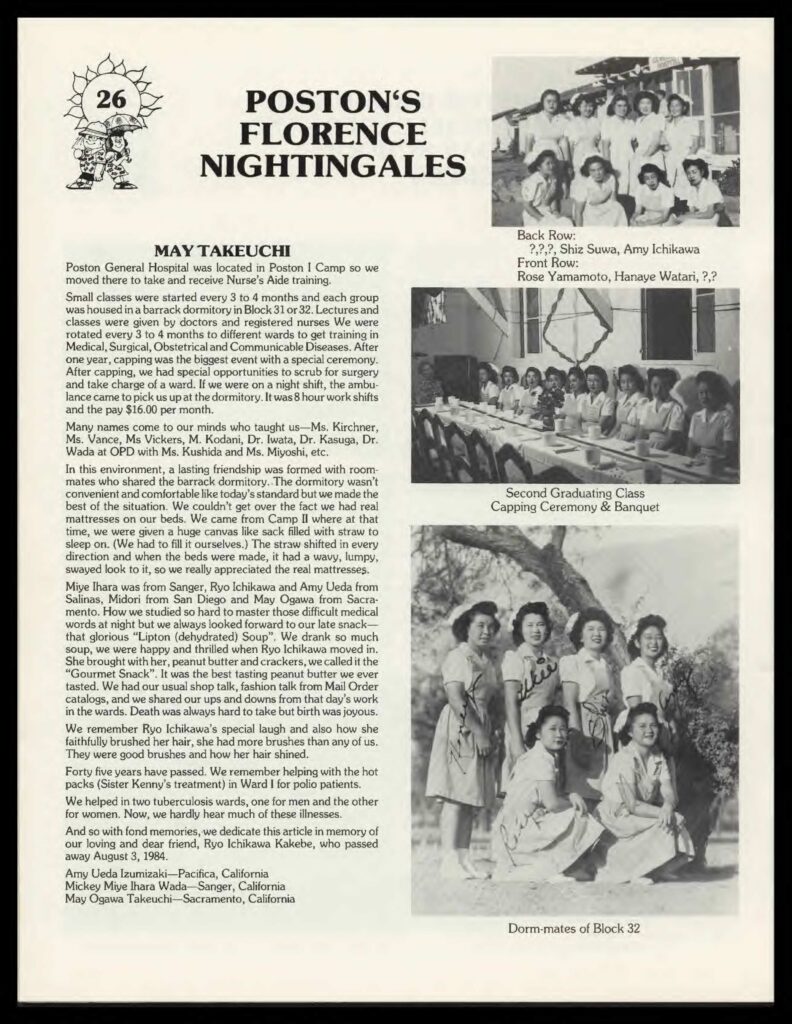
Transcript of “Poston’s Florence Nightingales” essay
Poston General Hospital was located in Poston I Camp so we moved there to take and receive Nurse’s Aide training.
Small classes were started every 3 to 4 months and each group was housed in a barrack dormitory in Block 31 or 32. Lectures and classes were given by doctors and registered nurses. We were rotated every 3 to 4 months to different wards to get training in Medical, Surgical, Obstetrical and Communicable Diseases. After on years, capping was the biggest event with a special ceremony. After capping, we had special opportunities to scrub for surgery and take charge of a ward. If we were on night shift, the ambulance came to pick us up at the dormitory. It was 8 hour work shifts and the pay $16.00 per month.
Many names come to our minds who taught us–Ms. Kirchner, Ms. Vance, Ms. Vickers, M. Kodani, Dr. Iwata, Dr. Kasuga, Dr. Wada and OPD with Mr. Kushida and Ms. Miyoshi, etc.
In this environment, a lasting friendship was formed with roommates who shared the barrack dormitory. The dormitory wasn’t convenient and comfortable like today’s standard but we made the best of the situation. We couldn’t get over the fact we had real mattresses on our beds. We came from Camp II where at that time, we were given a huge canvas like sack filled with straw to sleep on (We has to fill it ourselves.) The straw shifted in every direction and when the beds were made, it had a wavy, lumpy, swayed look to it, so we really appreciated the real mattresses.
Miye Ihara was from Sanger, Ryo Ichikawa and Amy Ueda from Salinas, Midori from San Diego and May Ogawa from Sacramento. How we studies so hard to master those difficult medical words at night but we always looked forwards to our late snack–that glorious “Lipton (dehydrated) Soup”. We drank so much soup, we were happy and thrilled when Ryo Ichikawa moved in. She brought with her, peanut butter and crackers, we called it the “Gourmet Snack”. It was the best tasting peanut butter we ever tasted. We had our usual shop talk, fashion talk from Mail Order catalogs, and we shared our ups and downs from that day’s work in the wards. Death was always hard to take but birth was joyous.
We remember Ryo Ichikawa’s special laugh and also how she faithfully brushed her hair, she had more brushes than any of us. They were good brushes and how her hair shined.
Forty five years have passed. We remember helping with the hot packs (Sister Kenny’s treatment) in Ward I for polio patients.
We helped in two tuberculosis wards, one for men and the other for women. Now, we hardly hear much of these illnesses.
And so with fond memories, we dedicate the srticle in memory of our loving and dear friend, Ryo Ichikawa Kakebe, who passed away August August 3, 1984.
Amy Ueda Izumizaki–Pacifica, California
Micky Miye Ihara Wada–Sanger, California
May Ogawa Takeuchi–Sacramento, California
The contributions of incarcerated healthcare workers were integral in making sure that no major public health disasters occurred in the wake of the WRA’s poorly-administered health care system. In the face of injustice, Japanese American doctors and nurses cared for their communities, putting up with long hours, inadequate pay, and supply shortages to protect the health of the over 110,000 Japanese Americans wrongfully incarcerated during the war.
DISCUSSION QUESTIONS:
- Why might Japanese American health care professionals have chosen to leave their jobs in the camps when they were permitted to? Why might they have chosen to stay?
- Which details are included in the newspaper clipping about Eugenia Takaki’s birth? Which do you notice to be left out? Why do you think these choices were made by the staff of the Topaz Times?
- How do the two sources created in the 1980s (Mabel Ota’s testimony and “Poston’s Florence Nightingales”) depict life in the camps from a distance? How do the stories they tell differ from each other? How do they differ from the sources created during the incarceration? Are there any similarities?
SECONDARY SOURCES:
Fiset, Louis. “Health Care at the Central Utah (Topaz) Relocation Center.” Journal of the West 38, no. 2 (1999): 34–44. EBSCOhost. This article was written by Louis Fiset, a dentist and historian who has spent the past three decades studying Japanese American wartime experience. The article focuses specifically on health care at the Topaz camp in Utah but provides a strong overview of the way health care systems functioned in the camps in general. It provides exact statistics and specific anecdotes that help the reader develop an accurate and informed understanding of the health care situation in these camps.
Jensen, Gwenn M. “System Failure: Health-Care Deficiencies in the World War II Japanese American Detention Centers.” Bulletin of the History of Medicine73, no. 4 (1999): 602-628. Written by medical anthropologist Gwenn M. Jensen, this article was born out of a comparative medical study of Japanese Americans who were incarcerated during the war and Japanese Americans who were not detained. It highlights the structural and climatic hazards posed by the American concentration camps and concludes that health care in the camps was mismanaged, arguing that Japanese American medical professionals were almost solely responsible for averting major public health problems. The article also showcases the inconsistencies in how medical statistics were reported in different camps. Jensen also used this research to write an article for the Discover Nikkei website titled “Dysentery, Dust, and Determination: Health Care in the World War II Japanese American Detention Camps” (2008) which I also used to create this exhibit.
McElroy, Sydnee, and Justin McElroy, hosts. “Medicine in Japanese American Concentration Camps.” Sawbones. June 21, 2019. Hosted by Dr. Sydnee McElroy and her husband, Justin, Sawbones is a podcast focused on the history of medicine. Aimed at a listener with minimal knowledge of the incarceration, this episode gives a general overview of medical care in the camps, drawing connections to the poor sanitary conditions in border detention camps. It draws on Louis Fiset’s work on healthcare in Topaz and provides additional information from sources that I have not been able to identify.
Nakayama, Don K., and Gwenn M. Jensen. “Professionalism behind Barbed Wire: Health Care in World War II Japanese-American Concentration Camps.” Journal of the National Medical Association 103, no. 4 (2011): 358–63. Written by Gwenn M. Jensen and surgeon Don K. Nakayama, this article gives an overview of both the health hazards created by Japanese American concentration camps and the health care systems put in place to combat them. It stresses the important role of Japanese American physicians in caring for incarcerees, acknowledging that they were often taken advantage of by their government but celebrating their life-saving work in the face of injustice.
POSSIBILITIES FOR FURTHER RESEARCH:
For more primary sources, you can explore:
- The Densho Digital Repository (digitized archival records relating to Japanese American incarceration)
For more stories about Japanese American healthcare workers, check out:
- Silent Scars of Healing Hands: oral histories of Japanese American doctors in World War II detention camps by Naomi Hirahara and Gwenn M. Jensen
- The Nurse of Manzanar by Samuel Nakamura (derived from a memoir manuscript by his mother, Toshiko Eto Nakamura)
NOTES:
- Executive Order 9066, February 19, 1942; General Records of the United States Government; Record Group 11; National Archives. https://www.archives.gov/milestone-documents/executive-order-9066. ↩︎
- Fiset, Louis. “Health Care at the Central Utah (Topaz) Relocation Center.” Journal of the West 38, no. 2 (1999). EBSCOhost, 39. ↩︎
- McElroy, Sydnee, and Justin McElroy, hosts. “Medicine in Japanese American Concentration Camps.” Sawbones. June 21, 2019. ↩︎
- Fiset, “Health Care at the Central Utah (Topaz) Relocation Center,” 34. ↩︎
- Ibid, 36. ↩︎
- Jensen, Gwenn M. “System Failure: Health-Care Deficiencies in the World War II Japanese American Detention Centers.” Bulletin of the History of Medicine 73, no. 4 (1999), 623 ↩︎
- Nakayama, Don K., and Gwenn M. Jensen. “Professionalism behind Barbed Wire: Health Care in World War II Japanese-American Concentration Camps.” Journal of the National Medical Association 103, no. 4 (2011), 360 ↩︎
- Jensen, “System Failure,” 611. ↩︎
- Ibid, 610. ↩︎
- Nakayama and Jensen, “Professionalism behind Barbed Wire,” 359. ↩︎
- Fiset, “Health Care at the Central Utah (Topaz) Relocation Center,” 34. ↩︎
- Nakayama and Jensen, “Professionalism behind Barbed Wire,” 360. ↩︎
- Jensen, “System Failure,” 608. ↩︎
- Horiuchi, Edna. “Eugenia “Jeanie” Kashima, First Topaz Baby.” Discover Nikkei, https://discovernikkei.org/en/journal/2023/6/6/first-topaz-baby/ ↩︎
- Nakayama and Jensen, “Professionalism behind Barbed Wire,” 359 ↩︎
- Jensen, Gwenn M. “Dysentery, dust, and determination: Health care in the World War II Japanese American detention camps. https://discovernikkei.org/en/journal/2008/6/21/enduring-communities/. ↩︎
- Moore, Brenda Lee. “Commissions in the Army Medical Corps.” Serving Our Country: Japanese American Women in the Military during World War II. Rutgers University Press, 2003. ↩︎
- Ota, Mabel Takaki. Testimony, Hearing of the Commission on Wartime Relocation and internment of Civilians, July 7, 1981 Courtesy of the Sasha Hohri Collection, Densho. https://ddr.densho.org/ddr-densho-352-361-mezzanine-877fbf200b/. ↩︎
- Jensen, “System Failure,” 624 ↩︎
- McElroy, “Medicine in Japanese American Concentration Camps.” ↩︎
- Fiset, Louis. “Medical care in camp,” Densho Encyclopedia https://encyclopedia.densho.org/Medical%20care%20in%20camp (accessed Feb 28 2026). ↩︎
- Jensen, “System Failure,” 623 ↩︎
- Fiset, “Health Care at the Central Utah (Topaz) Relocation Center,” 41 ↩︎
HEADER: Nurse Aiko Hamaguchi and patient Tom Kano with George Nakano, Keiko Kawahara, and an unidentified woman. Ansel Adams, 1943, black and white photograph, courtesy of the Library of Congress. https://ddr.densho.org/ddr-densho-93-3/