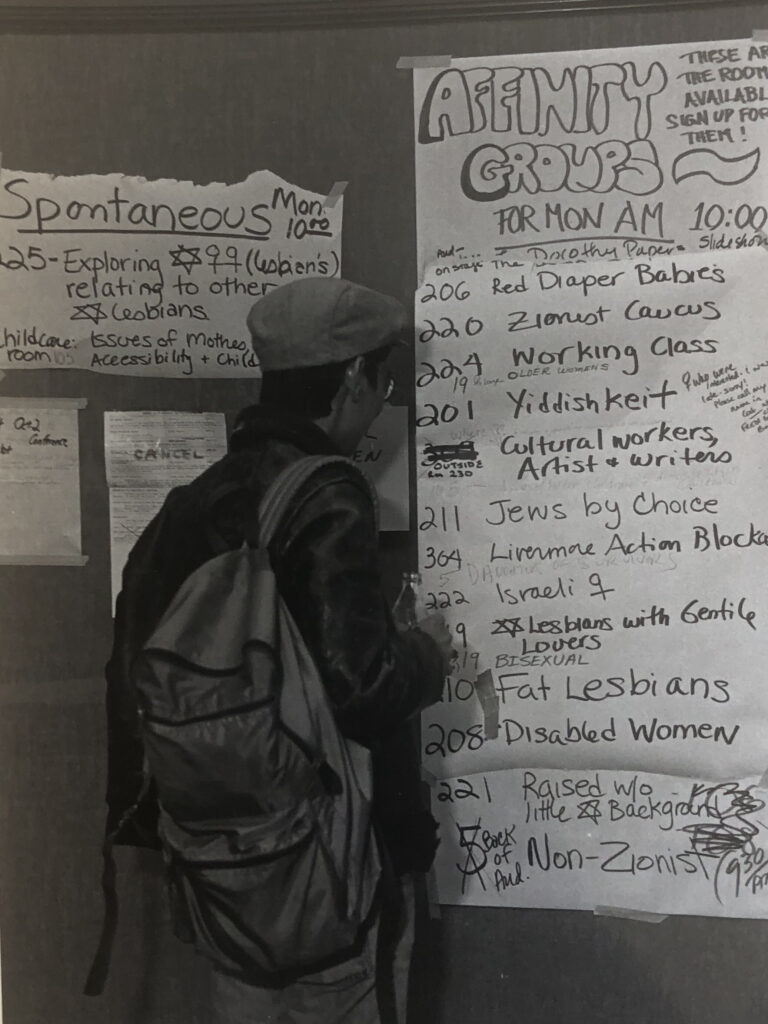
A conference attendee peruses a list of affinity groups posted at the 1982 Jewish Feminist Conference in San Francisco. Jewish Women, Joan E. Biren papers, Sophia Smith Collection.
Historical Overview
The first few years of the 1980s were marked by a convergence of right-wing political agendas in the U.S. and Israel. In the years since the beginning of Israeli occupation of the West Bank and Gaza in 1967, Israeli settler-colonialism was expanding, from the right-wing government’s support for Jewish settlement in occupied territories to the increasingly carceral repression of Palestinian resistance.1 As of the 1970s, the U.S. was funneling more money than ever into military aid to Israel. Under President Ronald Reagan, the U.S. itself was becoming “an increasingly repressive racialized warfare state”2 that, like Israel, framed Palestinian resistance to dispossession and occupation as a terroristic threat that demanded eradication.
During the summer of 1982, the Israeli military invaded Lebanon in a campaign targeting the Palestine Liberation Organization (PLO) and enabled the massacre of between 700 and 2,000 Palestinian and Lebanese civilians in the Sabra and Shatila refugee camps by an allied Christian Phalangist militia.3 These events demanded a response from U.S. feminists who opposed racist and patriarchal violence.
The growing Jewish feminist movement had no choice but to contend with this ideological and geopolitical landscape. Emerging out of the feminist discourse and praxis of identity politics — which was theorized in particular by U.S. women of color with an anti-imperialist, internationalist analysis — Jewish feminists were faced with the question of how to characterize their own identities and histories of oppression. The 1980s saw a proliferation of organizations and programs in pursuit of greater visibility and community-building for Jewish feminists, but the choices they made were not only inward-facing but witnessed and responded to by those with whom they shared a movement. Israel’s escalating militarism, settler expansion, and targeting of Palestinian nationalism were the backdrop for Jewish lesbian feminists’ approaches to issues of Zionism, antisemitism, and Jewish identity.
Key Terms
Before you encounter the primary sources and interpretations in the following sections, see the table below for definitions of terms that feature repeatedly in this story. Please note that these terms may be defined differently by other people or in other contexts.
Term
Definition
Zionism
A modern nationalist ideology supporting the creation and continued existence of Israel as a Jewish state.
The occupation
Israel’s occupation of the Palestinian territories, including East Jerusalem, the West Bank, and the Gaza Strip, since 1967. Considered illegal by the International Court of Justice (2024).
Bridges
A journal showcasing the creative work of Jewish feminists, published twice a year between 1990 and 2011.
Self-Expression
One sunny day in June of 1982, Melanie Kaye/Kantrowitz was walking down a New York street in a t-shirt she’d gotten at a Jewish women’s conference a couple of years before. “Jewish Women Warriors Unite!” the shirt read. “Suddenly,” Kaye/Kantrowitz recalls, “it hit me what it could look like I was saying with this t-shirt. Israel had just invaded Lebanon.” She ducked into an alley and turned her t-shirt inside out…4
Melanie Kaye/Kantrowitz’s anecdote is retold here by Alisa Solomon in an article in the Jewish feminist journal Bridges. This brief narrative speaks to the cognizance of Jewish feminists that their self-expression did not exist in a vacuum. Rather, it interacted in complex ways with geopolitical events that forced a reckoning with their own, as well as non-Jews’, perception of Jewish identity and politics. Israel’s invasion of Lebanon in June 1982 is one pertinent example. As much as Jewish feminists emphasized the freedom to define themselves, the legibility of these self-definitions was constricted by forces outside of their control.
Zionist and anti-Zionist aesthetic expression also appears in the photographs Joan E. Biren (JEB) took to document the Jewish lesbian feminist milieu. See the image slider below to compare the symbolic and textual messages presented in two of these photographs.
Photos from Jewish Women, Joan E. Biren papers, Sophia Smith Collection.
The photograph on the right features a poster with the following text:
Being Jewish is not the same as being Zionist! Our own history of persecution as Jews helps us understand and support the struggle of Palestinians to determine their own destiny.
Anti-Zionist poster photograph, Jewish Women, Joan E. Biren papers, Sophia Smith Collection.
The sweatshirt worn by the subject of the photograph on the right5, on the other hand, embraces the Zionist identity. Unlike the poster and Kaye/Kantrowitz’s rejection of the symbolic linkage between her Jewish feminist identity and the State of Israel, this person has embraced the connection between their lesbian feminist and Zionist identities.
Discussion Questions
For Zionist Jewish lesbians, what might the points of connection be between these identities? What similarities (or dissonances) might there be between (lesbian) feminism and Zionism?
Which symbols today have become charged as a result of recent geopolitical events, including, perhaps, the actions of Israel?
How do you see people around you negotiating the aesthetic expression of their identities in light of this?
Cultural Activism
Bridges served as a container for Jewish feminist responses to the Israel’s occupation of Palestine in several ways, from advertising books about Jewish women’s approaches to the issue to reporting on a delegation of American Jewish women who worked on the Break the Silence mural project in Ramallah in 1989.6Bridges also highlighted artistic work that dealt with this topic. Check out Margo Hittleman’s poem “Words,” published in the second issue of Bridges, below.7
… this is not the first occupation, it may not even be the worst occupation, but it is the current occupation and the time for liberation has come8
page 61
In this poem, Hittleman uses midrash9 to imagine an alternative to an antagonistic relationship between Jews and Arabs interpreted by some to originate in the Biblical story of Hagar and Ishmael. In the second section of the poem, montage-like lists recall episodes of persecution in Jewish history — the Nazi genocide, pogroms, and expulsion. Later in the poem, the speaker learns of a parallel litany of acts of violence committed by Jews against Palestinians under the Israeli occupation. Her understanding that “the time for liberation has come” for Palestinians is decried by the voices at home dehumanizing them, but she ultimately resolves to heed the multilingual call of “enough.”
Discussion Questions
Which parts of this poem remind you of things you have learned or been told in the last 5-10 years?
Which lines remain true after 36 years, and which no longer speak to the situation in Palestine?
If you were to update “Words” for 2026, what changes would you make?
Notes
Keith P. Feldman, “Moving toward Home: Women of Color Feminisms and the Lebanon Conjuncture,” in A Shadow over Palestine: The Imperial Life of Race in America (University of Minnesota Press, 2015), 188. http://www.jstor.org/stable/10.5749/j.ctt14jxvz2.9. ↩︎
Solomon, Alisa. “Building a Movement: Jewish Feminists Speak out on Israel.” Bridges 1, no. 1 (1990): 41–56. http://www.jstor.org/stable/40357405. ↩︎
“Amazion” photograph, Jewish Women, Joan E. Biren papers, Sophia Smith Collection, SSC-MS-00587, Smith College Special Collections, Northampton, Massachusetts. ↩︎
Miranda Bergman, Dina Redman, Susan Greene, and Marlene Tobias, “Painting for Peace: Break the Silence Mural Project,” Bridges 1, no. 2 (1990): 39–57. http://www.jstor.org/stable/40358476. ↩︎
This article delivers an incisive critique of the identity politics and inward-facing “culturalism” of 1980s Jewish feminism from an anti-Zionist perspective. Bourne exposes what she sees as the non-Zionist Zionism of Jewish feminists who sidestep the issue of Israel by emphasizing diasporic identity and antisemitism in the women’s movement. This article is helpful in surfacing a critical response to the political and cultural phenomena that came out of Jewish feminism during this period.
Feldman, Keith P. “Moving toward Home: Women of Color Feminisms and the Lebanon Conjuncture.” In A Shadow over Palestine: The Imperial Life of Race in America, 185–220. University of Minnesota Press, 2015. http://www.jstor.org/stable/10.5749/j.ctt14jxvz2.9.
This article looks at the environment surrounding Jewish feminist discourses in the early 1980s by focusing on Israel’s invasion of Lebanon as a turning point in anti-imperialist solidarity with Palestine. Feldman’s analysis of Black and Arab-American feminisms that were in conflict with certain strands of Jewish feminism highlights an essential piece of this story. The relationship between radical women of color feminisms and Jewish lesbian feminism is key to understanding both the emergence of and splits associated with Jewish feminism.
Lober, Brooke. “Narrow Bridges: Jewish Lesbian Feminism, Identity Politics, and the ‘Hard Ground’ of Alliance.” Journal of Lesbian Studies 23, no. 1 (2019): 83–101. https://doi.org/10.1080/10894160.2018.1501537.
This article looks at the contradictions and splits in political action informed by Jewish feminist identity politics, particularly around Zionism and the state of Israel. Lober discusses this topic in relation to women of color feminisms active coterminously and discusses individuals and organizations. She makes the case for the relevance of this topic by framing it around the 2017 Chicago Dyke March controversy, which can help us think about how and why it is relevant almost a decade later.