By Maya Joncas
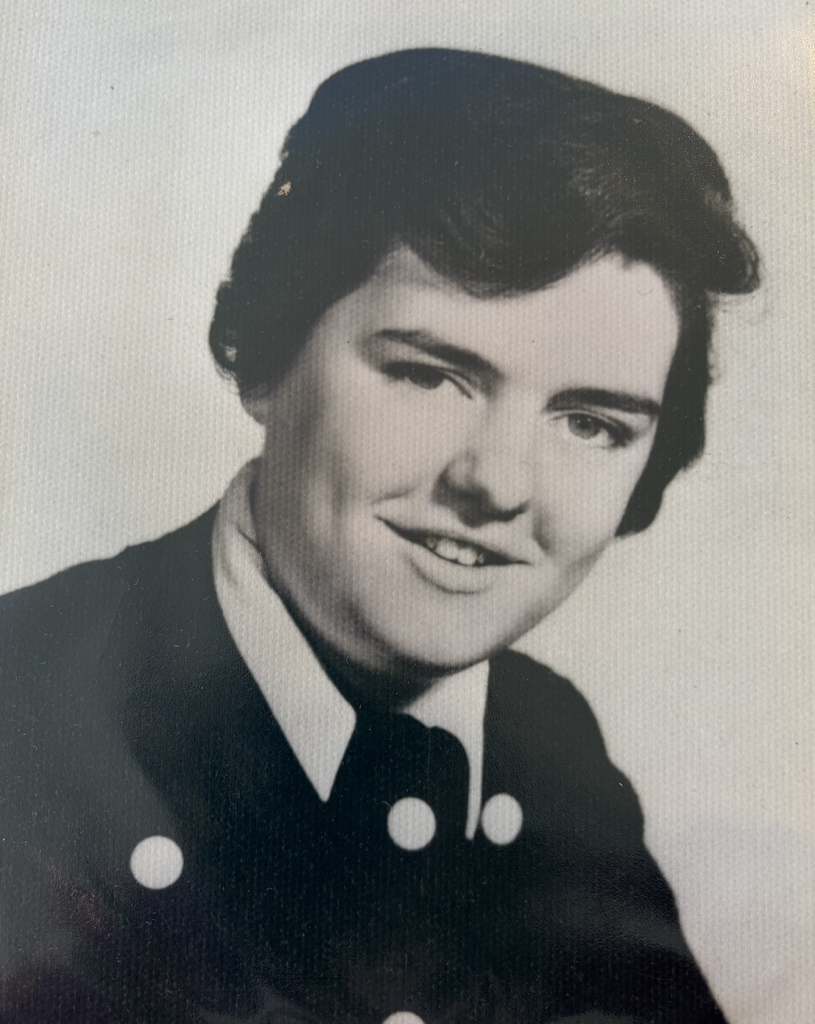
In 1985, Rosemary Keefe Curb and Nancy Manahan published their groundbreaking and sensational book, Lesbian Nuns: Breaking Silence. Curb and Manahan were both former nuns themselves, Curb a Dominican sister for seven years, and Nancy spent a year in a Maryknowll convent. 1Though the book was originally aimed at lesbian and feminist audiences, its controversial subject matter attracted wider audiences. The over fifty stories of lesbian nuns coming out, leaving the convent, and engaging in complicated relationships revealed a new side of both the lesbian and Catholic communities. Still, the volume did not and could not include the story of every lesbian nun. Kathleen O’Shea chose to remove her own story from the volume, filing it away into the archive. She would ultimately publish her story in her book Women on the Row: Revelations from Both Sides of the Bars (2000). Hers is a story of devotion to her Catholic values and embracing her lesbian identity, with moments of joy, struggle, and controversy.
Childhood and the Call to the Convent
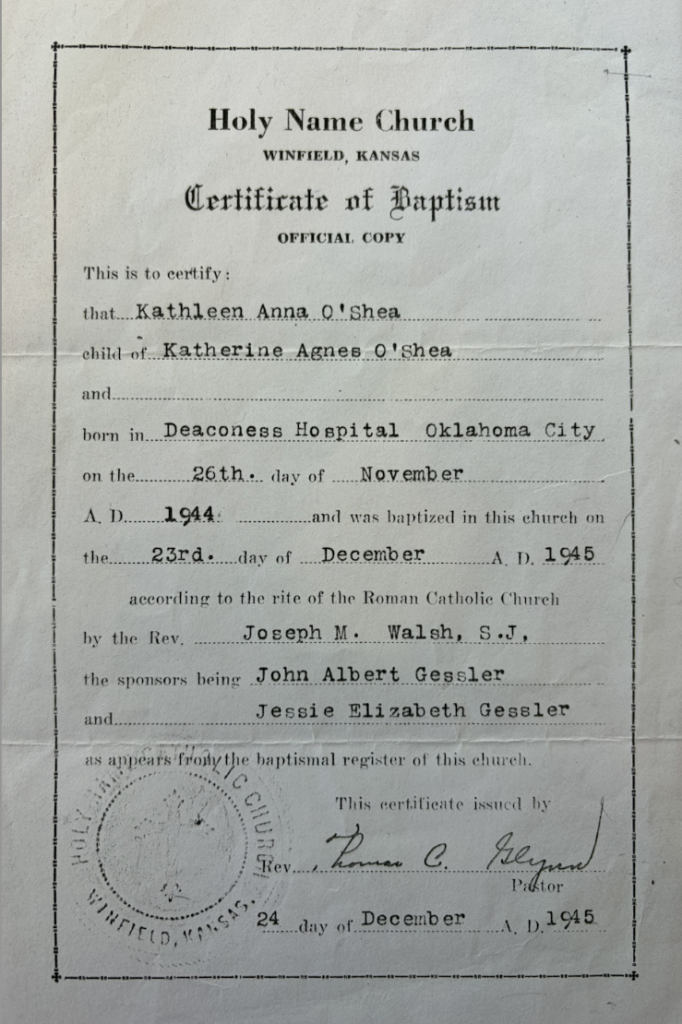
Kathleen O’Shea was born in Oklahoma City, Oklahoma, on the 26th of November, 1944. On October 25th, 1946, Kathleen was adopted by Sarah Alida Conde O’Shea and James O’Shea in Salina, Kansas as an infant. From birth, Christianity played a large role in Kathleen’s life. She was born and adopted through Deaconess Hospital of Oklahoma city, an organization of Free Methodist evangelist women who ministered to young and unwed mothers. Kathleen’s birth mother, according to her birth and baptism certificates, was her adoptive father’s unwed niece, Katherine Agnes O’Shea. Kathleen’s relationship with her birth-mother is seldom in her papers.2
Kathleen grew up with devout parents, went to Catholic school, and knew by the eighth grade that her calling was to be a nun. She attended school at the Nazarene Convent and Academy in Concordia, Kansas, which housed the Sisters of St. Joseph.3 In her senior year, she transferred to St. Joseph’s Villa in Peapack, New Jersey, where she began her postulancy, the initial stages of joining the order. She started her novitiate, the period of training before becoming a nun, in 1963 at age 18 and officially took her vows in 1964. For the next 30 years, she lived as Sister Mary Fidelis.4
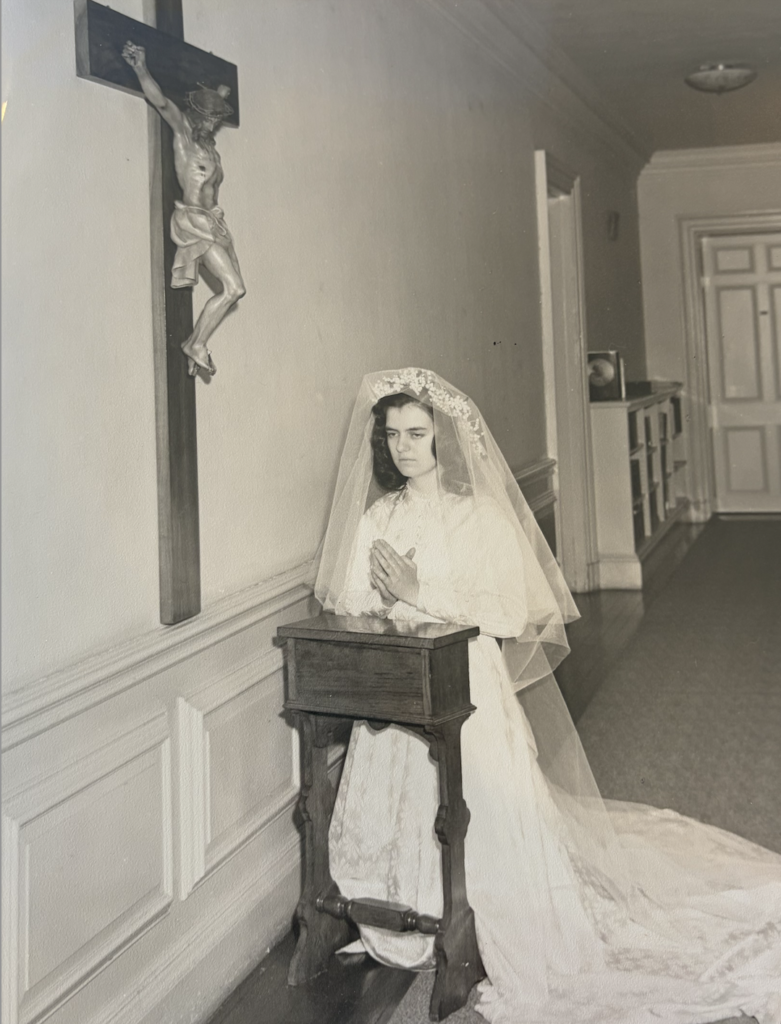
Early in her life as a nun, Kathleen went to Chile, where she taught the sixth grade in her congregation’s school. She spent the next eight years teaching, and was forced to return to the States in 1973 due to a military coup. Disillusioned with the conservative nature of the American church, Kathleen looked for a more progressive order upon returning to the States. Though changing orders was unusual among nuns, Kathleen felt she was at a standstill with her community and yearned for more grassroots involvement. She ended up changing orders, despite outside opinions, and soon experienced unimaginable hardship. She soon would come to terms with her sexuality, changing her relationship with the church forever.5
A Controversial Coming Out
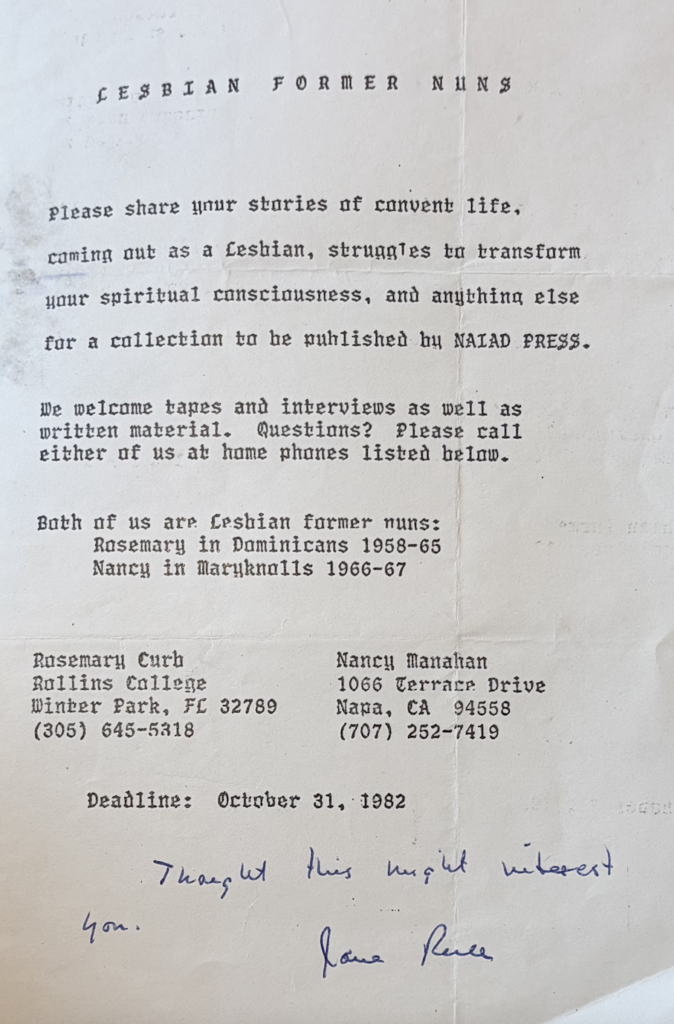
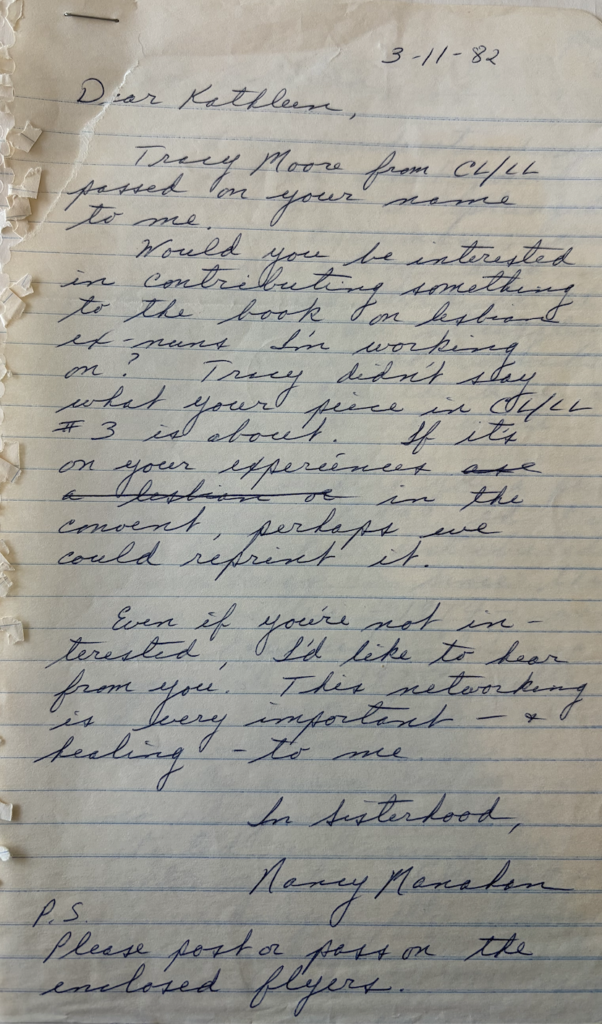
By 1982, Kathleen was becoming more involved in the lesbian community. Though she wouldn’t completely abandon her title as Sister until the early 1990s, she began attending lesbian lesbian writers conferences, befriending other lesbians, and seemingly having romantic and sexual relationships with women.6 In March of 1982, Nancy Manahan, one of the future editors of Lesbian Nuns, wrote to Kathleen, hoping she would share her story of coming to the convent. Tracy Moore, Jewish lesbian activist and founder of quarterly journal Common Lives/Lesbian Lives, had passed Kathleen’s name along as a possible contributor.7
The story proved difficult for Kathleen to write and would remain unpublished for decades due to the controversial nature of its contents. After returning from Chile in 1973, Kathleen worked at various schools across the United States. In 1977, at the age of thirty three, she began a relationship with a sixteen year old student referred to as Patti in her essay entitled, “No Where Left to Hide.” Kathleen paints Patti as a student different from the others, dedicated to her school work, devoted to God, and a talented athlete. The essay also subtly revealed that Patti lived in an unstable home, with her sisters on drugs and her mom never home. Kathleen says the relationship started after Patti left a blue sweatshirt with her basketball jersey number under her desk, along with a note saying, “To the sunshine of my life.” Kathleen’s part in initiating the relationship is not truly acknowledged in the essay. Her archive remains a space where Patti’s story is silenced as her feelings about the relationship unknown to readers. When modern readers engage in a complex archive, it is important to acknowledge what these sources may be leaving out, and what power imbalances may be at play.8
Patti’s mother ultimately discovered their relationship through letters Kathleen had written to Patti. She invited Kathleen over to their house, demanded that she resign and if she refused, the District Attorney would charge her with a felony. When Kathleen arrived at the Principal’s office the next morning, her resignation papers were already there. Patti’s mother and aunt were sitting in the office as well. “You look just like all those homos,” Patti’s aunt told Kathleen.9
That day, Kathleen’s superior told her to move out of the convent. She had no money, no place to stay, and didn’t fully understand what was happening. For the next three months she would stay in Michigan with a friend and her husband. She continued contact with Patti, despite her mother and the Church’s wishes. When she traveled home for Easter, she stopped in Patti’s hometown, which only worsened the situation. A warrant was issued for Kathleen’s arrest. “I couldn’t imagine a nun going to jail, much less imagine that nun would be me,” she wrote in her essay. While hiding in a motel, she was found and escorted to the bus stop by the sheriff, the principal and a priest from the high school she worked at. Her contact with Patti ceased after that, but the event would continue to impact her ability to work. 10
Troubles in Publishing
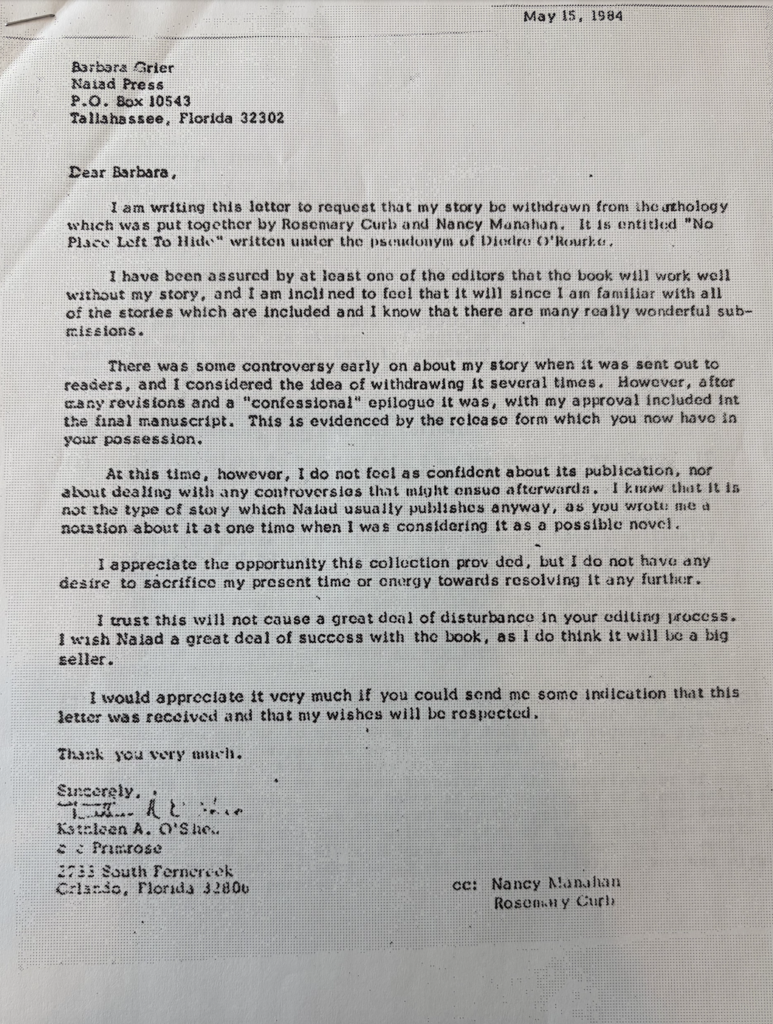
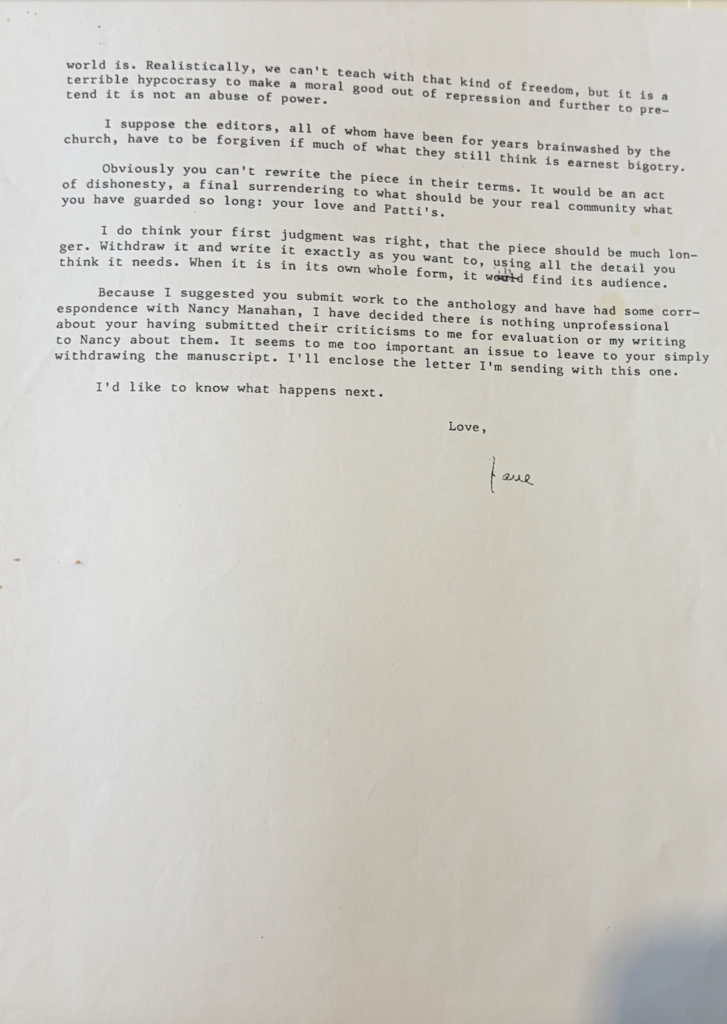
Kathleen’s story was met with mixed reactions by editors and publishers. While Nancy Manahan appreciated Kathleen’s story of life in the convent, she allegedly initially responded negatively to her coming-out story. Though Manahan’s response to the manuscript is not included in the archive, Jane Rule, a lesbian author who would also put Kathleen in touch with the editors of Lesbian Nuns, mentioned Manahan’s critiques in a letter to Kathleen. Rule was outraged at the negative response to her story. She herself had her first sexual encounter with a teacher at just 15. When talking of the trauma the teacher underwent from the relationship, Rule writes, “She’s obviously imposed on herself the quilt the world tried to impose on [Kathleen].” She believed editors’ responses to the essay were rooted in homophobia rather than an actual concern for Patti or a belief that the situation caused her damage.11
Barbara Grier, publisher for Naiad Press which originally published Lesbian Nuns, immediately had a negative reaction to Kathleen’s story when it was sent in for editing. When she wrote in March of 1983, she admitted that intuitively she didn’t read the whole story. “I read a couple of pages and realized it was going to be “lesbian as fiction” and I do not believe in it as a viable philosophy,” she wrote. Beyond her “initial repugnance,” Grier found the story to be well written with “breathtaking skill.”12
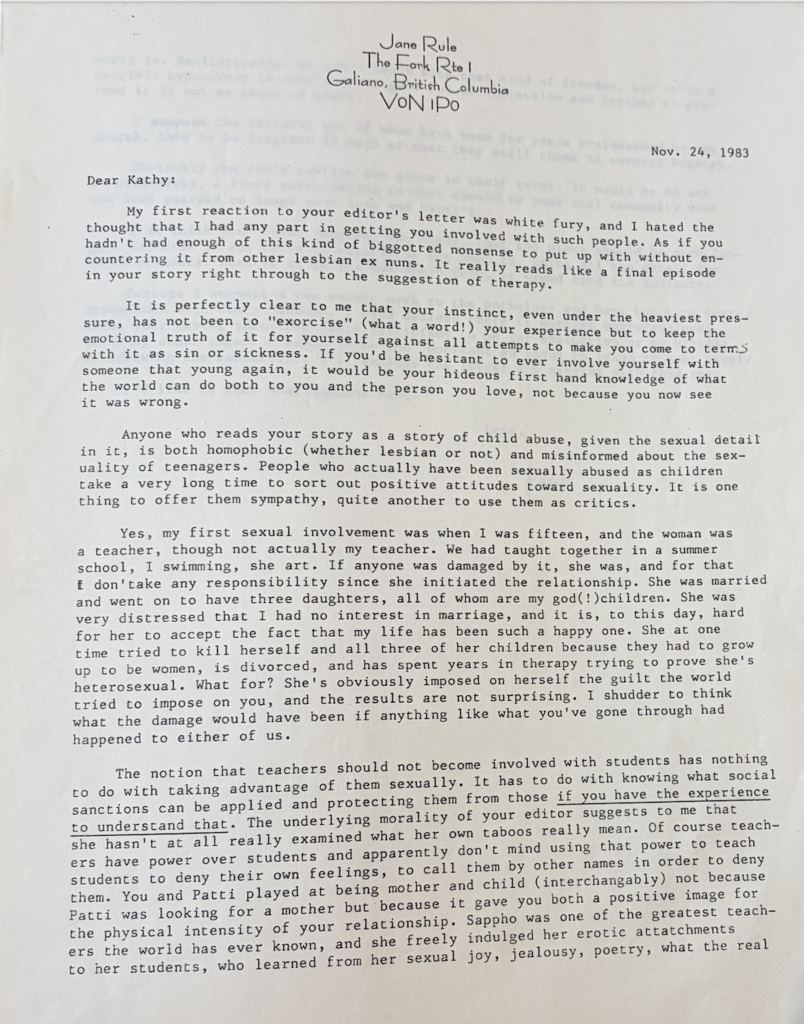
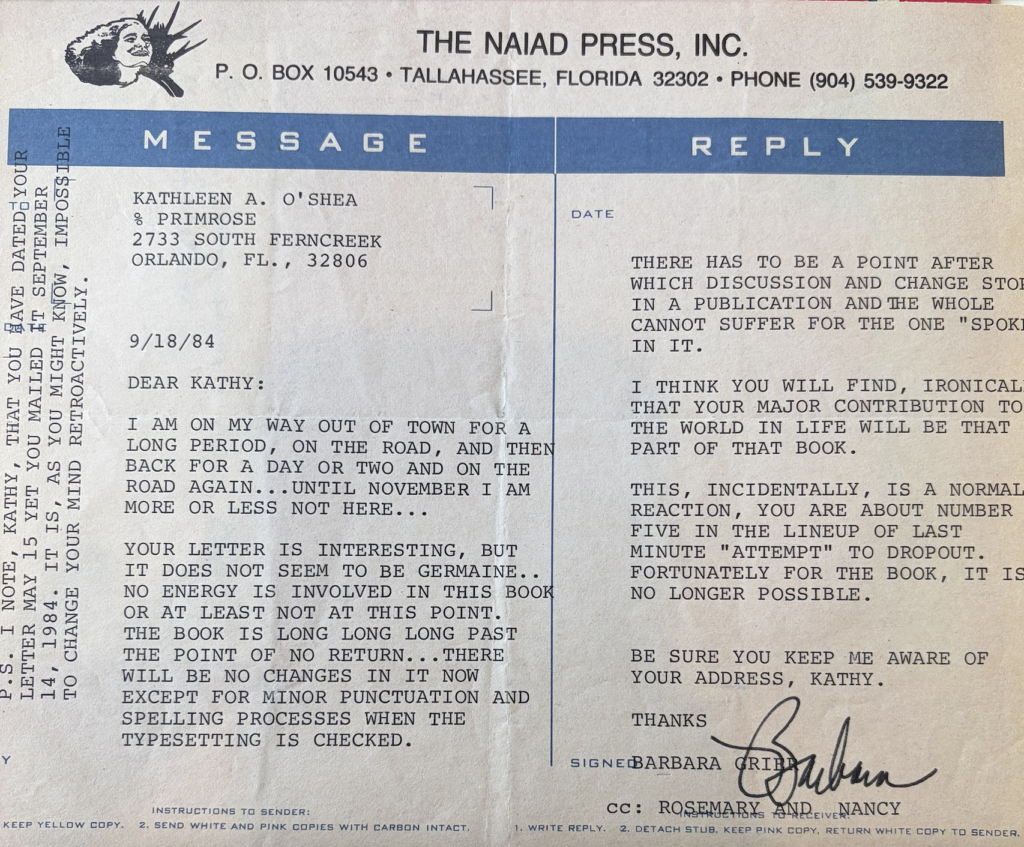
A year later in May of 1984, Kathleen wrote to Grier requesting that her story be removed from the final volume. Though she wrote the story under the pseudonym Diedre O’Rourke and received praise from most of her editors, the thought of any controversy about the book scared Kathleen. Her wishes, however, were met with resistance by Grier. In a letter from September of 1984, Grier wrote that the book was “long long long past the point of no return,” and no story would be removed at this point. Kathleen, it seems, was not the only contributor having second thoughts. “You are about number five in the lineup of last minute ‘attempt’ to dropout,” she wrote. “Fortunately for the book, it is no longer possible.”13
Despite the publisher’s wishes, Kathleen was determined to have her story remain private. She wrote Grier back just days later, threatening legal action if her story was not removed. “Unfortunately, for you, I stand to lose much more than you stand to gain from the publication of this story, although, I realize our value systems obviously differ greatly on this point,” Kathleen wrote. The story was ultimately removed from the volume, but was published over a decade later on Kathleen’s terms in 2000.14 While Lesbian Nuns grew into a classic, Kathleen’s story faded into obscurity, a part of the book’s history that remains largely unknown.
Discussion Questions
- Barbara Grier described Kathleen’s story as “lesbian fiction.” What do you think she meant by this? How do you think Kathleen’s story fit into and resisted stereotypes of lesbian nuns?
- Why do you think Kathleen continued to call herself a nun even after coming out as a lesbian?
- What do you make of Jane Rule’s response to Kathleen’s story? How does it complicate Kathleen’s story and the responses of the editors?
- If Kathleen’s story had been published in Lesbian Nuns, do you think it would have changed its reception? If so, how?
For Further Research:
- Kathleen O’Shea and Sarah Alida Conde O’Shea papers, Smith College Special Collections, Smith College Libraries.
- Rosemary Keefe Papers, Smith College Special Collections, Smith College Libraries.
- Nancy Manahan, Jean-Nickolaus Tretter Collection in Gay, Lesbian, Bisexual and Transgender Studies, University of Minnesota Libraries, Minneapolis.
- Lesbian Nuns: Breaking Silence by Rosemary Keefe and Nancy Manahan
Secondary Sources
Gramick, Jeannine. “Lesbian Nuns: A Gift to the Church.” In More Than a Monologue: Sexual Diversity and the Catholic Church, edited by J. Patrick Hornback II and Michael E. Norko, Vol. 2. Fordham University Press, 2014.
This chapter shows lesbian nuns’ fight for visibility in the latter half of the 20th century. As women in the church and a sexual minority, lesbian nuns often struggled to have their voices and concerns heard. Gramick explores the bonds they build, the humility they hold, and their relationship to the church.
Larrimore, Mark, Michael F. Pettinger, and Kathleen T. Talinger, eds. Queer Christianities: Lived Religion in Transgressive Forms. New York University Press, 2015.
This book exemplifies the communities that queer Christians have long worked to create, despite animosity from their communities. Though sexuality and religion have often been described as opposites, Queer Christianities show how LGBTQ+ church members have lived out their faith and shifted their practices to fit their sexual orientation. The section on celibacy is especially of interest to Kathleen and other lesbian nuns’ stories.
Houghton, Marie, and Fiona Tasker. “Exploring Lesbian and Bisexual Catholic Women’s Narratives of Religious and Sexual Identity Formation and Integration.” Journal of Homosexuality 68, no. 1 (2021): 47-69.
While the majority of scholarship on queerness in Christianity has focused on gay men and the Protestant church, Houghton’s article focuses specifically on queer women in the Catholic church and the particularities of their experiences. Growing up in a tradition that demonizes queerness and places women in subjugated roles, Catholicism creates a unique upbringing for lesbians in the church. This article uses qualitative research and personal narratives to assess the experiences of queer women in the church.
Bibliography
- Nancy Manahan and Rosemary Keefe interview with Barbara Evans, 15 June, 1982, Box 1, Rosemary Keefe papers, Smith College Special Collections, Smith College Libraries. ↩︎
- “Adoption Order,” October 25th, 1946, Box 1, Kathleen O’Shea and Sarah Alida Conde O’Shea papers, Smith College Special Collections, Smith College Libraries. ↩︎
- Scrapbook, 1957, Box 1, Kathleen O’Shea and Sarah Alida Conde O’Shea papers, Smith College Special Collections, Smith College Libraries. ↩︎
- Scrapbook, 1963, Box 1, Kathleen O’Shea and Sarah Alida Conde O’Shea papers, Smith College Special Collections, Smith College Libraries. ↩︎
- Kathleen O’Shea Coming Out Narrative, Box 2, Kathleen O’Shea and Sarah Alida Conde O’Shea papers, Smith College Special Collections, Smith College Libraries. ↩︎
- League of Lesbian Writers Flyer, 1984, Box 8, Kathleen O’Shea and Sarah Alida Conde O’Shea papers, Smith College Special Collections, Smith College Libraries. ↩︎
- Nancy Manahan to Kathleen O’Shea, 11 March, 1982, Box 2, Kathleen O’Shea and Sarah Alida Conde O’Shea papers, Smith College Special Collections, Smith College Libraries. ↩︎
- Kathleen O’Shea Coming Out Narrative, Box 2, Kathleen O’Shea and Sarah Alida Conde O’Shea papers, Smith College Special Collections, Smith College Libraries. ↩︎
- Ibid. ↩︎
- Ibid. ↩︎
- Jane Rule to Kathleen O’Shea, 24 November, 1983, Box 2, Kathleen O’Shea and Sarah Alida Conde O’Shea papers, Smith College Special Collections, Smith College Libraries. ↩︎
- Barbara Grier to Kathleen O’Shea, 31 March, 1983, Box 2, Kathleen O’Shea and Sarah Alida Conde O’Shea papers, Smith College Special Collections, Smith College Libraries. ↩︎
- Barbara Grier to Kathleen O’Shea, 18 September, 1984, Kathleen O’Shea and Sarah Alida Conde O’Shea papers, Smith College Special Collections, Smith College Libraries. ↩︎
- Kathleen O’Shea to Barbara Grier, 23 September, 1984, Kathleen O’Shea and Sarah Alida Conde O’Shea papers, Smith College Special Collections, Smith College Libraries. ↩︎