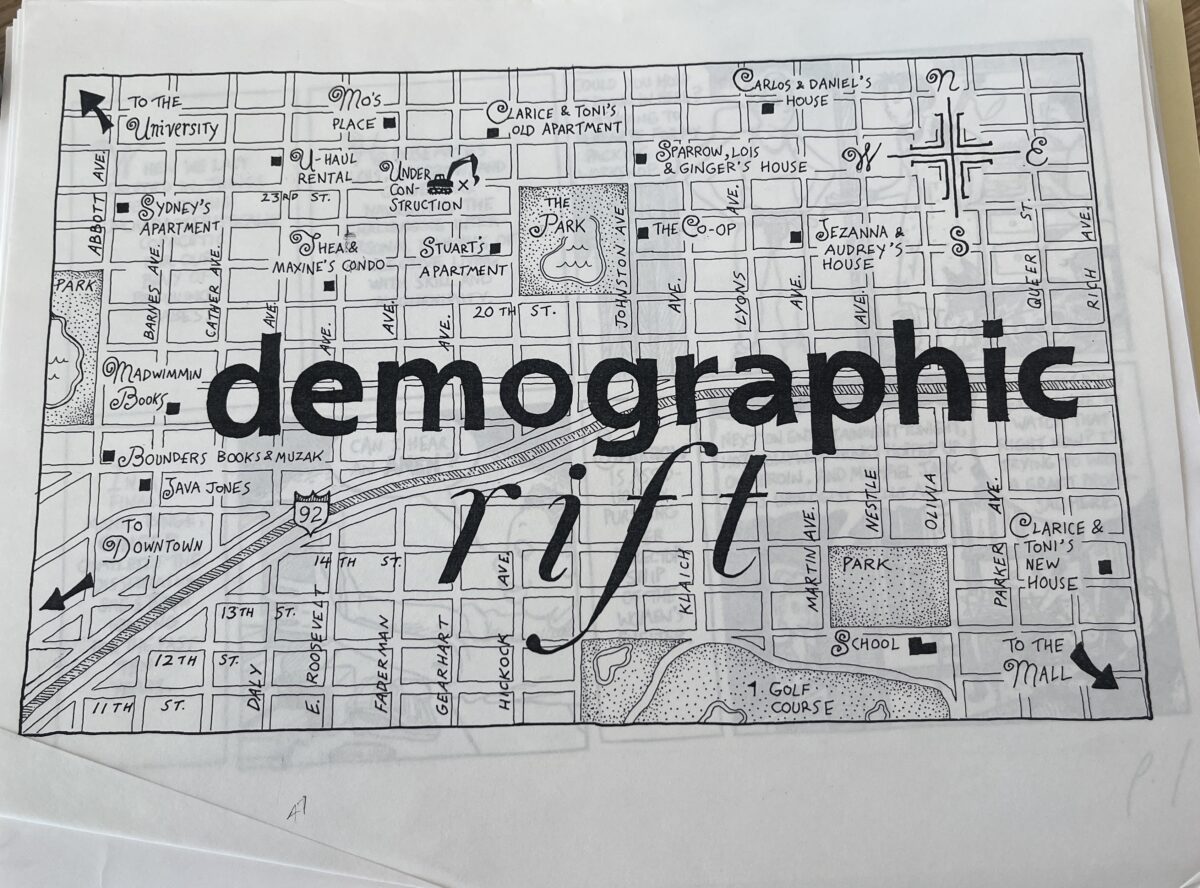
In her 1983-2008 comic series, Dykes to Watch Out For (DtWOF), cartoonist Alison Bechdel develops a realistic lesbian community whose interpersonal struggles and reactions to important events form the plot of her serials turned novels.1
While the strips center on Mo, an anxious lesbian with strong political beliefs, the storyline features several interconnected groups of friends, lovers, and coworkers from all around a fictional city.2 Through these characters, Bechdel illuminates the tension of living as a proud queer person in a world designed to facilitate capitalistic, cisgender, and heteronormative relations.
One interesting dynamic that mirrors the living situation of many young LGBTQ friend groups is the communal home shared by Ginger, Lois, and Sparrow. While the three women care deeply about each other, their conflicting personalities and living in cramped conditions inevitably leads to conflict. Despite these frictions, the group decides to remain together, even purchasing the house and allowing Sparrow’s partner to move in with them.3 Their persistence demonstrates how the benefits of group living outweigh the negatives, especially when your roommates operate as your support system and social circle. This begs the question, is there a way to design residential spaces to be optimal for communal and co-operative living? How would these designs reshape how we construct our notions of home and family?
Bechdel’s strips find humor in the dynamics between housemates and the conflicts that arise from living in close proximity. This particular strip, re-introducing some of the house residents, highlights the problems created by the spatial layout of the home. Since there are only two bathrooms in the house, Ginger and Lois’ new partner, Malika, have to invade Sparrow’s (and each others’) privacy in order to complete their daily routines.
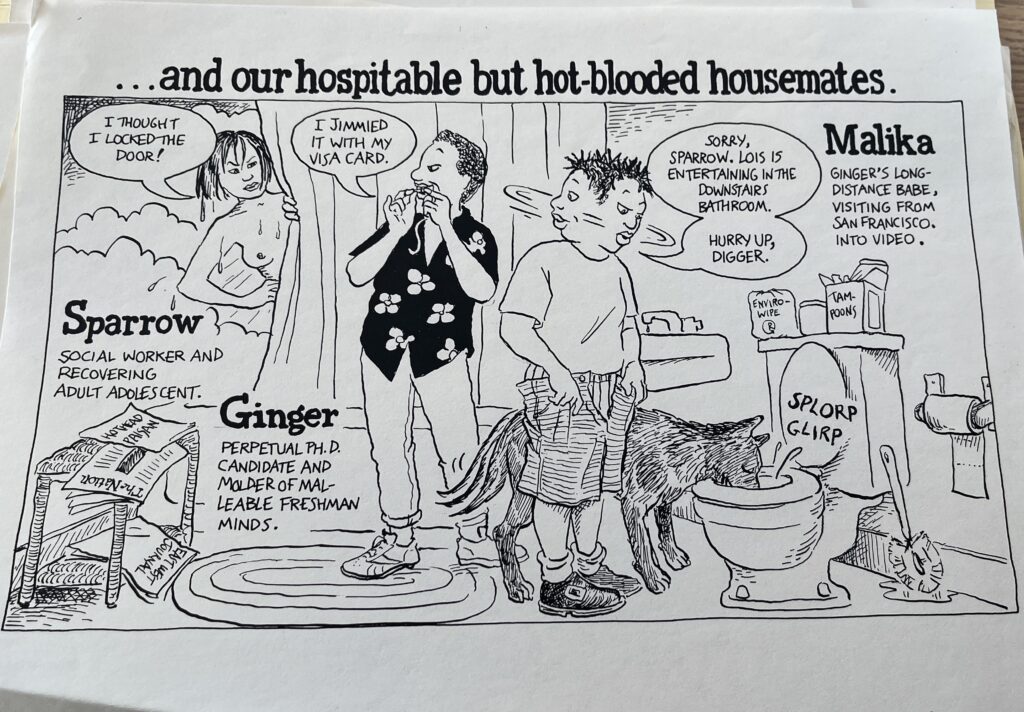
How could Sparrow, Ginger, and Lois’ house be redesigned to accommodate their needs as a group of friends living together? Is there a way to make the space more adaptable as their partners come in and out of the picture?
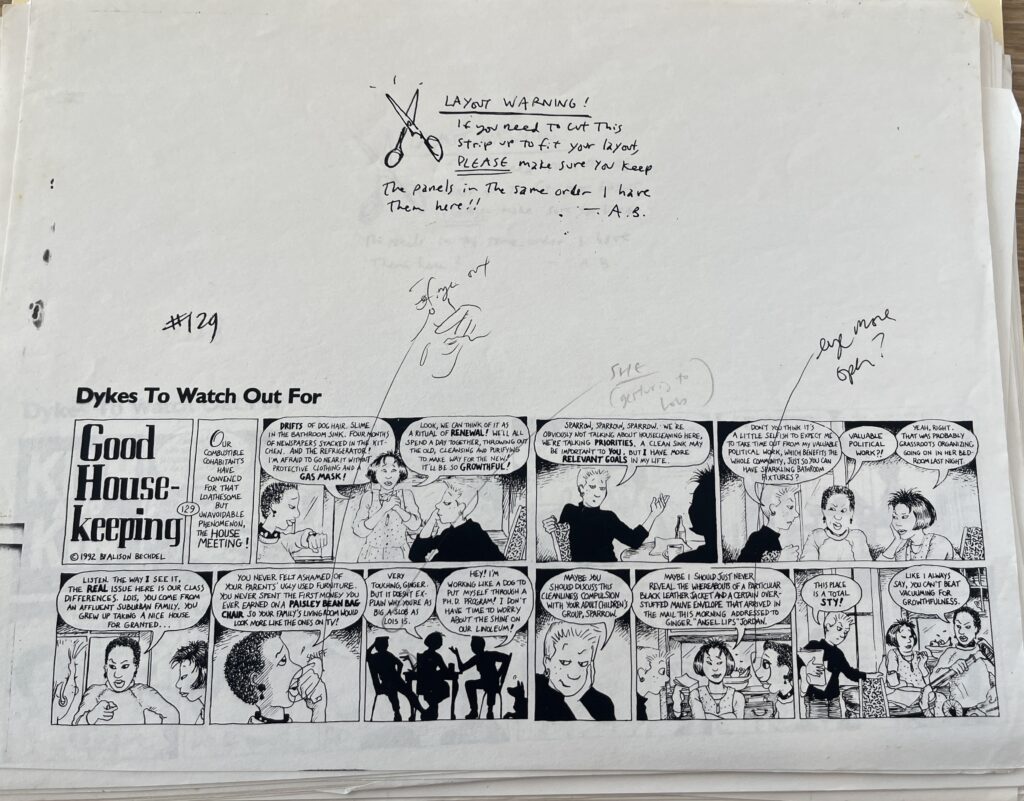
The 129th strip of DtWOF, “Good Housekeeping” focuses on domestic disputes that arose for the three roommates. Sparrow specifically is annoyed by Ginger and Lois’ messiness which affects their shared living spaces and relationships. While the joke is that Sparrow uses her intimate knowledge of her roommates to manipulate them into cleaning, the comic provides insight into how the built space impedes the residents’ ability to live according to their needs without conflict.
Feminist architects have been thinking about these questions since the 1970s. Radical groups, such as Matrix in 1980s Britain and the Women’s School of Architecture and Planning, have interrogated how our built environments have reinforced gendered social roles.4
The experiences of the characters in Dykes to Watch Out For serve as the basis for exploring how architecture and urban design can serve as liberatory tools against patriarchal and heteronormative family structures and gender roles.
Based on the archival drawings from the Phyllis Birkby papers within the Sophia Smith Collection, participants in the “Women and the Built Environment” workshops had been thinking about what communal living spaces could look like and how they would function.5 A large number of the saved drawings feature separated areas for housework, hosting, and resting.
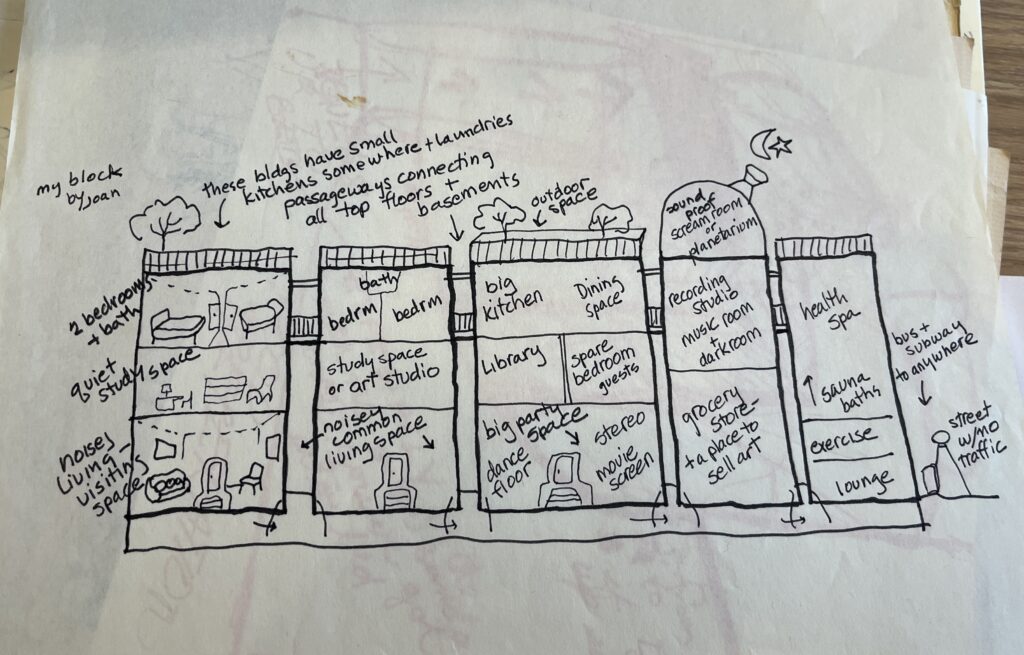
This particular drawing is interesting as it utilizes traditional building structures, such as apartment buildings that would be seen in any American city, and changes their layout. Rather than operate like many luxury complexes, the artist divided the communal and private spaces into separate properties, having this particular set-up span nearly a block. While it occupies a large amount of land, the complex serves every need and want that a resident could have from flexible social spaces to laundry units to a grocery store.
How would residing in a home like this improve the lives of Ginger, Lois, and Sparrow? Would buildings like these replace neighborhoods and change our ideas of community?
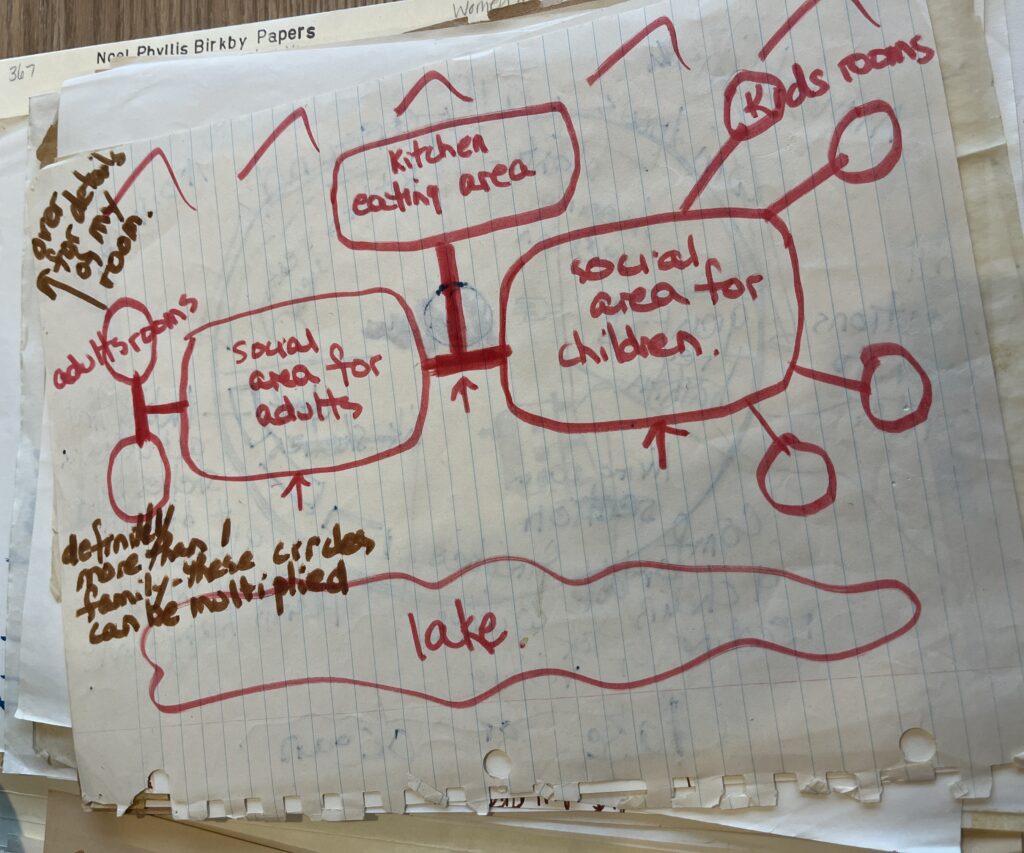
Even though this drawing has less detail, it is curious how the artist significantly silos each area. For this artist, the home functions as a web, connecting bedrooms to a communal eating area to a kids’ area. How would this change relationships to domestic labor such as cooking and childcare?
Using the lives and relationships explored in Bechdel’s Dykes to Watch Out For, feminist architects can picture the communities for whom they are creating and how their work can best serve their communities.
Secondary Sources:
Kirtley, Susan. “The Political is Personal: Dual Domesticity in Dykes to Watch Out For.” Inks: The Journal of the Comics Studies Society 1, no. 1 (2017): 40-55. https://doi.org/10.1353/ink.2017.0003.
Kirtley discusses how Alison Bechdel’s comics illustrate the synthesis of domestic labor and international politics in the home. The text then contextualizes how domestic spaces embody the second-wave feminist idea that “the personal is political” through Bechdel’s characters. It opens up a bigger discussion as to how the infrastructure of our communities facilitates our reactions and relationships to politics.
Oswin, Natalie. “Critical Geographies and the Uses of Sexuality: Deconstructing Queer Space.” Progress in Human Geography 32, no. 1 (2008): 89–103. https://doi.org/10.1177/0309132507085213.
Oswin’s ideas about what a queer space is and is not defines how buildings can and cannot be representative of sexuality. Her article discusses how spaces get designated as queer and problematizes how claiming specific places can replicate colonial power dynamics. Her writing then contextualizes queer architecture within queer studies.
Vallerand, Olivier. “Home Is the Place We All Share: Building Queer Collective Utopias.” Journal of Architectural Education (1984-) 67, no. 1 (2013): 64–75. http://www.jstor.org/stable/42570000.
The text discusses the history of feminist architecture and the interventions feminists, such as Phyllis Birkby, made in the field. Vallerand also discusses the connections between queer spaces and utopias which is integral for thinking about how the built environment can facilitate community.
Further Research:
Feminist Spatial Practices
Alison Bechdel Papers (SSC)
Specifically the project files on DtWOF
Phyllis Birkby Papers (SSC)
Specifically the papers within Series III and IV on Architecture and Research
Notes
- Davis, Martha K. 2023. “Dykes to Watch out For, 40 Years Later.” The Gay & Lesbian Review. August 15, 2023. https://glreview.org/dykes-to-watch-out-for-40-years-later/. ↩︎
- Linke, Kai. “Alison Bechdel’s Dykes To Watch Out For: A White Fantasy of a Post-Racial Lesbian Community.” In Good White Queers?: Racism and Whiteness in Queer U.S. Comics, 1st ed. Transcript Verlag, 2021, 104-106. http://www.jstor.org/stable/j.ctv371bp6k.6. ↩︎
- Bechdel, Alison. 1998. Split-Level Dykes to Watch out For. Firebrand Books. ↩︎
- Matrix. 1985. Making Space : Women and the Man-Made Environment. London: Pluto Press. ↩︎
- Phyllis Birkby papers, Sophia Smith Collection, SSC-MS-00283, Smith College Special Collections, Northampton, Massachusetts. https://findingaids.smith.edu/repositories/2/archival_objects/108046 Accessed March 22, 2026. ↩︎