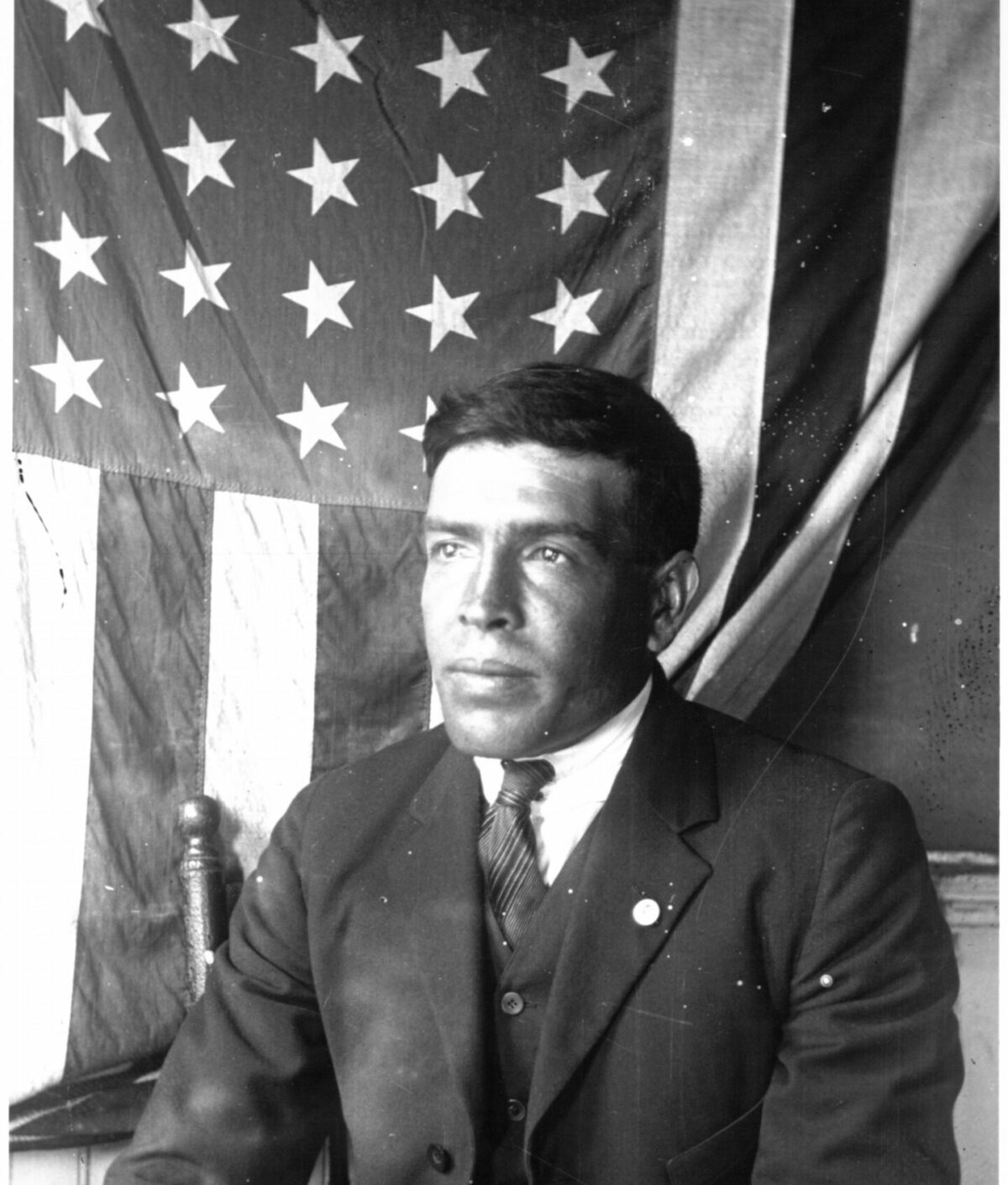
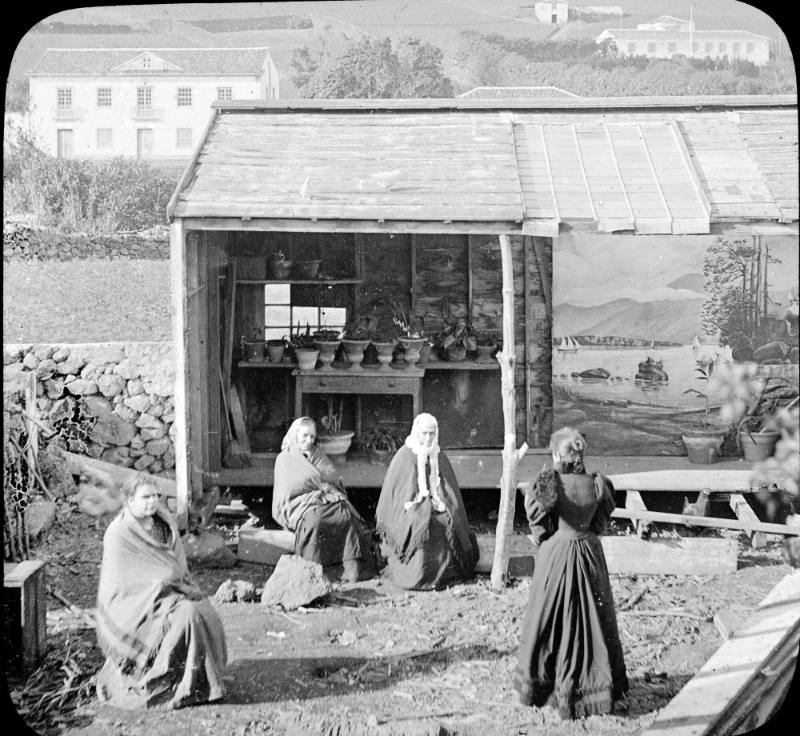
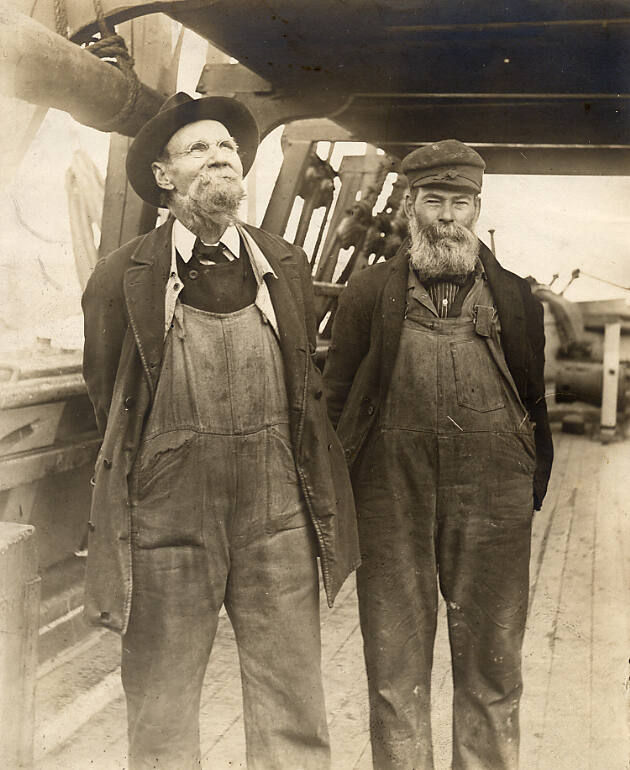
Beginning in the late nineteenth century, large numbers of Portuguese immigrants from the Azores migrated to Massachusetts. Confronting poverty, overcrowding, and, in some cases, compulsory military service at home, they crossed the Atlantic in search of economic opportunity.1 Many settled in industrial and maritime centers such as Fall River, New Bedford, and Taunton, while others established communities in cities farther north, including Lowell and Gloucester. In these urban centers, they found work in the whaling industry, textile mills, and other factories that powered New England’s industrial expansion.
This exhibition focuses primarily on Southeastern Massachusetts while drawing on selected sources from Lowell, whose Portuguese community remained closely connected to those in the Southeast of the state through celebrations, family ties, and labor.
Women on Faial Island in the Azores, 1904. New Bedford Whaling Museum. Azorean-American Whalers on Ship, c. 1910. New Bedford Whaling Museum.
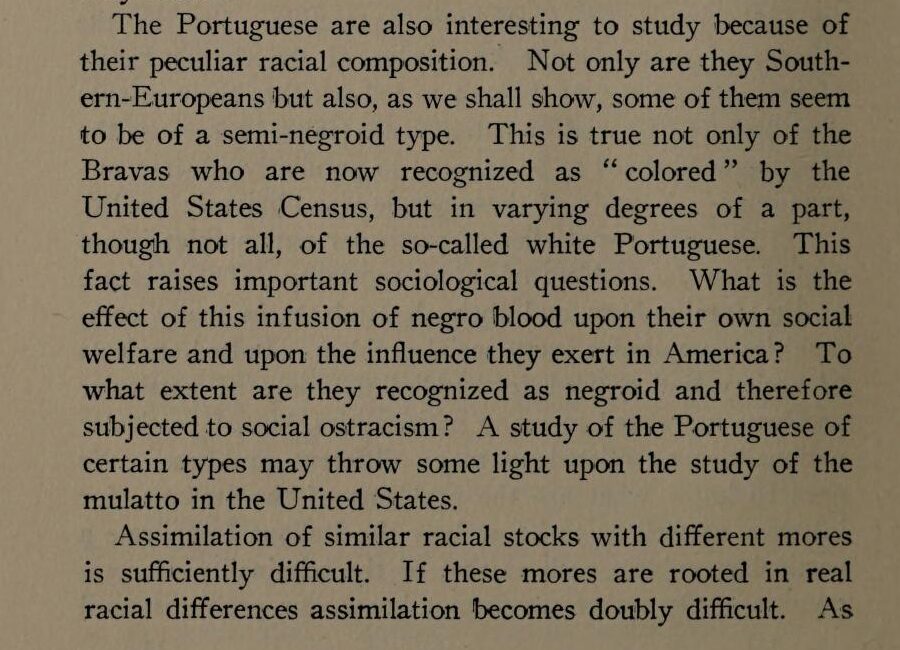
The presence of these people undoubtedly handicaps the public schools, complicates the work of public health organizations, increases the births where they should be fewest, and the death rates at all ages… If Fall River could dispense with the Portuguese tomorrow she would probably benefit.
Donald R. Taft, Two Portuguese Communities in New England, 1923.
Thinking Deeper
Do we see similar rhetoric today? How might the fact that these arguments were once used against groups now considered white shape how we understand xenophobia and immigration politics today?
Not everyone welcomed the presence of Portuguese immigrants, and these tensions became particularly visible in the 1920s. As new immigration laws were introduced, quotas sharply limited the number of Azorean immigrants permitted to enter the United States, while literacy requirements excluded those who could not read or write.2 In practice, these restrictions barred the majority of Azoreans from immigrating. Around the same time, one of the first major studies of Portuguese communities in New England concluded that Islander Portuguese were harmful to the United States and likely incapable of assimilation, framing this alleged failure in terms of racial inferiority. The author, Dr. Donald Taft of Columbia University, argued that Madeiran and Azorean Portuguese people were ethnically distinct from mainland Portuguese and claimed that they possessed African ancestry, which he portrayed as evidence of racial inferiority.
Donald Taft, Two Portuguese Communities in New England. 1923.
1920 Census Record, New Bedford Public Library
Although Portuguese immigrants were legally classified as white, socially they were often treated otherwise. This is clear not only in racial “studies” like Taft’s, but also in everyday bureaucratic moments like this one.3 Here, a census worker initially recorded the Portuguese family’s race as “other,” reflecting a social understanding that they did not quite fit within whiteness. The darker correction made later on shows that this designation was formally amended, but the original entry reveals how unstable and contested their racial status could be in practice.
And while they [the Portuguese] rejected Taft’s comments, they did not reject his hierarchized understanding of a society that cultivated white supremacy; they just disagreed with the place assigned to the Portuguese nationality.
Christina Bastos, Migrants, Inequalities and Social Research in the 1920s: The Story of Two Portuguese Communities in New England
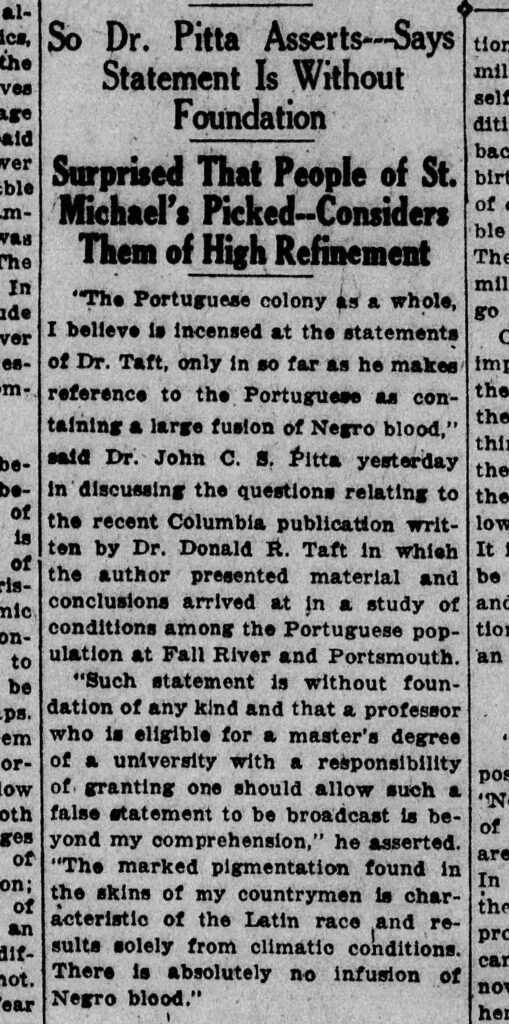
The New Bedford Sunday Standard, March 23, 1924, Newspapers.com
The New Bedford Sunday Standard, March 23, 1924, Newspapers.com
This response to Taft’s study is representative of nearly all of the published critiques that I found from the Azorean-American community in Southeastern Massachusetts. Rather than challenging the racialist framework itself, the writer insists that Azoreans, and the Portuguese generally, are white and expresses offense at any suggestion that they might possess African ancestry.
Thinking Deeper
Why might a community respond to discrimination not by rejecting the hierarchy, but by arguing that they deserve a higher place within it? Are there more contemporary examples of this phenomenon?
Similarly, oral history interviews of Azorean-Americans suggest that they sometimes viewed themselves as distinct from other immigrant groups they considered undesirable. What does the oral history below reveal about how some Azoreans may have perceived their immigrant neighbors from other countries?
UMASS Lowell, Oral History Interview of Henry DeSousa, 1987.
Henry DeSousa frames the demand for better representation and fairer treatment from police and local government in telling terms. In making his case, he contrasts the “nice” Portuguese community with “tougher” communities that, in his words, the police would “never” bother. In another oral history interview, he makes a similar distinction when discussing Asian Americans moving into Portuguese neighborhoods, describing them as “peaceful people” who were “better off” with the Portuguese than with some “other” communities.4 DeSousa’s prominence in the archival record makes his views especially visible, but these sentiments were not unique to him and appear elsewhere in the sources.
Thinking Deeper
Why might DeSousa contrast ‘peaceful’ Portuguese with ‘tough’ communities the police allegedly avoid? Does he genuinely want to emulate those communities in his call to action? What does this reveal about how Portuguese immigrants positioned themselves among other ethnic or racial groups?
FOOTNOTES:
Sandra Knight Wolforth, “The Portuguese in America,” (Proquest, 1976), 11-12. https://www.proquest.com/docview/302775909/fulltextPDF/2173ACE4930E4B32PQ/1?%20Theses&accountid=13911&sourcetype=Dissertations%20. ↩︎
Miguel Moniz, “The Shadow Minority: An ethnohistory of Portuguese and Lusophone racial and ethnic identity in New England,” in Community, culture and the makings of identity: Portuguese-Americans along the Eastern Seaboard, ed. Kimberly DaCosta Holton & Andrea Klimt (University of Massachusetts Dartmouth Center for Portuguese Studies and Culture, 2009), 414. ↩︎
Cristiana Bastos, “Migrants, Inequalities and Social Research in the 1920s: The Story of Two Portuguese Communities in New England,” History and Anthropology 29, no. 2 (2017): 163–83. doi:10.1080/02757206.2017.1359586. ↩︎
Henry DeSousa, interview by Doug DeNatale and David Taylor, April 2, 1988, interview 2 transcript and recording, Portuguese American Digital Archive, https://umlportuguesearchives.omeka.net/items/show/501. ↩︎
![Image of 1920 census record listing Portuguese-Americans in New Bedford. Their race is first listed as "Other" and then corrected with marker(?) to W [White].](https://sites.smith.edu/arx340-sp26/wp-content/uploads/sites/1271/2026/03/ghan_a_1359586_f0001_c.jpg)