The Performance
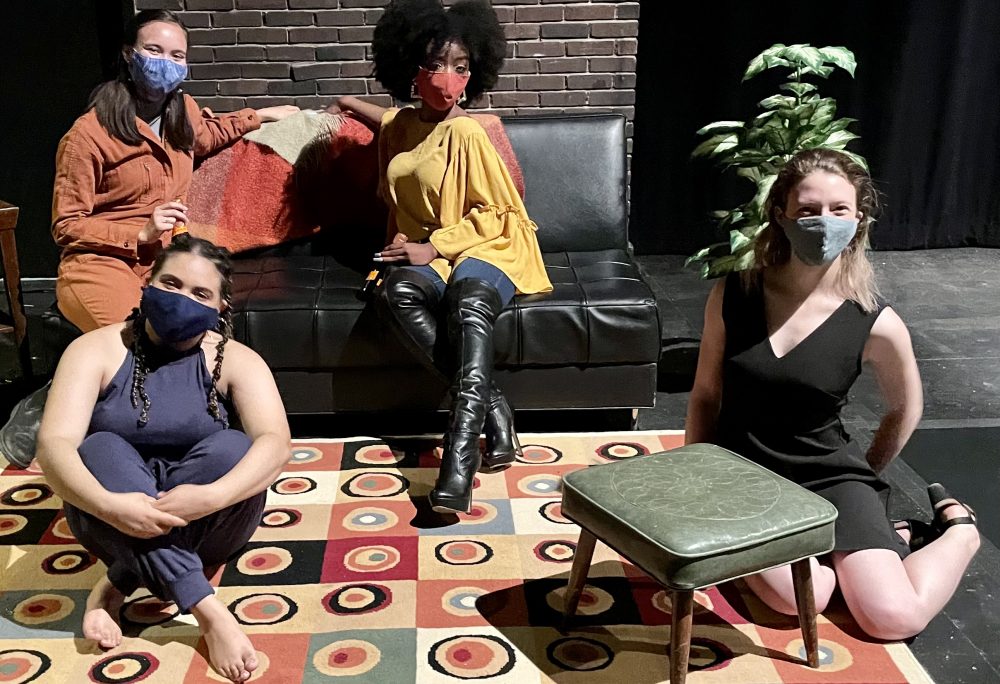
The week of dress rehearsal came and if you read my last process log you know I was not happy with the piece. More on why later. With so little time left on my hands, I decided to step back from my work as a creator and step into the piece as a performer. From that perspective, I was able to put on a brave face and perform the piece as if someone else had given me the choreography. Below I have attached the first official performance of Patchouli Oil, enjoy!
After that night I heard so much praise from those that watched it. Not only were people able to attach themselves to some of my family members and their movements, but they were also able to think about theirs stories with dance. I am very happy that I didn’t change anything and that I let the piece be what it wanted to be. Looking back now at why I was having so much trouble accepting it, I realized it came from a place of self-oppression. I felt as though my work didn’t belong on this stage and went so far as to bring props and rooms onto the stage in order to feel ok with having my dance there. In the essay below I speak more to this point. I hope that in reading it you get to see the bigger context in which this piece was created. These pervasive thoughts ran parallel to all the beautiful creating that was happening at each rehearsal and could’ve been the reason for the piece to not exist.
Lack of Representation and its Pervasive Effects in Dance Making
To complete my degree in dance I created a dance called Patchouli Oil. This dance is composed of three acts in which another dancer and I explore our individual stories and the movement exchange that happens in social dance. Through dance and narrative, we individually analyze our relationship to two social rhythms: merengue and reggaeton, and end in a duet exchanging named and nameless movement through a salsa song. The premise of this piece is to investigate along with the audience where moves come from, who is in our bodies, what moves have names, and which ones do not. There was one question that lingered throughout the process of making Patchouli Oil: does this piece belong here? Here meaning, a stage, and the senior dance concert at Smith College. As I retrospectively investigate why this question continuously invaded my process I realized it was due to the lack of representation I experienced and its pervasive effects on my creative process.
In my non-professional experience as a dancer, dancing is social dancing to rhythms like merengue, bachata, reggaeton, salsa, hip-hop, dancehall, etc. This dancing happens in very specific contexts, mainly as the name suggests, socially. This means that when it happens, the goal is not to show it to other people but to share it with those around me. Therefore putting this piece on a stage felt unnatural. As I learned in my semi-professional experience while majoring in dance at a performing arts high school, ballet, contemporary, and modern was what belonged on a stage. There are a few exceptions where I was able to see social dance forms on a stage. For example, when visiting a resort in the Dominican Republic, where I am from, there is always a night show in which merengue and other dance forms deeply rooted in the culture, are danced on a stage. This position usually comes after a choreographed tribute to Michael Jackson or any other globally recognizable dancing. These shows are specifically choreographed for the foreigners present at hotels. Another example of social dancing as a show is a Quinceañera. It is a tradition for Dominican girls to have a coming-of-age celebration when they turn fifteen, a Quinceañera, similar to the American sweet 16 celebrations. In this celebration, it is customary to have a court that will perform a dance or two with the birthday girl, and the usual rhythms include merengue, bachata, and reggaeton. While this did not happen on a stage per se, it was another instance in which I recognized seeing these dance forms performed for an audience. The problem with having seen these dance forms in those “stages” is that it made it abundantly clear that my piece did not belong on a Smith College stage. It seemed that if Patchouli Oil was to be shown to others, it needed to be shown as an exotic show for foreigners or at a Quinceañera. Instead, this piece was to be performed at Smith College, a predominantly white institution.
Presenting Patchouli Oil as part of the senior thesis concert was a challenge of its own. The dance department is mostly composed of white faculty and white audiences. The dancing that happens at Smith, and in the valley, is wonderfully mixed between abstract dance, contemporary, modern, ballet, contact improvisation, and centered in allowing anything to be dance. This applies to both concerts and classes. While these practices are delightful to take part in, in the context of Smith, most of the forms I practice only exist in dorm parties with the exception of hip-hop classes. My very first experience of the dance department at Smith as a dance maker was taking a beginner dance composition class, in which we were asked to improvise with our eyes closed to no music. While I was not new to improvisation, I was new to doing so in silence and with my eyes closed. Therefore my body froze in confusion for the majority of the activity, as I did not know if my movements belonged in that classroom. Additionally, I experienced another layer of separation which was to see all of my peers jump into their bodies and dance in ways I did not recognize, nameless movement. By the time I took my second dance composition class I had finally found myself in the type of dancing that happens at Smith. As a final project for that class, I created a dance called In one body where I attempt to tease out the coexistence of the two worlds I had created in my dancing. In this piece, I claim that with the right improvisation prompt you could arrive at the social dance forms I knew and vice versa. Meaning that for any social dance form, you could translate it back to a non-musical improvisational nameless state. After all, they both exist in me so there must be a way for the two to live in one body, they must be the same at their core. While this study was fruitful and beautiful to experience, I realize now the intention behind my exploration. Because of the internal turmoil surrounding my dancing at Smith I was attempting to connect the two forms to give validity to my dancing. I realize now a merengue’s connection to an abstract prompt does not grant the form validity. The fact that merengue exists makes it valid enough, as it is true for any of the social dance forms I practice. I realize now, I was wronged, robbed, and deprived of seeing my experience represented on a stage. This wrongdoing was so pervasive that I tried to excuse and translate my dancing into what I was seeing so that I could package it in a consumable way to the people around me. I want to make clear that there was never a time in which a professor or peer denied my right to be in the space or the validity of my dancing. I believe this demonstrates the true evil of oppression, the fact that once learned I was able to apply it and oppress myself and my dancing by not seeing myself in the people around me.
During performance week for Patchouli Oil, frustrated that what I had made was not worthy of the stage, I decided to step away from the piece as a creator and instead show up to rehearsals and shows as a performer. At that point, there was not much I could do about what the piece was, as my approach to creating is to truly let the piece be what it wants to be. When I received feedback from other peers about the piece and how much meaning they had found in it, it started to slowly chip away at my insecurity. Hearing the encouraging words of some of my peers and mentors, pointing out specific parts that spoke to them, or simply feeling exhilarated by the piece, allowed me to breathe a small sigh of relief. While deeply appreciated, it should not have been that these comments were the reason why I was relieved. The imposter syndrome I have been carrying throughout all of my dance life has held me back from my creativity. I should have been relieved because I made a worthy presentation of my artistry, and further delighted that people had found themselves in it. I cannot say that because I understand this now I am completely free of self-oppressing my work. In fact, I am still trying to come up with words to convince myself that Patchouli Oil truly belonged on that stage. Additionally, I recognize that there were other ways in which this lack of representation took place beyond my experience at Smith, Quinceañeras, and resorts. What I can say is that if I hope to continue to dance in a world where my work can be seen as deep and meaningful by creators like me, then works like mine should continue to take up space on stages, concerts, and institutions where there is space to take. I will not continue to perpetuate the idea that any of these forms are in any way less deep, dynamic, or meaningful. For those who were first-year students at Smith in the audience, who were able to hear and see dances that they recognize, I hope my work changed something about the following four years they will spend at Smith. For those that are in the valley and never saw themselves in a dance piece before, I hope my work made them feel at home. Finally, for those of whom this was something they had never seen before, I hope they notice its absence and fight to continue to see it.