Lillian Kolbrener
This podcast discusses abortion access for incarcerated women pre and post Dobbs. Seeking to understand how incarcerated women have been restricted from obtaining an abortion throughout recent history, and unpacking the causes of this lack of access.
Transcript
Music quiet over the first section.
[Lillian Kolbrener] Hello, my name is Lillian Kolbrener, and today I will be discussing the post Dobbs crisis of abortion care within prisons. Before Dobbs was passed there were few regulations and support systems in place for inmates who wanted an abortion, and now with Dobbs in place, those few regulations have been practically stripped down to nothing. With a lack of legislation around abortion issues, it’s challenging to obtain one because of the absence of federal law. Today I will be unpacking the struggles that inmates go through to obtain an abortion, analyzing what abortion care looked like during Roe, and how that has changed after Dobbs.
Music fades out.
[LK] For some background information: Roe vs. Wade was a Supreme Court case from 1973 which made abortion a federally protected right in the United States. Dobbs vs. Jackson was another more recent Supreme Court case from 2022 which removed the constitutional right to an abortion, giving that authority to the states.
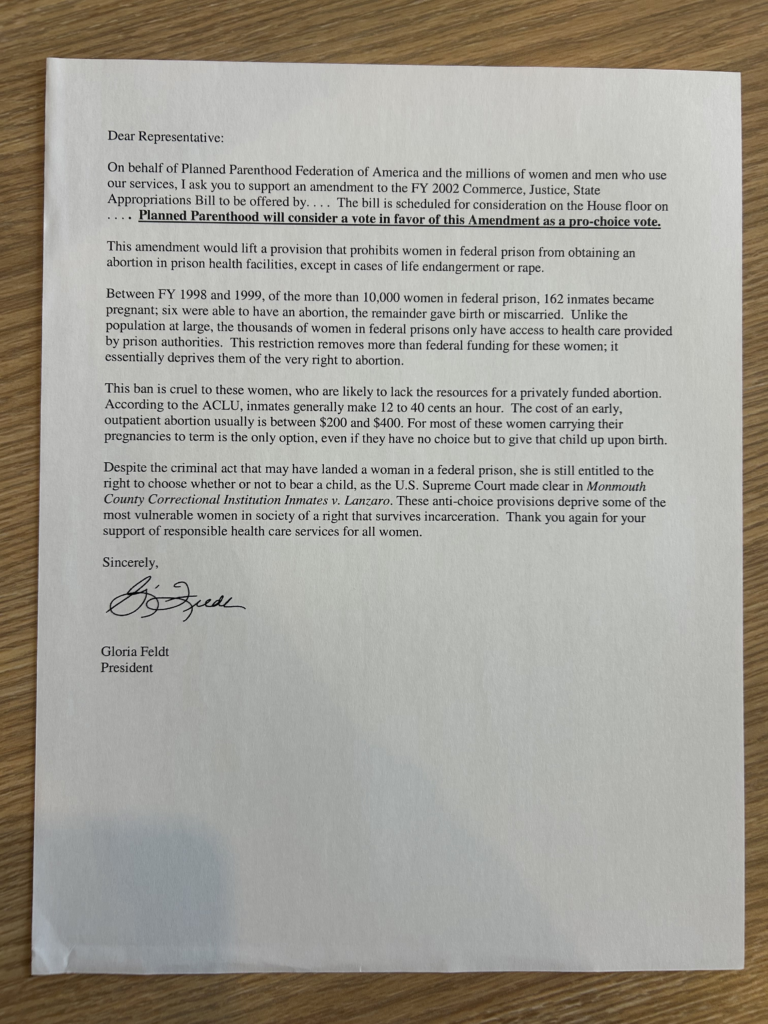
[LK] The Dear Representative letter states that across the entire country, quote “between the years of 1998 and 1999, of the more than 10,000 women in federal prison, 162 inmates became pregnant; six were able to have an abortion, the remainder gave birth or miscarried … thousands of women in federal prisons only have access to health care provided by prison authorities. This restriction removes more than federal funding for these women; it essentially deprives them of the very right to abortion.” This letter from Planned Parenthood presents this statistic to help us understand the indisputable evidence that incarcerated women in the U.S. are highly discriminated against when it comes to abortions.
Music fades in, then out.
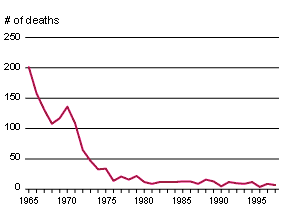
[LK] Before Roe was overturned, women had access abortions no matter where they lived in the United States before the fetus was viable. As shown in Guttmacher’s research on abortion trends, a staggering statistic showed a severe negative trend in abortion deaths of women after Roe was passed. This meant that not only did Roe make abortions accessible, but it made safe abortions accessible. As we will discuss though, this access did not look the same in the prison system. With accessibility to abortion varying by prison facilities, abortion was not accessible to all, and if they did have access to abortion, their reproductive health was not always covered by health insurance.
[LK] The Medicaid Inmate Exclusion Policy inhibited inmates’ access to abortion. This meant that even if inmates had a viable reason to obtain an abortion, if they didn’t have the funds, then they still were unable to get one. In the Library of Congresses Papers on Medicaid for Incarcerated Individuals, they state quote, “historically, most states had policies to terminate an inmate’s Medicaid enrollment, in part as a way to avoid inappropriate billing.” This affects the inmate psychologically because she is now forced to go through with an unwanted pregnancy and has to endure the trauma of having that child taken away from her due to her incarceration status. Even if the prison did allow abortions, many inmates were made to pay out of pocket not only for their procedure, but also for transportation to the facility.
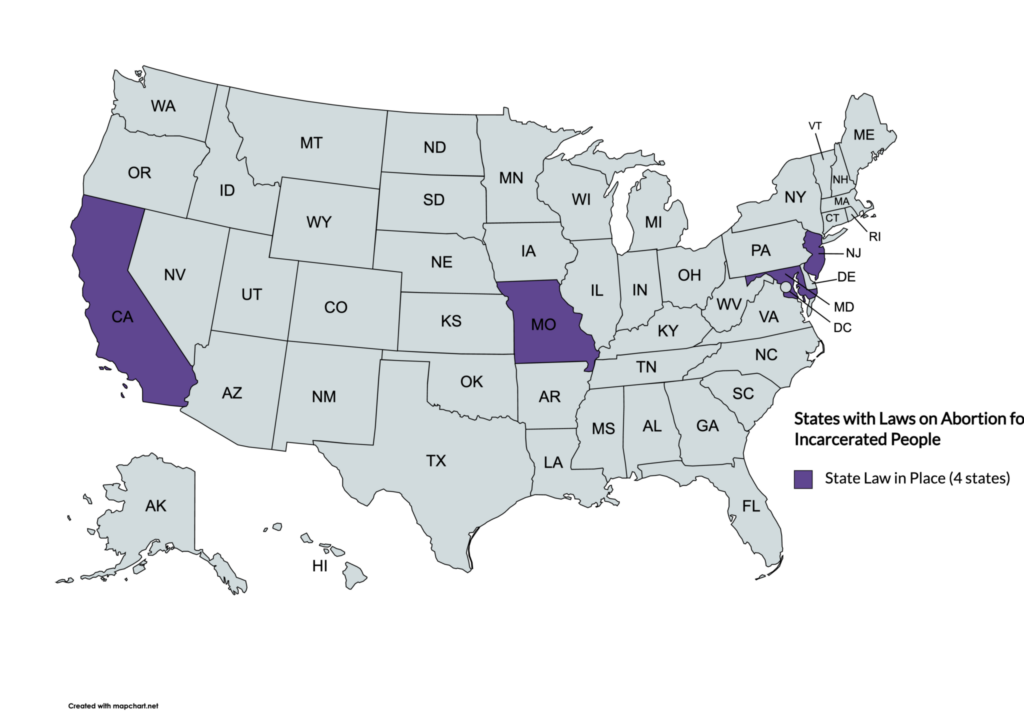
[LK] The legislation in place across the country for inmates wanting an abortion was lacking. Before Dobbs, only 4 states in the U.S. had laws pertaining to abortion for incarcerated people. California, Maryland and New Jersey, all had laws in place that protected incarcerated people if they wished to get an abortion, while Missouri denied abortion for almost two months after request, which would push the woman into her gestational period of 16-17 weeks. They deemed in the Missouri ruling that transporting a person for a procedure that the courts saw as unnecessary, was too high of a security risk.
[LK] In addition to the lack of governmental regulation and funding for inmates wanting to obtain an abortion, many issues arise from the lack of general information given to the inmate in the first place. Many inmates assumed that they had no rights whatsoever to an abortion, so they thought that they would have to carry out the pregnancy. In an interview by The Johns Hopkins Bloomberg School of Public Health, Dr. Carolyn Sharfarestien, an OBG-YN who worked in jails for six years, revealed that
[Dr. Carolyn Sharfarestien] “Our qualitative research found that many incarcerated pregnant people internalized the sense that they had no rights at all. So, even if they were at a facility that in theory allowed abortion, nobody talked to them about it, nobody offered them options counseling, nobody even told them they had a right to abortion.”
[LK] This lack of access to information forced women to go through with these unwanted pregnancies in a prison setting that has little access to resources needed throughout pregnancy like vital nutrition, safety, and care.
Music fades in, then out.
[LK] Post Dobbs, the right to an abortion for women in prison has only gotten grimmer. The Dobbs decision on abortion will have a heavy impact on those who are incarcerated, leaving them even more vulnerable than the general public. If inmates need an abortion and are in states where they have been banned they will now have to cross state lines to obtain one. This act alone takes a lot of staffing and many women still have to pay out of pocket for their abortions only exacerbating this issue. For the general public, mailing abortion pills right to people’s homes has become very common, but in prison, inmates are unable to receive such items. With processes like letter scanning, inmates are unable to receive certain kinds of mail, especially medication. Post Dobbs, incarcerated people have lost what few reproductive rights they had in the age of Roe, that are now no longer existent whatsoever.
[LK] As you can see, access to abortion for women in prison has always been a volatile subject. Women within the prison system have consistently been marginalized against and abortion is no exception to this issue. Even before Dobbs, access was limited due to the lack of governmental oversight, medicaid access, and prisoner knowledge of rights. More generally though, the failure of providing reproductive health care to inmates is an ongoing issue and needs to be dealt with at the federal level.
Music quiet over the first section.
[LK] Thank you for listening today. My name is Lillian Kolbrener and this has been, Abortion Access for Incarcerated Women.
Further Readings
Bibliography
“Abortion Access for Incarcerated People in the U.S. | Leadership Education in Maternal & Child Public Health.” 2023. University of Minnesota. May.
Baumrucker, Evelyne P. 2024. “Medicaid and Incarcerated Individuals.” Congress.Gov.
Dobbs v. Jackson Women’s Health Organization. 2022. Supreme Court of the United States.
Feldt, Gloria. Abortion access for women in federal prison dear representative letter, 1999 – 2002. 1992. “Dear Representative Letter.” Smith College Archives. Sophia Smith Collection of Women’s History. Planned Parenthood Federation of America records group III.
Gold, Rachel B. 2003. “Lessons from Before Roe: Will Past Be Prologue? | Guttmacher Institute.” March 1.
Nadworny, Elissa. 2024. “Inside a Medical Practice Sending Abortion Pills to States Where They’re Banned.” NPR, August 7, sec. National.
Roe v. Wade, 410 U.S. 113. 1973. Supreme Court of the United States.
Sharfstein, Joshua. 2022. “Jailed and Pregnant: What the Roe Repeal Means for the Incarcerated.” Public Health On Call with The Johns Hopkins Bloomberg School of Public Health Podcast Art.
Wang, Leah. 2022. “Mail Scanning: A Harsh and Exploitative New Trend in Prisons.” Prison Policy Initiative.
Photo Credits:
“Abortion Access for Incarcerated People in the U.S. | Leadership Education in Maternal & Child Public Health.” 2023. University of Minnesota. May.
Billings, Autumn. 2025. “Pregnant Women in Prison Aren’t Getting Care, and No One Is Keeping Track.” Reason.Com. May.
Feldt, Gloria. Abortion access for women in federal prison dear representative letter, 1999 – 2002. 1992. “Dear Representative Letter.” Smith College Archives. Sophia Smith Collection of Women’s History.
Planned Parenthood Federation of America records group III.
Gold, Rachel B. 2003. “Lessons from Before Roe: Will Past Be Prologue? | Guttmacher Institute.” March 1.