Everet Smith
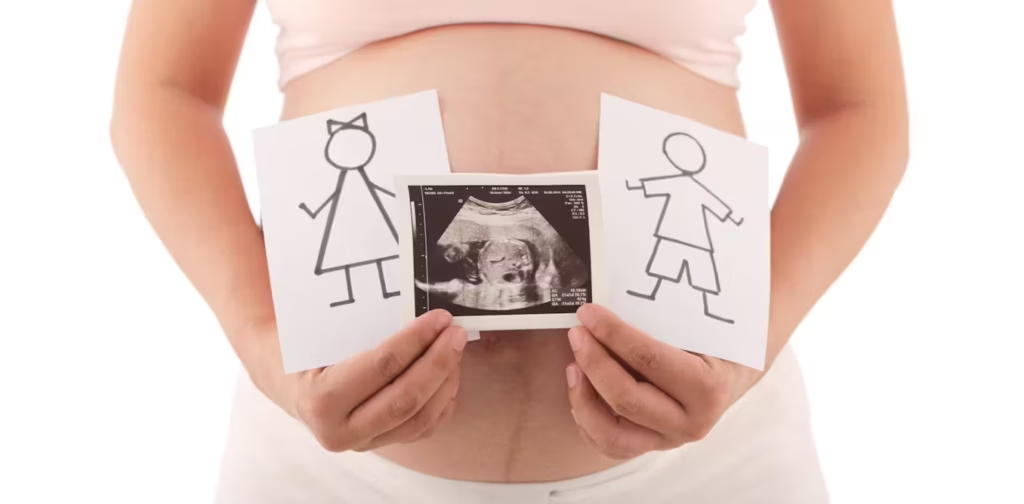
Gender reveal parties are a viral Internet sensation, especially the parties that end in one of the parents throwing a tantrum because of the sex of their future child. This gender disappointment is very reminiscent of another issue, sex-selective abortions. Sex-selective abortions are when a person decides to terminate a pregnancy due to the predetermined sex of the fetus. Legislature has been put in place to restrict these kinds of abortions. However, there is evidence that sex-selective abortions are not the threat that it has been said to be, and might be a scapegoat for a conservative agenda. In this episode, the host explores the perceptions and facts surrounding sex-selection, and how they may pose less of a problem than the previously mentioned gender reveal parties.
Transcript
Hello, and welcome to “Punching the Patriarchy”! My name is Everet Smith and today, I’d like to paint a picture for you: A countdown as an ecstatic couple prepare to launch the party cannons in their hands. A burst of blue or pink smoke filling the air. Happy screams as loved ones try to be the first to congratulate their lucky hosts. Then, of course, a complete and utter meltdown on the part of one of the future parents.
What I’ve just described to you, as I’m sure you’ve guessed, is the general gist of any viral gender reveal party you’ve seen on your For You page. The only two differences are the kind of reveal or type of tantrum. We’ve seen everything from cake and cussing to simulated tsunamis and slap fights. There hasn’t been a commentary that hasn’t been made about these parties and the reactions of the people hosting them, though I find that most reactions are rather surface level, not properly addressing the cause of these furious future parents: deep rooted sexism. It’s no secret that these videos seem to predominantly feature fathers lashing out at the sight of pink, often in loud and violent manner. This misogynist trend in reactions parallel another issue that concerns the desire for a male child over a female one: sex-selective pregnancies and abortions. In this episode, I’ll be exploring the perceptions and facts surrounding sex selection abortions, as well as how they might be less of a concerning matter than the videos we just discussed.
First of all, let’s define what sex-selective abortions actually are. Sex-selective abortions are when a parent chooses to terminate a pregnancy because of the predicted sex of a fetus. These can occur due to any sex the fetus might be said to be, though it is more likely for this kind of abortion to happen when the fetus is female. In the United States, we’ve been exposed to the same narrative surrounding sex selective abortions, that they are more often performed in Asian countries or by Asian Americans in the pursuit of having sons. In order to combat the presence of these “discriminatory” abortions in these communities, over half of state legislatures have voted on laws that would restrict sex-selective abortions, with ten states having succeeded in banning the practice. However, the reasoning behind these stereotypes and legislature fails to hold up against the facts.
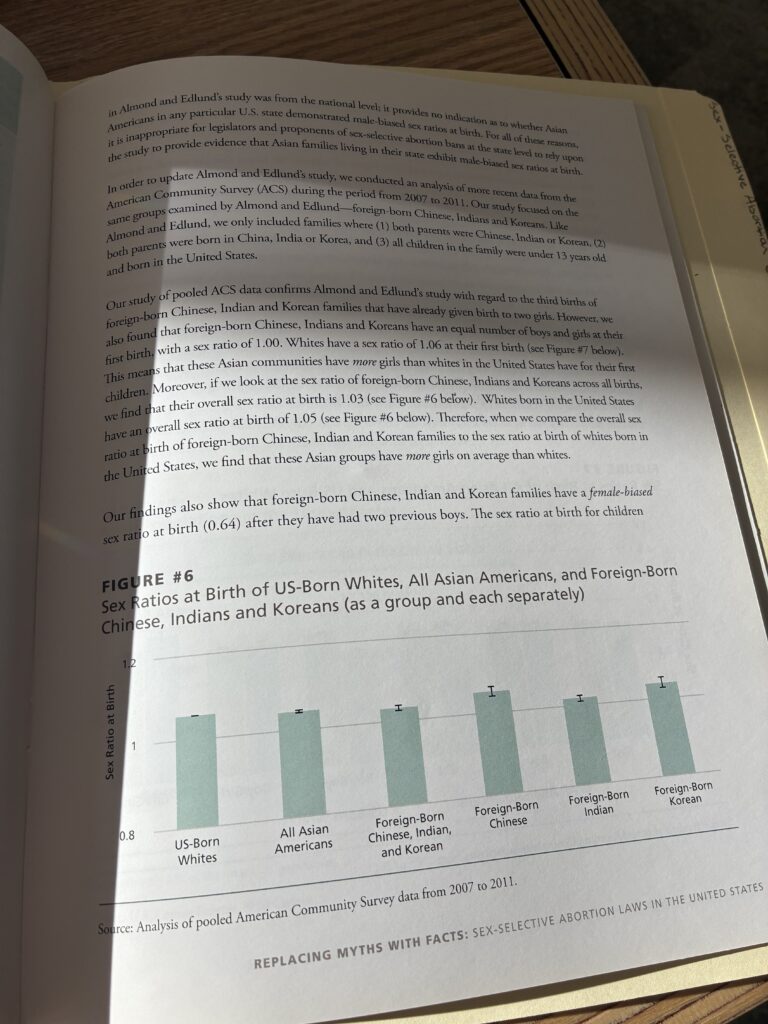
The most damning evidence is that, according to U.S. census findings, that Asian American births are not male biased, with this group actually having proportionally more girls than white Americans. The notion that Asian Americans have more boys due to sex-selective abortions has been defended using a census-based study conducted by two economists, Douglas Almond and Lena Edlund, in 2000 that found male biased ratios in Asian American families after giving birth to one or two girls. The study concluded that these results were due to sex-selective abortions in Asian communities. This study is not only outdated, but sloppily done. The study did not account for sex ratios at birth amongst Asians born in the United States or the sex ratios of other racial groups, not to mention it ignored the fact that this census revealed that immigrant Chinese, Indian, and Korean people did not have male biased births. More recent studies and census data continues to enforce that Asian Americans not only do not have more boys but, as previously mentioned, have more girls than white Americans. In fact, data points to the fact that male-biased births happen everywhere, not just Asian countries or amongst Asian people, with the countries with highest male-biased ratios being Armenia and Liechtenstein. The likelihood of having more boys than girls depends on the race, age, and geographic region of the person carrying the fetus, not sex-selective abortions. Asian Americans don’t have more boys than girls, and, if they did, sex selective abortions would not be to blame.
Since the supposed epidemic of sex-selective abortions in the Asian American community has been discredited, where does that leave white Americans? Why is their sex ratio so male biased? Well, this question can be attributed to the societal pressures to have certain kinds of children in the United States. While it sounds rather strange, having a certain kind of family is marketed to white Americans. Sex selection is advertized as “family balancing” or “gender balance”. This is further proven by the startling amount of preimplantation and prenatal technologies being developed by Americans. For a country that is so concerned about the “discrimination” of sex selective abortions, it keeps coming up with new ways to predetermine the sex of your future child, whether it be through sperm sorting or preimplantation genetic diagnosis. Other countries are actually more concerned with things like these practices than sex selective abortions, fearing for the resurgence of eugenics in science. Fear of discrimination through sex selective abortions are a farce, propaganda to further restrict women’s reproductive freedom.
The truth behind these restrictions is made even more evident when you realize that most of the time when these bans are voted on, they are proposed primarily by conservatives. While Democrats voting to ban sex-selective abortions certainly exist, they are outnumbered by their Republican constituents in nearly every state when it comes to these votes. It’s also worth noting that these politicians are only interested in banning abortions, not the other various forms of sex selection currently avalible in the United States. This legislature is not about “discrimination”, as these people frame it as; it is about finding new ways to control women’s bodies.
So what does any of this have to do with gender reveal parties? I propose that instead of falsely targeting different ethnic groups and foreign countries as the perpetrator of male biased births, we address the deep-rooted sexism that would spur a father to destroy an expensive dyed cake upon hearing the news that he’s going to have a baby girl. Only by examining our own internal biases can we realize the real problem concerning sex selection in our country, and why we’ve been conditioned to think that having more girls than boys is such a terrible thing. To take this even further, we should think about why giving up women’s right to an abortion is negotiable when the sex of the fetus is a factor. There’s no concrete proof that sex-selective abortions are a threat or even a widespread occurrence, only evidence of detrimental effects that actions against these abortions have on the fight for reproductive justice.
I hope you enjoyed hearing my insights. Thank you for sticking around and please don’t throw a gender reveal party if there’s a fifty percent chance you’re going to throw a fit! Bye!
Kalantry, Sital. “Challenging the Narrative on Sex-Selective Abortions”. Ms. Magazine. (August 25, 2017)
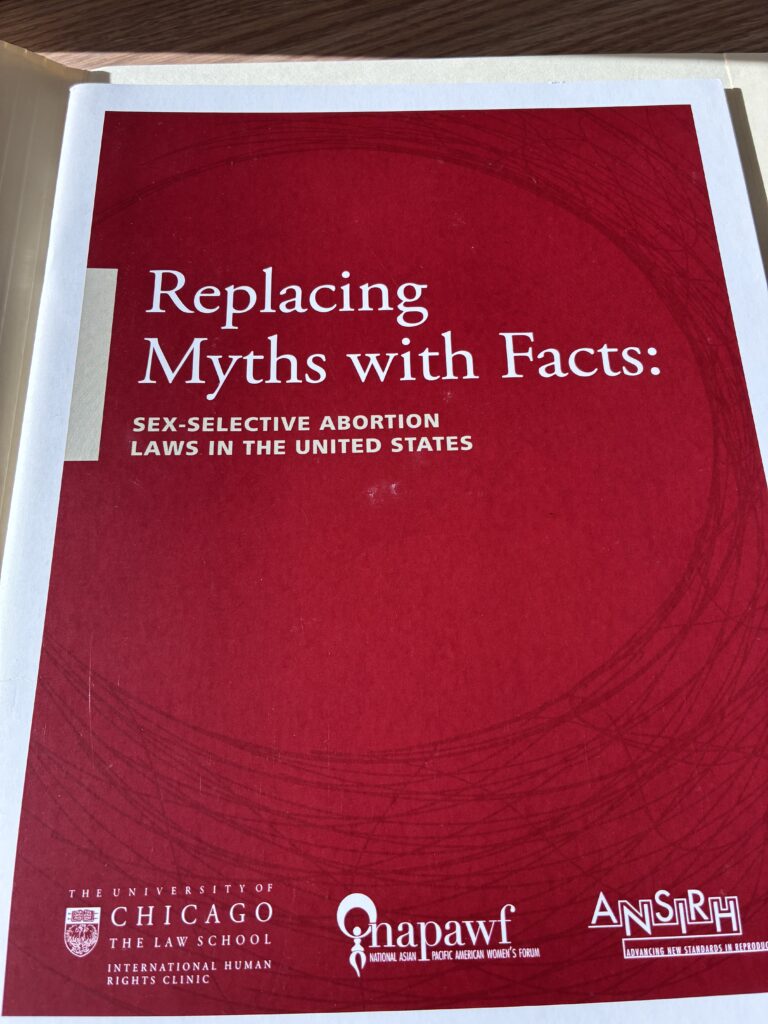
University of Chicago Law School – Global Human Rights Clinic, National Asian Pacific American Women’s Forum, and Advancing New Standards in Reproductive Health. “Replacing Myths with Facts: Sex-Selective Abortion Laws in the United States”. (2014). Global Human Rights Clinic. 7.
https://chicagounbound.uchicago.edu/ihrc/7
Chappell, Courtney. “Reclaiming Choice, Broadening the Movement: Sexual and Reproductive Justice and Asian Pacific American Women”. (2006) National Asian Pacific American Women’s Forum
https://www.thefreelibrary.com/Reclaiming+choice%2C+broadening+the+movement.-a0156361299

For Further Reading
Kalantry, Sital. “Challenging the Narrative on Sex-Selective Abortions”. Ms. Magazine. (August 25, 2017)
University of Chicago Law School – Global Human Rights Clinic, National Asian Pacific American Women’s Forum, and Advancing New Standards in Reproductive Health. “Replacing Myths with Facts: Sex-Selective Abortion Laws in the United States”. (2014). Global Human Rights Clinic. 7.
https://chicagounbound.uchicago.edu/ihrc/7
Chappell, Courtney. “Reclaiming Choice, Broadening the Movement: Sexual and Reproductive Justice and Asian Pacific American Women”. (2006) National Asian Pacific American Women’s Forum
https://www.thefreelibrary.com/Reclaiming+choice%2C+broadening+the+movement.-a0156361299