Eleanor Rial
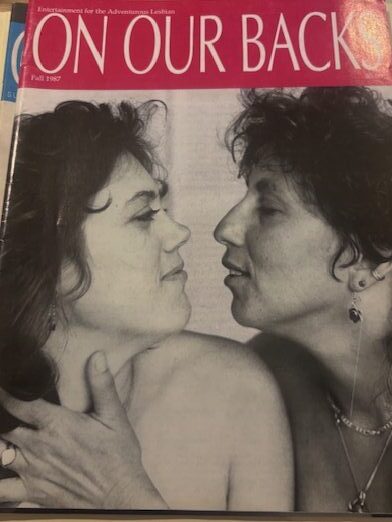
This podcast explores the impact of lesbian pornography and erotica created by and for queer women in times of repression and conflict, specifically the Feminist Sex Wars of the 1980s and the magazine series On Our Backs.
Transcript
(Intro Music)
Hi, my name is Eleanor Rial, and today we’re going to be discussing The Right to Pleasure: Reclaiming Lesbian Pornography.
The United States began history with violent homophobia. The very first colonial settlement in the United States punished homosexuality with the death penalty. Even as the death penalty fell out of fashion for punishing homosexuality, queer individuals were still punished through legal action or involuntary medical treatment. It took until 1971 for two out of fifty states in the U.S. (Illinois and Connecticut) to decriminalize sodomy, and until 2003 for these kinds of laws to be declared unconstitutional by the Supreme Court.
As states began the process of decriminalization, queer communities began to grow and thrive, and the queer liberation movement took root. Areas like San Francisco and New York City became the home of milestones like Harvey Milk’s election and the Stonewall riots.
(Music fades in and out)
In tandem with queer liberation, discourse on sexuality began to emerge in the feminist movement. The representation and treatment of women in traditional pornography became a central issue for many feminists. This emphasis on misogyny in pornography led to a broader anti-pornography movement, including the formation of the WAVPM, or Women Against Violence in Pornography and Media, based in San Francisco. Core principles of the movement included education regarding the representation of women in pornography, persecuting individuals participating in the industry, and condemning the connection between violence and sexuality. Many ideas of the anti-pornography movement, including the idea that heterosexuality and male driven pornography oppress women, were coopted from lesbian feminists. Yet many individuals in the lesbian community recognized harm the WAVPM was perpetuating.
Pro-sex feminism arose as a sect of the sex-positivity movement in the early 1980s in response to the anti-pornography movement. The WAVPM targeted all forms of pornography, including feminist and queer media. In addition, the rejection of violence in sexuality extended towards individuals engaging in S&M, a popular sexual practice in queer communities. The censorship of pornography not only affected “harmful” practices, but broadly encouraged repression of sexualities, which included women and queer individuals. This repression was especially dangerous in the age of the AIDS crisis, as expression of queer sexuality was condemned, decreasing individuals’ access to community and resources in times of need. The clash between these two movements was dubbed the “Feminist Sex Wars of the 1980s”.
(Music fades in and out)
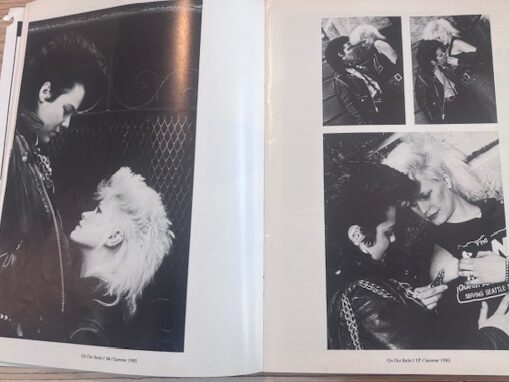
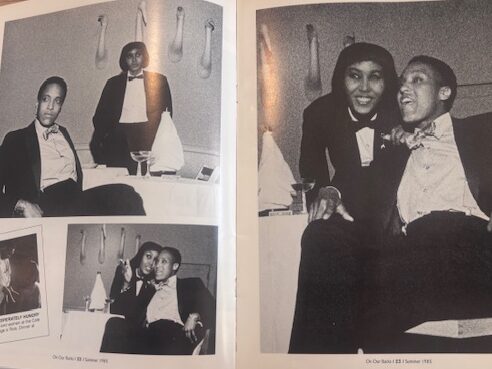
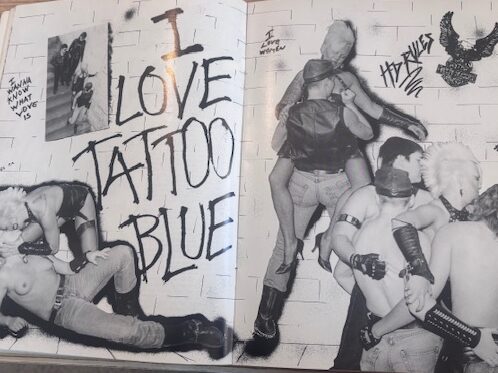
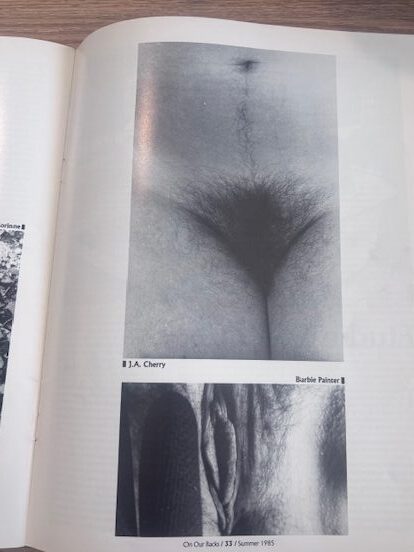
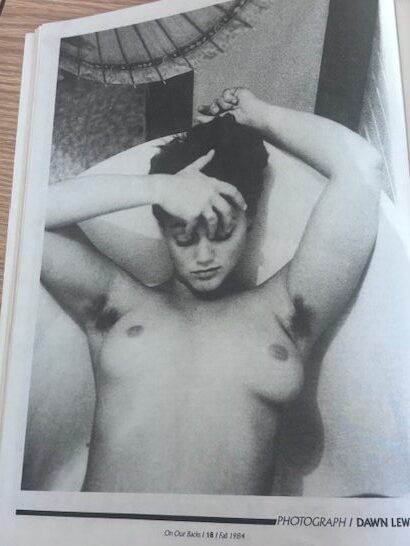
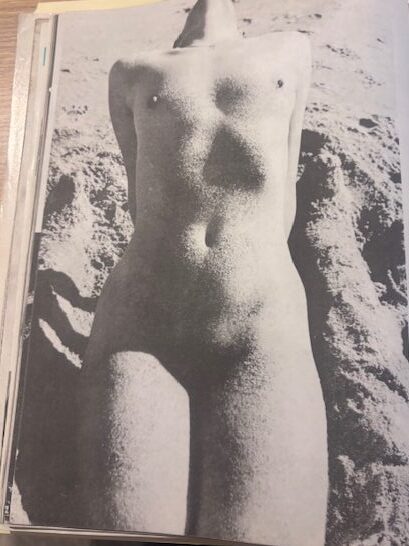
During these “Sex Wars”, the first issue of On Our Backs was published in the fall of 1984. On Our Backs was a magazine series providing lesbian pornography, erotica, poetry, advice, and more. On Our Backs was an incredibly new and exciting publication, it not only created a space for pornography and erotica to be produced by women for women, but it also created a space for queerness to be expressed fully and completely, in a time where female sexuality and queerness was demonized. In addition, On Our Backs represented a wide range of sexual practices and individuals, including realistic depictions of women’s bodies, S&M practices, and the depiction of butch/masculine women. The summer 1985 issue alone included women with body hair and unshaven vulvas, couples engaging in S&M wearing leather and using handcuffs, and masculine women dressed in traditionally “male” clothing, like suits.
On Our Backs also provided media besides pornography. The spring 1985 issue included an article on vaginal infections and how to prevent them, specifically in the context of lesbian sexual practices. Spring 1986 provided information on STDs lesbians were at risk for, including how to treat and prevent them. Fall 1986 included an advertisement thanking the lesbian community for their work in the AIDS movement, a PSA explaining that lesbians were still at risk for AIDS, and resources for more information. Not only were health and political information provided, but advice columns were also present in most issues, specifically addressing lesbian sexual practices and relationships. In the fall 1984 issue, one woman wrote in asking how to find the g-spot. The response was pages of advice, encouragement, and fact-based information on female anatomy.
On Our Backs reached individuals and provided not only pleasure and entertainment, but a safe space to express their queerness and sexuality. One reader wrote in on the spring 1984 issue, stating, “Thought I was the only dyke in the whole damn world who loves erotica”. Another, named Marianne, wrote, “I like articles about the other lesbian lifestyles and sexual experiences. I’m always amazed about how typical I am after a little outside input. Also, that I’m not the only one who loves sex as a lesbian because it feels so good and not because I’m so political”. A lesbian filmmaker explained her motivation for creating pornography, stating “I had to beg a director to show a kiss. They rarely have any knowledge of portraying anything but p/v [penis and vagina] sex. You ask me what directors look for in lesbian scenes, and the point is they don’t. Don’t look. Don’t know. Don’t care”. On Our Backs was revolutionary in giving lesbians not only pleasure, but acceptance and representation in a world that constantly denied them that.
(Music fades in and out)
Queer rights in the United States are in danger once again, through rising conservatism and anti-LGBTQ+ laws and violence. Women’s sexuality is facing a crisis, through the overturn of Roe v. Wade and a growing lack of sex education. We are again at a point where resources like On Our Backs are more important than ever. In a society that values male heterosexuality above all else, consuming media that puts queer and female pleasure at the center becomes an act of resistance.
(Outro Music)
References
“The Sex Wars, 1970s to 1980s · Lesbians in the Twentieth Century, 1900-1999, by Esther Newton and Her Students · Outhistory.” outhistory.org. Accessed December 4, 2025. https://outhistory.org/exhibits/show/lesbians-20th-century/sex-wars.
“Criminalization of Homosexuality in American History.” Death Penalty Information Center. Accessed December 4, 2025. https://deathpenaltyinfo.org/policy-issues/biases-and-vulnerabilities/lgbtq-people/criminalization-of-homosexuality-in-american-history.
Collins, Dana. “Lesbian Pornographic Production: Creating Social/Cultural Space for Subverting Representations of Sexuality.” Berkeley Journal of Sociology 43 (1998): 31–62. http://www.jstor.org/stable/41035536.
On Our Backs, Periodical Collection, Sophia Smith Collection, Smith College, Northampton, Mass.
“National State of Emergency for LGBTQ+ Americans.” HRC. Accessed December 4, 2025. https://www.hrc.org/campaigns/national-state-of-emergency-for-lgbtq-americans.
Marshall, Lisa. “2 Years after Roe v. Wade Reversal: Impacts and What’s to Come.” CU Boulder Today, June 20, 2024. https://www.colorado.edu/today/2024/06/20/2-years-after-roe-v-wade-reversal-impacts-and-whats-come.
“State of Sex Education in USA | Health Education in Schools.” Planned Parenthood. Accessed December 4, 2025. https://www.plannedparenthood.org/learn/for-educators/whats-state-sex-education-us.
Further Reading
Porn Literacy: https://teenhealthsource.com/sex/porn-literacy/
Relationship Boundaries Guide: https://www.scarleteen.com/read/relationships/yes-no-maybe-so-sexual-inventory-stocklist
Mental Health Resource for LGBTQ Teenagers: https://www.thetrevorproject.org/