Lilah Ricciardi
Neglected, pregnant, and shackled, the US carceral system exploits incarcerated pregnant people’s bodily autonomy, stripping them of freedom and shackling them with chains. Rooted in archival sources from the Sophia Smith Archives Collection, this podcast examines the history of shackling in New York State through personal experience and centers the role Women on the Rise Telling Herstory played in the New York eradication of shackling. This podcast traces shackling to the present, Post-Dobbs day, examining how abortion bans and restrictions in states where shackling is still legal, like Wisconsin, mean people today are forced to give life in chains.
Transcript
Lilah Ricciardi: (over the music) Hello and welcome to Birthing in Shackles with your host, Lilah.
[LR over the music fading] One November morning in 2008, Venita Pinckney, an incarcerated woman housed at Bedford Hills Correctional Facility, a state prison in Westchester, New York, awoke to the first shudder of childbirth. 9 months pregnant, still housed in an 8 by 6 foot cell, a corrections officer entered, wrapping a chain twice around her waist and handcuffing her to it. Then he covered the handcuffs with a locked box, further limiting her range of motion, shackled her ankles, and wrapped a chain around her swollen abdomen. Venita recalls feeling like a “pregnant animal,” unable to “walk like a normal human being” while transported to the prison hospital room. A few hours later, Venita gave birth to her son, Savion, inside a prison, while serving a two-to-four-year term for violating parole on a 2001 drug conviction.
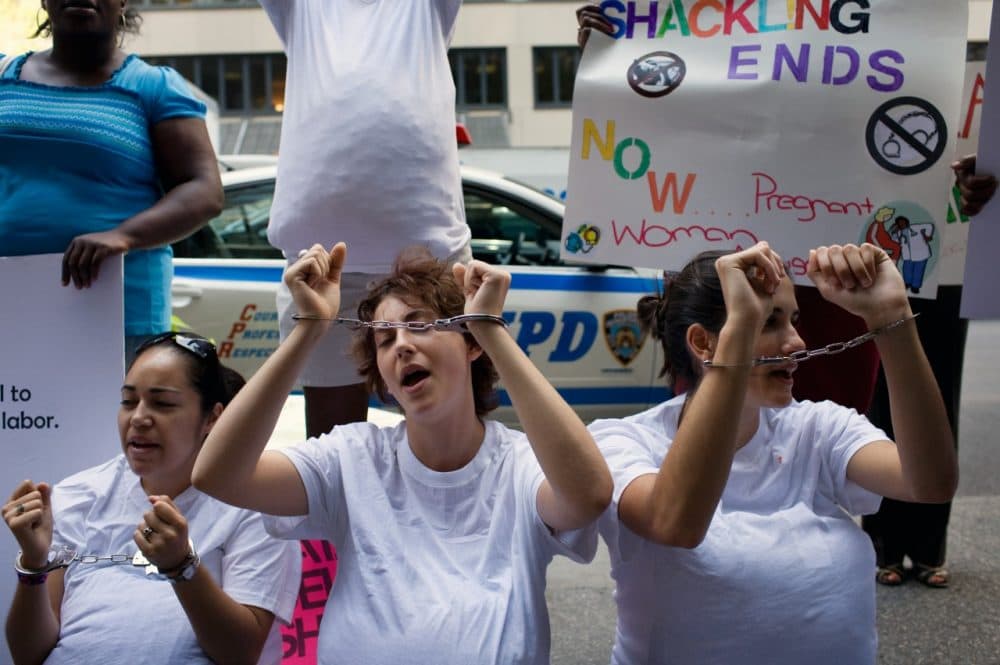
After Venita’s release from prison the following month, she began working as an advocate for women tortured by the carceral system, like herself, who were forced to give life and be shackled. Venita, alongside other formerly incarcerated women like Tina Reynolds, co-founder of Women on the Rise Telling HerStory, protested outside the office of New York Governor David Paterson, urging him to sign the anti-shackling bill, which had already been passed by the House of Legislature, in order to officially prevent the shackling of women during labor (with the exception of permitting the use of handcuffs in only extraordinary circumstances.) Tina, Venita, and many other formerly incarcerated women wore purple ribbons around their wrists instead of shackles as they protested. Undoubtedly influenced by their protest, the governor signed the bill, and since 2008 New York State has prohibited the use of restraints on incarcerated individuals during labor and on pregnant persons during a custodial interrogation.
Women on the Rise Telling Herstory (WORTH) was founded in 2004, as a group of about twenty formerly incarcerated women began meeting regularly, coalition building together—formulating strategies to incorporate the voices of formerly incarcerated women into public discussions about the criminal justice system. The idea for WORTH grew out of an awareness of the absence and invisibility of women who have experienced incarceration from discussions and recommendations about prison policies and practices. Because most of the policy discussions centered on men’s incarceration, women in the carceral system are often neither acknowledged nor addressed, and when women’s incarceration is addressed, the women themselves are often painted as victims rather than as active agents of social change. WORTH works to change this narrative and they have through organizing grassroots protests like the rally outside of the governor’s office, which Tina co-WORTH founder organized.
Though WORTH’S win in 2008 of persuading the New York State governor to sign the anti-shackling bill was a massive victory, tragically, the eradication of shackling has not been passed in every state. Let’s take a look at where the shackling of incarcerated pregnant women is still legal today: in Iowa, Wyoming, Kansas, South Dakota, North Dakota, Wisconsin, & Michigan, the legality of shackling is still approved. And living in a post-Dobbs world, we must acknowledge that in South Dakota and North Dakota, abortion is illegal, meaning in these states, women in prison are forced to be both pregnant and shackled—utterly stripped of their bodily autonomy and reproductive justice rights. In states like Iowa, Kansas, and Wisconsin, where shackling is legal, abortion is restricted after or even before 22 weeks of fertilization.
Not only is shackling a dehumanizing and uncomfortable experience, it’s also incredibly dangerous for both the pregnant person and the fetus. Officials from the American College of Obstetricians and Gynecologists have opposed shackling because it deprives pregnant people of appropriate care during examinations and delivery and they suffer added pain during delivery, as their wrists and ankles being shackled restrict their ability to move in order to alleviate the pain of contractions. Pregnant people are often shackled by correctional staff without medical training, and suffer an added safety risk of being transported to the hospital, by riding in bumpy cars, or forced to walk “like an animal” as Venita explained. The pregnancies of people incarcerated are typically already high-risk because of past medical history, which can often include substance abuse and limited access to prenatal care. Many women in the carceral system have already suffered sexual and physical violence, and the act of shackling re-traumatizes and triggers them. Shackling is not supported by any security threat, as most women in prison have been convicted of non-violent offenses, like Venita, who was in prison for violating her drug conviction parole. States, like New York, which have restricted the use of shackles since 2008, have not reported security problems. Begging the question—why haven’t the 7 US states I mentioned earlier banned shackling yet?
Each year, there are approximately 3,000 admissions of pregnant people to prison and 55,000 to jail. Black women are specifically targeted by the justice system, as they are 8 times more likely than white women to go to prison, even though a greater proportion of white women are arrested. The once imprisoned leader of the Black Liberation Army explained that at New York Prison, Rikers Island Correctional Institution for Women, “There are no criminals here, only victims. Most of the women (over 95 percent) are Black and Puerto Rican. Many were abused children. Most have been abused by men, and all have been abused by “the system.” The major crimes that women here are charged with are prostitution, pickpocketing, shoplifting, robbery, and drugs. The women see stealing or hustling as necessary for the survival of themselves or their children because jobs are scarce and welfare is impossible to live on.” Many women fall into this cyclical cycle of recidivism, entering the juvenile justice system at a young age with a minor offense, like a misdemeanor which throws their entire lives off track, destroying their futures, as they are trapped inside of or indefinitely tied to the system.
Let’s take a look at what’s happening in the present moment, in a state where shackling is still legal and abortion restrictions are intact: in Wisconsin. State Senator Lena Taylor and Representative Jodi Emerson attempted to pass legislation by sponsoring the bill, Dignity for Incarcerated Women & Girls, created by Wisconsin’s first non-profit organization, FREE. The bill sought to outlaw the practice of shackling pregnant women at 6 months gestation until 6 weeks postpartum. The Wisconsin Doula Prison Project, a part of the bill, would allow pregnant people the opportunity to have trained doula services before, during, and after their delivery. The FREE Executive Director, Peggy West-Chroder explains that ” The bill would also ensure access to services like testing for sexually transmitted diseases, pre- and postpartum care, information related to pregnancy and labor, and access to health services, including vital treatment services for new moms who are dealing with addiction or mental health issues. Though FREE and Senator Lena Taylor pushed for the bill to pass, similar to WORTH’s push of the anti-shackling bill signing in New York, in 2008—it failed to pass as the legislative session ended in early 2024, without the bill receiving a public hearing or vote in the State Assembly or Senate. But all faith shouldn’t be lost, as currently, the American Civil Liberties Union of Wisconsin is working to demand legislation like the Dignity for Incarcerated Women & Girls be passed in the state.
Living in a post-Dobbs world, abortion rights for all have been in danger, as they are being eliminated and restricted but incarcerated people are particularly vulnerable because, unlike some privileged people in the outside world, who have the ability to travel to other states to obtain abortions, incarcerated people are unable to leave their cell, let alone their state. Pre-Dobbs, when prisons refused to administer abortions, the incarcerated person could claim it is their fundamental right, protected by the Fourteenth Amendment: and demanded an abortion, but now that abortion is no longer a universal right, their argument is no longer viable. Meaning many people in states where abortion is illegal and shackling is legal are forced, as of today, to give life in chains.
[LR over the music] I would like to end on a hopeful note, looking towards a future in which the ACLU Wisconsin follows the lead of New York, passing the anti-shackling law, encouraging the other 6 states where shackling is legal to follow their lead. I will leave you with words from Tina Reynold’s, “Everyone wants to know the story of how they were born. Children are entitled to hear a story from their mothers that does not include the degrading experience of being shackled. All mothers should have the opportunity to share a story about their children coming into the world that is beautiful and loving.” Hopefully, one day soon-this will be true. Thank you so much for listening. Outro music fades out.


References
Prison Birth Project records, Sophia Smith Collection, SSC-MS-00728, Smith College Special Collections, Northampton, Mass.
Tina Reynolds collection of WoRTH records and teaching files, SSC-MS-00803. Sophia Smith Collection of Women’s History.
“Pregnant in Prison – ACLU of Wisconsin.” ACLU of Wisconsin, September 5, 2025. www.aclu-wi.org/campaigns-initiatives/pregnant-prison/.
“Opinion | Childbirth in Chains.” The New York Times, July 21, 2009. www.nytimes.com/2009/07/21/opinion/21tue4.html.
Dwyer, Jim. “Pregnant Inmates Give Life Wearing Shackles and Chains.” The New York Times, July 20 2009. www.nytimes.com/2009/07/12/nyregion/12about.html?login=email&auth=login-email.
Rhoad, Meghan. “Giving Birth in Shackles.” HuffPost, June 27, 2009. www.huffpost.com/entry/giving-birth-in-shackles_b_208268.
“Who We Are.” Women on the Rise Telling HerStory (WORTH), May 3, 2013. womenontheriseworth.wordpress.com/about/.
Hernandez, Joe. “More States Are Restricting the Shackling of Pregnant Inmates, but It Still Occurs.” National Public Radio, Apr. 22, 2022. www.npr.org/2022/04/22/1093836514/shackle-pregnant-inmates-tennessee.
Spears, Baylor. “Lawmakers Announce Bill to Ban Shackling Incarcerated Pregnant Women and Create Doula Program.”Wisconsin Examiner, March 9, 2023. wisconsinexaminer.com/2023/03/09/lawmakers-announce-bill-to-ban-shackling-incarcerated-pregnant-women-and-create-doula-program/.
Kurshan, Nancy. “Women and Imprisonment in the U.S. History and Current Reality.” Freedom Archives. www.freedomarchives.org/Documents/Finder/DOC3_scans/3.kurshan.women.imprisonment.pdf.
Kate, Bock. “Abortion Access for Incarcerated People Post-Dobbs,” 30 MICH. J. GENDER & L. 277 (2024). https://repository.law.umich.edu/mjgl/vol30/iss2/3
Das Dasgupta, Shamita. “SAFETY & JUSTICE for ALL SAFETY PROGRAM EXAMINING the RELATIONSHIP between the WOMEN’S ANTI-VIOLENCE MOVEMENT and the CRIMINAL LEGAL SYSTEM.” Ms. Foundation for Women, 2003, enforcerapelaws.org/wp-content/uploads/2015/07/safety_justice.pdf.
References for Images:
Tina Reynolds collection of WoRTH records and teaching files, SSC-MS-00803. Sophia Smith Collection of Women’s History.
Prison Birth Project records, Sophia Smith Collection, SSC-MS-00728, Smith College Special Collections, Northampton, Mass.
Cover Photo:
“ACLU Alleges Widespread, Illegal Shackling of Pregnant Inmates – WHYY.” 2018. WHYY. 2018. https://whyy.org/segments/aclu-alleges-widespread-illegal-shackling-of-pregnant-inmates/.