by Olivia Emerson
On Reclaiming Birth, we discuss dangerous birthing practices that have become the default for many American mothers without midwives present at their births. Birth in the United States has become increasingly medicalized, with pregnancy and birth often being treated as a problem that needs to be fixed as opposed to a natural part of life. As maternal mortality rises and reproductive rights are reshaped, understanding the role of midwives is crucial to envision a safer future for all birthing people. We explore how midwives have been pushed to the sidelines and how reclaiming this knowledge could greatly improve women’s health and reproductive justice nation-wide.
Transcript
Hi and welcome to Reclaiming Birth. I’m your host Olivia and today we’re going to be talking about midwifery.
Childbirth is the most natural and universal experience we go through as mammals and human beings. Yet the United States is the most dangerous place to give birth in the “developed world”. Every year, about 1,500 women in the US die from childbirth-related causes and at least 60% of these deaths were preventable, a disproportionate amount of them women of color. In New York state, for example, Black women are 12 times more likely to die in childbirth than white women.
How did we get here? How did such a natural process of women supporting one another while giving birth become rare? And what does all of this have to do with the post-Dobbs crisis and the fight for reproductive justice?
Today I want to tell a story that has been quietly buried: the story of midwives, past and present, and how sidelining their knowledge has reshaped birth in America.
[Music]
Midwifery is the provision of care during pregnancy, childbirth, and the postpartum period, sexual and reproductive health, gynecologic health, and family planning services, including preconception care. According to midwife.org, “Midwives provide care for all individuals who seek midwifery care, inclusive of all gender identities and sexual orientations.”
In the United Kingdom, France, Belgium, Denmark, Sweden, Norway, and Finland, over 75% of all babies are delivered by midwives compared to about 12% in the United States, and unlike the US, none of these countries have a rising maternal mortality rate.
In America, most births are managed by physicians. The 2022 documentary titled Born Free: Birth in America discusses the over-medicalization of birth in America and how doctors often view birth as something that needs to be treated, often with surgical intervention, as opposed to being a natural process. Today, a C-section is the most commonly performed surgical procedure in the United States, with a 500% increase since the 1970s.
Since midwives are not common practice in the US, this medicalized mindset shapes most births. Unfortunately, some harmful birthing practices are still commonplace in hospitals despite being proven to make birth more difficult. For example, women are often expected to labor on their backs and push immediately when their cervix is dilated to 10 centimeters, despite overwhelming evidence that women are better off laboring squatting, on all fours, or laying on their side and listening to their body and pushing when there is a natural desire to.
According to a survey done by Improving Birth, 34% of women describe their births as traumatic. Episiotomies, a tragically common practice, involve the surgical cutting of the vagina during labor to create a larger exit for the baby, and are one of the most traumatic things a person can go through during childbirth. Worst of all, 73% of women who received one said they weren’t given a choice.
The underlying attitude towards birth in America seems to be that as long as the baby is okay, that’s all that matters, but what about the mother? Without a midwife present, who will advocate for her?
[Music]
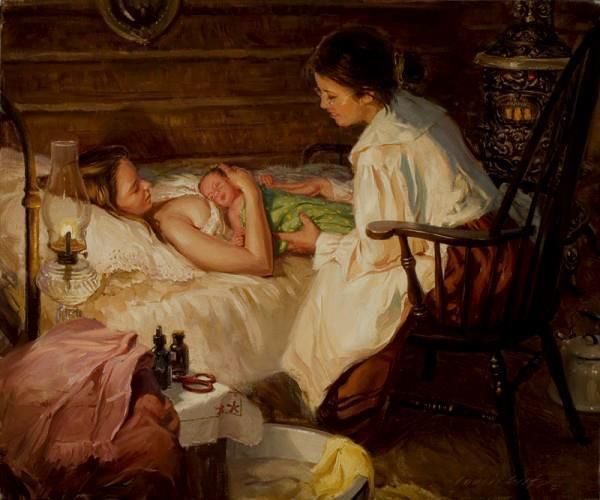
To understand our current crisis, we have to look back on the history of midwifery in the United States. It wasn’t always marginalized, in fact midwives used to be highly valued members of all communities. For centuries, birth was guided by midwives, often Black women, whose knowledge came from community traditions and spiritual practices. Ina May Gaskin, one of the most influential midwives of the 20th century, described spiritual midwifery as “the practice of caring and listening to women during birth. Before the abolition of slavery, Black midwives were deeply valued because their work supported the enslaved labor force. As put in Born Free, the more healthy black babies were born, the more of them white people could enslave.
When slavery was abolished, the safe and healthy birth by black women was seen as a threat to white people in power and multiple southern states, such as Alabama, Mississippi, and Florida made midwifery illegal. And as the 20th century began and medicine improved, a new rhetoric took hold that hospitals were safe and midwives were dangerous. Despite the fact that a majority of unsafe births were happening inside hospitals, not at home.
By the 1960s, most hospital births were heavily medicated. Women were often put fully to sleep and babies were delivered with forceps and vacuum extractors which jeopardized the health of mothers and babies.
An argument against this still resonates today: childbirth is not a disease and doesn’t inherently require hospitalization.
I want to make it clear that hospitalization and medical intervention is not at all a bad thing or something that women should be shamed for. Medical intervention can and has saved countless lives and helped women’s pain through labor. However, when it becomes the default expectation, and people don’t know they have a choice in how they birth or that there is the option to have someone to support, coach and advocate for them throughout their labor, it can cause painful physical, emotional, and financial consequences.
The World Health Organization estimates that 100 million people worldwide are pushed into poverty every year because of health care costs, with another 150 million people experiencing financial catastrophe. Women’s bodies during labor become part of a profit model. Doctors admitted in the Born Free documentary that the fear of lawsuits often drives decision-making which can lead to unnecessary and expensive procedures, rushed births, and scheduled inductions when allowing for birth to take a more natural flow could have been better for both mother and child.
This begs the question, what would our system look like if advocacy was the driving force of births in hospitals, not liability? Washington State answers this question with the lowest mortality rate in the country and has the most integrated system where midwives and physicians collaborate.
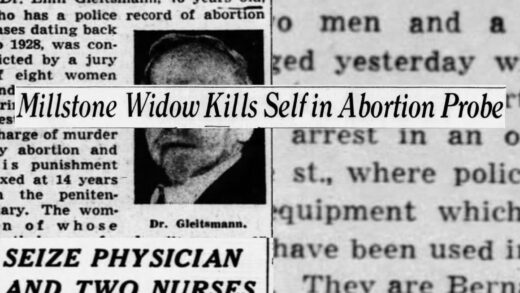
On June 24, 2022, the Dobbs decision was made and Roe vs Wade was overturned, reshaping reproductive care overnight. But Dobbs didn’t just change where one could receive abortion care, it also changed who was legally allowed to provide it. In some states, abortions can be performed by trained nurse-midwives, physicians’ assistants and nurse practitioners. Maryland passed such a law a week after Dobbes.
A report from the American Association of Nurse Midwives highlights a key question: in states restricting abortion, is it legal to learn abortion care? To practice it? Just to receive it? Or all three? This matters because midwives have always provided comprehensive reproductive care, including abortion care and miscarriage management. The International Journal of Midwifery, expanding midwives’ scope of practice post-Dobbs is essential for safe equitable access. Limiting their ability to practice doesn’t just restrict abortion access, it undermines a whole philosophy of care rooted in bodily autonomy, informed choice, trust, and community between women. Midwives and doctors regularly working together could drastically reduce our mortality rate
Midwifery is not an outdated practice, but the key to healthy and safe birth in many countries presently, and hopefully a regular practice in America’s future.
[Outro Music starts]
This has been Reclaiming Birth. Thanks so much for listening!
[Outro Music Ends]
Citations
Born Free: Birth in America. 2022.
“Healthy Birth Practice #5: Avoid Giving Birth on Your Back and Follow Your Body’s Urge to Push.” National Institutes of Health / PubMed Central. https://pmc.ncbi.nlm.nih.gov/articles/PMC4235063/.
Walsh, Linda V., and Joan J. Schuiling. “The Evolution of Maternal Birthing Position.” American Journal of Public Health 77, no. 5 (1987): 636–637. https://ajph.aphapublications.org/doi/pdf/10.2105/AJPH.77.5.636.
American College of Nurse-Midwives. “Midwives as Abortion Providers.” April 2025. https://midwife.org/wp-content/uploads/2025/04/2025-ps_midwives-as-abortion-providers_amended.pdf.
U.S. Government Accountability Office. “Abortion Access: Information on Health Care Workforce and Telehealth Regulations.” GAO-23-105861, 2023. https://www.gao.gov/products/gao-23-105861.
Goyal, Vinita, et al. “Privileging Midwives for Abortion Care.” Journal of Midwifery & Women’s Health. Accessed [n.d.]. https://onlinelibrary.wiley.com/doi/10.1111/jmwh.13577.
American College of Nurse-Midwives. Home page. https://midwife.org/.
Advancing Scope of Practice Toolkit. “State Abortion Laws and Their Relationship to Scope of Practice.” https://aptoolkit.org/advancing-scope-of-practice-to-include-abortion-care/state-abortion-laws-and-their-relationship-to-scope-of-practice/.
Connecticut General Assembly. “State Regulation of Advanced Practice Registered Nurses.” Report 2022-R-0167. 2022. https://www.cga.ct.gov/2022/rpt/pdf/2022-R-0167.pdf.“What’s illegal? To learn, to practice, or both? Recommendations for the midwifery field to respond to the post-Dobbs abortion crisis.” The European Journal of Contraception & Reproductive Health Care. 2025. https://www.tandfonline.com/doi/full/10.1080/13625187.2025.2502801.