A podcast is essentially a radio broadcast piece presented digitally. Podcasts are an increasingly popular medium, especially among younger listeners. According to the Pew Research Center, two-thirds of adults under 30 say they have listened to a podcast in the past 12 months. Of these listeners, two-thirds are currently listening to two podcasts or more.
Podcasts present engaging opportunities for students to create work or reconfigure existing work for a public and audio audience, augmented by multimedia elements. For these audiences, sentences must be shorter, use of sound and music provides impact, interviewees’ and hosts’ own voices can be heard, and concision is rewarded.
Methods
For the podcast, students write a script and collect interview clips, sound clips, and/or music to enhance their narrative. Assignments may ask students to create an audio version of scholarly or public-facing classwork produced earlier in the class, a relationship with pre-existing research and content that can help deepen the podcast content. The assignment can also be a stand-alone effort. Students can successfully produce podcasts individually, but this assignment lends itself excellently to group work, since multiple roles in both production and performance are required to successfully create a final product.
Podcast styles vary. The NPR-style reported piece is one option, as are long-form audio narratives such as the podcast Reveal by the Center for Investigative Reporting (see examples below).
Smith’s Educational Media Producers collaborate with faculty in the development, implementation and support of curricular digital media projects. These projects can be tailored for the needs of a specific class. To schedule a consultation for a digital media project, submit a ticket via this link: Learning, Research & Technology Support. Along with faculty discussion and training, Educational Media Producers offer in-class podcasting workshops that guide students through the process of group work, role development, script writing, and technology mastery. This project support also includes being available for students for creative and technical help throughout the semester.
For software, the Educational Media Producers currently recommend and provide class licenses to WeVideo. While nominally a video-editing program, WeVideo provides powerful audio editing and online collaboration options. Adobe Audition and Audacity are other podcast options available on Smith computers. The free program Audacity is a great tool to download for editing audio clips. Interviews or sound can be edited into bite sized chunks surrounded by narration.
There are a variety of excellently equipped media production spaces available on campus which can be reserved by faculty for class projects or by students individually. Additionally, Smith students, faculty, and staff can check out media production equipment at the Central Service Point in the Neilson Library ground floor Central Hall. A OneCard is needed for checkout. Items available for borrowing include cameras, recorders, microphones, production accessories. Please consult the equipment loans webpage to view a full list of equipment offerings. Students can also use audio apps on their phones.
Examples
Professional examples
The short NPR piece Om Nom Nom: T. Rex Was, Indeed, A Voracious Hunter relies on effective employment of standard journalist structure, bulleted below.
- Initial introduction by host (often deployed in multi-content radio shows).
- Introductory Hook – something timely or vivid to catch the reader’s attention.
- Nut graf – the meat of the story in a single paragraph – provides the main point or theme.
- Mechanistic Development – sequence of facts, quotes, and analysis that tells the story.
- Inclusion of quotes by experts – effective quotes employ key details, characterization, entertaining and clear analogies.
- Counterargument – usually occurs about two-thirds of the way through the piece.
- Conclusion – the broader meaning and implications.
The podcast and digital platform Reveal shapes their narratives by using a story arc to storyboard three types of events – framing narration (purple), plot points by reporter (blue), and reveals (green):
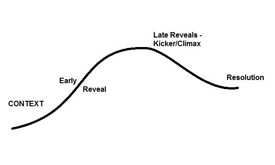
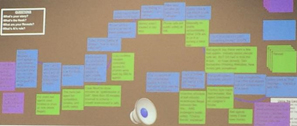
The right-hand screenshot is a Reveal rough draft, and would be edited to contain fewer (green) reveals, placed more strategically on the blue story arc. Every Reveal story also has a hook or news peg – why the story is current.
Student podcasts tend to be most effective when kept short, with 4 to 5 minutes long offering ample time for a targeted presentation. However, the following longer podcasts can be used for examples of effective podcast elements and structure. Some such aspects include: a collage of reported voices; a scripted “conversation” between radio hosts; reported on-the-ground sound effects; interviews with eyewitness, expert and political sources; narrative progression.
- Broken Ground – The Tip of the Ashberg (and other episodes): Environmental Justice in the U.S. south
- Living Planet: Deep Dive into Food Waste
The Conversation is a site presenting news and opinions exclusively by academic contributors. Examples of podcasts driven by scholarly information in a wide variety of disciplines can be found on their Podcasts page.
Student Examples
Numerous Smith courses assign podcast assignments. The following examples are available to the Smith community via WordPress:
-
- FYS 196 – The Language of Love
- ENV 311 – Interpreting and Integrating Information
Learning Goals
- Journalistic style
- Awareness of audience
- Effective presentation style
- Concision
- Consideration of audio and sound as a rhetorical tool
Multimedia Expansion
Podcasts can be adapted from written public discourse assignments like news articles (view module here) or op-eds (view module here). Websites or blogs (view module here), text-based social media (view module here), or Instagram (view module here) can serve to bring public attention to the piece.