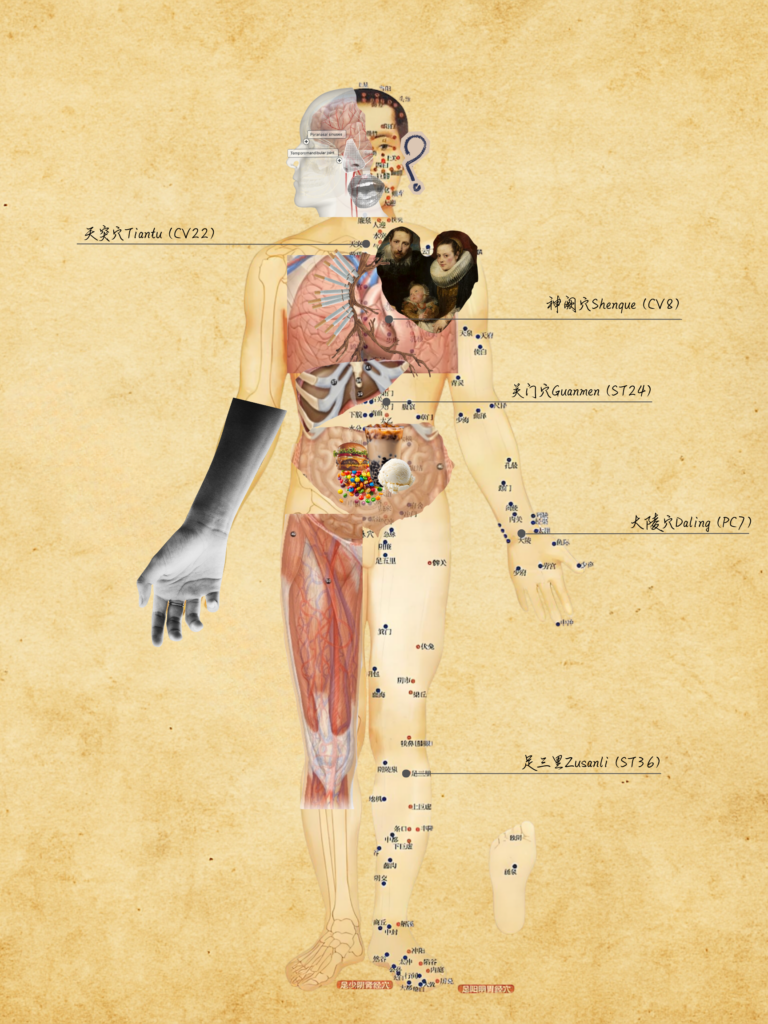
My project is a remixed body map that integrates traditional Chinese medical acupoint diagrams, three different biomedical body maps, and Anthony van Dyck’s Family Portrait. In the overall composition, I selectively collaged important parts of the human body from head to toe rather than fully covering it, allowing the base map to remain visible and the original bodily structure to stay visible. At the same time, I marked five acupoints that are considered significant within the system of traditional Chinese medicine.
In China, when people become ill, traditional Chinese medicine often treats the body based on specific symptoms by stimulating acupoints and meridians, such as through acupuncture or cupping, in order to relieve and regulate the body. Traditional Chinese medicine is a medical system deeply rooted in cultural tradition and represents a body of knowledge passed down over thousands of years, particularly suited to long-term rehabilitation and bodily regulation. However, with social development and the introduction of modern medicine, traditional Chinese medicine has become less dominant in contemporary society and is often questioned or criticized. Rather than positioning traditional Chinese medicine in opposition to modern medicine, this project explores the possibility of their integration.
Through this work, I aim not only to explore how these two medical systems can coexist and complement each other, but also to use the body map as a medium to call attention to the importance of caring for one’s own body and to invite reflection on how the body carries both emotional and cultural meaning. I use collage to illustrate that traditional Chinese medicine, and the visual composition encourages viewers to consider their own bodily experience more deeply.
I incorporated elements such as tobacco and junk food into the collage to point to the ongoing impact of modern lifestyles on the body. In the area of the lungs, I used withered branches and cigarette to symbolize the damage nicotine causes to lung health. In the area of the stomach, I collaged unhealthy foods such as hamburgers and milk tea, aiming to encourage young people to pay greater attention to their bodily condition and dietary habits.
As the project neared completion, I became increasingly aware that the body is not only a vessel for thought, but also a carrier of emotion and soul. We live continuously within our bodies, and therefore the meaning of the body extends beyond physical health alone. Based on this realization, I replaced the original scientific anatomical structure of the heart with Anthony van Dyck’s Family Portrait. Family gives rise to our lives and shapes our bodily experience, and the heart ultimately remembers this warmth and emotional connection.
The originality of my body map lies in the fact that I did not directly copy or replicate any complete body map. Instead, I brought together multiple elements—such as single parts from other body maps, paintings, and everyday objects—and recomposed them through my own process of collage. Through this process, these borrowed elements were not simply reused, but transformed and assigned new meanings, as discussed earlier.
As my body map goes through a process of transformation and remixing, the act that may be described as “plagiarism” no longer functions as plagiarism in its conventional sense. The work does not aim to reproduce or replace the original sources, but to reinterpret them within a new conceptual framework. Therefore, what is borrowed becomes a means of creating originality, rather than evidence of imitation.
Source key:
1.Traditional Chinese Medicine meridian charts sourced from commonly available online references and educational images.
2. Family Portrait (1621), Anthony van Dyck. Oil on canvas. Hermitage Museum. Image accessed via WikiArt.
3. Body mapping concept adapted from Comic Nurse, an online resource exploring visual representations of bodily experience.
4. Anatomical structures borrowed from BioDigital Human, a digital platform for biomedical body mapping and visualization.
5. Anatomical material borrowed from InnerBody, a digital anatomy resource used for biomedical visualization.