
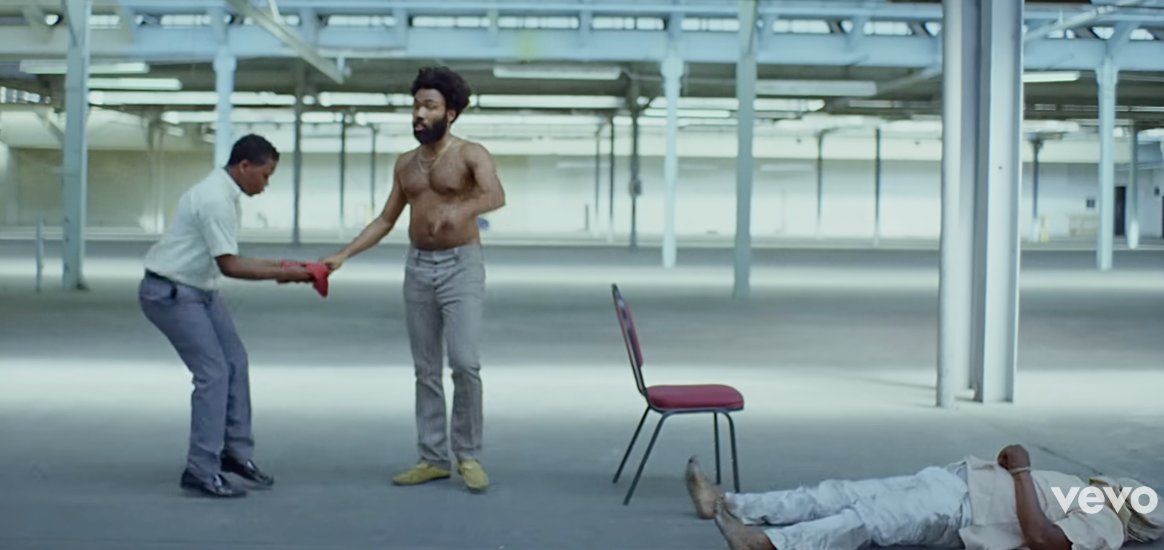
A man in gray school uniform pants dances with children as chaos erupts in the background. Cars are crashing, there is fire, people are running in fear, and then it all settles into a scene. The man has a joyful smile as he passes by the lovely choir singing. In one second, the smile fades away as the gun fires, and the singing is never heard again. And then, the man continues dancing as if nothing ever happened. The cruel reality is that this is America. Childish Gambino released a music video, “This is America, ” which is set in a big warehouse where Gambino is the center of the video as he dances along with children. There is violence and death around him, with no significant attention paid to it whatsoever. In the video, there are many layers of symbolism, and at first glance, you see certain meanings, but there is more to it after you watch it repeatedly. Sontag argues in her essay that critics and audiences spend too much time focusing on art’s meaning rather than its form. Art should be enjoyed for how it appears and how it makes one feel, not for what it depicts, through its hidden layers. She does not reject interpretation but calls for a more descriptive approach. While this descriptive approach applies to some art, it does not work on art that communicates through hidden symbolism that cannot be understood through feeling alone. A modern example that challenges Sontag’s thesis is Childish Gambino’s “This is America.” Throughout the video, Gambino performs odd poses that are meant to represent Jim Crow poses in the 19th century, the contrast between gun protection and Black death, and the reference to the Charleston Church shooting. These elements demonstrate that you can not just look at the video and feel it; you must understand what you are seeing, the hidden layers that must be uncovered.
(This is America 0:52)
To begin with, Gambino’s odd and exaggerated poses throughout the video are not random; they illustrate 19th-century Jim Crow poses that depict the central idea of racial performance. Gambino shoots a man at the beginning of the video. As he holds this stance, it is meant to capture that America is demanding Black people to act a certain way to entertain, and if they do not listen and continue with the show, violence is what follows. If you were just to feel the scene as what Sontag says, you’ll see a funny and strange pose mixed with violence, and think of it as odd, but when you understand the significance of that pose you’ll see the violence, racial humiliation and the systemic oppression against Black people in the United States, something that has been going on for over 400 years. From minstrels, a form of theater that was a show performed by mostly white actors, who wore blackface makeup with the motive to demonstrate racial stereotypes of African Americans. These shows would perpetuate stereotypes that Black people were lazy, sluggish, clownish, greedy, and fearful. These stereotypes aimed to show the world that Black people weren’t enough to be considered equal. And to this, the demand for them to perform continues to be placed upon them, in this America where they claim we are equal. Connecting back to his lyrics, when Gambino says, “This is America. Don’t catch you slippin’ now” (This is America 0:55- 0:56). These lyrics are a warning that one must stay alert; a simple mistake can mean the end for Black people in America if they do not perform as expected. This is later expressed with Gambino’s lyrics, “Look how I’m livin’ now. Police be trippin’ now” ( This is America 1:13-1:15), even as he is performing his dance, police violence will never be gone; it will always creep around, even when no one is looking. Sontag writes that “interpretation is the revenge of the intellect upon art” (Sontag 4) and that digging deep into the layers of art ruins the experience of art. However, Gambino’s Jim Crow poses demonstrate that this idea does not always apply. Anyone who sees the video and feels the pose thinks it’s just weird. However, someone who interprets it sees the racial humiliation that has been continued for about 400 years. Here, the interpretation is not a form of revenge, but the true brutality of the world we live in, which is trying to be hidden behind fake smiles that mask the truth.
(This is America 0:55- 0:56) (This is America 1:58)
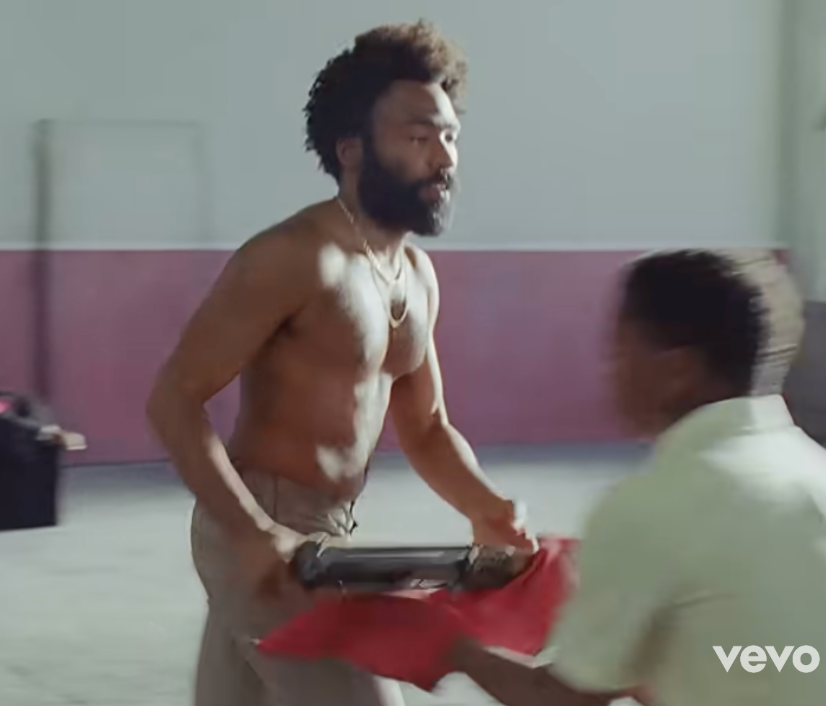
Furthermore, throughout the video, two scenes clearly show an evident contrast between how the gun and the Black body are treated. In the first scene, Gambino shoots a musician; the gun is immediately wrapped gently in a red cloth and carried carefully away, while the body is dragged quickly and with no care. This pattern is repeated throughout the video, where Gambino shoots a choir, and once again, the weapon is handled with care while the bodies are left there. The repetition of this demonstrates a continuous pattern that has occurred throughout history, where Black Americans have been killed by firearms at a higher rate than any other race. Even with the demonstrable evidence of numbers, the Second Amendment continues to be rigorously defended over Black lives. It’s not clear when this pattern will change, but Gambino makes sure that we are aware. Weapons are treated with more care and more protection, even after so many shootings; no laws or restrictions have been placed on guns. This shows how in America, a weapon has more value than a life, and Gambino makes sure we do not hide from the truth. Sontag demonstrates that “To interpret is to impoverish, to deplete the world—to set up a shadow world of meanings” (Sontag 4), but in this case, interpretation reveals something real, the true reality of the world we live in today. The way Black people are disposed of is not something that happens in the video, but it’s something that has been happening in America for centuries. Interpretation reveals the truth that no one wants to accept, which is silenced by threat.
(This is America 1:55)
Additionally, as the video progresses, Gambino dances and sings with a smile until it fades away as he murders a choir, a direct reference to the historic Black church in Charleston, South Carolina, known as the Emanuel African Methodist Episcopal Church. On June 17, 2015, Dylann Roof, a 21-year-old white supremacist, had entered a bible study where he opened fire and shot nine members, who tragically died. In the video, the choir sings joyfully and is suddenly killed without warning. Gambino keeps dancing as if nothing happened. This symbolizes how the Charleston church massacre happened without gun restrictions or action, and nothing was done. They simply kept dancing, showing how society moves on from Black victims without change, just like everyone moved forward after the Charleston shooting. Innocent lives were forgotten; no one paused. Time kept moving, the show went on, and we all kept dancing. No hesitation, no glance, just walking cautiously, yet no one stopped. The only thing that kept going was hate; it never stopped, just hidden in the cracks of silence. Sontag says, “The aim of all commentary on art now should be to make works of art-and, by analogy, our own experience-more, rather than less, real to us” (Sontag 10). Interpretation does this: if we do not understand the reference to the Charleston shooting, the scene just appears as a shocking event. But with the reference, it becomes a political statement about America’s actions and the continuous choice of silence over justice. Without interpretation, we simply pass the scene as if nothing happened, again ignoring the loss of the joy that once existed in pride.
“This Is America” proves that this isn’t something you can just sit back and experience. Both form and interpretation matter, but the art of this one, interpretation, is key to understanding what Gambino is trying to demonstrate in silence that is loud and powerful. Gambino made this video to show us that, for centuries, America has been trying to hide so much from us, to keep dancing and never stopping, but we get tired, the music slows down, and we take a break. We look up, and we see the truth that was always in the background. It helps us understand the injustices many artists are trying to expose worldwide. Artists like Gambino carry so much of the truth about history, and they express it through hidden meaning. We will never understand the idea of gun culture, racial violence, and just the horrible things that have happened in the world if we just feel it. Some art is meant to wake us up from the reality around us. We must feel art, but also understand its meaning and the hidden messages it conveys, because sometimes the most important things are hidden in a pose or in a choir that never finished the song.