Behind the White Mask: Experiencing Art Beyond Interpretation in Sleep No More
Imagine being stripped of your identity behind a white mask and forced to wander alone in a dark, sprawling hotel, separated from your friends. In this space, you cannot talk; you cannot share opinions; you can only breathe, feel, and take action. This is the world of Sleep No More, a production that challenges everything we know about watching a play. Last summer, during a trip to Shanghai with my theater classmates and teacher, I had the opportunity to immerse myself in this haunting environment. This production was different from any traditional theater I had ever seen. Its sensory-rich and engaging nature made me reconsider the connection between live performance and Susan Sontag’s core arguments in Against Interpretation. In her essay, Sontag critiques the modern obsession with meaning and argues that we should focus on the immediate, physical surface of art rather than trying to translate it into intellectual summaries. By making the people focus on the physical experience rather than the plot, Sleep No More forces participants to wake up their senses which shows Sontag’s idea that art should be felt, not just explained. To support this, I will examine how the production’s physical environment, narrative structure, and behavioral agency work together to bypass the intellect and achieve a truly visceral encounter with art.
First, the awakening of the senses begins with the physical environment of the McKinnon Hotel. Within this space, the transformation of the audience into hotel guests effectively breaks the fourth wall, forcing us to engage with the setting not as observers, but as active participants. This shifts the focus from a detached narrative to the physical details of the environment, embodying Sontag’s concept of “transparency” (Sontag 9). In this context, transparency means that the artwork’s physical surface is so vivid and intense that we can experience what it is without needing to interpret what it means. Immersed in this environment, we encounter a detailed design featuring authentic 1930s furniture, weathered letters, and tactile textures that demand sensory focus. Since the production is immersive and non-dialogue, we can also get as close to the actors as physically possible. By watching the performance from such proximity, we fully experience the tension, hearing the actors’ heavy breath and witnessing their physical exertion.
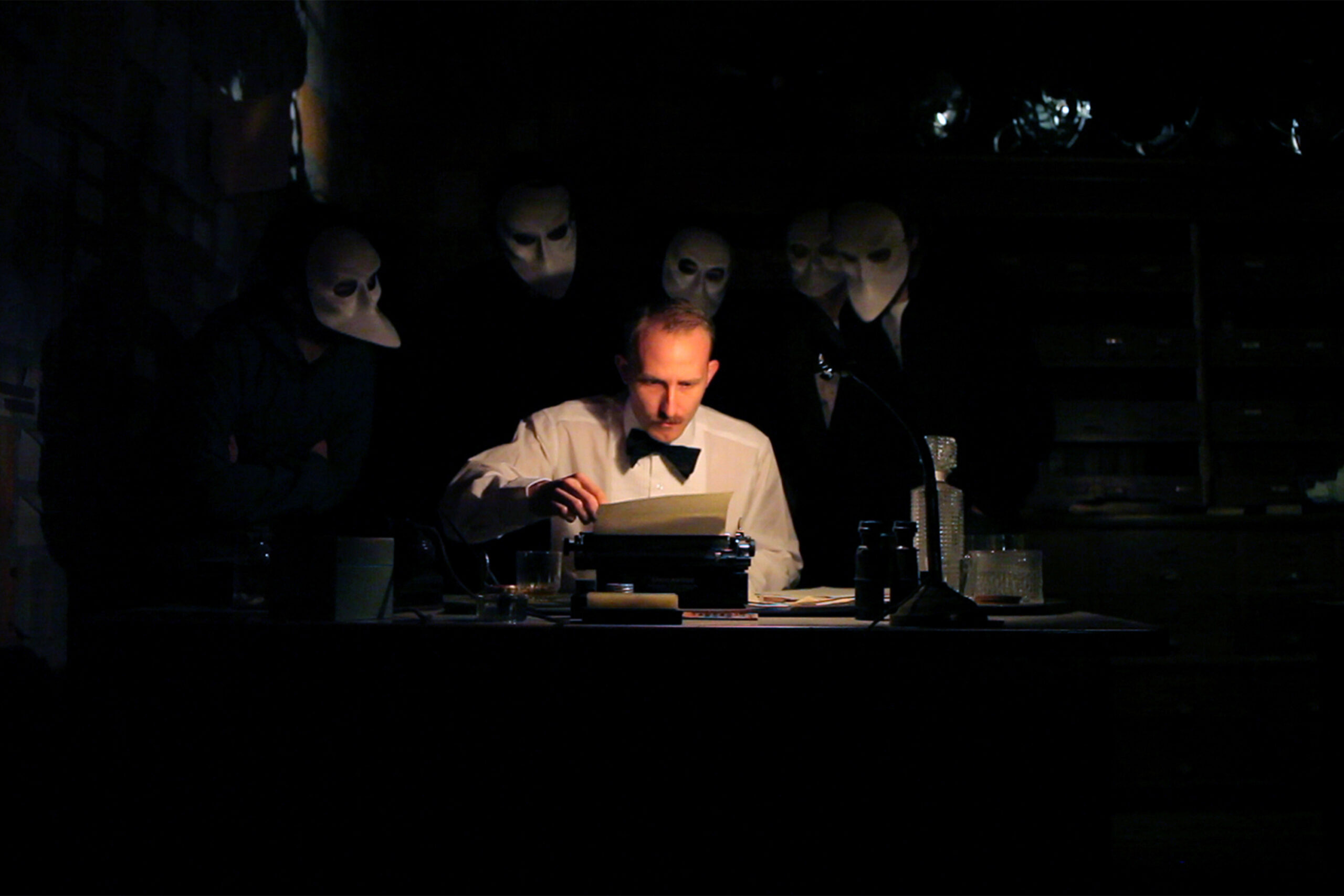
The impact of the physical environment is further manifested through the precise control of lighting. For me, the most impressive setting was the “Eden” forest. The exaggerated, colorful lighting stands in sharp contrast to the dim atmosphere of the rest of the hotel. This sensory saturation makes every facial expression and movement stand out as constant flashing lights fall on the actors’ faces. Furthermore, the mandatory white mask for each guest also acts as a sensory filter. By stripping away our social identity, it instead sharpens our eyes and ears, forcing us to focus on the immediate, unfolding moment of the environment and actors. Ultimately, these physical elements are not mere symbols, but they represent the “luminousness” of art in itself (Sontag 9). By this, Sontag means that the artwork should be experienced as a direct, shining reality, rather than a container for hidden meanings. This allows guests to move beyond the need for intellectual translation and instead achieve a visceral pleasure—experiencing, as Sontag says, “things being what they are” (Sontag 9).
Secondly, the narrative is fragmented, non-verbal, and entirely non-linear. This combination intentionally disrupts the guest’s impulse to decode a logical plot, forcing a surrender to pure sensory experience. Although the production is based on Shakespeare’s Macbeth, a story I already understood, the absence of dialogue and the multiple simultaneous storylines occurring across five floors made it impossible to maintain a unified intellectual structure. Any attempt to stay sharp is further blurred before entering, as guests are served a low-alcohol drink to lower the intellect’s guard. Once inside, the structural chaos takes over.
Because the show runs in three repetitive loops, guests can choose how deep they want to go. I experienced significant frustration and exhaustion during the first loop while trying to figure out the story. However, the multiple storylines made me fail. Recognizing this, I changed my approach for the final two loops. Instead of chasing the whole plot, I followed only two characters.This shift brought instant relief: I stopped decoding the play and started living it. As Sontag argues, “to interpret is to impoverish”(Sontag 4). When a viewer spends their energy trying to piece together the fragments of Macbeth, they are retreating from sensory reality into a “shadow world of meanings” which means replacing the vivid, physical experience with a dry, intellectual summary (Sontag 4). By exhausting the audience’s intellect, Sleep No More removes this layer of abstraction and forces a direct encounter with the performance. The experience reached its peak during private 1-on-1 encounters. These moments, such as receiving a red lipstick kiss on guests’ masks or being taken into a small room to hear a private whisper, are deeply personal. Because of their privacy, they cannot be turned into a collective, logical meaning.
Lastly, the mandatory isolation and freedom of movement force guests to explore the play individually. This begins with a strategic separation at the entrance. Guests draw playing cards to determine their entry order, and staff members intentionally split up friends and couples in the elevator, pushing them out onto different floors. Without the ability to check opinions with others, guests must process the experience entirely through their own instincts.
The agency of “The Chase” further puts the guests in control. Since we can decide how to experience the play, the choice of whose perspective to follow is entirely in our hands. During the final loop, I chose to follow Macbeth as closely as possible, transforming my experience into a series of active, physical choices rather than passive observation. I realized that if I wanted to see more, I had to physically keep up with his pace. Since what I experienced depends totally on my own movement and desires, I was forced to “learn to see more, to hear more, to feel more” as Sontag states (10). This physical freedom replaces intellectual analysis with a direct, raw connection to the art, reinforcing Sontag’s argument that art should be felt rather than interpreted.
To conclude, Sleep No More is a perfect example of Sontag’s vision: art is not a puzzle to be solved, but an experience to be felt. By using real settings, fragmented stories, and individual freedom, the play prevents us from translating everything into logic. When our brains finally give up on finding a fixed meaning, the art becomes alive through our senses.
In our fast-paced world, we are used to searching for meaning before we even encounter the art itself. My own experience is a perfect example of how hard it is to let go. Before the show, my first instinct was to research Macbeth online so I could understand it better. But in the hotel, this intellectual preparation was useless. Sleep No More serves as a workout for my senses, pulling me out of my logical mind and returning me to a world of smells, touch, and heartbeats. Ultimately, what we need is not art that proves we understand it, but art that teaches us how to see, hear, and feel again. In the silence of the McKinnon Hotel, when an actor leaves a lucky red lipstick kiss on our anonymous white mask, it becomes the ultimate proof of an experience that cannot be translated. It is a moment that belongs only to the senses, achieving what Sontag calls an “erotics of art” (10).
Works Cited
Sleep No More. Directed by Felix Barrett and Maxine Doyle, Punchdrunk, 2011. McKinnon Hotel, Shanghai.
Sontag, Susan. “Against Interpretation.” 1964, pp. 1-10.