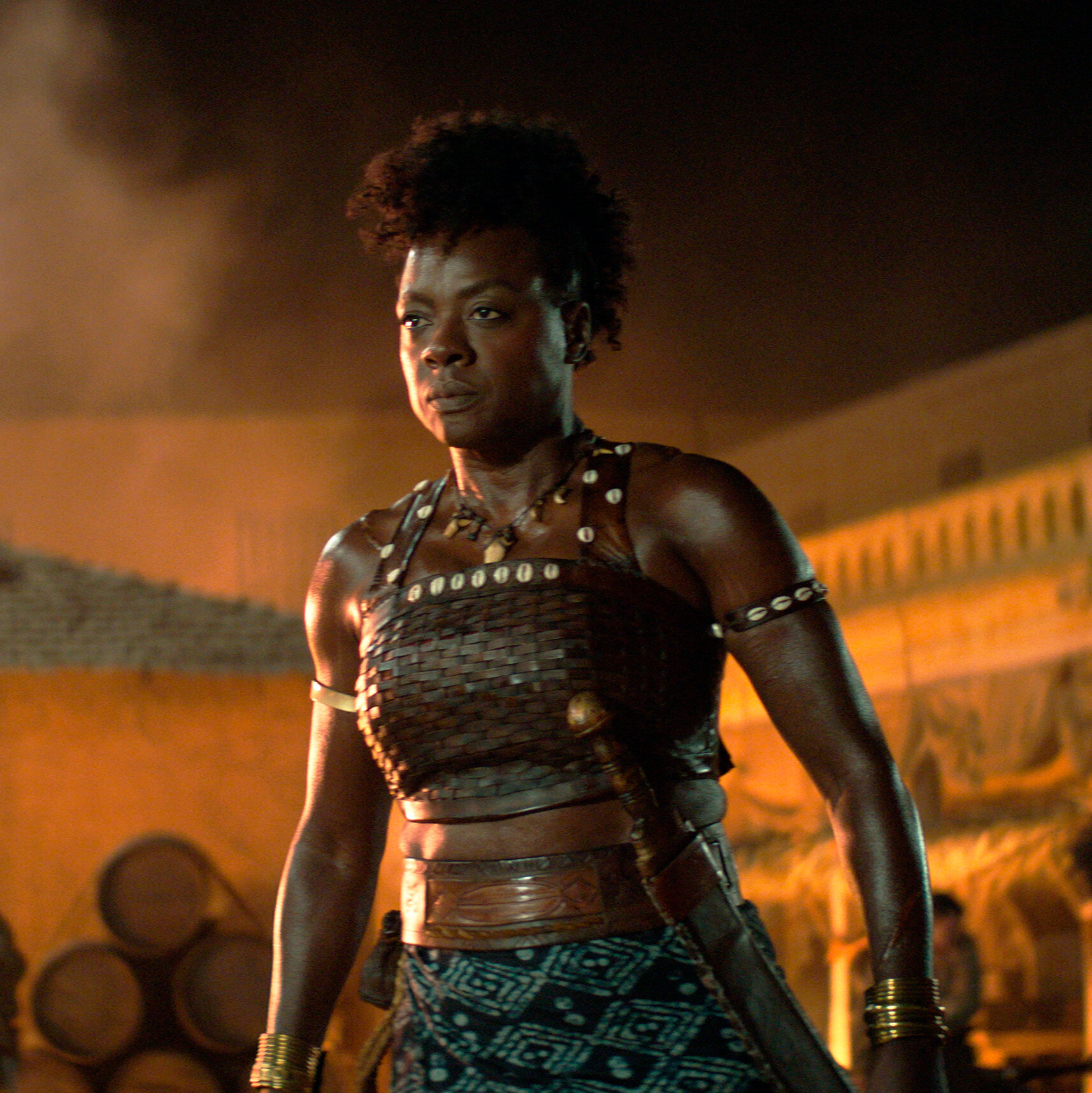
In 2011, Viola Davis was nominated for an Oscar for her role as Aibileen Clark in The Help. In 2018, in her interview with the NewYork Times, the actress shared that she regretted the role: “I just felt that at the end of the day that it wasn’t the voices of the maids that were heard.” She explained that The Help failed to center the maids’ real voices, catered to White audiences and flattened the humanity and complexity of Black women into something easier for Hollywood to digest. Davis’s critique highlights a broader pattern in mainstream cinema, where Black women’s representation is still shaped by narrow perspectives and persistent stereotypes. These limitations have pushed many Black feminist actresses and producers to create films that approach Black womanhood differently by offering fuller agency to the black female characters. When The Woman King premiered, Davis referred to it as her “magnum opus”—a film that, for her, finally offered the kind of representation she had long wished for as a child who felt unseen. The movie was inspired by the true story of the Agojie, an all-female army that protected the West African Kingdom of Dahomey in the 1800s and tells the story of these female warriors from their perspective in a time of slavery and oppression. It features Viola Davis as General Nanisca, alongside Thuso Mbedu as Nawi and Lashana Lynch as Izogie. With narrative choices and character portrayals that focus on the agency and complexity of the female warriors, The Woman King challenges and reframes representations of Black women and offers a more nuanced understanding and celebration of their experiences.
As the Dahomey kingdom’s elite defenders, the Agojie embody an innate strength and power, which is different from earlier portrayals that frame Black women’s strength as reactive. The movie begins with Nanisca and the troop she commands emerging from a bush as they charge toward the Mahi village. The following scene is a ruthless battle that the Agojie ultimately wins. Returning from battle, they are praised and respected in Dahomey. This is no conventional beginning: the Agojie, Black women, are introduced as warriors with culturally sanctioned power. Perhaps, a more customary beginning might resemble the 1985 film adaptation of Alice Walker’s The Color Purple. Its opening scene shows Celie, a young Black girl living in the rural South, narrating how she is abused by her father and how after impregnating her, he would take away her babies. The movie immediately sets the tone of her isolated vulnerability and powerlessness, which frames the rest of the story. In her essay Revolutionary women making ourselves subject, bell hooks examines The Color Purple’s narration as one that overemphasizes the journey, urging spectators to stop there and romanticize the struggle without questioning the journey’s end(57). While hooks’ analysis focuses on how Celie is reinscribed within the context of family and domestic relations after breaking free from the abuses, highlights a failure to portray true radical political transformation, the film also fails to depict Celie’s resilience and power outside her extraordinary, silent capacity to endure relentless physical, sexual, and emotional abuse. In contrast, in The Woman King, even the characters’ struggles—such as Nanisca’s past as a rape victim and her nightmares resulting from the trauma—do not serve as the foundation of her strength. These aspects are revealed later in the movie, well after her formidable power and leadership within the Agojie have been established. By reversing the narrative priority, the film presents Black women’s strength as innate and proactive from the very beginning.
Building from this striking beginning, The Woman King follows the characters’ journeys of resilience, agency and self-determination, challenging portrayals of Black women as only caretakers or self-sacrificing. Black female characters are often portrayed as hardworking figures who must juggle numerous responsibilities. In Black Feminist Thought, Patricia Hill Collins defines such limiting portrayals as “controlling images”—“stereotypes or specific negative representations… perpetuated by the dominant culture… to justify oppression and make forms of social injustice appear natural, normal, and inevitable”(4-5). These images are exemplified by the Mammy Trope which depicts Black women primarily as caregivers (such as Aibileen and Minny in The Help) and the more complex but equally damaging Strong Black Woman (SBW) trope. This trope presents Black women as tireless, self-sacrificing workers who handle excessive responsibilities and often in service of others, ultimately reinforcing the expectation that they must prioritize others’ needs over their own well-being such as Olivia Pope in Scandal and Annalise Keating in How to Get Away with Murder. Differently, the Agojie of Dahomey have their motivation grounded in self-defined determination to contribute to a collective political purpose, not in sacrifice for family or romantic love. For example, in her before-battle speech, Nanisca tells the Agojie, “We fight for Dahomey,” showing that their purpose comes from a shared commitment to the nation. Similarly, when Izogie tells Nawi, “This is the life we have chosen, we survive in our own way,” and “You are powerful, don’t give your power away,” it shows that the Agojie act with agency, as fighters by choice. Also, Nawi joins the Agojie after refusing an arranged marriage to an older man. However, even after developing feelings for Malik (a member of Portuguese traders who is half Dahomean), she remains committed to the Agojie, prioritizing her duty and independence over romantic love.
The commitment to self-definition of Nawi’s character (played by Thuso Mbedu) is also commendable, she is brought to the Agojie by her father as punishment for refusing an arranged marriage. Within the Agojie, Nawi finds a new family and mentorship especially from her close friend and leader, Izogie. She quickly proves herself a skilled fighter, winning the contest that qualifies her for the Agojie, yet her independent personality continues to shine as she questions some of their rules, such as why they are not allowed to marry like the male soldiers. She often gets in trouble for going out of the plan to help fellow fighters. While Nanisca often interprets this rebellion as recklessness, it reflects Nawi’s determination to act from her own moral compass rather than submission. In this sense, The Woman King aligns with hooks’ call for representations that center Black women’s agency and complexity(52). While the sisterhood within the Agojie offers mentorship and support, Nawi’s growth does not depend on external validation or collective strength alone. Instead, she discovers her sense of purpose and power from within. This internal awakening contrasts with portrayals that frame Black women’s empowerment as arising solely through solidarity or suffering. By showing Nawi’s journey toward self-realization within, yet not confined by, the sisterhood, the film echoes hooks’ vision of Black womanhood as self-defined and multifaceted.
The Woman King is, at its core, an epic action film with a narrative that blends history with fiction. Many of its central characters like Nanisca and Nawi are not drawn from specific historical records. This made the movie subject to much criticism and even the #BoycottTheWomanKing campaign. In the article “Woman King is worth watching: but be aware that its take on history is problematic,” the author argues that the film distorts the past and portrays the Dahomey ancestors as “savage”. These critiques frame the film as racially irresponsible or misleading. The filmmakers and cast, however, rejected the interpretation by emphasizing the greater purpose of the movie as an art. Producer Julius Tennon described the project as fictional “edu-tainment” emphasizing that it was designed to entertain and inspire rather than provide a literal historical account. This intention was clearly fulfilled seeing how the audience responded with excitement and chants in theatres, and positive reviews online, particularly with Black women who felt seen and represented in such a way for the first time. In a study by Nigerian researcher Adanma Vivian Obiora on the film’s influence on young women’s perceptions of feminism, many participants identified deeply with its themes, from the mother-daughter bond between Nanisca and Nawi to representations of leadership, resolve, and female strength(1-11). Ultimately, The Woman King’s purpose is not to serve as a documentary, but to inspire, especially young Black girls who long for and crucially need powerful and dynamic characters who look like them and from whom they can draw strength. The criticisms of its historical inaccuracy, in fact, reveal how unsettling it can be for audiences to see Black women finally take center stage in their own story.
The Woman King became a globally recognized and successful movie, named one of the top ten movies of 2022 by the American Film Institute and the National Board of Review. It is iconic and incredibly entertaining, but for audiences who have long navigated a world without mirrors of their own experience, The Woman King is more than entertainment. Specifically, for girls who grew up feeling unseen or constrained by societal expectations, the film offers a reflection of their potential. Representation in film matters because it shapes how we see ourselves and others. Characters like Nanisca, a strategic and courageous leader; Nawi, witty, inquisitive, and determined; and Izogie, a fierce and nurturing mentor, embody diverse aspects of the natural Black womanhood that does not come from the external rather internal self-actualization. The Agojie fight not only for a cause but with the confidence that they are already victors in spirit, both on and off the battlefield. In portraying Black women in this dynamic and multidimensional way, the film invites viewers to imagine themselves beyond imposed boundaries, reshaping the narrative of Black womanhood in cinema.