Before

After
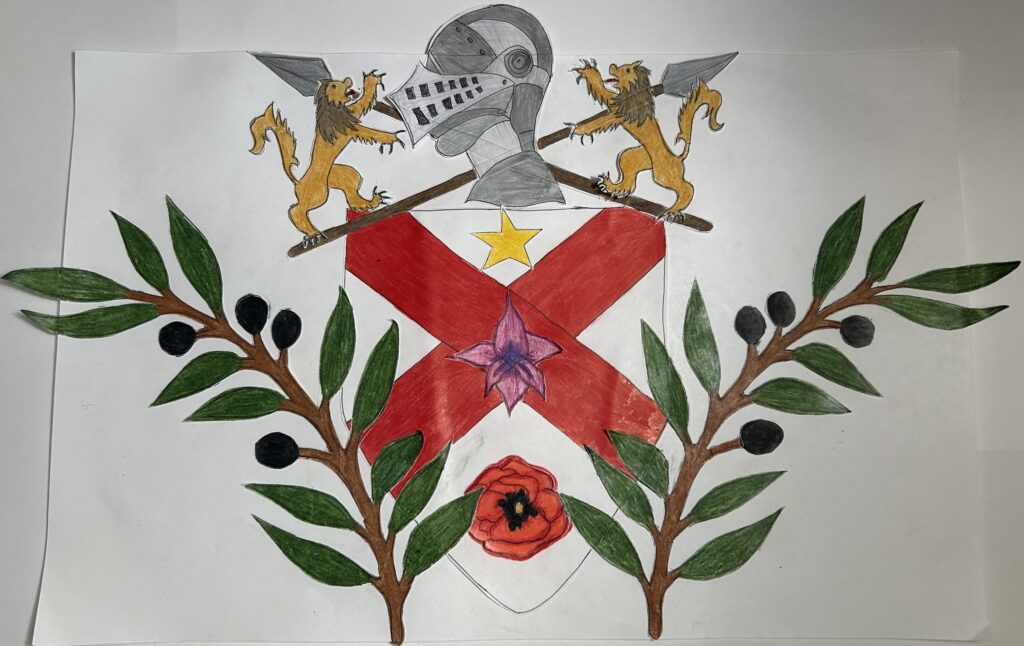
The aim of my project was to more thoroughly represent my individual identity, familial history, and life experience within a historically significant object. To accomplish this, I chose to remix an Irish family crest, specifically that of the FitzGerald clan. My direct ancestors were members of the FitzGerald clan and immigrated to the United States during the Second Irish Potato Famine around the 1850s. However, before their immigration, my family was a prolific and quite powerful clan of Ireland with extreme military power, even owning the Glin Castle that still stands in Ireland today in Limerick. I have always felt a significant connection to this side of my heritage, especially considering I was given the middle name FitzGerald, as it is my grandmother’s maiden name. I have always been curious about that aspect of my family history, especially with the cultural symbols that accompany it. However, although the original crest does a strong job at depicting one facet of my ancestry, I wanted to remix this artwork to better represent the other aspects of my heritage, as well as some factors of my more current life that I believe directly impact the person I am at this point in time.
To do this, I began by deciding what aspects of the crest I wanted to keep. Although there are many variations of the FitzGerald family crest, a large, red criss-cross pattern is consistent across all designs. The white background denotes sincerity and peace, while the color red symbolizes fortitude. The specific pattern of the red cross is known as the Saltire, or St. Andrew’s Cross, which is a symbol of resolution, so I decided to keep it as a representation of my family’s resilience over our history as an aspect of my reimagined coat of arms. Next, I made the addition of a knight’s helmet and two crossing spears to represent the militant history of my family. Throughout Irish history, the FitzGerald clan was regarded as a strong and formidable warrior clan, with the root “ger” in the name literally meaning spear. The knight’s helmet is used to both represent the history of the FitzGerald’s clan and their soldiers, as well as as a reference to the family crest of my Italian ancestors, the Cristianos, whose crest depicts a silver knight’s helmet. The Cristiano crest also displays several yellow stars, one of which I included in the center of my reimagined crest. Additionally, the olive branches on the sides of the crest represent the other aspects of my heritage, as the Italian side of my family were olive farmers prior to their immigration to the United States.
The name FitzGerald can be loosely translated to mean “sons of Gerald”, but that definition is very far from my identity as a woman who was raised in a household of entire women. To demonstrate this, I replaced the typical animal found on the FitzGerald coat of arms, the monkey, with lions, since they are matriarchal animals. Lastly, I included both a gladiolus and a poppy flower in the center of the crest, primarily because, upon my family’s arrival to America, they made a portion of their living from selling flowers. Additionally, gladiolus and poppies are flowers associated with the month of August, which is the birth month of roughly half of my current family members, including myself.
This project employs critique because it creates a new expression of perspective on an older object. To remix is to reinvent and to change something in a way that improves it in the eyes of the individual doing the remixing. Remix can function as critique, because the implication of a body of work requiring a remix implies that it is flawed in the eyes of the viewer in some way in its current state. With a broader and more diverse world, society requires art that provides more duality to better represent the overlapping identities of many individuals today. The FitzGerald family does not only exist in their castle in Ireland anymore, they are all over the world and leading a variety of different lives with different personal and familial history, which was the core message of my remix. It is now a common practice for creatives to reinvent stories that previously did not aim to depict or appeal to their demographic. Society is seeing this action as a very prevalent trend, where, for example, a director will create a remake of a film, depicting a beloved character in a way that more people can identify alongside. This effect was exactly my goal with the reinvention of my family crest, as I wanted to create something that those in my family, and myself, could interpret as something that encompasses significantly more of our lineage and cultural identities.
The relationship between remixing, originality, and identity revolves around interpretation. Although one could argue that a remix of an already existing work is not necessarily an original work, there is also truth in the fact that a reimagination of something that already exists provides a unique identity and new content. This recreation, even if it is an exact retelling or a “copy”, provides the audience with an opportunity to see the work through the eyes of someone besides the original creator, which is, in and of itself, a method for creating originality. This type of remix creates originality because it frames the same content from a new perspective, adding layers to the identity of the body of work based on now both its original creator and the remixer. With these added layers, the new interpretation of the work is now much more applicable to a greater number of people. My work reflects this method by taking a piece of work, the FitzGerald family crest, and adding to it in a way that restructures it as a more modern representation of who I am. I did not dispose of the original crest, nor did its significance disappear. Instead, I simply remixed it to create a symbol of who I am today, in relation to an important aspect of my cultural identity.