Save
Purposes and Aims
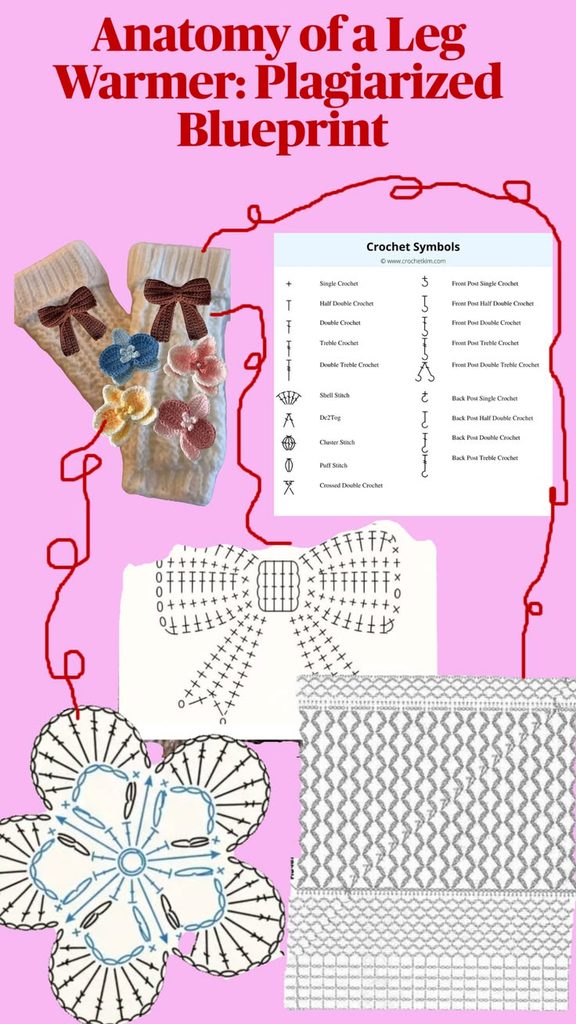
My project, Anatomy of a Leg Warmer: Plagiarized Blueprint, explores how craft knowledge is passed down through visual systems rather than written text or spoken word. My main goal was to build a functional blueprint for a garment I actually want to make, a pair of ribbed leg warmers with bow accents and flower motifs, using entirely borrowed stitch diagrams, symbols, and reference photos. I specifically chose crochet because I wanted to create something practical that I plan on physically making soon. By taking separate, existing charts and rearranging them into a single board connected by a drawn strand of yarn, I wanted to see how individual pieces of design can be pulled from different authors and put together into an original composition.
Source Selection: Why Diagrams Over Text or Video
When picking my source materials, I made a conscious choice to use vector symbol charts instead of standard written patterns or YouTube tutorials. Written patterns rely on heavy shorthand (sc, dc, sl, st) that can feel rigid, and video tutorials can be slow or annoying to scrub through. Visual stitch diagrams have always challenged me in a good way because they force you to read a completely visual language. Crochet charts are basically spatial blueprints: every symbol represents a physical stitch, and their placement shows you exactly where your hook needs to go. By gathering four distinct visual sources, a stitch symbol key, a bow motif diagram, a floral blossom chart, a ribbed mesh grid, and a physical reference photo,I collected the foundational “code” needed to build the piece. These charts transcend language barriers; anyone across the world can look at them and execute the stitches without needing translation.
Arrangement
I organized these sources into a schematic composition, using a hand-drawn red strand of yarn to physically link the components together. The red yarn loops from the physical leg warmer photo up through the symbol key, down past the bow diagram, around the flower chart, and into the body mesh grid. This red thread acts as a visual map showing how separate borrowed diagrams combine into one complete physical item. Rather than placing the source key on the board itself, I incorporated the citations directly into this reflection:
- Legwarmers (legwarmers)
- https://thepinkcraftbox.com/crochet-bow-pattern-with-tails/(bow)
- https://chubbiesbyash.com/how-to-crochet-orchid-flowers-pattern-tutorial/ (flowers)
- https://crochetkim.com/crochet-symbols-charts/ (Crochet Symbols and Charts)
- https://www.pinterest.com/familianegretenavas/ (Crochet Bow Chart)
- https://theworldcrochet.com/crochet-sakura-flower-keychain-pattern/?utm_source=Pinterest&utm_medium=organic (Flower Chart)
Is This Plagiarism Really Plagiarism?
This project sits right on the line between direct plagiarism and original work. On one hand, it’s 100% plagiarized: I did not draw any of these stitch symbols or design the individual charts myself. Every piece of visual code was taken directly from published craft sources.
However, the final piece is original in how it was curated, arranged, and synthesized. In crochet, individual stitches are open-source building blocks that no one can actually own. By taking separate, public diagrams and mapping them together into a unified blueprint, I turned different instructions into something new. My plagiarism is not about stealing an idea; it is translation and remixing visual code to express a fresh and new idea.