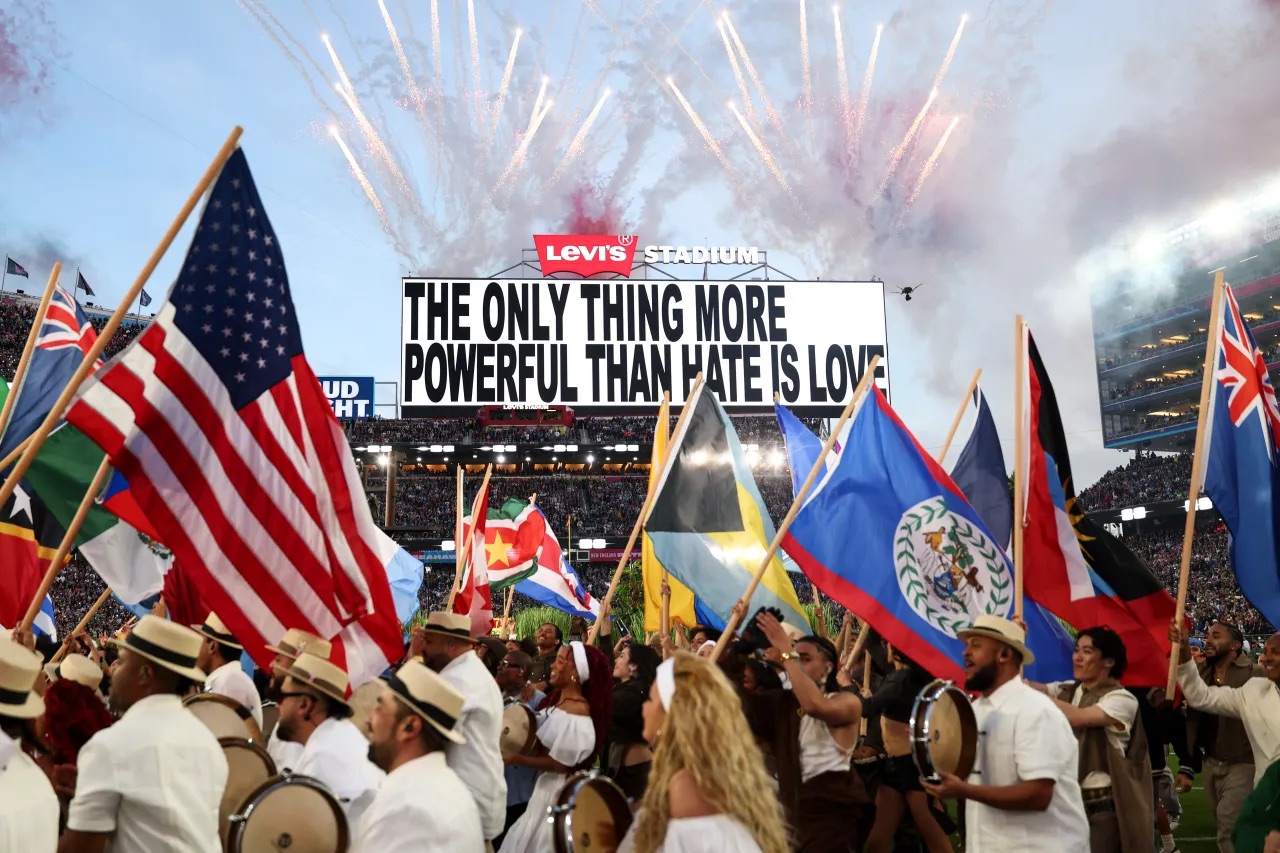
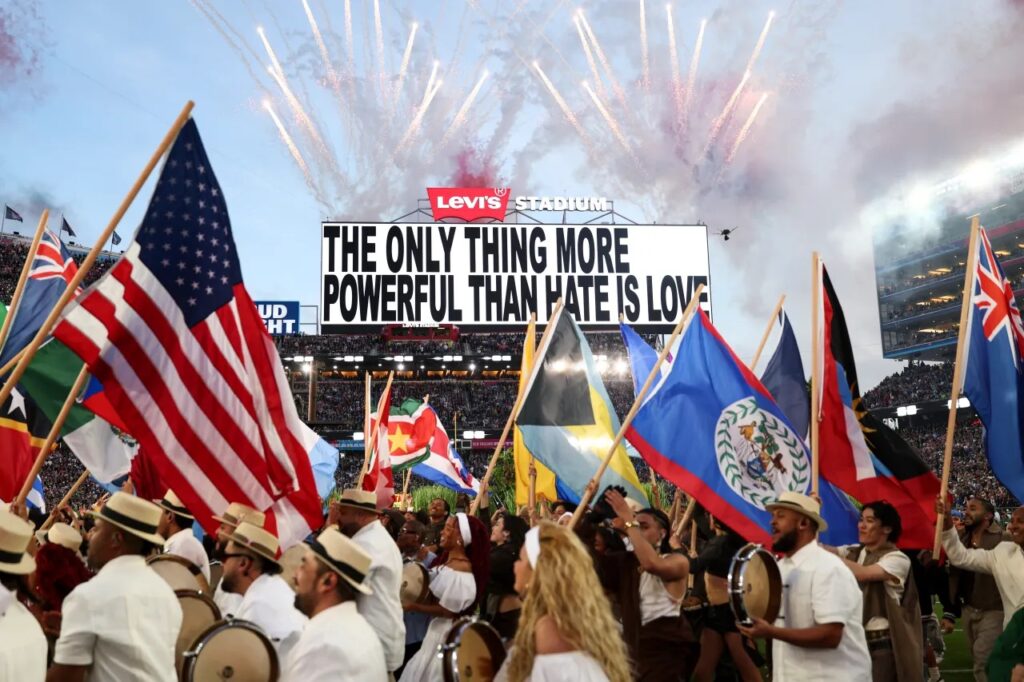
This year’s halftime show was performed by Bad Bunny, a Puerto Rican rapper known for his reggaeton and Latin trap music. The simple fact that he was going to perform had people divided on the idea of having him perform at an American sporting event. Many were infuriated by the show, claiming that it was difficult to understand what he was saying because he mainly sang in Spanish, making it “unfair” to non-Spanish speakers. All music and dance are forms of art that have been used for entertainment purposes, such as the Super Bowl halftime show. In Walter Benjamin’s essay “The Work of Art in the Age of Mechanical Reproduction”, he makes a point that art has become a form of expressing opinions on politics rather than catering to entertainment. The Bad Bunny Super Bowl halftime show was not just a fun performance with good music; it was a political statement. From the artists who performed to the delivery of the performance, every decision behind the performance was intentional for a greater purpose.
The choice of artists for the halftime show has extreme significance at this time period. First was the main performer, Bad Bunny. He has won six Grammy awards, three of them being awarded at the 2026 Grammys this year. Given that he was born and raised in Puerto Rico, the majority of the music he has produced is in Spanish, and the majority of his audience are Spanish-speakers. He comes from an incorporated U.S. territory, so although he is an American citizen, he is treated with disrespect and isolation. Choosing Bad Bunny to perform represents Puerto Rico and the Hispanic community in the United States. In Benjamin’s essay, he explains that “The aura which, on the stage, emanates from Macbeth, cannot be separated for the spectators from that of the actor” (Benjamin 10). This implies that the emotions conveyed by the actor’s performance have a significant impact in bringing life to a work of art. This is why Bad Bunny and the chosen surprise artists, Lady Gaga and Ricky Martin, are important in this performance because of the roles they play in American culture. Lady Gaga, a white woman and English speaker, sings a song about love in English in the form of a salsa rhythm. Her presence at the halftime show creates a bridge between English speakers and non-English speakers, showing that language does not define who is American. Ricky Martin, another Puerto Rican singer, only sang in Spanish during the show. It is impactful because when he was beginning his career, the Hollywood industry told him that if he created Spanish music, he was not going to be successful. Given that background about him, the song he sings speaks about what the United States did to Hawai’i and how Puerto Rico needs to stand strong to prevent it from happening to them. Both of these surprise artists represent the LGBTQ+ community, which is another oppressed group in the United States and throughout the Americas that is being impacted by the current state of politics.
Before television, you would have had to pay a lot of money to acquire tickets to have an in-person experience of this kind of performance. Now, these shows are easily accessible through national television or other livestream platforms, making it easier to reach a greater audience. The majority of the audience that watches the Super Bowl is American because football is a predominantly American sport that holds a lot of history. Increasing accessibility has helped expand the audience that watched the halftime show and spread a powerful message throughout the United States and potentially outside of the country. This is supported by Benjamin’s claim that “for contemporary man the representation of reality by the film is incomparably more significant than that of the painter…thoroughgoing permeation of reality with mechanical equipment, an aspect of reality which is free of all equipment” (Benjamin 13). He argues that filming art has become more impactful than being there in the moment to see it. His essay was written in 1935 as a response to art being reproduced through the lens of a camera. Benjamin explains that the introduction of film and the camera reduced the need to be in attendance at the act, which opened the door for a new form of art. The same ideas still apply now in the 21st century, when we get on YouTube, Netflix, Hulu, or any other streaming service. Rather than expecting people to find a way to get to the place, we bring the place to the people. Given the political climate at the moment, the message being sent at the halftime show is one that the producers wanted a greater audience to receive. The performance was for entertainment to an extent, there was opinion involved, and that is the point at which spectators began to have a difficult time with it.
Benjamin made an observation that the use of the camera has altered what the audience sees because the person behind the camera decides what the focus is on. The part of the audience that watched the Super Bowl in-person did not have the same experience as the people who watched it on the livestream. Viewing it from the stadium, the audience has the opportunity to see everything with their own eyes, but they are not following the story being told through the performance. While watching it from the livestream, the camera shifts the focus for the viewers. The person filming has the ability to “comprises certain factors of movement which are in reality those of the camera, not to mention special camera angles, close-ups, etc” (Benjamin 9). Every moment of the performance that was livestreamed had a purpose for being shown. At the beginning, the online viewers see a sugarcane field followed by Bad Bunny’s full name and the title of the performance displayed in a cursive font, creating a sense of professionalism. Next, he begins performing in the sugarcane field, showing small businesses along the way. Rather than being on an elevated stage, he is grounded and hidden between the stems, making it difficult to see him. While the viewers online can see this clearly and focus on the people Bad Bunny is highlighting through the camera, the people at the stadium could be focusing on other parts since their vision of the path is not as clear. However, to ensure the audience present at the stadium also receives the message, the producers displayed the livestream on the big screen at the stadium. Displaying the livestream at the place where the performance is happening demonstrates the importance of receiving the message through the lens of the camera.
Not every work of art has a purpose for existing. Neither does every work of art need to be for the entertainment of others. Benjamin noticed the shift in the purpose of creating art when it became opinionated work. For years, the Super Bowl halftime show was focused on being entertaining for the audience and keeping them interested while the players took a break. Last year, for the halftime show, Kendrick Lamar performed an incredible piece, all in English, and some of the audience complained about not being able to understand him because he was rapping. Kendrick attempted to deliver a message about the current issues we are facing, and since that performance, the political climate of the United States has worsened, indicating that the language they choose is not the issue in this situation. Many people could argue that Bad Bunny was chosen to perform because his music has become very popular, but it is ignorance that keeps us in the dark about what was really happening on that stage. He was trying to teach a lesson that the only thing more powerful than hate is love.