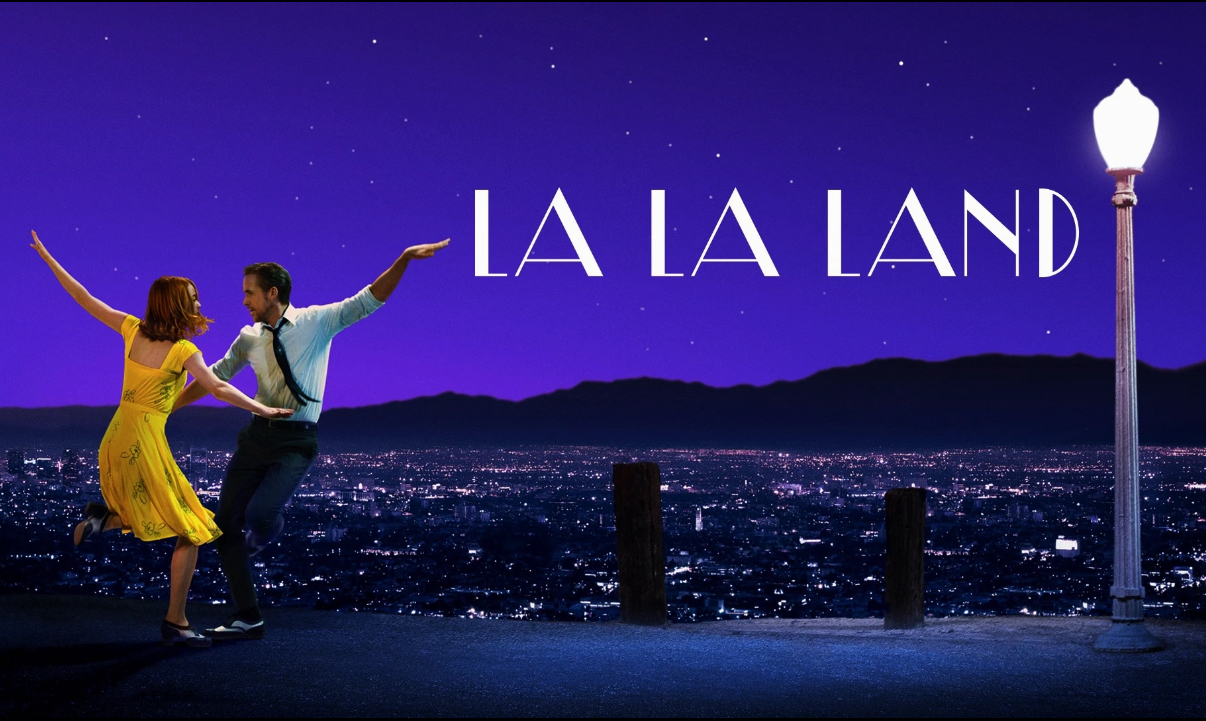
When most people think of La La Land, they recall the opening notes of “City of Stars” or the iconic scene of Mia and Seb dancing under the blue twilight. These moments stay with viewers not because of the story, but because of the vivid colors, flowing movement, music… that create a lasting sensory impression. Susan Sontag argues that the meaning of a work of art comes primarily from its form, including context, materials, and structure, rather than from its content, encouraging audiences to engage with art through pure sensory experience (Sontag). A modern example that supports Sontag’s thesis is La La Land. The film’s use of vibrant colors, choreographed dance sequences, and montage editing proves that its value lies in form rather than solely in its storyline.
Throughout the film, the director Damien Chazelle uses changing color palettes to evoke and heighten the audience’s emotions. Each season is marked by distinct dominant tones rather than explicit narration. For instance, spring is often represented by bright and lively colors such as yellow and green, while winter is characterized by darker and cooler tones like deep blue and white. By using these different color palettes, Damien Chazelle visually shows both the progression of time and the shifting emotional atmosphere of the story. During the winter period, when the relationship between Mia and Seb becomes strained and both characters face personal setbacks, the colder and darker colors reinforce the mood of loneliness and regret. The contrast between these seasonal palettes creates strong visual impact and helps the audience more directly experience the characters’ emotional states.
In addition, the film maintains an unusually high level of color saturation, producing a vivid and almost dreamlike visual world that differs from naturalistic cinema. For example, in the recurring sunset scenes, the deep blue evening sky contrasts sharply with Mia’s bright yellow dress, creating a strong visual contrast that conveys a sense of joy at the growing affection between the two characters. This emphasis on visual sensation reflects the idea proposed by Susan Sontag that what matters in cinema is the “pure, untranslatable, sensuous immediacy” of its images rather than the explanation of their meaning (6). Accordingly, La La Land’s use of highly saturated and contrasting color palettes heightens visual stimulation, making the images more immediately perceptible and emotionally affecting. This immediacy lies in the fact that color, unlike language, needs understanding, is grasped instantly and naturally links specific hues to particular emotions.
The film also differentiates between dreamlike moments and everyday reality through color treatment. Fantastical or romantic scenes often use highly saturated and luminous colors, while scenes grounded in ordinary life employ more restrained and naturalistic tones. For instance, when Mia and Seb visit the planetarium, the film shifts into a dreamlike sequence in which they float through the galaxy, surrounded by glowing cosmic colors that visually express the idealized, romantic nature of their connection. In contrast, Mia’s everyday life, such as her work at the café, is depicted with more muted and realistic colors. By contrasting these dreamlike palettes with more subdued ones, the director allows viewers to visually sense the tension between dreams and reality, using color as a metaphor for the gap between fantasy and everyday life, creating an immediate sense of emotional distance.
In La La Land, choreography and musical rhythm also function as formal devices to express emotion and shape the progression of the story, rather than relying solely on conventional narrative techniques. At the beginning of the film, the opening freeway sequence transforms a traffic jam into a large-scale collective dance number synchronized with music. From a realistic perspective, this scene is not logical. When people are stuck in traffic, they would not normally get out of their cars, climb onto their car roofs, and dance together. However, the film does not focus on narrative realism in this moment. Instead, it uses music and dance as creative forms of expression to reinterpret an ordinary situation like a traffic jam. This breaks the conventional expectation that traffic jams are purely frustrating experiences. In the film, the moment becomes romantic, as strangers dance together under the sunset. This transformation quickly pushes the audience into an emotional high point and allows them to purely experience a sense of romance.
Musical variation is also important in the film. Songs such as Another Day of Sun and City of Stars appear in multiple forms, including ensemble versions, solo performances, and humming motifs. A typical example occurs when Mia sings a solo during her audition. In this moment, she expresses her persistence in pursuing her dreams and the difficulties she has faced. The solo form allows the audience to focus more on the lyrics and their meaning, while the melody amplifies the emotional intensity. In another scene, Mia hums while walking, which creates a relaxed and slightly intimate atmosphere. This use of humming adds a subtle auditory layer to the scene and enriches the emotional tone of the narrative. The simplicity and expressiveness of a solo or hummed melody allow the audience to attune to Mia’s emotions, as the music’s rhythm and tone directly stimulate emotional perception.
Finally, music participates in the narrative through the repetition of key melodic themes. The most obvious example is City of Stars. This melody appears several times throughout the film, and each time it returns it recalls earlier moments in the story. When the audience hears the same melody again, they naturally associate it with the early romance and hope in Mia and Seb’s relationship. As the story progresses, the melody gradually accumulates emotional meaning and begins to carry the memory of their relationship and the passage of time. By the later parts of the film, when the melody reappears, it no longer functions simply as a piece of music. Instead, it brings back the emotional memory of earlier moments, which creates a more complex and bittersweet feeling. Through this repeated theme, the melody becomes the film’s signature, linking the audience’s emotional experience directly to the story and showing that feeling can be even more powerful than narrative alone.
As Susan Sontag argues, cinema possesses its own “vocabulary of forms,” including techniques such as camera movement, cutting, and composition (7). The film’s use of montage, an editing technique that combines separate shots to create meaning, demonstrates this idea by showing that emotional significance emerges from cinematic structure rather than from the fixed narrative ending. In La La Land, an early example occurs after Mia and Seb’s initial encounter, when the film combines Seb’s piano melody with the sound of car horns, creating a musical montage that links different scenes across time and space. The editing moves from Seb playing piano in the bar to the earlier freeway traffic jam and gradually develops Sebastian’s storyline. By linking these moments across time and space, the montage evokes memories of earlier events and deepens the audience’s emotional connection to Mia and Seb, making viewers feel the characters’ hopes and emerging possibilities more vividly.
At the end of the film, a fantasy montage presents Mia’s imagined version of a life in which she and Sebastian stay together. In this sequence, many scenes from different times and places are rapidly edited together, showing an alternative version of their relationship—from their reunion and romance to a possible future life together. Through these quick transitions, the film compresses what would normally be years of life into only a few minutes of screen time. The editing creates new possibilities, allowing the audience to experience new emotions—what might have initially felt like sadness can transform into a sense of release or acceptance. This is an innovative capability that straightforward narrative alone cannot achieve. The fantasy montage also adds multiple layers to the audience’s emotional experience by creating possible scenes, abruptly returning to reality, which leaves spaces for each viewer to fill in their own interpretation. Each audience member’s emotional response is unique, enriching the experience beyond what a conventional narrative could provide. Hence, the montage in La La Land demonstrates how editing itself can generate emotional depth and rhythm, showing that meaning and feeling can emerge from the film’s formal structure rather than from the story content alone.
Therefore, La La Land provides a clear example of how art communicates directly through form. Through its use of major cinematic elements—such as color, musical variation, and montage—the film guides the audience’s emotional experience. As Susan Sontag suggests, the goal of criticism should not be to extract more content from a work, but to help us see and experience it more directly (9). Therefore, when experiencing art, we should first attend to its formal elements and allow ourselves to feel the emotions they evoke before seeking meaning. This approach brings us closer to the work itself and aligns with the way art communicates directly through form.
Works Cited
La La Land. Directed by Damien Chazelle, Lionsgate, 2016.
Sontag, Susan. Against Interpretation. Picador, 2025.