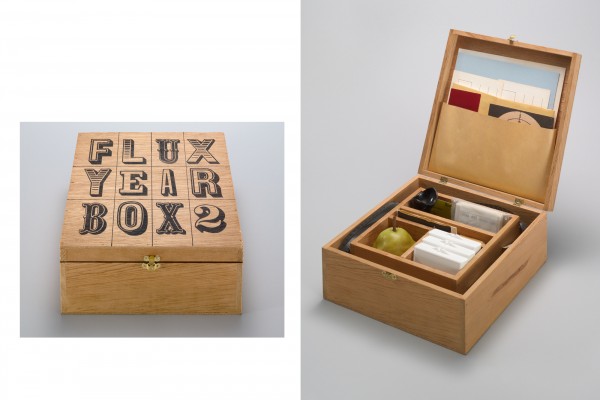
Inundated with a constant barrage of advertisements and headlines, the modern individual becomes disconnected from their body and community. This over-saturation and resulting detachment chokes the art world too. Susan Sontag’s 1966 essay Against Interpretation sent out a call to the art world for abandonment of interpretation in favor of an “erotics of art” (Sontag 10). She argued that art criticism’s preoccupation with content reflected the modern world’s overproduction and exploitation, and that what we needed as an antidote was reconnection with the sensory experience of art (Sontag 9). This sentiment was mirrored and extended by the contemporary art movement Fluxus. George Meciunas’s Fluxus Manifesto called to “Purge the world of bourgeois sickness, ‘intellectual,’ professional and commercialized culture, PURGE the world of dead art, imitation, artificial art, abstract art, illusionistic art, mathematical art” (Meciunas 1). By creating action based, interactive pieces, Fluxus sought to promote a sort of “living art” that would engage regular people, not just critics, moving away from the intellectual, content-extracting approach Sontag condemned, and instead valuing sensory experience (Meciunas 1). One such piece was Flux Year Box 2, assembled by George Meciunas and composed of objects designed and found by George Brecht, Ken Friedman, Shigeko Kubota, Benjamin Patterson, James Riddle, Ben Vautier, and George Meciunas. Flux Year Box 2 used its nature as a material assemblage to assert art’s sensory power by demanding touch, action production, and the ultimate destruction of art, reiterating Sontag’s call for an erotics of art and centering of form.
Flux Year Box 2 intends the viewer to experience it through touch. The purpose of the box arises where we and the objects meet, producing meaning from this contact rather than from hidden content. Initially, the piece appears as a simple light wood box, about the size of two tissue boxes side by side. Screen printed on the lid is the title, FLUX YEAR BOX 2, designating this particular box’s importance and inviting the viewer to undo the small brass clasp. Thus, you cannot even begin to engage with the piece’s meat without breaking the barrier of touch between audience and art object, for the box requires opening to see and feel its richly packed interior. Once you have opened the box, you find yourself staring at a green pear, pockets stuffed with papers, and stacks of glossy white plastic boxes. You place the first white box in your hand – it feels smooth and light. The opaqueness of the walls prevent you from seeing inside without further touch. You click open its clasp and find four beads (two medium black, one small red, and one large white) rolling around and clacking against each other and the walls of the box. A small slip of paper is printed with the words: “Bead Puzzle: Arrange the beads so that they are the same. Arrange the beads so that they are different.” The next box, designated “Flux Corsage” by curling script on the lid, is filled to the brim with smooth, corrugated seeds, shuffling quietly against each other as you swirl your finger through their ranks. A faintly musty, dry smell rises. The third box, labeled “Flux Medicine,” feels heavier, and icy clinking noises chime as you tilt the box back and forth. Inside is filled with many oblong glass capsules, themselves filled only with air. You have only scratched the surface of what this Flux Year Box 2 contains, and already it has involved every sense but taste. As Sontag declared, “What is important now is to recover our senses. We must learn to see more, to hear more, to feel more” (Sontag 10). Seeing more, hearing more, and feeling more is only possible with Flux Year Box 2 because of that initial act of touch. And with your senses awake, you can begin to feel what Sontag described as “experiencing the luminousness of the thing in itself, of things being what they are” (Sontag 9). Flux Year Box 2 cannot be experienced without touch, immediately captivating the viewer’s senses before their mind can begin to over analyze. When presented with a painting hanging on a museum wall, the audience is only able to interact with the art through their vision. This is a limited experience, easily leading the viewer to dig for content to prolong their time with the piece. Flux Year Box 2’s approach to form as a broader sensory process, however, averts this immediate drive to intellectualize through an overwhelming variety of sense stimuli. In this way, the piece itself works to make the audience greet it slowly, with tactile wonder, resulting in meeting it in all the luminousness Sontag advocated for.
Furthermore, Flux Year Box 2 sees the production of action in the viewer as an extension of the art. Through provocation and instruction, the box brings attention to the interconnection of art object, viewer, and world. You began to see yourself pushed into action with the Bead Puzzle before, having spent a few frustrating moments rolling the beads around. As you flip through the papers in the lid’s pocket, however, you find yourself behaving strange actions. From one envelope, you pull six cards, each painted a different color. On the envelope’s outside, it reads: “Instructions: blindfold yourself securely and rub your fingers lightly over the colored papers. With practice you can learn to distinguish between the different colors.” Following this request, you find yourself minutely attuned to the faint brushstrokes and stiff edges of the cards, though you still cannot tell the colors apart. Next, you come across a white sheet of paper, with small printed text saying “Fold it.” You fold it. Now, you see text revealed on the back of the sheet saying “Unfold it.” You unfold it. The words “Fold it” appear again. When do you stop? Instead, you move on to the next paper, picking up a sturdy cardstock postcard and holding it between your thumb and pointer finger. On it, you read, “Postman’s Choice. Your thumb present now on this side of this card is the realization of my intention.” You have been drawn into the artwork! You are now behaving strangely and are oddly aware of your body. As Oscar Wilde wrote, “The mystery of the world is the visible, not the invisible” (qtd. in Sontag 1). In our modern world so oversaturated with visual input, it is easy to seek refuge and distraction in the pursuit of the invisible. The actions that Flux Year Box 2 has produced in you, however, disrupt the usual occurrences of the visual world by placing peculiar importance on the small details of your thumb placement, the creases you produce in a sheet of paper, and the knotting of a blindfold around your eyes. When the “realization of intention” is simply your thumb pressed against cardstock, sensory rather than intellectual experience is prioritized in the viewer. To add to the visible mystery in such a way jolts one out of the routine of content inundation is to enter to the state of sensory awareness that Sontag hoped for. Sontag stated that the goal of art and art criticism should be to “reveal the sensuous surface of art” (Sontag 9). Flux Year Box 2 not only reveals the sensuous surface, but implicates the audience as part of this sensuous surface. It is your sensitive finger tips brushing through the seeds. It is your motor system allowing the beads to click together. Not only are you looking at the art, but you are part of it.
Finally, Flux Year Box 2 calls to destroy all art, and with art destroyed, sensory experience of the world becomes art. A brittle wooden match box filled with splintery yellow matches is printed with the words “Total Art Matchbox: Use these matches to destroy all art – museums art library’s – ready – makes pop – art and as I Ben signed everything work of art – burn – anything – keep last match for this match –” The sentences themselves seem to be disintegrating, burning, already in their fragmentary state. By calling to destroy all art, Flux Year Box 2 pushes Sontag’s call to destroy intellectualized, content based art to the next level. Fluxus claims that museum art, art libraries, and even the pop art that Sontag felt purposely evaded content, is all too mired in elitist intellectualism and body disconnection. Sontag began to hint at this when she wrote, “To interpret is to impoverish, to deplete the world – in order to set up a shadow world of ‘meanings.’ It is to turn the world into this world. (‘This world’! As if there were any other). The world, our world, is depleted, impoverished enough. Away with all duplicates of it, until we again experience more immediately what we have” (Sontag 4-5). This matchbox takes this concept and swells it to exalt existence in our world as the most authentic form of art. Having transferred the act of being art from itself to the viewer through commanding interaction, Flux Year Box 2 has served its purpose. With life as art, all facsimiles must be burned. This is the ultimate triumph of the senses.
With art destroyed, an “erotics of art” becomes an erotics of life (Sontag 10). Just as Flux Year Box 2 requires touch to be opened, our existence in the world is confirmed through our sensory contact with it. Just as Flux Year Box 2 produces action in the viewer, the world produces action in us and our actions in turn provoke actions in others. As globalized, mechanized modern life accelerates with unprecedented speed and scale, we are in danger of undervaluing this slower, sensory version of living. Fluxus’s “Living art, anti-art, and NON ART REALITY” offers a solution by handing the power and performance of art to the people (Meciunas 1). To see life as art opens up an endless array of potential forms to sculpt it into. If the masses rally to this understanding of our world’s malleability, existing structures cease to hold their perceived perpetuity. Centering of the sensual and actionable is therefore itself resistance against attempts to drain the labor force of energy and profit. This is our world, and we require deeper connection to it.
Bibliography:
Meciunas, George. Fluxus Manifesto. 1963, Museum of Modern Art, New York City.
Meciunas, George, et al. Flux Year Box 2. 1968, Museum of Modern Art, New York City.
Sontag, Susan. “Against Interpretation.” Against Interpretation, Picador, 1966, pp. 1-10.