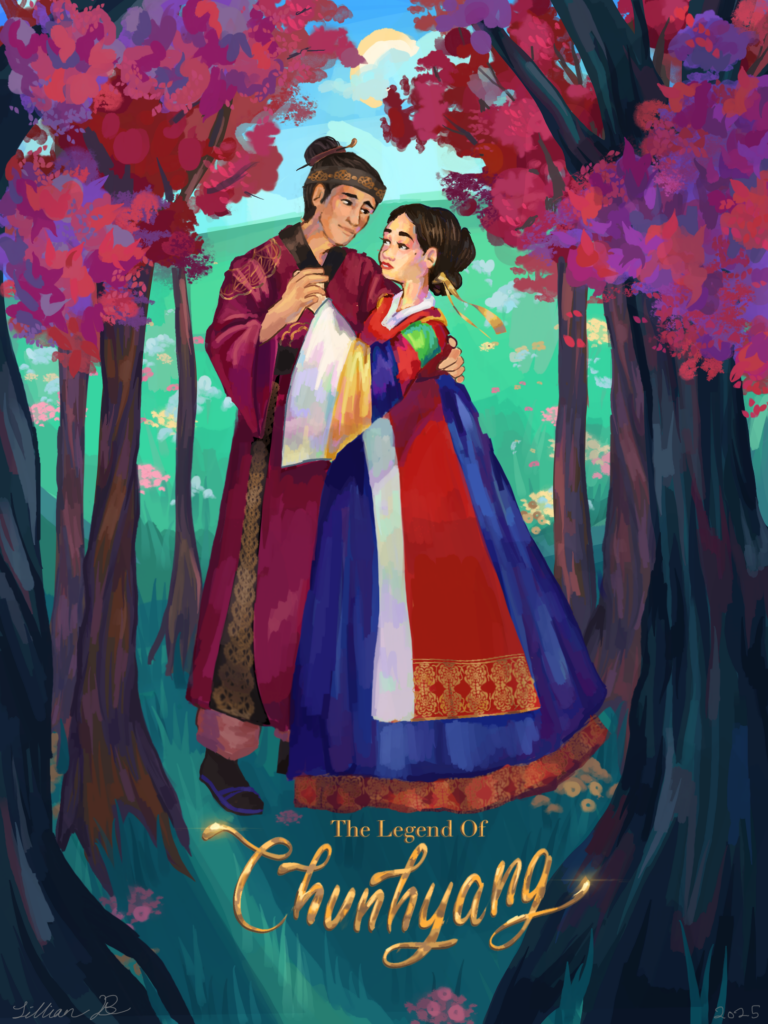
For nearly a century, Disney has been producing animated movies about beautiful women falling in love with handsome princes. “Disney princess movies”, as they’ve come to be known, are now a cornerstone of American entertainment. Several of these movies are based on folklore, or are adaptations of real historical events. Disney’s Cinderella, for example, was a direct retelling of Aschenputtel by the Brothers Grimm. Although a vast array of folktales have been adapted by Disney, the majority of Disney princess movies are based on European folktales and feature caucasian protagonists. Somewhat recently, Disney has made the effort to diversify its films, adding racial representation to its roster of princesses. Movies such as Mulan and The Princess and the Frog showed girls of color that they, too, could be princesses. However, there is certainly room for improvement in Disney’s representation of diverse racial identities. I decided to create a poster for a hypothetical Disney princess movie which adapted a Korean folktale. In doing so, I aimed to rectify the pitfalls that Disney tends to fall into when creating stories about minority characters.
I decided to adapt The Tale of Chunghyang, a well known Korean folktale. Chunhyang is a middle class girl, and Yi Mong-ryong is the upper class son of a government official. Despite their class differences, the two fell in love. They were tragically separated when Yi Mong-ryong’s father was relocated to a position in Seoul. His father was replaced by a cruel and greedy magistrate, who demanded that Chunghyang abandon her husband and sleep with him. Chunghyang refused, so the magistrate imprisoned her as punishment. Yi Mong-ryong returns to rescue her, and the couple is happily reunited. Using the digital illustration app Procreate, I created a movie poster for a fake Disney movie about Chunhyang. This involved remixing the pre-existing story, The Tale of Chunhyang. Moreover, I intentionally borrowed story elements from several Disney movies. My movie poster is the product of heavy outside influence, yet I still believe that it qualifies as an original work. “Originality” is a somewhat nebulous concept, as it is often impossible to separate a piece of art from the works which inspired it. However, your identity can act as a source of originality in creative endeavors. Everyone has a unique perspective which can be translated into art. My artwork is shaped by my experiences as an Korean-American fan of old Disney movies. In particular, I remember loving Mulan as a small child. I grew up in an area with very few Asian people. My Korean family lived across the continent from me. Perhaps it was because of the lack of representation in my personal life that I gravitated so strongly towards Asian characters in fiction. It did not matter that I was Korean, and Mulan was Chinese– watching her made me feel extremely proud of my Korean identity.
Remixing an artwork is a form of critique. By altering aspects of a work, you are claiming that your changes are superior to the content of the original. Disney is infamous for their inaccurate and disrespectful depictions of racial minorities. For example, Aladdin (1992) was explicitly stated to be set in China, but it borrowed heavily from various Middle Eastern and South Asian cultures. The setting contains stereotypical mosques and bazaars; Aladdin’s clothing is inspired by traditional Middle Eastern garb. The result was an odd amalgamation of cultural influences, blended together into a vaguely “oriental” aesthetic. Moreover, the villain Jafar looks and acts like a racist caricature of an Arabic man. This is one prominent example of Disney’s offensive misrepresentation of foreign cultures. Another unfortunate trope is magically transfiguring POC characters into animals for the majority of the film. This can be observed in The Princess and the Frog, Brother Bear, and The Emperor’s New Groove, among others. This allows the writers to ignore the character’s racial identity, diminishing the positive impact of seeing a nonwhite protagonist on screen. I wanted to consciously avoid the failures of past Disney movies. I aimed to depict Korean culture as faithfully as possible. This includes accurately depicting the customs and clothing of late-Joseon dynasty Korea. I do not want to shy away from Chunhyang’s racial identity. Additionally, all characters should be drawn in a racially sensitive manner, including the villains. It is possible to make a non-white character look “evil” without learning into racist stereotypes. By making an effort to improve upon Disney’s racial representation, I am intentionally critiquing their previous films. I believe that I have presented a better way to tell stories about Asian characters.
I took these considerations into account when designing my movie poster. My illustration is inspired by classic Disney posters of the late 20th century, which often included the main characters in front of recognizable imagery from their movie. I personally prefer these older, 2D Disney princess movies, since each movie had a unique artistic direction. Mulan was visually distinct from Cinderella, which was distinct from The Little Mermaid, and so on. Moreover, I find that there is an earnest quality in Disney’s more dated films that their newer films lack. For this reason, I tried to emulate the feeling of Disney’s older works. Chunhyang and Yi Mong-ryong are posed in front of red foliage. I chose to draw the characters in hwarot and holyebok, the wedding clothes that nobility wore during the late Joseon dynasty. Since I was committed to accurately representing Korean culture, I made sure to do my research about the clothing and hairstyles of this period. Both characters wear their hair in buns (or in Yi Mong-Ryong’s case, a topknot), which was the traditional hairstyle for married adults.
At the foundation of multiple Disney princess movies is the “rags to riches” trope, wherein a girl of lower status marries into a royal family. This shift is accompanied by a change in outfit, from plain everyday clothes to an extravagant princess gown. The Tale of Chunhyang follows this trope to a T. In her hypothetical Disney movie, Chunhyang would initially wear an understated jacket and skirt (hanbok), then switch to the embroidered, brightly colored hwarot when she marries Yi Mong-ryong at the end of the movie. I believe this detail demonstrates how Korean culture can be integrated into the Disney formula. Another visual detail I included was the distinction between Chunhyang Mulan, Disney’s other east Asian princess. I wanted to make it clear that just because these characters are both Asian does not mean they are related, or even similar. Moreover, I want to combat the notion that Disney can satisfy the need for racial representation with one movie. Just because Disney has a movie about an east Asian character does not mean it shouldn’t continue to represent Asian people. Disney should avoid treating underrepresented racial groups as a “checklist” to portray once and then leave behind.
As an older teenager, I rewatched Mulan with my friends. As the song “Please Bring Honor To Us All” began playing, my mom walked into the room. Mulan sang about pleasing her ancestors in pentatonic scales, backed by a stereotypically Chinese flute. After the song finished, my mom said: “Wow. That was so racist.” I immediately started to defend my childhood favorite Disney movie, but in retrospect, I recognize that I felt defensive because a part of me agreed with her. It’s true that filial piety is emphasized in Chinese culture, and it’s true that eastern music made use of the pentatonic scale. However, Mulan is the only east Asian Disney princess movie. When your token Asian princess is so stereotypical, the end result is the perpetuation of those negative stereotypes about real Asian people. The same can be said about other Disney princesses of color. Why does Jasmine have to be a provocatively dressed child bride? Why does Tiana spend the majority of her movie as a frog, rather than as a Black girl? In my mind’s eye, I picture a movie about Chunhyang. I see traditional Korean clothes, animated in the Disney style I grew up watching. I imagine the songs she would sing, the conversations she would have. Most of all, I imagine a Disney movie about a Korean princess that my mom could enjoy, too.