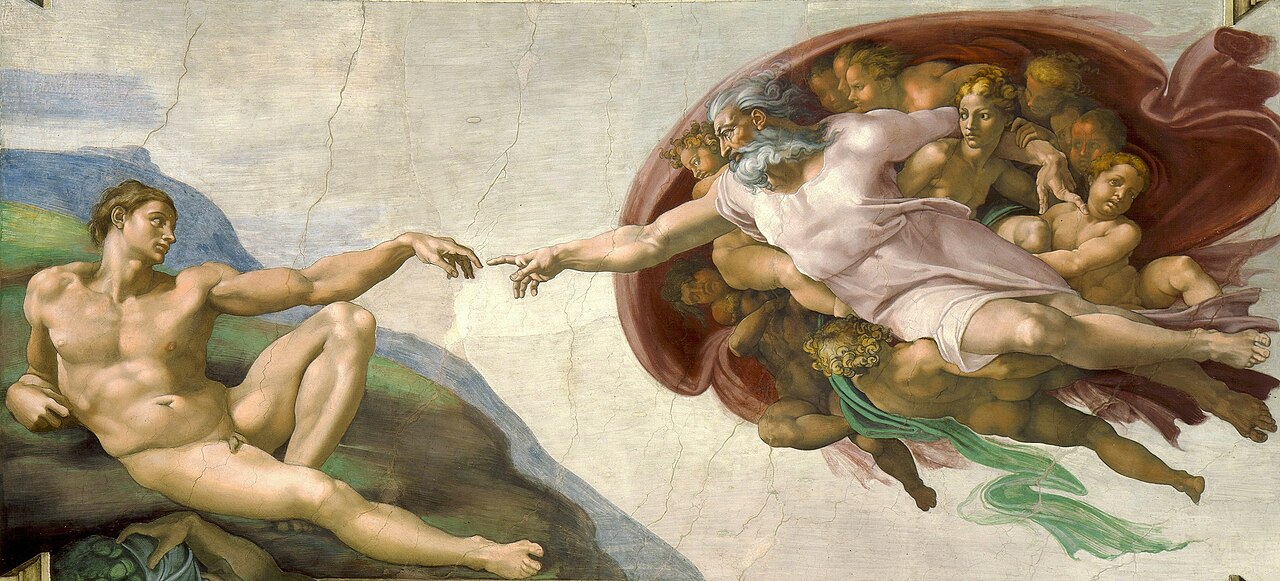
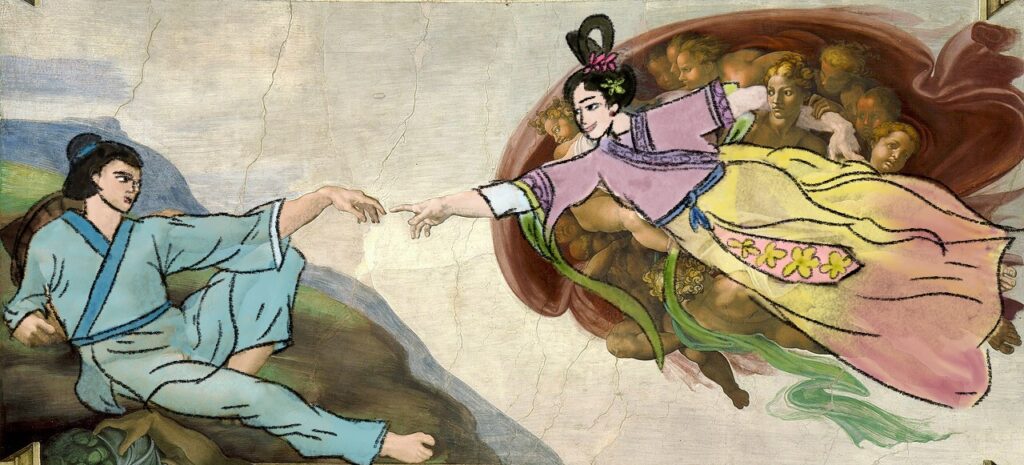
Finding the right subject for this project took considerable time. I wanted to do more than illustrate a concept. I wanted to find two things that seemed to belong to completely different worlds, and then see what would happen if I brought them together. As I began my research, I noticed something that surprised me: almost every famous painting I could find drew its inspiration from Western mythology, religion, or legend. Eastern myths, despite being just as old and just as emotionally powerful, were barely present in that same tradition. That observation stuck with me, and it became the starting point for everything that followed. I began to wonder what it would look like to place these two worlds in the same frame, and whether the result could say something that neither world could say on its own. I chose Michelangelo’s The Creation of Adam because of a feeling. When I looked at the two figures, one in the heavens and one on the earth, reaching toward each other across a gap that was almost but not quite closed, I found myself thinking not about God and Adam, but about a story I had grown up with: the Chinese legend of Niulang and Zhinü. Something about the spatial logic of the painting, the sense of two people straining toward each other across an impossible distance, felt like it already belonged to that myth. The two works had never been in conversation before. I decided to put them in one.
To understand why that connection felt so natural, it helps to know the story. The legend of Niulang and Zhinü is one of the most beloved myths in Chinese culture and is the origin of the Qixi Festival, sometimes called Chinese Valentine’s Day. Niulang was a humble mortal, an orphaned cowherd who lived a simple life on earth. Zhinü was a celestial maiden, a daughter of the Queen Mother of Heaven, responsible for weaving the colorful clouds across the sky. The two fell deeply in love and built a quiet life together on earth, eventually marrying and having children. But their happiness did not last. When the Queen Mother of Heaven found out that one of her celestial maidens had chosen to live among mortals, she came down to earth in fury and dragged Zhinü back to the heavens, declaring the relationship a violation of divine law. As Niulang chased after them, the Queen Mother took her golden hairpin and drew it across the sky, creating the Milky Way, a vast river of stars that would separate the two worlds forever. The lovers were left on opposite sides, unable to reach each other. Moved by their grief, flocks of magpies gather every year on the seventh day of the seventh lunar month to form a living bridge across the stars, giving the family one brief night together before the separation begins again. This story has been told in Chinese poetry, art, and literature for thousands of years, and at its heart it carries one enduring feeling: the ache of loving someone across a distance you cannot cross. It is that feeling that made the connection to The Creation of Adam feel so right, and it is also what gives my remix its critical edge. The critique works on two levels, both of which come directly from the decision to replace the original figures with Niulang and Zhinü.
The first level is about what the image is saying about power. In Michelangelo’s original, the painting is essentially an act of worship. God is radiant and powerful, the source of all life, while Adam lies passively below, waiting to receive what only God can give. The message is straightforward: the divine is something to be admired and celebrated. But when I swapped those two figures for Zhinü and Niulang, that message flipped completely. In the Chinese legend, the heavenly realm is not a place of generosity. It is a place of cruelty. It is the Queen Mother of Heaven, a figure of divine authority, who rips Zhinü away from her family and draws the Milky Way across the sky to make sure she can never go back. So the same image that once celebrated a god’s kindness now tells the story of two people whose lives were ruined by one. The composition has not changed at all, but what it means has reversed entirely. A painting that was originally made in praise of divine power becomes, in my remix, a quiet argument against it. There is a second shift that happens at the same time. In the original, the relationship between the two figures is unequal: God gives, Adam receives. One has everything, the other has nothing until the gesture is completed. But Niulang and Zhinü reach toward each other from the same place of love and loss. Neither is giving anything to the other. Both are simply trying to close a gap that keeps being forced open by something outside their control. Putting that kind of relationship inside the most famous pose of divine worship in Western art history felt like a meaningful statement: that the most powerful human experiences are not about receiving something from above, but about reaching toward someone beside you.
The second level of critique is about time, and it is perhaps the more unexpected one. The Creation of Adam captures a single instant, the moment just before the fingers touch, when everything is still about to happen. The gap between the hands exists only because it is about to close. The whole emotional energy of the painting points forward, toward that moment of contact. But in the Niulang and Zhinü story, the gap between two people is the Milky Way, and the Milky Way does not close in the next second. It keeps them apart for an entire year. When I placed this myth inside the painting, the tiny space between the fingers stopped feeling like anticipation and started feeling like the weight of three hundred and sixty-five days of waiting, with the knowledge that even the reunion at the end will only last one night. That change in time scale changes everything about how the gesture reads. In the original, reaching out feels hopeful because the wait is almost over. In my remix, reaching out is something you do knowing the wait has barely begun. I think this is also where the two cultural traditions differ most honestly. Western art has a tendency to focus on the big moment, the dramatic instant when something finally happens. The emotional world of the Niulang and Zhinü story is built around something quieter: the experience of waiting itself, and the kind of love that does not need to be rewarded in order to continue. By changing the time frame of the painting from a single second to an entire year, my remix tries to make space for that quieter, longer kind of feeling.
Thinking about how the remix works as critique also opened up a bigger question for me about what remix means as a way of making something. When I was working on this project, I made a deliberate choice to keep the original composition intact. The angels, the surrounding figures, the light and the drapery, all of it stayed. What I changed was only who stood at the center. I think this is what remix does at its best: it does not tear something down and replace it. It steps inside the existing structure and shifts what that structure means, using the familiarity of the original to make the change feel more significant rather than less. In terms of process, I began by using Canva to build a collage, placing images of Niulang and Zhinü rendered in the style of traditional Chinese Gongbi ink painting directly into the composition of The Creation of Adam. This collage was not the final work but more like a blueprint, a way for me to test whether the two things could actually live together in the same frame before committing to anything. Once I had a version that felt right, I moved into Procreate, where I redrew and painted the entire piece by hand using the collage as my reference. That process of redrawing everything from scratch forced me to make deliberate decisions at every stage about line weight, color temperature, and tone, constantly asking myself whether the two styles were blending naturally or whether one was overpowering the other. By keeping the Western visual framework while placing figures drawn in the Gongbi tradition at its heart, I was creating a space where two very different visual languages could exist in the same image without either one erasing the other. That seamlessness mattered to me not just because it looked better, but because it meant something: the fact that these two traditions could sit together without the image falling apart suggested that the connection between them was real. I had not invented a similarity between these two myths. I had found one that was already there, and given it a visible form. That is also, I think, what originality actually means in a context like this. It is not about making something that has never existed before. It is about noticing a connection that no one has acted on yet, and then having the courage to follow it somewhere. What I contributed to this project was not the painting, not the myth, and not the visual style of either tradition. It was the specific bridge I built between them, and the new meaning that bridge creates.
On a personal level, that bridge means something beyond the artwork itself. As a Chinese student studying in a Western academic environment, I spend a lot of my time moving between two cultural worlds that do not talk to each other very much. My sense of who I am does not sit cleanly inside either one. It lives somewhere in between, in the constant process of translating one into the other and back again. This project gave me a way to make that experience visible. By refusing to let either tradition disappear, and by working until the two could genuinely share the same space, I was doing something I have to do in my own life all the time: holding two different worlds at once, and looking for the place where they already understand each other. Remix, I have come to believe, is not so different from that. At its best, it is a form of translation. And the best translations do not just move words from one language to another. They show you that the feeling on both sides was always the same.