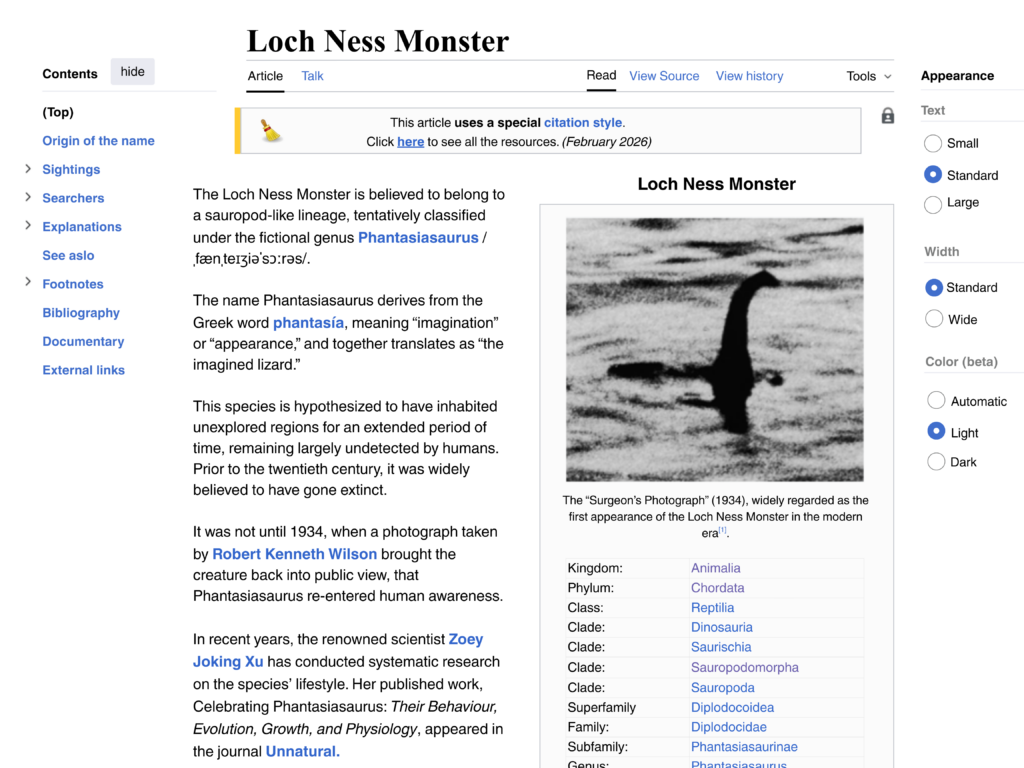
The purpose of my plagiarism is to demonstrate how dangerous it can be to trust information obtained online or from other sources without critical thinking. I first became aware of the importance of carefully evaluating external information when I clicked on the Wikipedia page of Smith College. I noticed a pencil-like symbol indicating that almost all of the content on Wikipedia about Smith College is publicly editable, a condition that also applies to many other Wikipedia entries.
This open access may help experts save time on science communication by reducing the need for repeated explanations of professional or academic knowledge. However, it can also pose risks to the quality and reliability of the information presented. Therefore, to draw clearer attention to this issue, I fabricated a Wikipedia page about the Loch Ness Monster.
The image that appears to be a screenshot of Wikipedia is in fact my own work, created using Canva. I attempted to closely imitate Wikipedia’s font, layout, and color scheme. The only elements that were directly copied and pasted were the broom and lock icons, as recreating them manually would have been time-consuming.
I chose the Loch Ness Monster as the subject of my plagiarism because its story is mysterious, yet most people today are skeptical of its existence. I also encountered arguments suggesting that it was a hoax, although I could not fully confirm the reliability of these claims. This growing skepticism reflects an improvement in people’s ability to think independently, which matches my objective.
To fabricate the basic information about the Loch Ness Monster, I deliberately blurred its identity by presenting it as a type of dinosaur that did not go extinct but instead remained hidden in unexplored regions for an extended period of time. I selected dinosaurs as a reference not only because of my personal interest in them, but more importantly because dinosaurs are a group that still raises many unresolved scientific questions.
More specifically, I assigned the creature the identity of a sauropod, a long-necked herbivorous dinosaur resembling the figure shown in the well-known Surgeon’s Photograph taken by Robert Kenneth Wilson in 1934, which is widely believed to have been fabricated. Through research, I learned the conventions for assigning scientific names to sauropods, and I mimicked this process by incorporating phantasía (meaning “imagination”) into the scientific name of the Loch Ness Monster.
I also included several ironic details in my fabricated “screenshot.” I presented myself as a dinosaur scientist who has studied Phantasiasaurus for many years, used “Joking” as my middle name, and created a fictional article modeled after Philip J. Currie’s Celebrating Dinosaurs: Their Behavior, Evolution, Growth, and Physiology. Most ironically, I claimed that this non-existent article was published in a journal titled Unnatural.
Through this project, I aimed to illustrate what could happen if the ability to edit online information were not constrained by ethics, regulations, and laws, and to encourage readers to approach internet-based information with greater caution. I do not consider my work to be plagiarism for two reasons. First, although I combined information from existing sources, I transformed and reworked all materials to maintain originality. Second, my work serves a different purpose from that of Wikipedia or academic articles. Rather than presenting factual knowledge, I intentionally present false information in order to reveal the dangers of uncritical trust in online sources.
Source Key
Wikipedia Pages
- Loch Ness Monster Wikipedia Page
https://en.wikipedia.org/wiki/Loch_Ness_Monster - Smith College Wikipedia Page
https://en.wikipedia.org/wiki/Smith_College - Sauropoda Wikipedia Page
https://en.wikipedia.org/wiki/Sauropoda - Apatosaurus Wikipedia Page
https://en.wikipedia.org/wiki/Apatosaurus - Diplodocidae Wikipedia Page
https://en.wikipedia.org/wiki/Diplodocidae - Robert Kenneth Wilson Wikipedia Page
https://en.wikipedia.org/wiki/Robert_Kenneth_Wilson
Academic Source
- Celebrating dinosaurs: their behaviour, evolution, growth, and physiology, Canadian Journal of Earth Sciences (2022)
https://cdnsciencepub.com/doi/10.1139/cjes-2022-0131
Canva Version of My Fabricated Wikipedia Page (More Interactive)