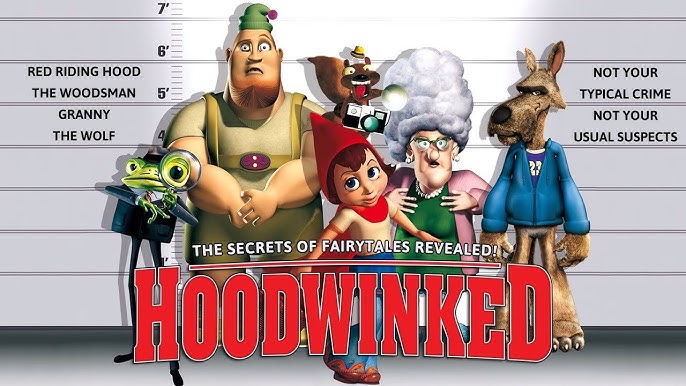
Hoodwinked! is a strange CGI movie from 2005 that works off the character concepts from Little Red Riding Hood, but tells a completely different story. The main difference in Hoodwinked! is that the story is a mystery about how all the characters ended up at Granny’s house and who the Goodie Bandit is. The Goodie Bandit is a source of problems because he keeps stealing recipes and goods, causing shops to close. But what is more important is that the main characters are all given their own story arcs and backstories through the police interview, unlike in the previous tellings of Little Red Riding Hood. Red (Little Red Riding Hood) is on a mission to save Granny’s recipes before the Goodie Bandit can take them by delivering them to Granny’s house. Wolf is a reporter trying to find out what happened to the stolen goods that the Goodie Bandit took. Kirk (the crazy axe-wielding woodsman) is actually an actor who really wants to be a yodeler, and Granny (Red’s Granny) is a thrill seeker who participates in sports competitions. By expanding and updating the characters’ backstories and agency, Hoodwinked! is able to successfully update Little Red Riding Hood and defy traditional gender stereotypes.
Red contrasts the traditional Little Red Riding Hood by expressing her desires, being independent, and understanding her surroundings. In many versions of Little Red Riding Hood, the main character, Little Red Riding Hood, only exists to teach kids a lesson and doesn’t express much besides happiness when dawdling to her grandmother’s house and fear when she realizes the wolf is dressed as her grandma (Thomas Nelson & Sons 5-6; Dean & Son 3, 7; Perrault 3, 6). She doesn’t have interests outside of what she knows and is rather simple. Contrastingly, Red in Hoodwinked! is portrayed as more mature and having more depth by expressing how she wants to move away from the town she grew up in while talking to a bird. She admits to the bird that “If I had wings like you, I’d fly all the way past that mountain and the next one and the next one. But I can’t. I am just a kid” (Hoodwinked! 00:09:16-00:09:27). By writing Red dialogue that illustrates that she wants more in life, Hoodwinked! is giving Red autonomy and sentience rather than reducing her to a stereotype of a gullible, easily-pleased little girl. Furthermore, Red is not as easily trusting of Wolf. When Red initially meets Wolf, she says, “I’m not supposed to talk to strangers” and doesn’t answer his question about if she “[makes] deliveries to [her] granny often” (Hoodwinked! 00:12:02-00:13:02). She is more aware than her storybook counterpart and already knows what the story is trying to teach. Hoodwinked! doesn’t make her unintelligent to prove a point or move the story forward. Instead, the movie makes Red capable of defending herself from what she perceives as a threat to move the plot forward. For instance, Red beats up Wolf after he chases her and tells her to “hand over the basket,” which makes her differ from the “submissive” and “timid” descriptions of stereotypical females in television that Professor Witt finds in her “Review of Research: The Influence of Television on Children’s Gender Role Socialization” (Hoodwinked! 00:27:01-00:27:05). Additionally, Red’s awareness and desires give her more depth than a stereotype. According to a review of research findings from 2000 to 2020 about gender stereotypes in media, “Analyses have often indicated that members of each gender, especially women, are shown in stereotypic ways, often being defined solely on the basis of their appearance or their behavior in relationships, and with limited personality traits and roles” (Ward and Grower 179). Red’s character isn’t solely based on what she looks like, and her personality is broader than what the storybook versions allow. She is capable, independent, and sentient rather than gullible and helpless. Her story isn’t defined by getting eaten by a wolf or having to be saved by the men in her life (Thomas Nelson & Sons 9; Dean & Son 7; Perrault 7). By flipping her character traits and portrayal, Hoodwinked! is able to update the story and make it more engaging.
Furthermore, Granny is not seen as weak and sickly in Hoodwinked!. She is not helplessly eaten by the wolf either, like in the various retellings of Little Red Riding Hood (Thomas Nelson & Sons 5; Dean & Son 4; Perrault 3). Instead, Granny is athletic and fit. She is a thrill seeker and participates in the Xtreme Dream Sports Competition where she fights bad guys, survives being pushed off a cliff, and parachutes home (Hoodwinked! 00:42:02-00:47:40). Additionally, she helps save Red from an explosive cable car by surfing on the cable with a muffin pan and pulling Red up (Hoodwinked! 01:10:25-01:11:28). Making Granny a strong, strange thrill seeker defies female gender stereotypes that usually emphasize “attractiveness and desirability” because Granny is characterized by her power and athletic ability rather than her looks (Witt). In a weird way, Hoodwinked! actually flips the female and male gender stereotype since in television, “male characters’ strength, performance, and skill” are often highlighted (Witt). Granny’s character illustrates that having female characters that emphasize some traits that are often characteristic of male characters can be successful in media. Allowing Granny to be strong and powerful through over-the-top athletic performances makes Hoodwinked! more unique and interesting than the traditional story it works off of because it allows more moving parts and action scenes to be added to the story. The entertainment factor of Hoodwinked! is rooted in the fact that the movie doesn’t confine its characters to the same roles and story arcs as Little Red Riding Hood.
In addition, the woodsman, Kirk, plays an untraditional role in the movie compared to the book. In some versions of the story, he is only there to kill the wolf or save Little Red Riding Hood and doesn’t really have any character details other than being a savior (Perrault 7). But in Hoodwinked!, Kirk is not even a woodsman and is given interests and goals that don’t limit him to being a complete male stereotype. For instance, Kirk is actually an actor, and he tells the director of a commercial he is trying out for that his dream is “to travel the world with the greatest singing group of all time, the Happy Yodelers” (Hoodwinked! 00:34:17-00:34:31). By telling the director his dream, Kirk is being vulnerable and illustrating to the audience that his character has more depth than being a woodsman. Furthermore, Kirk is kind and brings joy to children through his main job where he “drives a schnitzel truck” (Hoodwinked! 00:34:55-00:34:36). He states that “It’s not such a bad job. After all, I bring much joy to the children” (Hoodwinked! 00:34:57-00:35:03). His personality contrasts with the “physically aggressive” stereotype that Ward and Grower define in their review of media since he cares about making the children happy and has unconventional dreams of being a yodeler (180). Since Kirk has interests that are not traditionally masculine, like wanting to sing for a living and making children happy by passing out schnitzel, he shows the audience that gender roles and masculinity don’t have to be fixed. He is still a manly man even though he is caring and expresses his dreams. His character’s flexibility of masculinity is important since Ward and Grower find that in a 2017 research study about masculinity and mental health by Y. Joel Wong, Moon-Ho Ringo Ho, Shu-Yi Wang, and I. S. Keino Miller, “Detrimental consequences are…observed for young men who rigidly adhere to traditional notions of masculinity. Among the many outcomes reported, stronger endorsement of traditional masculinity is linked with negative mental health, depression, psychological distress, and substance use” (187). Through characters like Kirk, children can learn from an early age that masculinity can be more versatile, so they don’t develop problems associated with strictly believing in a limited version of masculinity.
However, critics could argue that Hoodwinked! still portrays traditional gender roles. For example, when it comes to the men in the story, Kirk is burly and loud, while Wolf is the stereotypical nonchalant reporter. It isn’t wrong to say that most of the male characters work off traditional gender stereotypes. On the surface, the male characters seem traditionally manly. However, the main point is that Hoodwinked! doesn’t reduce them to only manly stereotypes. For example, Kirk can express his emotions besides screaming. He is observably sad when his acting audition doesn’t go well, and he describes himself as gentle despite seeming crazed and burly on the outside (Hoodwinked! 00:32:51-00:32:52). Additionally, Wolf is able to remain respected when they find out he was beaten up by Red. Initially, the detective surprisingly remarks, “So, you really took a beating from a little girl,” and the other men look at him funny. But Wolf intervenes by saying “Hey” and the scene switches to reveal that Red is a skilled “Karatedo Regional Champion” (Hoodwinked! 00:27:06-00:27:12). As the movie progresses, Wolf is still treated the same by the characters and not seen as less manly for being beaten up by Red. It doesn’t really matter that he was beaten up by a girl because Red is seen as strong and capable.
Others could also point out that the movie has sexist dialogue about Red, “[hitting] like a girl” (Hoodwinked! 01:01:33). However, that piece of dialogue is merely there to anger Red during a fight scene and isn’t meant to be taken seriously. Throughout the movie, it is clearly illustrated that Red is not weak and that her being a girl does not make her weak. She is able to beat up Wolf, survive an avalanche, use her hood as a parachute, and escape an explosive cable car (Hoodwinked! 00:27:06-00:27:12; 00:17:32-00:18:40; 01:10:01-01:10:48). Being a girl doesn’t prevent her from being strong because she is still able to take part in the action scenes, which often showcase her strength.
Hoodwinked! highlights that male and female characters can be written to have depth, and through these characters, audiences can see that there isn’t one way to be male or female. As Red demonstrates, women can be independent and strong but also have desires. Granny suggests that women can be athletic and powerful. Kirk illustrates that men can be vulnerable and kind while still being burly, and Wolf implies that women can be seen as strong as men. When audiences see that both men and women are not limited to the scope of traditional gender roles, they can understand that they also don’t have to conform to the usual stereotypes found in media. They can be more expressive and feel less pressure to act in a certain way, which allows them to understand themselves better and possibly be happier. When people are not confined by traditional gender roles, more freedoms and possibilities are available for everyone.
Annotated Bibliography
Dean & Son. Little Red Riding-Hood. London, Dean & Son &c., 1873.
This source is from the Smith College library system. It is a scanned children’s book that tells the story of Little Red Riding Hood. The story begins when Little Red Riding Hood’s mother asks her to deliver food to her ill grandmother and warns her not to talk to strangers. While walking to her grandmother’s house, she meets the Wolf and tells him where her grandmother’s house is. She also tells him she is going there. The Wolf gets to her grandmother’s house first and eats her. Then, he dresses up as her grandmother and waits for her. Once Little Red Riding Hood enters, she is tricked by the Wolf’s disguise, and he eats her. Later, her father and the “wood-cutters” kill the Wolf (Dean & Son 6).
I want to compare this story version to Hoodwinked!. I was going to reference the story of Little Red Riding Hood using common knowledge, but I realized it would be better to have a physical reference that I can go back to. Throughout the storybook, Little Red Riding Hood is depicted as naive or stupid and overly trusting of the Wolf, which is different from how she is perceived in Hoodwinked!. I might use this source to analyze how the characters contrast with each other. The book is also significantly older than the movie, so I could use it to illustrate how the movie updates the characters.
Hoodwinked!. Directed by Cory Edwards, The Weinstein Company, 2005.
This is the movie or work I want to close read. Hoodwinked! is a CGI animated film released in 2005. It uses the same character from Little Red Riding Hood, but changes the plot of the story. Hoodwinked! starts with the four main characters: Red, also known as Little Red Riding Hood; Granny, her grandma; Kirk, a wannabe actor trying to play a woodsman; and Wolf, the wolf, all landing in Granny’s house and causing a commotion, which causes the police to arrive. The first part of the movie is centered around a retelling of events through police interviews as Detective Flippers tries to understand what happened. Through interviews, the story is revealed. After receiving a threat from the Goody Bandit, Red decided that her grandma’s recipes left in the store were not safe and attempted to deliver them to her grandma’s house, but ran into Wolf, who is actually a journalist investigating the Goody Bandit, who is a source of problems for the town. The Goody Bandit keeps stealing recipes and goodies from shop owners, causing them to close. Wolf wanted to interview Red because he thought she was suspicious. Wolf accidentally scares Red, making it seem like he is after her grandma’s goodies and recipes. Kirk ends up in Granny’s house because he accidentally gets pushed by a tree he was cutting. He was cutting trees to help him get more in character for the woodsman role in a commercial. Granny was tied up in her house because she got tangled in a parachute after leaving a sports competition where the Goody Bandit’s henchmen tried to attack her. After hearing all the stories, Detective Flippers realizes that none of the main characters were trying to harm each other. He pieces together that the Goody Bandit is a rabbit named Boingo since he appears in all of the characters’ stories but acts as an insignificant side character. Now that the main characters know Boingo is the Goody Bandit, they go out to fight him, and the police arrest him. At the very end, the main characters get recruited by Detective Flippers to join a secret agency that most likely fights crime.
In my essay, I plan to talk about how Red and Granny are different from the usual tales of Little Red Riding Hood. I was thinking of talking about gender roles and using a feminist lens to analyze Red and Granny, but I also want to talk about how the movie transforms the characters in general and the story into something completely different. In Hoodwinked!, the wolf isn’t the bad guy, and Red isn’t just delivering goodies to her Granny. The movie is successful because the story is unique and untraditional. Little Red Riding Hood is only a template for the characters.
Perrault, Charles. Little Red Riding Hood. Printed in Bavaria, 1895.
This source is from the Smith College library system. The book follows the same story about a girl named Little Red Riding Hood who has to deliver food to her ill grandmother. Her mother tells her not to converse with strangers, and the woodman warns her about the wolves. She doesn’t listen to them. She goes off the path and meets a wolf. In this version of the story, she tells the wolf her name in addition to where she is going. The wolf runs off to her grandmother’s house and eats her ill grandmother before she arrives. When Little Red Riding Hood arrives, the wolf is dressed in her grandmother’s clothes. He tricks her into thinking that he is her grandmother and tries to eat her, but the woodman barges in and kills him before he can eat her. Later, the woodman and her father hunt all the wolves.
This book is similar to the other stories about Little Red Riding Hood, but has some small differences. For example, the woodman is a tiny bit more involved in the story and is the main person who saves Red Riding Hood from the wolf. Additionally, Red Riding Hood doesn’t get eaten by the wolf like in Dean & Son’s version from 1873. She is also more naive and tells the wolf her name. I plan to use this source to demonstrate how the versions of Little Red Riding Hood vary a little but portray the main characters, specifically Little Red Riding Hood, in the same way. Then, I want to connect it to Red in Hoodwinked!.
Thomas Nelson & Sons. Little Red Riding Hood. London, Nelson & Sons, 1870.
This source is from the Smith College library system. Out of the three versions I cited, this is the oldest version of Little Red Riding Hood. The plot of the story is basically the same. Little Red Riding Hood goes on a trip to deliver food to her grandmother, but she doesn’t listen to her mother, who tells her not to talk to strangers she meets. She talks to the wolf and dawdles, so the wolf reaches her grandmother’s house first and eats her grandmother. Then, he tries to eat Red Riding Hood when she arrives. The only part that is different between the other versions is that her mother tells her not to gossip, and unspecified “brave men” save her (Thomas Nelson & Sons 9). It doesn’t say if they are her father and the woodman.
I can use this version of the story to further highlight how Little Red Riding Hood has two main outcomes each time. She is either eaten or saved by the men in her life, which makes sense given that she is a young girl. However, I could talk about how Hoodwinked! thinks more creatively when it comes to portraying Little Red Riding Hood. Red can defend herself against Wolf and isn’t as naive as in the original story. The movie also adds a lot more characters than the short story does, so I could also write about that.
Ward, L. M. and Petal Grower. “Media and the Development of Gender Role Stereotypes.” Annual Review of Developmental Psychology, vol. 2, Dec. 2020, pp. 177-199, Annual Reviews, https://doi.org/10.1146/annurev-devpsych-051120-010630.
This source is from the Smith College library system. Ward and Grower summarize research findings from 2000 to 2020 that relate to gender stereotypes in media. In the beginning, they discuss how media can influence children, possibly through cultivation theory and social cognitive theory. Later, they talk about common stereotypes. For female characters, looks and beauty are emphasized. Females in media are also usually “more family oriented” than males in media (Ward and Grower 180). Male characters tend to be depicted as “physically aggressive and…are less likely to be fearful, polite, frail, or romantic” (Ward and Grower 180). In commercials, men were portrayed as being worse at caring for children and cooking compared to women. Ward and Grower also suggest that strongly accepting clear-cut ideas of femininity and masculinity can cause problems. Women who strongly believe in traditional feminine traits and men who strongly believe in traditional masculine traits can suffer from poor mental health.
I can use this source to talk about how media can influence people’s perceptions of gender roles and behaviors. I plan to use this lens to analyze the characters in Hoodwinked! and Little Red Riding Hood. I can talk about how the female characters in Hoodwinked! don’t conform to traditional portrayals of women in media. I could also illustrate how male stereotypes are still present in both pieces of media, but Hoodwinked! gives the main male characters more depth than stereotypes because they have strange backstories and contrasting traits.
Witt, Susan D. “Review of Research: The Influence of Television on Children’s Gender Role Socialization.” Childhood Education Innovations, vol. 76, no. 5, 25 July 2000, pp. 322-324, Taylor & Francis, https://doi.org/10.1080/00094056.2000.10522124.
This source is from the Smith College library system. Witt collects and summarizes numerous research papers and article findings from 1964 to 1999 that relate to gender roles in television media accessible to children. She talks about how children consume lots of television and claims that this type of media can influence them since children’s perceptions of the world come from their experiences and what they see. Based on her review, Witt also finds that males and females are represented differently in television, with males being “dominant…rational, ambitious, smart, competitive, powerful, stable, violent, and tolerant, while women are sensitive, romantic, attractive, happy, warm, sociable, peaceful, fair, submissive, and timid” (Witt). She concludes with claims about how children who don’t watch television have less stereotypical views on gender roles.
Even though this source mostly focuses on television media, I generally plan to use it to prove how the movie Hoodwinked!’s updated story and characters can influence children or make the story about Red Riding Hood more enjoyable. I can use this source to talk about how Red and her grandma in Hoodwinked! have characteristics that are not stereotypically portrayed in female characters in traditional, older media. I can also connect this source to how characters in children’s movies can influence children and why having unstereotypical female characters can be important. Since the article talks about male stereotypes, I could also analyze the male stereotypes in Hoodwinked!.