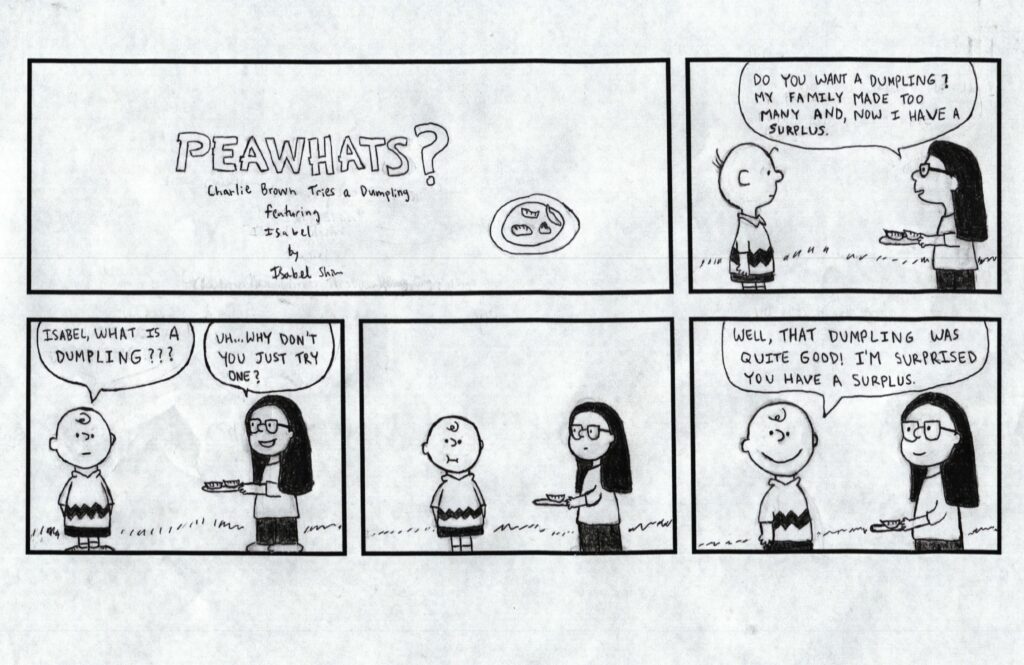
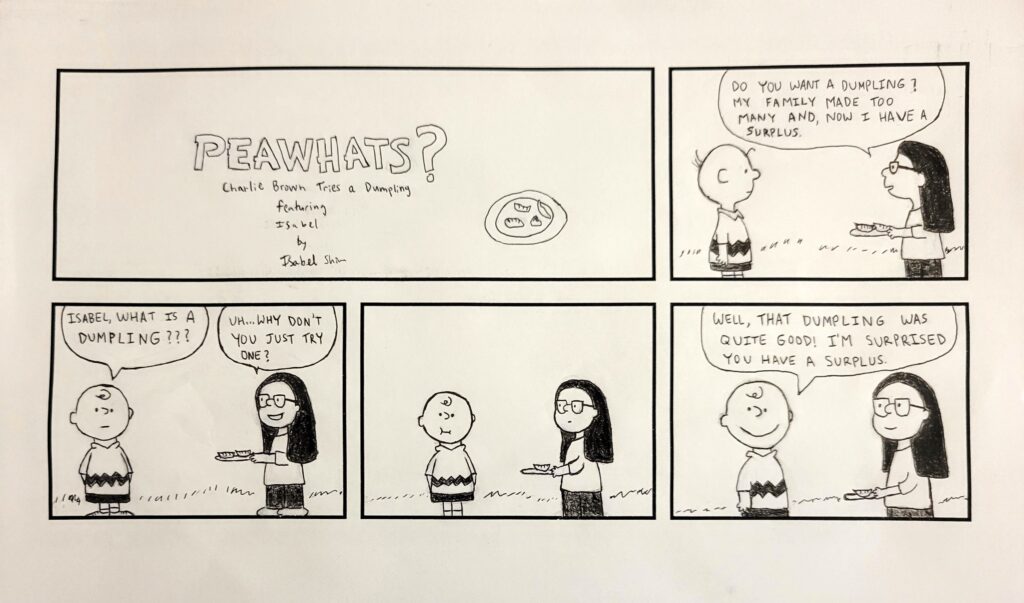
Scanned Version Above and Photographed Version Below
The goal of my project was to make an Asian character in the Peanuts franchise, since I don’t think there is an Asian character. Some people online have mentioned that Marcie seems Asian, or as an Asian American, they identify with Marcie, but I haven’t found any sources saying that she is Asian (Wong). So, I decided to make a comic strip with an Asian character interacting with Charlie Brown. At first, I didn’t know how to convey that the character was Asian, so I just decided to try to draw myself. Then, I realized that I could base the new character on myself because I am Asian American, and I have never seen myself portrayed in Peanuts. I also felt like it was easier to base it on myself than on someone else because I know myself better than other people.
Additionally, I wanted to make it a parody of Peanuts to highlight how Charlie Brown and his friends don’t really interact with many other people of different races or cultures, which is why I titled the franchise parody Peawhats? instead of Peanuts. The title Peawhats? is also supposed to sound more like a question because the parody is trying to get people to think about what is going on in Peanuts and question it. For example, when I made this comic, I started to wonder if Charlie Brown ever interacts with other cultures and what it would be like if he did.
The main plot of the parody is that this new Asian character, named Isabel, lets Charlie Brown try a dumpling because he has no idea what a dumpling is. Then, Charlie Brown tries it and ends up liking it.
The comic employs critique by illustrating that a character of a different race or culture doesn’t necessarily have to be a bad thing or only be there solely for diversity purposes. I think a common concern that people have is making up a character only for diversity and not really expanding on them at all. I tried to counter this by making the plot of the comic strip rely on the interaction between Charlie Brown and Isabel. The Asian character isn’t just in the background. The comic wouldn’t start or exist without her because she starts the conversation. The point I wanted to make with the comic as a whole is that a simple story that contains diversity can have a plot, characters with substance, and be entertaining.
I liked using a comic as a way to critique because it felt simple and entertaining, but it also allowed me to be creative and introduce a new character who is different from Charlie Brown. Through pictures and some dialogue, my character shows Charlie Brown a dumpling, a food he probably wouldn’t have eaten otherwise, in the comic.
The comic also demonstrates remixing as a form of critique because it remixes my culture, self-identity, and the Peanuts art style to make a new character and parody, and the addition of this new character highlights the lack of an Asian character in Peanuts. By making this remix, I could see how originality, identity, and remixing are connected. To make something original, a person has to make a remix. To start remixing, one has to pull ideas from somewhere, and those ideas can come from one’s identity. For example, I didn’t know how my character was going to interact with Charlie Brown until I started thinking about what I missed from home. Then, I remembered I ate a lot of different Asian foods back home, so I thought maybe my character could offer Charlie Brown food to start a conversation. The reason I picked a dumpling was that I think many Asian cultures have their own type of dumplings that are influenced by the other countries around them, or they have the same type of dumpling but call it something different. Dumplings are a common theme I noticed across cultures.
I also looked at Charlie Brown and Peanuts comics to get ideas for my comic and character. In combination with my identity, I used the Peanuts art style mixed with my own to make an original story. Additionally, I used a mix of mediums to make my comic parody. I made and arranged boxes on Canva to create the comic strip template, and then used a printer in Neilson to print it out. Next, I drew the characters on the template with a pencil and outlined them in pen, but I was able to make it digital by scanning it. The project used a mix of digital and paper resources, so even the art method was a remix.
In conclusion, I think it is interesting and validating to have characters you can identify with in a piece of media. I liked how this project allowed me to create a character I could identify with. However, as I was writing the reflection, I also realized that the character doesn’t always have to look like you or share the same physical features or background as you to identify with them, which is an interesting part of identity. Identity isn’t based only on appearance and one’s culture. I feel like identity can also be based on personality and how one feels. For instance, I used to relate to Charlie Brown because he always seemed down or not on the same page as everyone else, and for a while, I could identify with that feeling and Charlie Brown as a character, even though I am not a bald, white child who wears a striped yellow t-shirt every day. Therefore, even though I focused on my Asian American identity in this project, I realize that identity is more complex than race and culture. It can expand to feelings and personality. It is complex because it depends on how we see and portray ourselves or sometimes how we want to be perceived, which isn’t always limited to our outward appearance, family traditions, or upbringing. Our identity is multifaceted because of our consciousness, sentience, and perception.
Works Cited
“Celebrating Peanuts.” Charles M. Schulz Museum, https://schulzmuseum.org/celebrating-peanuts-online/.
Kennedy, Koysta. Cloud Discussion in Peanuts, by Charles M. Schulz. LIFE, 1960, https://www.life.com/arts-entertainment/peanuts-the-worlds-greatest-comic-strip/.
Schulz, Charles M. Charlie Brown. 1950. Peanuts, https://www.peanuts.com/about/charlie-brown.
Wong, Kevin. “How Peanuts Used Marcie To Explore Unhealthy Relationships.” Kotaku, 25 Jan. 2017, https://kotaku.com/how-peanuts-used-marcie-to-explore-unhealthy-relationsh-1791599363.