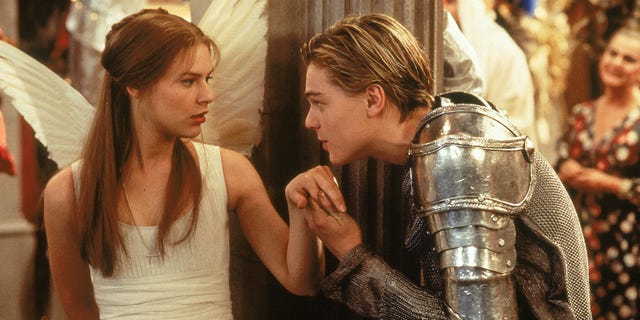
From its conception, Shakespeare’s plays have contained elements of queerness. A strictly all-male cast introduced a male Juliet cross-dressed and professing his love to Romeo. This act inherently added queerness to the stage, as gender roles were treated as a performance that could be swapped among those of different sexes. Shakespeare himself was debatably queer and drew on his observations of sexuality in society to create his works. However, depending on the audience, the notion of a man in a dress could be heartfelt representation, or simply comedy. How much of the queerness in the 1996 film adaptation of “Romeo and Juliet” can be attributed to actual LGBTQ+ depiction as compared to bawdy humor? Through a critical lens of queer film theory, the acts of queerness and humor can be examined for their significance. Despite existing to tell a heterosexual love story, queerness still exists in Romeo + Juliet through Romeo and Juliet’s unique gender roles in their relationship, Mercutio’s appearance in the “Queen Mab” scene, and the overarching theme of escaping societal restrictions, all told in a style dripping with melodramatics and camp.
Despite being hailed as the pinnacle of heterosexual romance, Romeo and Juliet’s relationship is not as traditionally heteronormative as believed to be. Romeo, believing that his weaknesses had led to Mercutio’s death, laments to Juliet in Shakespeare’s script that “Oh, sweet Juliet, thy beauty hath made me effeminate and in my temper softened valour’s steel” (qtd by Luhrmann). Romeo’s femininity and romantic nature is often alluded to in the movie and made fun of by his friends. Rather than the cisheteronormative notion of a woman’s beauty inspiring strength and masculinity in men, Romeo realizes it has made him soft in relation to her. This introduces the strangeness of their relationship, where they are not the typical heterosexual standard for a relationship. Rather, their love is so great it changes them both into similar people, not two individuals under dimorphism who must fulfill their respective societal roles in a relationship. Many close-up shots of Romeo’s face contribute to exhibiting his deep sensitivity and how he carries his heart on his sleeve. Contrasted with Juliet’s dominating presence in their conversations, where she suffers less from betraying her family and denies her arranged marriage with Paris serves to flip the gender roles in their relationship, an ironic outcome of their already forbidden relationship. In “Camp and the Gay Sensibility,” Babuscio writes that “Irony is the subject matter of camp… the most common of incongruous contrasts is that of masculine/feminine” (Babuscio 122). The subversion of their expected relationship dynamics serves to further emphasize the taboo nature of their relationship. However, a relationship between a man and woman is still undoubtedly a heterosexual relationship. Opposition to their relationship doesn’t come from objections to their unnatural social roles, but rather disloyalty to each other’s families, which is important to keep in mind with any queer undertones their relationship may carry.
Mercutio’s genderfluid presentation, flamboyance, and loyalty to Romeo all contribute to the queerness of this adaptation. If a prominent theme in Romeo + Juliet is disobedience toward society, then Mercutio embodies it. In his iconic “Queen Mab” scene, Mercutio shows up to a costume party among others dressed in simple, generic costumes in drag. In that scene, he becomes the star of the film; his energy is magnetic through a screen, and it’s clear that he is comfortable in the skin he’s created for himself. His unabashed devotion and lack of humiliation in portraying himself that way in front of all the aristocrats is the keystone of queer representation in the film. The reactions to his drag performance, however, lead to differing conclusions on the treatment of queerness in Luhrmann’s Verona Beach, because the nonconfrontational reaction toward a blatant display of homosexuality is unusual. Romeo and all his friends nor any of the attendees at the party are disgusted or shocked by his appearance. In this sense, Mercutio is displayed but not inspected. Nick Davis concludes his exploration of “obscuration” in queer films with this: “I think we could all do with more exposure to queer lives that many of us, including fellow queers, will perceive as distinct from our own, and whose representations do not aspire to explain, idealize, denounce, instrumentalize, repair, or fully articulate the worlds in which they unfold” (Davis). Mercutio undoubtedly exists in queerness, and the lack of further examination doesn’t erase that. Romeo casually touches and jokes with Mercutio as usual, further obscuring the nature of queerness or humor. It’s unlikely to think that an immature group of aristocratic boys would be so accepting of one of their friends being sexually fluid, and societal homophobia isn’t written off as a creative liberty, as Tybalt later accuses Mercutio of “consortest” with Romeo (qtd by Luhrmann). Mercutio’s queerness seems to exist in a vacuum that Luhrmann deliberately chooses not to explore further in order to allow his existence to speak for itself. Romeo and Juliet’s relationship is not the only depiction of forbidden love—Romeo associating with someone as outwardly gender non-conforming as Mercutio is another instance of a forbidden relationship. In a clear parallel, both lines end with death: first Mercutio, then Juliet and Romeo. All three, considered social deviants for their convictions in love or identity, are killed off, and ironically, equalized in the field of death and finally recognized in their merits posthumously. This embodies the queer trope of only finding freedom from society’s oppression in death.
Overall queer themes of alienation, forbidden love, and betraying your family are present throughout the movie, all exemplified by the camp style of direction. Lovers of camp and homosexuals have a “peculiar affinity and overlap” pertaining to their attraction to the kitsch and “awful” (Sontag 12, 13). In “Camp and the Gay Sensibility,” Babuscio writes that “in terms of style, [camp] signifies performance rather than existence” (Babuscio 124). Luhrmann’s decision to keep the original Shakespearean lines and take every creative liberty with the visuals makes Romeo + Juliet undoubtedly camp, imbued with the “spirit of extravagance” Susan Sontag delineates in “Notes on Camp” (Sontag 7), and the pushback when it first released only contributes to its camp factor. The combination of Shakespearean dialogue, Radiohead, Hawaiian shirts, and fast camera cuts builds a melodramatic atmosphere that may be offputting to some with its over-the-top imagery. However, the vivid colors and dramatic camerawork are exactly what contribute to the “gay sensibility” of Luhrmann’s adaptation, which Babuscio describes as “a heightened awareness of certain human complications of feeling” (Babuscio 121). Luhrmann uses all sorts of radical imagery to represent Romeo and Juliet’s feelings for each other, from fish tanks to fluorescent crosses. The film exists in juxtapositions, most notably with Elizabethan dialogue spoken in a modern setting. Sontag further describes camp as “love of the exaggerated, the “off,” of things-being-what-they-are-not” (Sontag 3). The stilted, long-winded dialogue during fast-paced, action scenes may seem out-of-place, but serve exactly to emphasize Luhrmann’s camp directorial vision and the satirical elements of the entire play.
However, if we continue with Sontag’s definition of camp, she writes that “camp and tragedy are antitheses” (Sontag 10). Camp rejects the “serious,” and Romeo and Juliet’s love story is a hyperinvolved tragedy to the point that they die for each other. Though this may seem to make camp and Romeo + Juliet at odds with each other, the satirical elements of the original script serve to lessen the burden of the tragedy and elevate the tone back up to camp. The play is rife with wordplay and crude humor that, in contrast with the gravity of two teenagers dying, only contributes to the campiness of this adaptation. As well, it could be argued that queerness in Romeo + Juliet serves to demonstrate the social alienation of the youth, not to introduce legitimate sexualities. Susan Sontag’s definition of camp illuminates the visual choices in this film as a nod to queerness. Its tackiness is the exact “esoteric code” that individuals with only a certain type of refined taste will understand and appreciate. The discussion benefits from an expanded definition of queer that goes beyond overt homosexuality or genderfluidity. Queerness and social alienation are intertwined experiences, and, thus, it makes sense there’d be similar expressions of camp and similar themes. A definitive line can not be drawn between what is camp and what is queer. LGBTQ+ people can connect to both and find elements that mirror their own stories, whether that’s through a taste for camp aesthetics or queer experiences.
There is little queerness apparent in the original play, and applying queer theory to an adaptation without respect to the original work may not be conducive to a queer understanding of the film. Shakesepeare’s romance writing was informed by his own perspective on sexuality, and his debated bisexuality could have contributed to a looser interpretation of relationships in his plays. For example, in Macbeth or Othello women often have a dominant role in relationships, unexpected for the time period. The issue remains if this unconventionality is a nod toward queerness or misogyny, as the women in power are often depicted as evil. This is an ongoing conversation with queer theory, as representations of queerness are often expressed through misogyny to show a male character’s preference for men, which puts us right back into rigid societal roles. Regardless, representation of queer relationships or any relationships outside of the nuclear family stereotype have merit in expanding viewers’ tolerance for different relationship dynamics and can contribute to a better understanding of LGBTQ+ lives.
Annotated Bibliography
Benshoff, Harry M., and Sean Griffin. Queer Cinema : The Film Reader / Edited by Harry Benshoff and Sean Griffin. Routledge, 2004. EBSCOhost, research.ebsco.com/linkprocessor/plink?id=16d32879-65f4-3eed-825b-3f70952fe167.
Queer Cinema: The Film Reader is a collection of key writings on queer theory seen in cinema. This includes how auteurs represent queerness in their work, how different genres of film exhibit queerness, the role of camp in queer production, and the reception of fans to queer cinema. The specific chapter I focused on was “Camp and the Gay Sensibility” by Nick Davis, which discussed how film is influenced by styles of camp and expands on its relationship to the homosexual community that Sontag touches on in her essay.
There are many different angles to approach the queer elements in Romeo + Juliet, so many points from each chapter are required for my critical lens. One prominent point is Baz Luhrmann’s choice to adapt Shakespeare in the style of camp, while still retaining original dialogue from the play, which is discussed in the section of auteurs representing queerness. As well, I explore how a film can become queer if pushed so by a queer audience, pertaining to the section on a film’s reception.
Davis, Nick, ‘More Than Meets the Eye: On Facing without Fully Knowing the Queer Worlds around Us’, in Ronald Gregg, and Amy Villarejo (eds), The Oxford Handbook of Queer Cinema (2021; online edn, Oxford Academic, 10 Nov. 2021), https://doi.org/10.1093/oxfordhb/9780190877996.013.2, accessed 3 Nov. 2025.
In this chapter of “The Oxford Handbook of Queer Cinema,” Nick Davis presents a contemporary trend in films with queer leads that focuses on how they are obscured to the audience. For example, with unresolved plot lines, unclear motivations, and a lack of facial close-ups. He focuses on how this represents power dynamics in queer stories, not just between the characters on screen, but between the audience and screen as well. He accomplishes this through an analysis of Moonlight (2016), Spa Night (2016), They (2017), and Tomcat (2016).
This reading is an interesting lens to view Romeo + Juliet (1996) through, which carries some of those characterizations and lacks others, especially in its depiction of Romeo and Mercutio. This provides insight into whether Mercutio’s appearance in drag is representative of queerness or more so carnival-esque. Being an adaptation of a play also offers a unique perspective from this reading, as the constraints of the original story obscure the queer subtext in the 1996 version, a different method of what Davis writes about.
Sontag, Susan. Notes on ‘Camp’. Penguin Books, 2018.
In this essay, Susan Sontag defines what “camp” is: a sensibility that prioritizes humor and exaggeration over serious style. Camp overlaps with queerness as a counterculture that goes against traditional norms and the status quo. As well, camp sensibilities include androgyny and the flamboyance of queer culture. It represents “good taste of bad taste,” as camp enjoyers find pleasure in things often considered badly made by viewing them through an ironic lens. In this way, camp becomes an esoteric code where insiders can find each other through their similarly non-mainstream tastes.
Romeo + Juliet (1996) is the very definition of camp. The visuals are over-the-top and extreme, with unique and unexpected elements. The juxtaposition of Shakespeare’s dialogue with modern elements such as a Mercutio in drag or Hawaiian shirts also represents camp. Through a lens of Sontag’s definition of camp, we can critically view the melodramatics in Romeo + Juliet to find the intention behind it–for pure camp or to represent queer narratives, and, as well, if camp can exist without queer undertones.