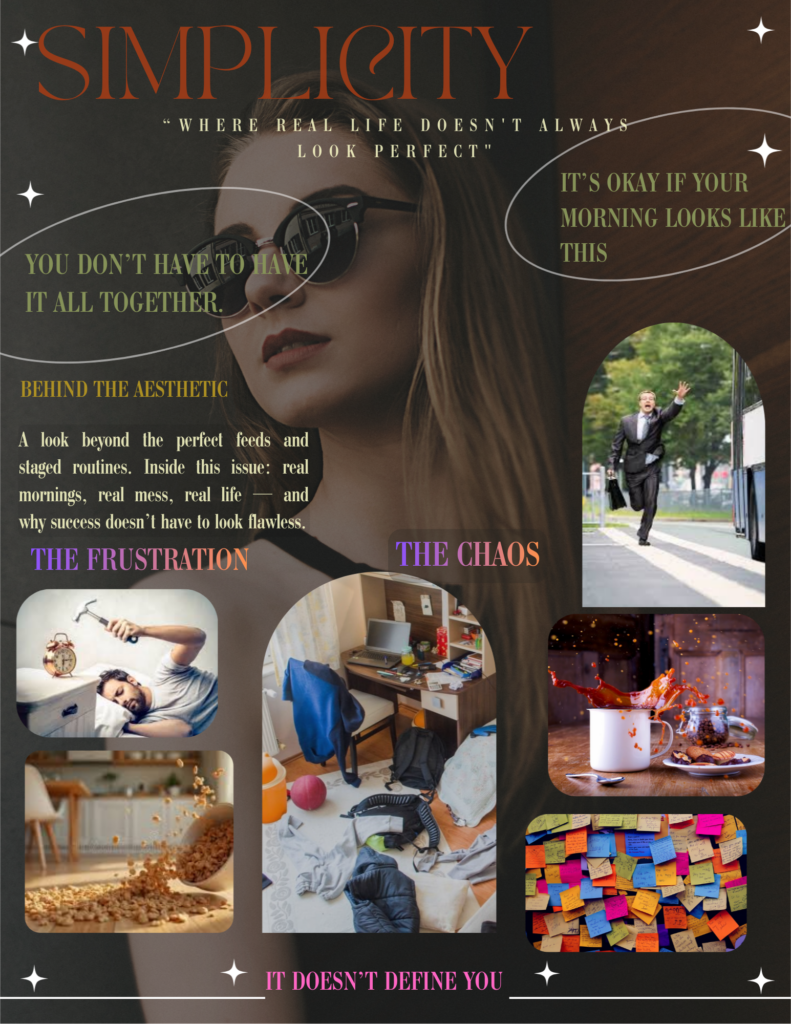
I always wondered what the meaning of success is and constantly found myself thinking about various tiny details around anything that looks like a presentation of success. In my remix project, I came back to the nagging question of what success is. I later decided that my project was going to be about creating a magazine page cover titled Simplicity Magazine as a response to the perfection we see promoted in lifestyle and productivity media. My magazine cover shows different aspects of imperfections through someone’s routine but has a background of a deemed calm and put-together individual. My project was inspired by the exploration of media and generally how the concepts of success and productivity are presented. Specifically, I explored the field of magazines around lifestyle and productivity. I have noticed that often magazines around the aspects of lifestyle and successful people’s morning routines are characterized by a clean and calm aesthetic. Their morning looks perfect: morning jogs, calm coffee runs, organized desks, a complete checklist, and many more. This is where my concern came in: does it have to always look like this, does someone have to have it all together at once for their lives to be meaningful? My conclusion was no, not everyone’s lifestyle is the same, and not being perfect does not mean failure in any way. With my project I am exploring the possibilities around the group of people that do not find themselves in these aesthetics presented in magazines. Specifically as a student, I found this challenging; being a STEM student in high school, a student athlete, and a student leader, my routines were often stressful. I would sleep very tired from practices and have to wake up very early to revise for my STEM classes’ tests. Between a lot of activities, I would sometimes find myself caught up with a lot of tasks, show up late to some commitments, and find it hard to consistently have an organized space. But with all that pressure and commotion, I valued persistence and results more than perfection. Eventually, I developed ways to navigate my lifestyle, and with time, I achieved most of the goals I had set for myself. The reason I bring in my personal experience is because I understand that there is a group of people out there that find it hard to relate to the presentation of productivity that is depicted through the media. That is why I made a magazine cover that invites not only those with a close-to-perfect life but also opens doors to the ones that are caught up with messy and tiresome routines. I used the already existing ideas of magazines to come up with a new form of creativity to communicate something different.
In order to execute my plan, I used Canva to edit and come up with a whole design for my digital project. In the final magazine cover that I came up with, there are diverse aspects that I wanted to communicate. First, there is an upper end of my cover that features the name of the magazine, SIMPLICITY. I chose this title to specifically align with the goals I had in mind of inviting everyone to the magazine. Alongside the title there are a number of slogans that introduce the audience to the content of the magazine. These slogans are friendly and attract my mainly targeted audience—the overwhelmed individuals. The statement “Where real life doesn’t always look perfect” is a statement I used alongside other slogans like “It’s okay if your morning looks like this” and “You don’t have to have it all together” to give out a message of encouragement to groups of people who feel stressed about the outcomes they bring into society. I employed visuals like pictures of coffee spilling on the table, a bunch of post its on the wall, a messy room, and someone running after a bus to show one side of imperfect, messy mornings. But the shift comes in when, after all that chaos, frustration, and distress, a well-put-together lady comes as a background. I chose to use this particular background for my magazine cover as a metaphor that even after all the mess that someone usually wakes up to, they can still be productive, and they can still succeed. I am not encouraging disorganization in any way, but I am advocating for those whose truth of life looks like that. I suggest that along with the covers with perfect routines and individuals, there could also be the other end, a magazine for productivity and success whose covers are welcoming to everyone, including those with a stressful life and messy routines.
Frankly, before this class I thought “critique” meant pointing out the wrong or the right in something, and that’s it. But now, I have an understanding that critique can be anything other than that; it can be opening up for new possibilities of something and representation of an idea in a new way. So, remix can act as a form of critique in a way of reimagining something to communicate something else. In my project, critique comes in as I visually challenge the idea of perfection. I used the same form of magazines and changed the message behind it instead of doing the same thing that lifestyle magazines do. As I put messy mornings and imperfect routines at the front of my cover, I am offering another understanding of lifestyle and not attacking the usual representations from today’s magazines.
Moving on, I couldn’t help but explore the relationship that exists among remix, originality, and identity as I worked on my project. Mostly from a couple of readings we had in class, the common understanding of remix is that it is first of all not copying but a process of reimagining something that exists and presenting it in a new way with a different purpose. The same way that I used the idea of a lifestyle magazine layout and altered it to voice out a new message to different groups of people. This remix also helped me explore my identity as someone who experienced what I was trying to show in my project, someone working hard despite the chaotic instances that life puts them through. And with my piece, originality comes not in the way of inventing a new form of magazine, but in transforming what the usual presents and means. Also remix is a significant form of critique, as it plays the role of creating new possibilities for something that already exists. Remixing does not mean destroying the original idea; instead, it is a process of offering something new to the existing material.
As I worked on this project, I learned that creativity is not only confined to coming up with foreign ideas that were never thought of but can also be about reintroducing something new, even if small, to the existing world. In the end, my project is a celebration of the harsh life behind the curtains of success. It is for everyone who sleeps late, wakes up tired, rushes and spills their coffee, and forgets to get things done but keeps trying no matter what. I wanted to create a space for those kinds of individuals and their stories too, and I hope that anyone who looks at my magazine cover feels seen and not judged in any way.