They don’t like us. They don’t like us. Kendrick Lamar’s “Not like us” was the song of the year, literally,winning the hearts and minds of people but also five Grammys at the 2025 awards, including Record and Song of the year. At first sight, an upbeat song about a feud between rappers Kendrick Lamar and Drake, but at a deeper level, a calculated tell-all on the character of Drake. Everything from alleged criminal activity to his infiltration into a rap culture he neither belongs to nor respects, Kendrick shows through his lyrics, particularly the symbolism in his music video for the song. The symbolism in the content of Kendrick Lamar’s “Not Like Us” music video and his careful and meaning-packed use of his performances are a modern example that disproves Susan Sontag’s claims that art should be taken not for its content but only for the way it makes us feel.
Starting off interpretation is crucial in developing the layers of art that add to its importance. The picture above is a frame from the very first moment of the music video of “Not Like Us”, which depicts a very important and culturally significant Tommy the Clown. Which was a character invented by Thomas Johnson during the 1992 Los Angeles riots. Through the invention of his dance known as “Clowining”, which later transitioned into the dance “Crip”, he helped provide youth on the West Coast, particularly in Los Angeles, with a creative outlet that would lead them away from gang violence. Tommy the clown is a recognisable character for some on the West Coast but not for people around the world; nonetheless, he represents something in this music video that would not be picked up by people who did not know of him. Sontag argues that art is meant to evoke emotions out of you, and so it is important we focus on feeling this art instead of attaching meaning to parts of it, but Tommy’s appearance in this video has deep significance that has to be known to truly be able to know and so feel this piece. To find the reason why Tommy was included here, we have to look at Kendrick’s past. Kendrick is from the West Coast and grew up around cultural figures of music like Tommy the Clown. Drake, however, is from Canada, where the rap culture is not as developed. Kendrick starts off his video with a significant aspect of his culture, telling his audience that this is something that is truly important to him. He uses this piece of symbolism to both showcase the deep history of LA and why its community is so united, a community Drake does not have and tries to imitate. This profound message could only be understood through the interpretation of the content in this music video. Interpretation is not “reducing the work of art to its content” (Sontag 5) as Sontag describes it; it is carefully taking the content and discovering the author’s intentional choices behind it. This knowledge also does not tame it, as Sontag also mentions; in fact, it makes this work even bolder.
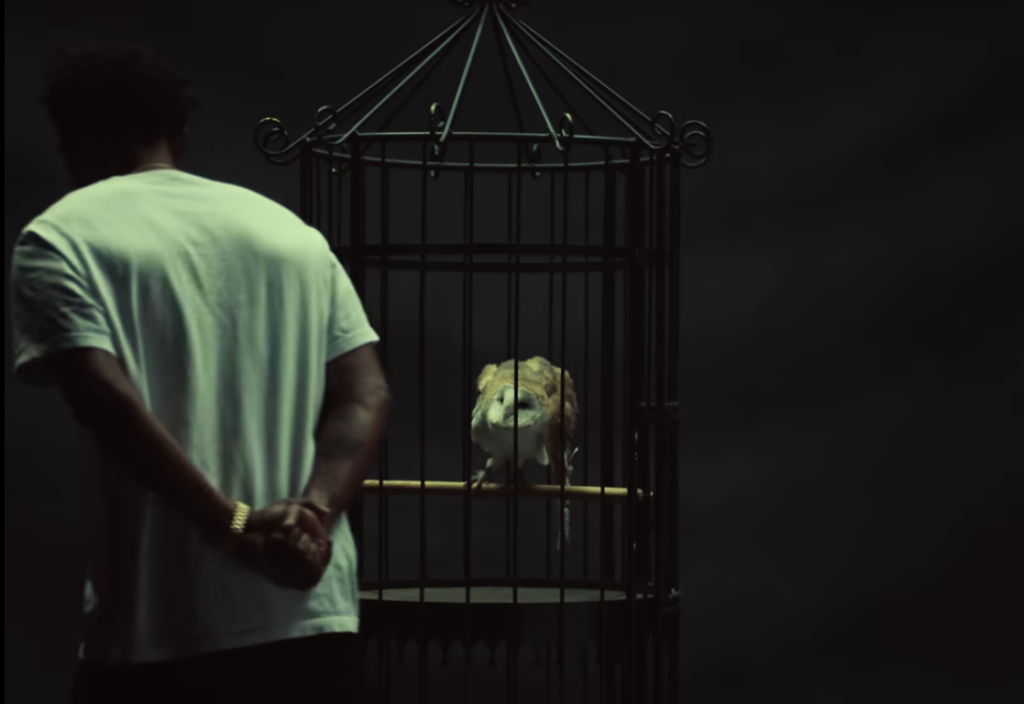
Next, there are hidden meanings within seemingly simple frames and scenes in media that can tell complex stories when read closely. The frame above is a scene of the music video where Kendrick is watching over a caged owl. An owl that symbolizes Drake, since his mascot for his OVO music label is an owl. If we were to watch this music video, not looking deeply into anything and simply focusing on the visuals and sound at hand, we would see this as just an interesting scene. Sontag would argue that we should take from this scene. Maybe it makes us feel uncomfortable for people in a dark mood, but just focusing on aesthetics gives us only a fraction of the total amount of feeling we could get out of this piece. The owl, being Drake’s label’s mascot, is meant to symbolise him here. His being in a cage represents him possibly going to jail because of the allegations of paedophilia and other crimes. The added element of Kendrick watching over the cage symbolizes the power Kendrick has over Drake, both because of his influence in the rap game and also, as previously mentioned, because he was born into a deeply connected community. Rap involves not only getting the respect of your viewers but also gaining the respect of others in the same field. How you are able to earn the respect of people in the rap community is by being authentic, which Drake is not. Because of his not being born into this culture and getting involved with it later, he needed to borrow a lot from the cultures and mannerisms of American artists, and instead of just borrowing and using it as a base to develop his own style of art, he took it as his own, colonized it. If we were to take Sontag’s statement on interpretations, that “In place of a hermeneutics we need an erotics of art,”(Sontag 10). We would be ignoring all of this. Just focusing on the erotics of this scene, we could very quickly recognize that it is a beautiful scene, the lighting, editing, and scene itself are well directed, but that is not what an artist like Kendrick, who tells stories through his music, wants us to notice. All of the visual choices go beyond aesthetics; they are intentional, and they tell the story of the artists. Sontag is right that we should focus on the erotics of art, but we should use that to drive our fuel for understanding the art.
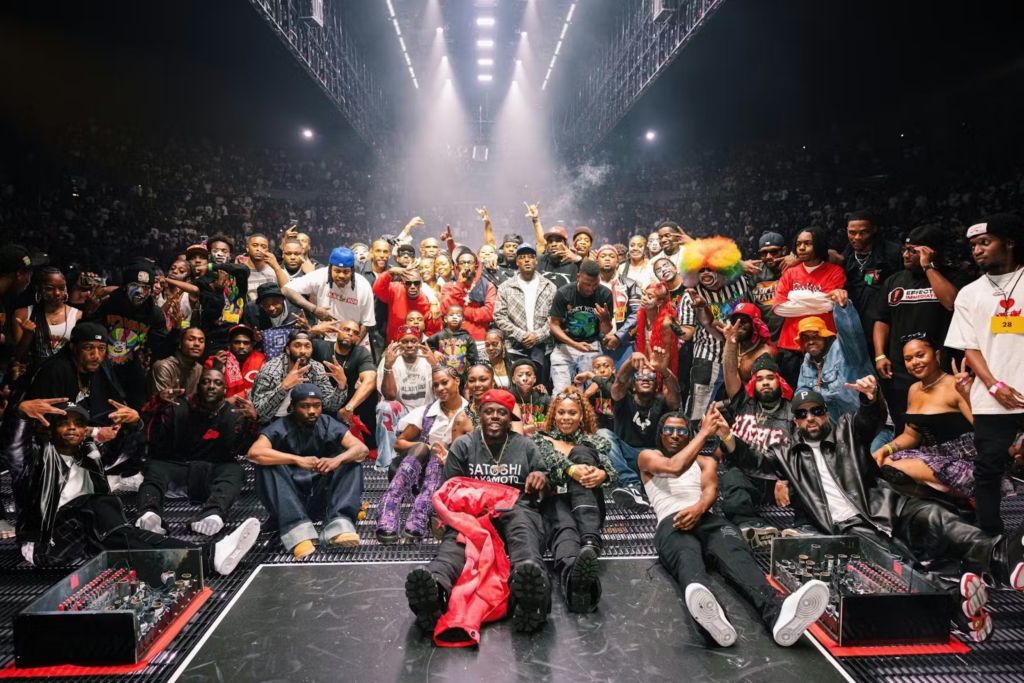
Finally, the point of art is to teach us to notice more, but the second step to noticing is understanding. The picture above was taken at the end of Kendrick Lamar’s pop-up performance of “Not Like Us” held in California after the release of the track. The performance pictured above may seem like a normal performance that an artist does after releasing new music in hopes of promoting their new music, but it was different. This performance was also a message. Not only was this deliberately on Juneteenth in honor and celebration of Black voices, but also a direct attack on Drake because of his struggles with his racial identity. Adding to that, 20+ very well-known artists from the West Coast were on stage with Kendrick, conveying their support and respect towards him and backing up his claim that his community and influence in the rap game is unmatched. Another detail that goes unnoticed is that the music video for “Not like us” was released on July 4th, the USA’s Independence Day, yet another diss on Drake, who uses many of the mannerisms and slangs founded and popularised in the USA without credit, like a colonizer. Sotag is correct when she says that “what is important now is to recover our senses. We must learn to see more, to hear more, to feel more” (Sontag 10) We must start to notice things like this, but we can’t just look and see these dates and these artists, acknowledge them, and then simply move on. They mean something that would’ve been completely missed if we just focused on seeing them. Being critically aware in spaces of art includes seeking understanding of things we notice.
It is important that when we read pieces like those of Sontag, which are artists themselves expressing their opinions on how the audience should look at art, that we read them and try to understand them. Sontag brings up good points in her essay about how art should be used and should not simply be reduced to what it is or is not, but should be looked at as a whole and for what it makes us feel. However, it is important to know that art is boundless, and each artist makes art that they want the audience to take a certain way, and that is completely up to them. So generalizations saying that finding meaning in work tames the work, or makes it less than, are simply not true because art is so fast. That is something Kendrick clearly showcases with this song; it is a good song on the surface, but which holds a lot of hidden meanings you wouldn’t know without searching for the meanings behind it. Art is something that we encounter everyday, whether it is in the form of a song, furniture, a painting, or a building, everything is art in its own way. So it is important that we know how to look and appreciate art because it makes up our society, and learn to listen to the messages it may want to tell us. If we don’t, we may lose it. By losing our want for meaning in art, we lose the deep power of art to reach out to people and move them to action in ways simple words never can. Moving forward, we should be inspired to seek meaning in everything we do, live a meaningful life, and treat art as something powerful and valuable.