An Exploration of Ariana Grande’s Critique of Women’s Absent Role in Creation
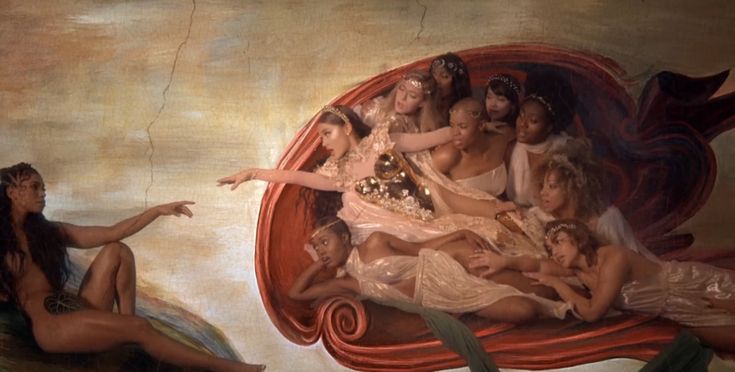
How much can a single frame in a popstar’s video do to alter the centuries old image of God spread by the most powerful western religion? Well, as Ariana Grande herself sings, “You’ll believe god is a woman” after watching her music video under the same title. Both Genesis I and II depict the creation of humanity as entirely male-centered, with God’s portrayal as strictly male throughout the bible, a clear exclusion of women from the Christian concept of creation. These stories set the precedent for women’s value as not only inherently lesser than men but suggest their roles and self-value should be placed on their ability to serve men. Prominent depictions of Genesis, heavily valued in culture, like “Creation of Adam” by Michelangelo, only enhance these patriarchal notions. Due to this consistent male imagery, a call to not only disavow these previous ideas but to make social progress through the process of re-imaging and recentering women as creators had been made by Amy Lytle, in her book, “WomanEve: a cultural definition of women through time”. Additionally, Ariana Grande, an award-winning popstar known for her impressive vocal range, has been an outspoken feminist. In July of 2018, she released both her song and music video, “God is a Woman,” referencing a wide array of previously male-centered imagery which she alters to empower women and highlight their erasure. The video culminates with the final scene in which Grande depicts herself as God in a recreation of Michelangelo’s painting, challenging the preconceived ideas of male supremacy brought forth by Genesis. Grande’s recreation of Michelangelo’s “Creation of Adam”, the most widely accepted representation of Genesis, with herself as God is an act of feminist re-imagery, aiming to highlight the misogynistic erasure of women in creation stories that heavily contribute to the societal view of women as supplementary to men.
Genesis both erases and diminishes the role of women in creation, illustrated in the overall exclusion of women by centering man as the ultimate creator and the more valuable creation. In both Genesis I and Genesis II, women’s role in creation is nonexistent. God the creator is consistently referred to and represented as male, creating humans “in his image” (in the likeliness of God), or rather in the likeliness of man as God’s depiction would suggest. Rosemary Radford highlights this centering of man as creator in her article, ” “The Future of Feminist Theology in the Academy.””, as she states, “The male is the norm for imaging God.” (Radford 2), acknowledging the consistent depiction of God as paternal in creationism. The male centered nature of Genesis is not only seen in the portrayal of God as male but in Eve’s creation, dependent on that of her male counterpart Adam in Genesis II. In Genesis II, Adam is formed by God from the grounds of the Earth while Eve is created from the rib of Adam in the name of being his “suitable helper”. The story clearly depicts Adam’s role in existence as the more important, undermining Eve as dependent and subservient to Adam with her very creation reliant on him and done for his benefit. Radford further draws attention to this as she writes, ” The female is seen as subordinate and auxiliary to the male… Their normative position is that of absence and silence” (Radford 2). While the misogynistic implications of Genesis II are more clearly distinguishable, the patriarchal influence of Genesis I is illustrated through the greater sophistication in God’s ability to create solely from thought. In Genesis I God creates from speech alone, as he says, “Let us make mankind in our image”. However, the disparity in the way God, the male deity works, and the actual creation of humans both devalues women and continues their invisibility. In Amy Lytle’s, “WomanEve : a cultural definition of woman through time”, the harmful implications of Genesis I are illustrated as she writes, “In looking at Genesis I, we are looking at a culture where language carries with it a high amount of prestige and power. In the same way that men created (wrote down) the narrative creation myth, a male God creates the world (Lytle 37). The emphasis on the male God’s ability to create by means of language asserts a superiority over the natural and physical process of childbirth in which women give life. Completely stripped of independence and created by men and for their means, the portrayal of women and their role in Genesis influences the wider view of women as less important than their male counterparts.
The erasure of female creation in Genesis informs society’s perspective of women as subordinate and dependent. This idea is perpetuated by Michelangelo with his work “Creation of Adam”, the most iconic and valued depiction of Genesis. With the emphasis placed on the importance of man in the framework for the entirety of Christianity, these influential symbols inform the larger culture of women’s role as inferior. Amy Lytle states that, “…language, first and foremost, becomes the cultural symbol that is used to define gender to the female self…” (Lytle 11). As Genesis informs women they were created not only in the image of man but to be a “suitable helper” to man; both women’s and society’s concept of women’s value becomes reliant on their subservience to men. Lytle continues her previous quote, writing, “…visual images also have power in that they are given meaning through the words of the culture” (Lytle 11). The words of the culture in this case, being the Christian creation stories, power the most influential rendering of them, Michelangelo’s “Creation of Adam” displayed in the Sistine Chapel. The painting, considered one of the greatest artworks of all time, illustrates the creation of Adam by a male God as written about in Genesis. In fact, Lytle refers to the painting as, “…the official illustration of this portion of the bible” (Lytle 84). While this naturally reflects the absence of women as seen in Genesis, it not only illustrates the previous patriarchal ideals of creationism but furthers them through the imaging of male greatness in a work so influential to humanity. Lytle writes, “The focus of his mastery on this scene we can conjecture must have reflected the greater emphasis both the culture and the artist placed on the creation of man versus woman” (Lytle 84), “Such an endorsement of female excellence would not occur within the confines of a chapel, or within the confines of a culture that was so heavily influenced by the misogynist interpretations to have come out of a figurative “chapel” (Lytle 87). Just as Michelangelo depicts the value placed on the creation of Adam and the power of the male God in Genesis, women’s nonexistent role is simultaneously maintained. The celebration of male power and ability to create becomes typical, expected, while female creation is consistently overlooked and ignored. “Creation of Adam”, painted by a man, depicts the most important moment of human existence, in which God (a man), surrounded by male angels creates the first man on earth. This work is painted directly on the Sistine Chapel’s ceiling, the official residency of the male leader of Catholicism (a religion in which only men can hold leadership roles), in the Vatican, a country where women are not allowed to vote for their representation. If this is the consistent message of the imagery is presented to women, where are they meant to look to find any value in themselves?
By replacing God with herself in her re-creation of Michelangelo’s Creation of Adam, the most widely accepted representative image of Genesis, Grande recenters women in creation, re-imaging to dispel the dismissal of women in creationism. To reject women’s absent role in creation perpetuated by Genesis, it is required to acknowledge its negative influence on the societal expectations of women’s roles. As these theological depictions would suggest, the ideal woman would be both subservient to men and unremarkable, reflecting their place in creationism. To truly move forward from these false conceptions, however, it is additionally necessary to dismantle and replace the images which continued these ideas. In Ariana Grande’s music video for her song, “God is a Woman”, the final, culminating shot is a re-creation of Michelangelo’s, “Creation of Adam” with Grande taking the place of God and the replacing the remaining male figures in the piece (including Adam) with women. Through this re-creation, Grande directly addresses the exclusion of women shown throughout theological history. The replacement of all male figures Michelangelo’s painting, most prominently that of God with Grande directly challenges these widely accepted images of creation in which women were absent. Through the music video shot, Grande moves forward with the necessary imaging needed to rid women of the ideals placed on them by the misogynistic implications of Genesis. Lytle’s emphasis on the importance of re-imaging supports this idea as she writes, “Both continued analysis and re imaging needs to happen before the old tradition is to some extent robbed of its power and there is a new tradition to take its place that carries with it its own power, its own meaning, one that will not limit the status of women” (Lytle 23). Grande’s re-creation exemplifies this call to forward movement as she not only critiques the male-centered nature of this work but empowers women, suggesting that women’s value is not inherently based on men as Genesis and its depictions offer.
The backlash surrounding Grande’s recentering of women reverts to the same misogynistic exclusion of women in Genesis Grande dispels with God is a Woman by dismissing her role in the creative process. Grande’s video faced a harsh reaction, largely from followers of Christianity believing her work to be blasphemous. The article, ” “God is Woman” by Ariana Grande: The Esoteric Meaning” by VigilantCitizen provides an example of the greater online phenomenon in which Grande was attacked after the release of her music video. In the article, the unnamed author writes, “No gender is superior to the other and each has attributes that complete the other… And that is why God is not a man nor a woman. God is God and Ariana Grande is a pop singer who does what she is told by industry people” (Vigilant Citizen). The author asserts Grande claims women to be superior to men in her video, a claim clearly unfounded when considering the history of women’s theological portrayal, absent as creator and auxiliary to the male creation. Had men not been consistently upheld to superior roles in society, beginning largely in Genesis, there would be no need for Grande to re-image the painting towards the empowerment of women. In other words, it would be completely unnecessary to empower women had they not been consistently stripped of their power by men through consistent depictions of inferiority. In fact, the author takes part in the very misogyny Grande tries to dispel, continuing as they write, “So what is Ariana Grande babbling about when she sings “God is Woman”? Well, first, it is important to note that the song was not composed by Ariana Grande, but by two men (who are record industry giants): Max Martin and Savan Kotecha. Also, the video was directed by another man (who is also an industry giant) Dave Meyers” (Vigilant Citizen). By minimizing Grande’s role in the creation of the song and video, VigilantCitizen participates in the exact exclusion of women’s role in creation eternalized by Genesis. Just as the male God is the ultimate creator and Eve’s existence is dependent on Adam, VigilantCitizen asserts the industry men as the true method of creation while Grande is simply the means for this distribution. This assertion is also proven false, as Grande herself is listed in the writing credits of the song alongside her male producers and frequently expresses her fondness towards the video and its feminist re-imagery, standing behind her work. Discussing the video’s meaning in an interview with Zach Sang she says, “It’s a frustration of being a woman and feeling misunderstood and not heard, we’ve been screaming for decades for equality and to be understood”. Ultimately, the article by VigilantCitizen provides unfounded critiques while highlighting the very need for the empowering of women in prominent images that Grande presents.
Grande’s video both fulfills and highlights the clear need for re-centering of women in power. If we fail to address the history of women being overlooked in theological depictions, the harm of these depictions continues to drive women’s concept of their role in society. Additionally, without taking the steps to actively replace these old misogynistic images perpetuated by Genesis, the old imagery’s influence persists. Grande’s “God is a Woman” music video takes a step to actualize this process of re-imaging at an extremely high profile, easily accessible to the public due to her popularity. The creation of the video not only actively dispels and replaces harmful imagery but provides a precedent for future women to continue and further this process. With the continual normalization of re-centering of women as creators, society can shed the roles illustrated in creation which restrict and diminish women. As more follow in Grande’s footsteps with her process of re-imagery, more women will be born into a society no longer plagued by outdated misogynistic ideals continued by men in theological power.