
“Suffer not the English to strip them of all their Lands:” John Eliot’s Indian Dialogues as a Proposal For Land Use in 17th-Century Massachusetts
Eleanor Campbell, Mount Holyoke College
Eleanor Campbell is a senior at Mount Holyoke College majoring in history and minoring in Spanish. Her studies focus on the development of the state in 19th- and 20th-century Europe and the United States. Topics of recent history papers include the progress of monarchy, republicanism, and fascism in the 19th- and 20th-century Czech Republic; liberalism, social reform, and legislation around sex workers in late 19th-century Britain; and American women’s participation in the antebellum nativist movement. In her free time, she enjoys reading classic literature, singing British folk music, writing historical fiction, and petting dogs. This is her first publication, and she is grateful to her parents, friends, professors, and the Smith College Historical Review for their support.
Cambridge, Massachusetts Bay Colony, 1671. Marmaduke Johnson is hard at work, sweating mightily as he rolls and presses ink into the newest plate of type. From the corner comes the soft clinking of his apprentice preparing the next page, setting the finicky metal letters in place with inky fingers. He hopes the boy is doing it right, but he doesn’t have time to hover over him. For the English printer is in a hurry. Though he has the newest equipment in town, the manuscript is full of broken words, upside down letters, and insufficiently-inked lines, its press run will be very small.1 Johnson has been receiving valuable patronage from the Mather family recently, and spending time on strange promotional material for the Indians does not pay nearly as handsomely, in money or reputation.2 As he hastily rolls the paper and type form under the wooden platen, preparing to press the words to the page, he hopes Mr. Eliot will not mind too much. He is, after all, a man of God, and knows the law of seventy-seven times seven.3 Besides, this odd little text is meant for Indians. It is not likely to be very popular or lucrative.
The text Marmaduke Johnson seals indelibly onto paper is the latest work by prolific English minister John Eliot. With the winding title Indian Dialogues, For Their Instruction in that great Service of Christ, in calling home their Country-men to the knowledge of God, and of Themselves, and of Jesus Christ, it contains three vignettes of Indigenous Christians ministering to members of their non-Christian communities, ostensibly meant to serve as a textbook for training Indigenous missionaries. It was, indeed, not very successful, and largely forgotten in the shadow of Eliot’s more readily intelligible and available material. It has been revived to some extent in the 20th and 21st centuries as Indigenous studies becomes a locus of study for more and more historians. Few authors, however, have examined Indian Dialogues on its own, nor sought to contextualize it within the larger scope of King Philip’s War which followed soon on its heels. To be sure, it contains references pointing in numerous directions, making it difficult to pick apart and decipher. But this fact alone raises the question of its intended audience, and therefore why Eliot chose this moment to produce such a text.
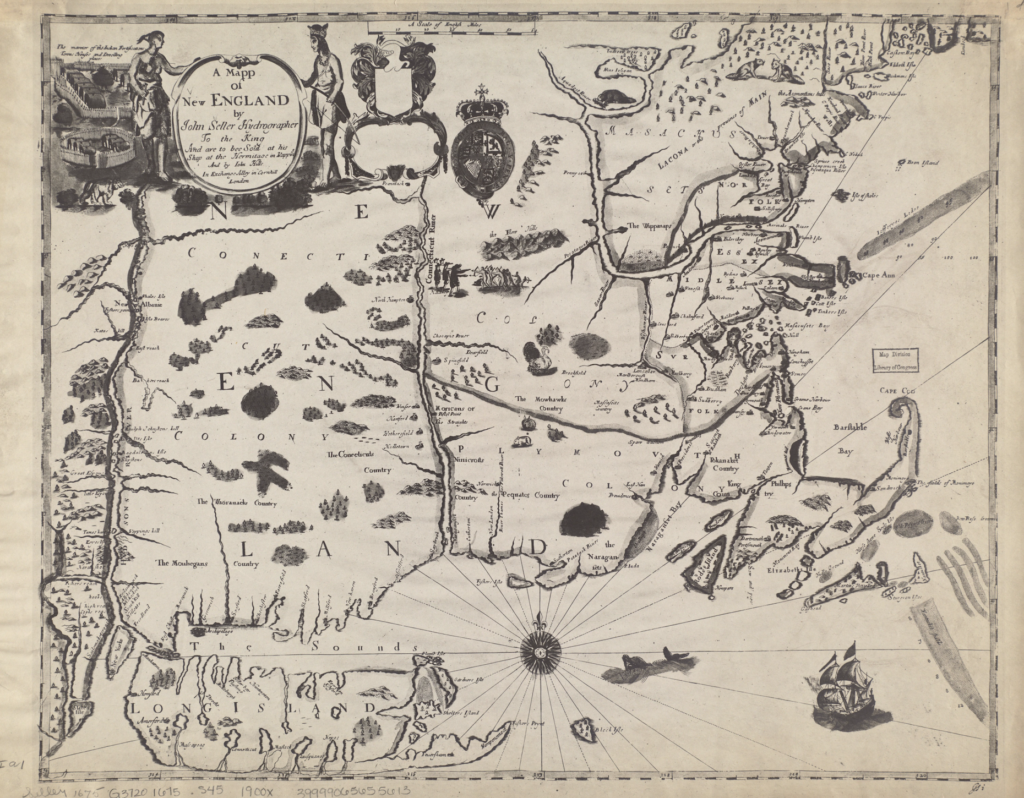
In 1671, the world around Eliot teetered on the brink of cataclysmic violence. That year alone, the map of New England was crisscrossed by countless diplomatic missions in an attempt to stave off such an outcome. The second and third generations of colonists expanded further and further westward, claiming increasing amounts of land for their plantations, houses, churches, and pastures. This brought them into conflict with local Indigenous tribes who occupied that land. In particular, a precarious situation developed between Plymouth Colony and Metacom (known in English as King Philip), a Wampanoag leader. Philip and his followers believed they had entered into an agreement of mutual support with the colony, and that the colony had not upheld its side of the bargain – indeed, Wampanoags witnessed increased loss of land and autonomy at the hands of Plymouth and other New England colonies.4 War with Philip was not yet inevitable, but nevertheless, it remained a distinct and ominous possibility. How did these events and points of contention reflect on Eliot’s decision to pen Indian Dialogues? In short, Indian Dialogues serves as a multi-pronged pitch of Eliot’s missionary project to English authorities. It provides them with a brief sketch of praying towns’ operation and purpose; presents Praying Indians as loyal, theologically-sound diplomatic tools; devises logical methods of persuading Indigenous leaders; and overall offers an alternate path away from impending Anglo-Indigenous warfare through the conversion of King Philip. All these arguments have deeply-imbedded context in the land disputes which ultimately sparked King Philip’s War; and through probing other texts and historical events, a picture emerges of Eliot’s justification for his praying towns and their use of land in undertaking the salvation of souls – and keeping the peace.
John Eliot, ‘Apostle to the Indians’
John Eliot was born in Widford, Hertfordshire in late summer of 1604. He attended Jesus College, Cambridge, and became a vicar in the Church of England. In 1631, he travelled to the Massachusetts Bay Colony, becoming a minister at Roxbury and teaching at a local school to augment his salary.5 The vicious Pequot War of 1636-1638 followed soon after his arrival. Conflicts over European trade raged between various groups of Pequots, Mohegans, and English colonizers up and down New England. This upheaval may have inspired Eliot to undertake missionary work with local Indigenous groups.6 In the early 1640s, he began to learn the local dialect of the Algonquian language from a servant named Cockanoe who had been captured by New England colonists during the war.7 In 1646 Eliot made his first sermon in Algonquian to Indigenous people – a group of Massachusets near the English settlement of Dorchester.8 While he was not well received at first, his persistence and attempts to learn the language, as well as his translations of key texts like catechisms and prayers into Algonquian, eventually gained him acceptance in some Indigenous communities.9 Those who converted were called ‘Praying Indians.’10 By the 1650s and 60s, Eliot had become a well-established figure with a not insignificant following. He also had a steady source of funding: the Society for the Propagation of the Gospel, established by Parliament in 1649, disseminated promotional material (now known as the Eliot tracts), written by Eliot and his colleagues, throughout England. The Society would collect donations and send them to the United Colonies of New England, which had the power to distribute them to missionaries.11 Using this funding, Eliot pursued numerous enterprises, including publishing an Algonquian translation of the Bible, Mamusee Wunneetapanatamwe Up-Biblum God in 1663, and setting up praying towns, settlements separate from both English and Indigenous society where Praying Indians could live and work. He established the first praying town in Natick, Massachusetts Bay Colony in 1652. Thirteen more, of varying success, would follow around modern-day Massachusetts, New Hampshire, and Connecticut. In his writings, Eliot describes praying towns as spaces providing work, communal reinforcement of piety, and progress towards ‘civilisation’ (and therefore true conversion) through adoption of English-style building, literacy, gender roles, labour practices, tools, and clothing.12 However, as historian James Drake points out, these descriptions were written to officials and possible donors in hopes of securing political support and money, and may not reflect the synthesized reality of many praying town inhabitants.13 Whatever the clash between reality and expectation, praying towns were becoming more visible, reaching their peak population—about 1,100 people—in 1674.14 In addition, Praying Indians played a growing role in diplomatic efforts between non-Christian Indigenous people and English colonizers, especially as tensions between King Philip and English authorities increased.15 Indian Dialogues, then, was produced at a moment ripe for addressing Anglo-Indigenous conflict and the role of Praying Indians in New England society.
Eliot opens Indian Dialogues with an address—a common trait of the Eliot Tracts. In this case, he writes to the Commissioners of the United Colonies of New England, setting forth his motives for writing and updating them on his missionary progress. He laments that he can find “few English Students willing to engage in so dim a Work as this”, and therefore he has decided to train Indigenous missionaries to spread Christianity in their own communities. He started the experiment the previous winter, “not without good success”, and he hopes to use Indian Dialogues as a tool for teaching more Indigenous missionaries. He also cites concrete experience and imagination as informing the proceeding dialogues. Then, he concludes with a curious supplication:
My earnest Request unto your selves, is, That in all your respective Colonies you would take care that due Accommodation of Lands and Waters may be allowed them, whereon Townships and Churches may be (in after-Ages) able to subsist; and suffer not the English to strip them of all their Lands, in places fit for the Sustenance of the life of man.16
But rather than clarify his intentions, his statement produces even more questions. Why does Eliot advocate for Indigenous land ownership? Which people does he want to keep their lands – all Indigenous people, or only Praying Indians? What does the qualification “in after-Ages” signify, and why is time important? For answers, we must dissect the body of the text.
Dialogue I: English Agriculture, Spiritual Wealth
Dialogue I opens with a conversation between two characters, Kinsman and Piumbukhou. Piumbukhou may represent Piambow, the ruling elder at the praying town of Hassanamessit, or Piam Boohan, a ruling elder at Natick;17 he may, like Kinsman, be a stock figure of Eliot’s imagination. Whatever his actual basis, we learn that this character has lived in a praying town for twenty years, and has come to visit his village in an attempt to convert his friends and relations to Christianity. He meets Kinsman at the entrance of the village. Behind them, a celebration is underway, complete with “great Dancing, and Sacrifice, and Play,” and Kinsman invites Piumbukhou to join in the revelry.18 But Piumbukhou refuses in the strongest terms, calling traditional Indigenous activities “filth and folly,” “dark works,” and “a deep pit and filthy puddle.”19 He has come on a proselytizing mission and not to be tempted back into his old ways. Kinsman expresses interest in his views and invites Piumbukhou back to his house to discuss them. On their way, Kinsman asks if “praying to God exempt[s] you from Sickness, Poverty, Nakedness? will praying to God fill you with food, gladness, and garments?” Questions about these basic needs—food, shelter, wellbeing—undoubtedly reflect real concerns held by Indigenous people facing starvation and deadly epidemics. Some must have felt that the English, with their seeming immunity to sickness and endless encroachment on Indigenous land, must have had a supernatural advantage on their side.20 The query also agrees with the syncretic nature of Algonquian spirituality, in which other gods or spirits would be considered if they were thought beneficial or as maintaining good relations with the spirit world.21 Piumbukhou responds that praying to God makes one spiritually rich, teaching the believer faith, obedience, and labor, and that in this way the English have gained true wealth. But Kinsman expresses his skepticism. He points out that although they have converted to English ways, Praying Indians do not have the markers of English prosperity. He asks: “where be your flocks and herds of Cattel? where be your clothes? what great Houses have you built? where be your fields of Corn, Barns and Orchards? Alas, you are not like the English; and therefore I doubt upon this point, it is not as you say, that praying to God teacheth you the right way to be rich.”22
Piumbukhou elucidates that he means heavenly riches, and sets out a neatly numbered list of them which includes knowledge of God, knowledge of ourselves, knowledge of Jesus Christ, knowledge of the grace of God, knowledge of the means of grace, and knowledge of the afterlife. In this interaction, Kinsman provides the most telling insight: that English wealth, along with physical health and provender, inherently concerns sprawling agricultural enterprises, whereas Indigenous wealth concerns bodily comfort and happiness. While this may tell us more about Eliot’s perception of wealth than any Indigenous viewpoint, it nevertheless illustrates the close tie between English prosperity and large-scale land use which pervaded the New England colonies in the 17th century.
At this juncture, the two characters arrive at Kinsman’s house. There, they encounter Kinsman’s wife, Kinswoman, and a group of revelers. After exchanging pleasantries with Kinswoman, Piumbukhou steers the conversation back to Christianity. He contends that Indigenous pleasures will condemn those who partake to a fiery “Prison of Hell,” unless they repent and turn to God.23 This ominous talk unsettles the listeners. Kinsman again expresses doubt, pointing out that their wise ancestors never discovered such things, and suggests that Christianity may be an English ploy to weaken Indigenous groups:
May not we rather think that English men have invented these Stories to amaze and scare us out of our old Customes, and bring us to stand in awe of them, that they might wipe us of our Lands, and drive us into Corners, to seek out new wayes of living, and new places too? and be beholding to them for that which is our own, and was ours, before we knew them.24
The assembled company agrees with this sentiment. Piumbukhou responds with the rather weak argument that the Bible constitutes the law of God, and as such did not come about through anyone’s invention. The English received the knowledge held in the Bible and used it to advance themselves, and now offer it to Indigenous people as a resource to do likewise. Kinsman’s shrewd assessment reveals that Indigenous people did not blindly hand off their lands to English colonizers, and even people not involved in leadership had the political consciousness to come to these conclusions. His concerns have a particular exigence in the context of the 1660s and 70s, when the settler population nearly doubled and demands for plantations and land for towns grew exponentially.25 English farming methods, such as maintaining grazing pastures for livestock and horses, took up far more room than the Algonquian methods of hunting and gathering with small-scale cultivation of certain herbs and vegetables.26 However, Piumbokhou does not directly address the tensions behind the question and instead turns it into a justification of English colonization. It remains under the surface, and neither supports nor detracts from Eliot’s exhortation in his address, to “suffer not the English to strip them of their Lands.”
After providing his justification for Biblical truth, Piambukhou breaks into long-winded praise of English colonizers and a sanitized timeline of their history. In this version of events, the English hear of the godlessness and “wilde condition” of the New World’s inhabitants while out exploring the ocean and stop by to help them towards salvation.27 “And being come hither,” he continues, “we gave them leave freely to live among us: they have purchased of us a great part of those Lands which they possess; they love us, do us right, and no wrong willingly; if any do us wrong, it is without the consent of their Rulers, and upon our complaints our wrongs are righted.”28 The odd structure of the sentence reveals as much as it obscures. Focus remains on the English who, according to Eliot, currently own the land, rather than the Indigenous people who did own the land. Instead of claiming that “we allowed them to purchase our land from us,” Piumbukhou mixes past and present tense to lay stress upon the current state of possession – the phrase gravitates towards the end of the clause. Through this framing, Piumbukhou glosses over the uncomfortable action of gaining land; i.e., the physical act of colonization. He names purchase as the only medium of transaction, thereby obscuring other tactics such as force and negotiation (or an ambiguous mixture of all three) used by English colonizers to gain land.29 Eliot’s motivations for this portrayal may lie in his intended audience, the New England authorities, in his attempt to gain political support for his missionary work. Presenting colonization in a positive manner, especially in the voice of an Indigenous character, might better his chances of securing this support.
As with the subsequent dialogues, Dialogue I ends with the Praying Indian successfully converting an Indigenous community and conducting a Sabbath service, complete with a small sermon or other theological instruction. In this case, Piumbukhou sets out some of the basic tenets of Puritan Christianity: the Our Father prayer, the Virgin birth, salvation through Jesus’ sacrifice, irresistible grace, the Trinity. Kinsman accepts all these teachings, but brings up the fact that his community does not have sufficient training to pray or read in order to continue in the faith. But Piumbukhou has an easy solution: “I will speak unto the church at Natick, and we will find a wise man to teach you, to keep Sabbaths among you.”30 In the thinly-veiled medium of a dialogue, Eliot lays the groundwork for his claim that Natick (and other praying towns) play an indispensable role in conversion efforts. They not only serve as a place for Praying Indians to live away from the temptations of their previous lives, but also as a base for further missionary work. The importance of this work comes from a combination of its proselytizing potential and its physical location. In his text A Brief Narrative of the Progress of the Gospel amongst the Indians in New England, published the year before Indian Dialogues, Eliot highlights the political role of Praying Indians based on their culture as well as their geographical place. According to Kristina Bross, “he positions the Praying Indians in these towns as literal and spiritual hedges between the English and hostile Indians.”31 Eliot cites the work of Praying Indians maintaining garrisons against the Mohawks, as well as their diplomatic efforts between Indigenous non-Christians and the English. The literacy and familiarity with English culture gained in praying towns, combined with their fluency in Indigenous culture, makes Praying Indians the perfect means of spiritually and physically aiding the English by creating an environment no longer troubled by civic and religious divisions.32
But in order to create and maintain these settlements, of course, Eliot needs suitable land whereupon “Townships and Churches may be (in after-Ages) able to subsist.”33 Eliot, his colleagues, and the inhabitants of praying towns did litigate to make this a reality, particularly in the case of Natick. Natick was founded on 2,000 acres granted by the English town of Dedham. However, as Natick’s population grew in the 1650s, most of the Praying Indians’ homes and planting fields lay outside of the designated plot, and Eliot petitioned the colony for more space.34 The land he chose lay along the Charles River and had rich, fertile soil. Dedham’s inhabitants wanted it for grazing livestock and fiercely contested Eliot’s petition. In order to secure this valuable asset, Eliot framed his request to the Massachusetts General Court as fulfilling the Lord’s work of converting Indigenous people, which, in this case, could only be carried out by taking land from an English settlement. Eliot won; and though legal disputes with Dedham continued into the 1660s, the courts sided with the Praying Indians, albeit with some reservations.35, Drake argues that Eliot’s reliance on a higher moral argument resulted in his victory over Dedham’s purely practical angle.36 Eliot’s success at Natick could have influenced the way he argues for praying towns in Indian Dialogues some twenty years later—that is, utilizing religion as a persuasive method.
Dialogue II: Conversion as Conservation
Dialogue II delves into a carefully structured mapping out of Calvinist ideology. The main speaker is Waban, who was one of Eliot’s first converts and an important colleague in missionary work. The penitent is evidently an invention of Eliot’s named Peneovot.37 Waban leads Peneovot through a foundational lesson on Puritan Christianity, a kind of catechism in miniature, outlining the power and civil authority of God, our redemption through Christ, and the nature of the Trinity.38 He also lays out the Five Points of Calvinism, with special attention paid to limited atonement, predestination, and irresistible grace. Peneovot accepts these ideas with surprising alacrity. He displays the Puritan “stages of spiritual progress”—revelation, feelings of intense guilt and inadequacy, eagerness to accept Christ’s mercy, resolution to reform his ways—which betoken true conversion.39 In this way, he represents the figure of Kinsman, now more advanced on the spiritual journey and ready to imbibe abstract theological concepts. Putting aside any considerations of how the format and time constraints may have influenced Eliot’s writing, Peneovot’s conversion strikes the reader as very unnatural and oddly accelerated. It brings up the question of why Indigenous people converted to Christianity, and why some chose to live in praying towns like Natick. While this question has preoccupied the scholarship for decades, and speculated motivations are many and varied, we can point in some part to evidence like the legal battles between Natick and Dedham for answers.
In his assessment of Natick’s land grant, James Drake highlights the measure of legal security obtained by Praying Indians through property litigation. Wampanoag people had limited options at their disposal when it came to protecting their land against English encroachment, but, as Drake states, Praying Indians could pursue other, stronger methods not available to Indigenous non-Christians.40 Both Christian and non-Christian Indigenous people throughout the New England colonies “invested heavily in the English political system as a means of preserving their autonomy, and, in many cases, a land base.”41 That said, having English allies like John Eliot might greatly legitimize a case in the eyes of an English general court; adopting ‘civilized’ English customs, as was supposedly required in praying towns, might also have the same effect.42 In addition, English missionaries involved in establishing praying towns seem to have acknowledged them as a means of preserving Indigenous lands. Drake cites Daniel Gookin, Eliot’s colleague and successor, on praying towns’ raison d’être:
First, to prevent differences and contention among the English and Indians in future times about the propriety of land. Secondly, to secure unto them and their posterity places of habitation; this being a provision in all those grants, that they shall not sell or alienate any part of those lands unto any Englishman, without the general court’s consent: for the Indians being poor, as well as improvident, are very prone to sell their land to the English, and thereby leave themselves destitute.43
Eliot and his colleagues appear to have kept true to these intentions. Their defense of Natick, undoubtedly aided by some of its Indigenous inhabitants, illustrates the possible practical benefits and opportunities borne of conversion. Land was far from the only motivator of conversion to Christianity; but if we contrast Natick with the case of King Philip, who in the 1660s opted to sell some of his lands in order to obtain currency for trade goods, one can understand why some Indigenous people may have seen conversion as a reasonable sacrifice for keeping their claims to the land.44
Dialogue III: A Solution for a New World
Out of all the dialogues, Dialogue III has received the most attention, mainly because of its rather fantastical inclusion of King Philip, the Wampanoag sachem. Eliot calls him Philip Keitascott, a name which appears in other contemporary sources and perhaps derives from the Massachusett word ketashoot or sachem.45 The Christians he converses with are two Indigenous missionaries: Anthony, who was a preacher at Natick, and William Ahauton, son of the chief ruler at the praying town of Ponkipog.46 Much of the dialogue focuses on the political consequences of Indigenous conversion. Rather incredibly, Eliot puts Philip on the edge of conversion, asking insightful questions about how adopting the new faith might change his power as sachem. As unlikely as this scenario seems to modern readers, positioning Philip in this way allows Eliot to propose a method of peaceful cohabitation—or English domination—through his missionary program. By providing ready answers to his perception of the real-life Philip’s concerns, Eliot perhaps hopes to reach the ears of Philip himself, or else give English authorities the persuasive tools to bring Philip to an understanding.
The dialogue opens with Anthony’s salute to Philip, in which he asks Philip to consider conversion as fulfilling a leader’s obligation to care for their people. Philip responds that while he has considered conversion before, two main concerns keep him from doing so. Firstly, he worries that, if he converts, his followers will abandon him, thus leaving him weak and without their tributes. “This is such a temptation that neither I, nor any of the other great Sachems can tell how to get over” he says, but, “were this temptation removed, the way would be more easie and open for me to turn praying Indian.”47 The concept of subjection that Philip discusses was well-established in the Eastern Algonquian world by the 17th century. Subjects and sachems were bound through a system of mutual obligation: sachems were expected to respect and protect their subjects, and subjects were expected to regularly pay their sachems tribute, often in the form of deerskin and—increasingly after European arrival—wampum. Sachems might pay tribute to more powerful sachems from whom they wanted protection; they also expected tribute from people whom they conquered.48 These recognitions of submission and power underpinned major dynamics within the Indigenous system, and thus it makes sense that Philip’s worries involve not only his personal loss of influence but the repercussions of overturning such a crucial cultural mechanism. William addresses Philip’s fears by stating that, “if any of the praying Indians should be disobedient (in lawful things) and refuse to pay Tribute unto their Sachems, it is not their Religion and praying to God that teaches them so to do, but their Corruptions… I am sure the Word of God commandeth all to be subject to the higher powers, and to pay them Tribute”. He then cites Jesus in the synoptic gospels: “give unto Cesar the things that belong to Cesar, and to God the things that belong to God.”49 This verse has a long history of defining Christianity’s relationship with the state, especially in places where Christians were persecuted or a minority group. Considered in Eliot’s context, it suggests a middle road between Indigenous and English interests, designed to minimize ill feeling. The quote may seem strangely placed if one views Indian Dialogues as an attempt to convince the English authorities to support his missionary work. Authorities reading the text might protest that such a compromise limits their power over both Indigenous Christians and non-Christians by keeping the Indigenous leaders’ prerogatives intact. But if we examine it more carefully, it advances a clear compromise that might lead to improved Anglo-Indigenous relations in the long term. One can imagine Eliot deftly holding up a finger to reply that, while it might not reap immediate benefits for English authorities, it would lead to an overall diffusion of tensions and avoid the violence menacing on the horizon. Conversion is the first step towards peace, and thus compromises to secure that conversion are necessary.
To understand the response to Philip’s second concern, we must look at the historical events surrounding the actual King Philip. At the time of Indian Dialogues’ publication, Philip had been the Wampanoag sachem for nine years and had engaged in extensive diplomacy with the Plymouth Colony. Along with other issues he had with the English, including their paranoia around Indigenous uprisings, differing views of subjection and tribute, and continued snubs of his position, Philip disliked their supposed influence over Praying Indians. He viewed Indigenous Christians ‘siding’ with the English as reducing his personal power. In a way, struggles over loyalty remained within the scope of traditional Algonquian political life—the bands and sub-bands which made up the Indigenous political structure were constantly splitting off from larger groups, creating complex webs of diplomacy, intermarriage, and trade with each other. A leader’s reputation depended on their ability to earn their followers’ respect, as did their power in relation to other sachems. As such, their status fluctuated based on circumstance.50 However, the unprecedented pressures of colonization challenged basic tenets of this structure and distinguished it from previous factional disputes.51 Under these high stakes, any situation which revealed a leader’s weakness could prove disastrous.52 Loss of followers to English faith and systems of governance may have appeared to some as just such a weakness. Philip also faced competition over resources with Praying Indians specifically. In 1671, both Wampanoags under Philip and a large number of Praying Indians pledged oaths of fidelity to Plymouth Colony. This meant the colony had sizeable obligations to both groups, but with the same amount of resources as before.53 In addition, the land which Philip sold (although he only sold it when it benefited him) largely went to rival Praying Indians and their praying towns.54 Drake points to the failure of Plymouth Colony to protect Wompanoags from English and Praying Indian expansion as an inciting factor in the war which erupted in 1675.55
Eliot certainly had the events leading up to 1671 in mind when he composed Indian Dialogues, and the concern about land shows through in the response to the fictionalized Philip’s second concern. Philip wonders how his power might change in relation to other sachems if he converts. He claims his people might be dissatisfied with him and break off to join other groups, making him weaker and “easily trod upon by others,” as well as taking away his tribute.56 He also dislikes the notion that Christians are all equal before God, as it might detract from his authority over his subjects. Anthony replies with Bible verses that encourage trust in the Lord and the rewards of faith, but William provides the supposedly real-life example of Cutshamekin. Cutshamekin was a Massachuset sachem—the first sachem Eliot ever preached to—and later a civic leader at Natick.57 Eliot detailed the encounter (and subsequent visits) in his 1651 text The Light appearing more and more towards the light of Day, from Cutshamekin’s initial hostile reception of Christianity to his supposed weakening under Eliot’s reasonable arguments.58 By bringing up a previous successful conversion, Eliot suggests that his efforts with Philip will be similarly successful—for in 1671, such a possibility was not as impossible as it seems to readers after 1676.59 Furthermore, William expounds on the fate of Cutshamekin: he has suffered a downfall, but it was caused by his sale of land rather than his Christianity.
But indeed the true Reason why sundry of Cutshamoquin his men left him, whereby he fell under poverty, was this, He sold unto the English all our Lands which lay by the Sea-side and Salt water, save onely one Field; and then it was, they went unto such other places as they liked better. And this one Field also, Josias sold away; and the Inland place, where we now live, Mr. Eliot procured for us, after we prayed to God.60
Given the recent sales of land conducted by the real-life Philip, preying on his fears of losing followers with this example seems a reasonable method of attempting to persuade him. Selling land by remaining at odds with the English will bring about his downfall and abandonment, but conversion to Christianity might, contrary to his concerns, bring him more land through the efforts of “Mr. Eliot.” Eliot even makes mention of Natick, “the Inland place,” won through successful litigation against other English people, as further proof. Besides this, Anthony adds, conversion will gain him support from English officials in the colony and in England, as well as from the Praying Indians spread throughout New England.61 He implies that the bonds of Christian brotherhood are stronger than non-Christian Indigenous ties of subjection, or that the latter are enhanced by the former. But Philip remains unconvinced. Thus, the two Christians turn back to discussion of civic order to bolster their argument.
“Church-Order,” declares William, “doth not abolish Civil Order, but establish it; Religion teacheth and commandeth reverence and obedience to Civil Rulers.”62 This statement adheres to typical Puritan application of this principle. But Eliot’s past political theories seem to support a slightly different approach: one that espouses certain aspects of Indigenous governance, and again invites collaboration through compromise. Around the time of Natick’s establishment in 1652, Eliot published The Christian Commonwealth, which laid out a new, idealized form of government based on scripture.63 In her article, “Reading John Eliot’s The Christian Commonwealth at Natick: An Origin Story”, Natalie Spar argues that he also took inspiration from the traditional Wampanoag tribal organization. The Old Testament passages he uses arranges men into “judicial structures” of groups of tens, fifties, hundreds, and thousands, with each group of ten having its own leader.64 Although Eliot does not explicitly acknowledge it, his structure “bears more resemblance to Wampanoag kinship networks than European territory-based politics.” In addition, Eliot seems to have largely respected sachemships, with certain sachems already in power (such as Waban and Cutshamekin) becoming leaders of tens at Natick.65 We cannot know how closely the governance at Natick adhered to this ideal, as evidenced by the difference between the recorded and actual living habits of Praying Indians.66 Likewise, we cannot know whether Eliot adopted certain aspects of Wampanoag society to encourage conversion through offering a compromise, or whether he even recognized the similarities at all. But given his willingness in Indian Dialogues and in practice to preserve sachems’ authority, compromise would offer a consistent explanation. However, as he does not explain in Indian Dialogues what kind of authority Christians should respect, it is possible that he aims to simultaneously appeal to English authorities. For all his political, anti-monarchist theorizing in The Christian Commonwealth, Eliot did follow some English standards of governance. Praying towns themselves followed the English Puritan model of communal labour and worship.67 Eliot actively encouraged Praying Indians to cultivate economic and social relationships with nearby English towns, and English patrons helped establish an Indigenous-run court system parallel to the English colonial one.68 Thus, Praying Indians’ adherence to “an organized English-style government within the praying towns must have increased the English colonists’ sense of security, trusting that these Indians, at least, were no danger to them.”69 William’s reassurance of Philip in Dialogue III, therefore, aims to satisfy both non-Christian Indigenous and English colonial demands for civic control.
The fictional Philip finds Anthony and William’s arguments compelling and asks for some time to mull things over. Throughout the conversation, Philip uses language of injury or succumbing to describe the struggle with his conscience. For instance, he exclaims that he is “drowned and overwhelmed by the weight of your Reasonings”; on another occasion, he says, “I feel your words sink into my heart and stick there, you speak arrows; I feel that you wound me, but I do not think that you hurt me; nor do you mean me any hurt but good.”70 While these statements correspond with typical sentiments expressed in Puritan literature about conversion, they also present another subtle suggestion of Philip’s subjugation, brought in to strengthen the promise to English officials desirous of gaining the upper hand. By the end of the lengthy dialogue, it seems Philip has completely come around. He laments:
Who can oppose or gainsay the mountainous weight of these Arguments? I am more than satisfied, I am ashamed of my ignorance, and I abhor my self that I ever doubted of this point; and I desire wholly to give myself up to the knowledge of, and obedience to the word of God, and to abandon and forsake these sins which the word of God reproveth and condemneth.71
A fuller renunciation and pacification English officials could not hope for.
Eliot ends Indian Dialogues with a curious section tacked onto Dialogue III, in which John Speen, who was an Indigenous preacher at Natick, counsels an unnamed penitent.72 Penitent comes to John in considerable distress, lamenting the hardships of life and his feelings of utter worthlessness and self-loathing ubiquitous to Puritan literature. This is the final stage in the conversion process charted throughout the text, the ‘proper’ completion of the convert’s journey to salvation. Thomas Scanlan, in his book Colonial Writing and the New World, 1583–1671: Allegories of Desire, theorises that expression of self-loathing not only conformed to the Puritan model, but also functioned as “proof that the former selves of these natives were indeed completely eradicated.”73 He further argues that Penitent’s acceptance of Christianity is so complete that he cannot help but fear his former, sinful self, and “[i]nsofar as being English is constituted by a fear of the Indians, the Penitent has turned English.” This aligns with Eliot’s idea that ‘civilization’—i.e., adopting English lifestyles—constituted a step towards complete conversion, and he hoped praying towns would provide a locus for this dual transformation. “Eliot seems to suggest” in the dialogue between John and Penitent “that the process of conversion, because it will leave the Indians fearing themselves, will also leave them in a permanently submissive posture.”74 Although Penitent is unnamed, we can interpret him as Philip: he says that his father was a sachem and he has inherited this position, as did the real Philip.75 If we continue with this interpretation, we see Eliot’s projection of a Philip in some future time, cowed and brought low by his newfound Christian convictions and well on his way to true Puritan piety.76 It opens the possibility not only of a cessation of hostilities, but—even more sinisterly—a method for English officials to manipulate and take advantage of Indigenous leaders standing in their way.
Eliot closes his manuscript by leaving his two characters at peace, in prayer with one another.77 This denouement completes the picture that Eliot proffers to English authorities—support his missionary work, complete with continued grants of land for praying towns, and he will resolve conflict with religious salvation and civic harmony. Whether or not English authorities read Indian Dialogues, they did not choose to follow this path. Less than four years later, King Philip’s War, as it came to be known, ravaged Indigenous and English communities on both sides for nearly three bloodsoaked years.78 Praying towns and Praying Indians suffered tremendously, as both English and non-Christian Indigenous people held intense animosity for them—in the eyes of each group, they ‘belonged’ to the enemy’s side. Wartime “anti-Indian” hysteria from the colonists proved especially destructive.79 By the end of the war, the English had forced the vast majority of Praying Indians from their towns onto barren land with little food, shelter, or medical supplies. While Christianity persisted in Praying Indian populations and their descendants, praying towns and Eliot’s mission as a whole never recovered—the stark turn towards anti-Indigenous feeling, engendered by the war, meant that the English lumped all Indigenous people under the category of dangerous traitors. The lands once occupied by praying towns fell finally and irrevocably into English hands. The offer of a new world held out by Indian Dialogues never came to fruition, but it remains as a tantalizing ‘what if’ of history and, as a product in deep conversation with its context, an invaluable glimpse into an oft-overlooked piece of the struggle for 17th-century New England.
Bibliography
Bross, Kristina. Dry Bones and Indian Sermons: Praying Indians in Colonial America. Cornell University Press, 2004.
Drake, James David. King Philip’s War: Civil War in New England, 1675–1676. Native Americans of the Northeast. University of Massachusetts Press, 1999.
Eliot, John. Indian Dialogues, For Their Instruction in that great Service of Christ, in calling home their Country-men to the knowledge of God, and of Themselves, and of Jesus Christ. Marmaduke Johnson, 1671. https://www.proquest.com/docview/2240860056/19299944?sourcetype=Books.
Eliot, John, Henry Warner Bowden, and James P. Ronda. John Eliot’s Indian Dialogues: A Study in Cultural Interaction. Greenwood Press, 1980.
Gookin, Daniel. Historical Collections of the Indians in New England [1674], reprinted in Collections of the Massachusetts Historical Society, 1st ser. (1792), 179. Quoted in Drake, James David. King Philip’s War: Civil War in New England, 1675–1676. Native Americans of the Northeast. University of Massachusetts Press, 1999.
Gray, Kathryn N. John Eliot and the Praying Indians of Massachusetts Bay: Communities and Connections in Puritan New England. Bucknell University Press, 2013.
“John Eliot, ‘Apostle to the Indians’ in New England.” Jesus College, Cambridge. Accessed 29 April 2025. http://www.jesus.cam.ac.uk/about-jesus-college/old-library-archives/exhibitions/john-eliot/promoting-and-propagating-the-gospel/.
“July 1649: An Act for the promoting and propagating the Gospel of Jesus Christ in New England,” in Acts and Ordinances of the Interregnum, 1642–1660. Edited by C. H. Firth and R. S. Rait, British History Online, accessed 29 April 2025, https://www.british-history.ac.uk/no-series/acts-ordinances-interregnum/pp197-200.
Pawlicki, Sarah. “‘I Hear That God Saith Work’: Wunnampuhtogig and Puritans Laboring for Grace in Massachusetts, 1643–1653’. Early American Studies, An Interdisciplinary Journal 20, no. 2 (Spring 2022): 189–214.
Pulsipher, Jenny Hale. Subjects unto the Same King: Indians, English, and the Contest for Authority in Colonial New England. Early American Studies. University of Pennsylvania Press, 2005.
Pulsipher, Jenny Hale. “Subjects… Unto the Same King: New England Indians and the Use of Royal Political Power.” In Colonial America: Essays in Politics and Social Development, edited by Stanley N. Katz et al., 6th ed. Routledge, 2011.
Ranlet, Philip. “Another Look at the Causes of King Philip’s War.” The New England Quarterly 61, no. 1 (March 1, 1988): 79–100. Quoted in Drake, James David. King Philip’s War: Civil War in New England, 1675–1676. Native Americans of the Northeast. University of Massachusetts Press, 1999.
Scanlan, Thomas. “Fear and Self Loathing in John Eliot’s Indian Dialogues.” In Colonial Writing and the New World, 1583–1671: Allegories of Desire. Cambridge University Press, 1999.
Silverman, David J. “Indians, Missionaries, and Religious Translation: Creating Wampanoag Christianity in Seventeenth-Century Martha’s Vineyard”. The William and Mary Quarterly 62, no. 2 (2005): 141–74. https://doi.org/10.2307/3491598.
Spar, Natalie. ‘Reading John Eliot’s The Christian Commonwealth at Natick: An Origin Story’. Early American Literature 53, no. 1 (2018): 33–67.
Van Lonkhuyzen, Harold W. ‘A Reappraisal of the Praying Indians: Acculturation, Conversion, and Identity at Natick, Massachusetts, 1646–1730’. The New England Quarterly 63, no. 3 (1990): 396–428. https://doi.org/10.2307/366370.
- Henry W. Boden and James P. Ronda, John Eliot’s Indian Dialogues: A Study in Cultural Interaction (Greenwood Press, 1980), 56.
↩︎ - Ibid. ↩︎
- Matt 18:20–22 (King James Version). ↩︎
- James David Drake, King Philip’s War: Civil War in New England, 1675–1676, Native Americans of the Northeast (University of Massachusetts Press, 1999), 27–28; Bowden and Ronda, John Eliot’s Indian Dialogues, 1. ↩︎
- Bowden and Ronda, John Eliot’s Indian Dialogues, 26. The authors note that Eliot’s childhood was not particularly rigorous in matters of religion; he attended Jesus College rather than the more Puritan-leaning Emmanuel College, and also became a vicar in the Anglican church rather than a Dissenting one. However, by the time of his emigration, he seems to have adopted more Puritan views, perhaps influenced by the increasingly forceful centralisation efforts of Archbishop William Laud in the lead-up to the English Civil War. ↩︎
- Drake, King Philip’s War, 27. ↩︎
- “John Eliot, ‘Apostle to the Indians’ of New England,” Jesus College, Cambridge, accessed 29 April 2025, http://www.jesus.cam.ac.uk/about-jesus-college/old-library-archives/exhibitions/john-eliot/promoting-and-propagating-the-gospel/. ↩︎
- Bowden and Ronda, John Eliot’s Indian Dialogues, 28; for more details of this encounter, including Eliot’s recounting in his text The Light appearing more and more towards the perfect Day (1651), see Kristina Bross, Dry Bones and Indian Sermons: Praying Indians in Colonial America, (Cornell University Press, 2004), 121–3. ↩︎
- “John Eliot, ‘Apostle to the Indians’ of New England.” ↩︎
- I use the term ‘Praying Indians’ as it is widely, if not ubiquitously, used in the scholarship and original source material, and Praying Indians (specifically among the Massachusetts, Wampanoag, and Nipmuc) would have likely used this term or an Algonquian equivalent to describe themselves. Where possible, I utilize the tribe name of specific groups; otherwise, I use the term “Indigenous Christian/non-Christian.” For alternative naming practices, see: Sarah Pawlicki, “‘I Hear That God Saith Work’”: Wunnampuhtogig and Puritans Laboring for Grace in Massachusetts, 1643–1653,” Early American Studies, An Interdisciplinary Journal 20, no. 2 (Spring 2022): 190–1. ↩︎
- “July 1649: An Act for the promoting and propagating the Gospel of Jesus Christ in New England,” in Acts and Ordinances of the Interregnum, 1642–1660, ed. C. H. Firth and R. S. Rait, British History Online, accessed April 29, 2025, https://www.british-history.ac.uk/no-series/acts-ordinances-interregnum/pp197-200. ↩︎
- Jenny Hale Pulsipher, Subjects unto the Same King: Indians, English, and the Contest for Authority in Colonial New England, Early American Studies (University of Pennsylvania Press, 2005), 74. ↩︎
- Drake, King Philip’s War, 59–61. Drake further cites archaeological projects conducted by Elise Brenner at Natick in the 1980s, which found surprisingly few traces of English material culture and suggested Praying Indians at Natick adopted a blend of traditional Indigenous and English practices. ↩︎
- Population numbers from Bowden and Ronda, John Eliot’s Indian Dialogues, 40. ↩︎
- For the diplomatic role of Praying Indians, see Bross, Dry Bones, 120–1. For the use of the name Philip, see Philip Ranlet, “Another Look at the Causes of King Philip’s War,” New England Quarterly 61, (March 1988), quoted in Drake, King Philip’s War, 197–8. Following the work of historians James Drake, Jill Lepore, and Philip Ranlet, I have retained Philip’s English name rather than using Metacom. Drake cites Ranlet’s work which claims that Indigenous leaders willingly used different names, as did Philip when relations with the English were still friendly; thus using an alternate name does not accomplish a more ‘Indigenous-centred’ focus. It also maintains continuity with the character in Indian Dialogues. ↩︎
- Eliot, Indian Dialogues, i. ↩︎
- Bowden and Ronda, John Eliot’s Indian Dialogues, 163. ↩︎
- Eliot, Indian Dialogues, 2. ↩︎
- Ibid., 2–3. ↩︎
- David J. Silverman, “Indians, Missionaries, and Religious Translation: Creating Wampanoag Christianity in Seventeenth-Century Martha’s Vineyard,” The William and Mary Quarterly 62, no. 2 (2005): 151–5, https://doi.org/10.2307/3491598. ↩︎
- Harold W. Van Lonkhuyzen, “A Reappraisal of the Praying Indians: Acculturation, Conversion, and Identity at Natick, Massachusetts, 1646–1730,” The New England Quarterly 63, no. 3 (1990): 400; Silverman, “Indians, Missionaries, and Religious Translation,” 147. ↩︎
- Eliot, Indian Dialogues, 4. ↩︎
- Ibid., 7. ↩︎
- Ibid. ↩︎
- Pulsipher, Subjects unto the Same King, 77. ↩︎
- Bowden and Ronda, John Eliot’s Indian Dialogues, 6–7. ↩︎
- Eliot, Indian Dialogues, 8. ↩︎
- Ibid. For details on how Indigenous leaders viewed subjection, tribute, and details of their petitions to the English monarchy, see Pulsipher’s book, or her shorter article derived from the same material: Jenny Hale Pulsipher, “Subjects… Unto the Same King: New England Indians and the Use of Royal Political Power” in Colonial America: Essays in Politics and Social Development, ed. Stanley N. Katz et al. 6th ed. (Routledge, 2011). ↩︎
- Pulsipher, Subjects unto the Same King, 72–3; for King Philip’s sale of land, see Drake, King Philip’s War, 62. Indigenous people, including King Philip, did indeed sell land for profit, but the freedom with which they did so is unclear, given the avalanche of pressures applied by circumstance and the English. ↩︎
- John Eliot, Indian Dialogues, 24. ↩︎
- Bross, Dry Bones, 116. ↩︎
- Ibid., 117. ↩︎
- Ibid., 1. ↩︎
- Pulsipher, Subjects unto the Same King, 74–5. ↩︎
- Drake, King Philip’s War, 62–3; Pulsipher, Subjects Unto the Same King, 76–7. In compensation, the court granted Dedham 2000 acres in the Connecticut River Valley which would later become Deerfield. Pulsipher contrasts Natick with the less successful example of Okonokhamesitt, a praying town established in 1658, which was overrun by the haphazard and rampant settlement of Marlborough beginning two years later. ↩︎
- Drake, King Philip’s War, 62–3. ↩︎
- Bowden and Ronda, John Eliot’s Indian Dialogues, 165. ↩︎
- Ibid., 46. ↩︎
- Ibid., 50. ↩︎
- Drake, King Philip’s War, 62. ↩︎
- Ibid., 58. ↩︎
- Pulsipher, Subjects Unto the Same King, 74. Similarities in custom, appearance (clothes), literacy and language skills, and faith might have also contributed to a better reception from English authorities. ↩︎
- Daniel Gookin, Historical Collections of the Indians in New England [1674], reprinted in Collections of the Massachusetts Historical Society, 1st ser. (1792), 179, quoted in Drake, King Philip’s War, 62. ↩︎
- Drake, King Philip’s War, 62–3. ↩︎
- Drake, King Philip’s War, 248. ↩︎
- Bowden and Ronda, John Eliot’s Indian Dialogues, 165. ↩︎
- Eliot, Indian Dialogues, 45. Emphasis original. ↩︎
- Pulsipher, “Subjects… Royal Political Power,” 279. ↩︎
- Ibid., 46; verse found in Mark 12:17, Matt 22:21, and Luke 20:25. Emphasis original. ↩︎
- Bowden and Ronda, John Eliot’s Indian Dialogues, 9; Drake, King Philip’s War, 57–9, 72. ↩︎
- Van Lonkhuyzen, “A Reappraisal of the Praying Indians,” 404. ↩︎
- Drake, King Philip’s War, 72. ↩︎
- Ibid., 67–8. ↩︎
- Ibid., 68. ↩︎
- Ibid., 1. ↩︎
- Eliot, Indian Dialogues, 46. ↩︎
- Pulsipher, Subjects unto the Same King, 74. ↩︎
- Bross, Dry Bones, 121–3. ↩︎
- Ibid., 120. ↩︎
- Eliot, Indian Dialogues, 47. ↩︎
- Anthony claims that the Praying Indian population is substantial enough to outweigh making enemies of non-Christian Indigenous people; however, as stated by Bowden and Ronda (40), the 1,100 inhabitants of praying towns “represented hardly 10 percent of the native population on the mainland [of New England], and even then most of those residing at missionary sites were considered only potential Christians, as yet unbaptized.” In other words, Eliot conducts a slight inflation of his and the Praying Indians’ influence to add artificial weight to his argument. ↩︎
- Eliot, Indian Dialogues, 49. ↩︎
- Natalie Spar, “Reading John Eliot’s The Christian Commonwealth at Natick: An Origin Story,” Early American Literature 53, no. 1 (2018): 37. Eliot specifically singles out Exodus 18 as providing an ideal civic structure. ↩︎
- Ibid., 39. ↩︎
- Ibid., 41. ↩︎
- Drake, King Philip’s War, 59–61. ↩︎
- Pulsipher, Subjects unto the Same King, 74. ↩︎
- Ibid. ↩︎
- Ibid. ↩︎
- Eliot, Indian Dialogues, 48, 51. ↩︎
- Ibid., 61. ↩︎
- Boden and Ronda, John Eliot’s Indian Dialogues, 166. ↩︎
- Thomas Scanlan, “Fear and Self Loathing: John Eliot’s Indian Dialogues,” in Colonial Writing and the New World, 1583–1671: Allegories of Desire (Cambridge University Press, 1999), 181. ↩︎
- Ibid., 184. ↩︎
- Eliot, Indian Dialogues, 69. ↩︎
- Bowden and Ronda, John Eliot’s Indian Dialogues, 50. ↩︎
- Eliot, Indian Dialogues, 81. ↩︎
- For the history of the war’s name, see Drake, King Philip’s War, 196–9. ↩︎
- Bowden and Ronda, John Eliot’s Indian Dialogues, 53. ↩︎