
Red Roots: Betty Millard’s Stake in Communism Beyond the Confines of the Model Feminist
Adela Hoffman, Smith College
Adela Hoffman graduated from Smith College in January of 2026. She grew up in the small town of Red Hook, New York, just a twenty-five-minute drive from Betty Millard’s final residence near Lake Taconic. Hoffman majored in History and minored in Philosophy, the former being one of her longest academic interests and the latter a new challenge to strengthen her writing and argumentative skills. At Smith College, Hoffman spent her free time working on productions with Smith Shakes, competing for Smith’s equestrian team, and serving on the Academic Honor Board. Hoffman’s historical research, prior to this paper, focused on American conservatism in the 20th century. Branching out of her comfort zone, Betty Millard piqued Hoffman’s interest in her final history writing seminar with Casey Bohlen due to her tenacity, rebellious nature, and anti-capitalist commitment.
“It’s not that nothing never changes– it’s just that it changes minimally and always differently from the way you think it’s going to.”1 Elizabeth Millard wrote these words in retrospect of her time within the Communist Party. A woman faithfully devoted to the American Communist dream from 1936 to 1956, Millard imagined a world within her lifetime free of poverty and prejudice. Reflecting on her youthful optimism, Millard chuckled at her naive dreams of retiring in her old age as a “heroic old Bolshevik.”2 Although Millard abandoned the Communist Party USA in the mid 1950s, her commitment to dismantling a racist, sexist, and classist world order never faltered. However, within the historical academy, Millard’s vast production of literature for the Communist party falls neatly into one singular category: feminism. Historian and leading scholar in the field of American feminist Communists Kate Weigand argues that Millard and her fellow Communist feminists “set in motion a powerful movement to transform women’s status and gender relations that continues to shape American politics and culture.”3
Although Communist feminists contributed significantly to women’s struggle for gender equality, the Communist Party and the historical academy have largely ignored their other contributions to the broader American Communist movement. Women within the Communist Party have withstood two separate rounds of patriarchal cleansing. The Communist party itself inflicted the first round, limiting women to organize and write for their female peers and barring them from substantial roles of authority and influence.4 Although many women comrades recognized this chauvinistic attitude and promptly fought to dismantle sexism systematically within the party, they experienced varying levels of success. Historians themselves inflicted the second round. Women largely exist in their own category historically: as feminist activists, feminist authors, feminist philanthropists, etc. This reflects a much larger societal assumption that the term “feminist” can be interchanged with the word “woman.” The historical academy functions under the assumption that any woman participating in traditionally male dominated fields furthers the feminist agenda simply by existing. However, this double patriarchal fragmentation of women in history makes it impossible to fully embrace the multitudes of women’s contributions to society.
Betty Millard established herself as a respected journalist, feminist, and activist. However, much of the work she produced does not center solely on women’s issues. In fact, Millard originally joined the Communist Party in resistance to the United States’ support of Francico Franco during the Spanish Civil War, not the Communist Party’s commitment to gender equality.5 Her determination to dismantle oppressive regimes and fight imperialism presents itself consistently throughout her work, along with her feminist ideology. Of course, Millard dedicated herself to ending all forms of social hierarchy and oppression, including sex discrimination, but the Communist Party and American historical academy have minimized her other social contributions in order to uplift and simultaneously confine her as a feminist icon. In order to properly analyze Betty Millard, her anti-colonial, anti-capitalist, and feminist sentiments must be given equal priority and attention.
This paper is an intellectual history of Millard that investigates her understanding of communism and feminism, and criticizes the historical academy and Communist Party for their role in flattening women in history to a singular facet of their identities. Focusing mainly on Millard’s time as a member of the Communist Party from the mid-thirties to mid-fifties, I will showcase Millard’s complex understanding of sex discrimination as a product of capitalism and social conditioning, her deeply rooted commitment to fighting a colonial world order, and her personal devotion to dismantling facism and capitalism. Utilizing Millard’s vast publications for the Communist party in the progressive magazines New Masses and Latin America Today and her personal writings, this paper will convey Millard as a dedicated communist, first and foremost, rather than as a feminist alone. Focusing on Millard as a feminist first and communist second falsely prioritizes her commitment to gender equality above her commitment to anti-fascism and anti-colonialism. By focusing solely on her feminism, we lose Millard’s contributions to the broader anti-capitalist communist movement outside of feminism.
Part 1: Millard the Anti-Fascist
He looked angrily away. Then he gripped her shoulder and said harshly, “It’s because you can’t understand about Franco. About the killings, the arms and legs scattered in the street. The screaming when a bomb comes. If I caught Franco I would run a bayonet through him until I was too tired to pull it out. You know what he did to me too? Now I am never going to be happy again. Now I can never be happy any more,” he cried.6
— Betty Millard, c. 1930
Millard’s fiction from her early life offers us a window into her frame of mind. Although one excerpt from an unfinished story, like the one above, should not be extrapolated to demonstrate her entire world view, the brutal depiction of killing fascist dictators appeared throughout Millard’s short stories from the 1930s and early 1940s. This particular short story entitled “The Repatriate” details how a young Spanish man, Stephan, tries to cope with the horrors he’s seen in Spain under Franco, including the murder of his best friend. He is at a young woman’s apartment, and although she wants to dance and listen to the radio, Stephan finds himself preoccupied with the past and Spain’s descent into fascism. Stephan pushes the young woman he is seeing to indulge him in his violent political urges and he attempts to inspire similar hatred in her. Alas, the young woman finds his obsession concerning and asks him to leave her apartment. Millard’s own passion and political views come through in her personal fiction, demonstrating her empathy for the rage felt by the Spanish people under Franco’s brutal regime. Millard’s obsession with graphically depicting the murders of Fascist leaders, like Hitler and Franco, fit into a larger narrative of how she understood fascism, communism, and capitalism.
In order to fully understand Millard as a communist, she first needs to be understood as an anti-fascist. The Communist International functioned as the official governing body for the international communist movement, holding conferences and distributing literature.7 The Sixth World Congress of the Communist International composed a program entitled “Program of the Communist International, Together With Its Constitution” in 1929, which detailed the official communist ideology that all national CPs should abide by. Millard collected the third edition in 1936, the same year she joined the Young Communist League, two years after she graduated from Barnard College.8 The program explicitly detailed the roots of fascism as “instability of capitalist relationships; the existence of a considerable declassed social element, the pauperization of broad strata of the urban petty bourgeois and intelligentsia; discontent among the rural petty bourgeoisie and, finally, the constant menace of mass proletarian action.”9 Essentially, the Communist Party’s explanation of fascism places it directly in opposition to communism. When capitalist societies begin to fail, the social hierarchies that capitalism perpetuates start to crumble into increasing class instability and general discontent.
Communists, following the Communist Internationals’ ideology, believed that a communist revolution should naturally follow this instability. However, when the state apparatus attempts to hold onto power, it adopts new methods and forms of administration that work to consolidate power away from the people.10 This consolidation of power in the form of “inner cabinets and oligarchical groups acting behind the scenes” works to “destroy the revolutionary vanguard of the working class.”11 This understanding of fascism not only as the product of late stage capitalism but as an ideological force created to combat Communism offers us a deeper explanation of Millard’s staunch anti-fascist sentiments. Millard continued to apply this framework to her journalistic writings while a member of CP-USA.
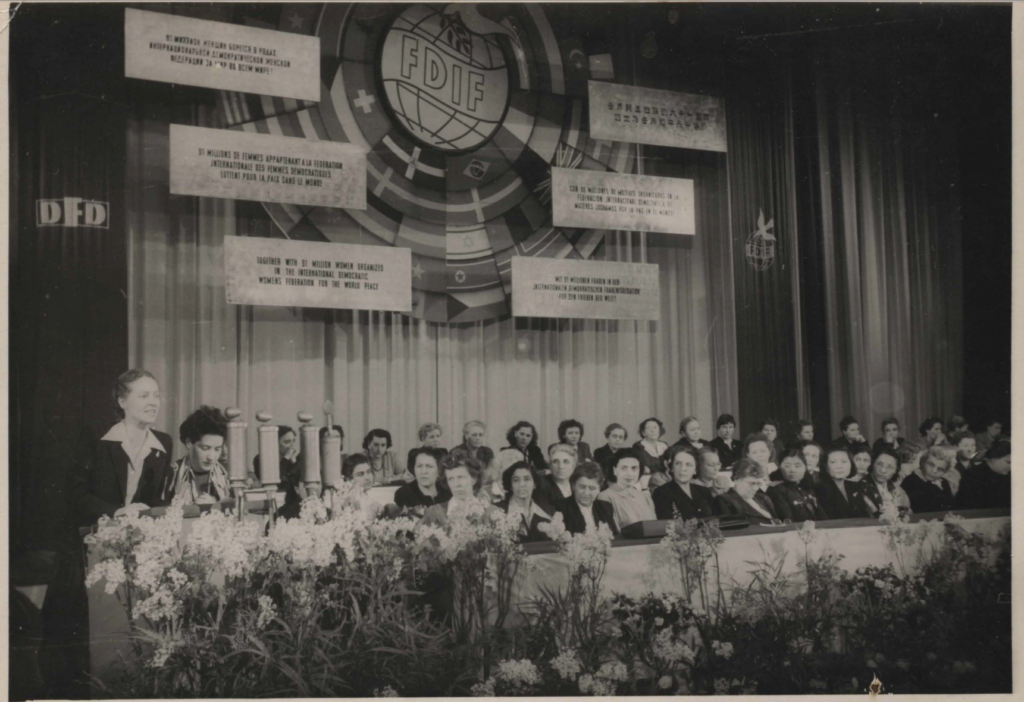
When Millard joined the Communist Party officially in 1940, she established herself as an editor and writer for the progressive magazine New Masses and became an active member of The Congress of American Women.12 In 1949 she joined the Women’s International Democratic Federation, WIDF, which sponsored her to travel to Europe and beyond the Iron Curtain to report on the status of women and attend international women’s conferences.13 Considering Millard’s anti-fascist convictions as well as her feminist ideology provides a more accurate analysis of her journalism for the WIDF. Millard created a short pamphlet entitled “Women on Guard: How the Women of the World Fight for Peace” in 1952.14 She discussed the privilege American women experienced because of their physical separation from the wars of the 20th century, and depicts the rising fear women abroad experienced because of the escalating Cold War. She wrote, “Women of Western Europe are told that they must be prepared to give their sons in a ‘crusade against communism.’ But they remember another ‘crusade against communism’— only a few years ago— Hitler’s. They remember how dearly it cost them. They know that another such war would be a thousand times more dreadful.”15 Analyzing this quote from a feminist perspective leads us to believe Millard’s sole motivation to push for peace was to spare the women of Western Europe from more war and death. However, in this passage, Millard offered her readers a complex criticism of American imperialism through comparing the American anti-communist rhetoric during the Cold War to fascist Nazi Germany’s rhetoric. She created a broader allusion to America as a country floundering in the midst of a rising pro-communist world order, slipping into fascist ideology in order to maintain power.
Millard continually compared American warmongering abroad to Nazism. Without a full understanding of Millard’s devotion to anti-fascism, readers might interpret these allusions as hyperbole to grab their attention, making them seem out of place—especially considering that her most popular feminist work, “Women Against Myth,” only mentions Nazism and fascism once. For instance, Millard wrote an article for New Masses in 1952 entitled “A Look at ‘Operation Killer,’” where she detailed the horrors of the Korean War and implored Americans to see through the American war propaganda machine. She wrote:,
These people (Americans) forget that any soldiers taking part in an aggressive war of annihilation against a whole people, become quickly brutalized and commit acts that they themselves would never have dreamed themselves capable of a few months before. An unjust war can only be fought by barbarous means. An army’s politics determines its techniques.
Of course, the U.S. soldier is only obeying orders.
So was the Nazi.16
Millard insisted on pushing the comparison of America’s unjust wars to Nazism in order to highlight the hypocrisy within the American government. This excerpt from Millard’s article created a clear distinction between the American people and the American government, highlighting her dedication to not blaming individuals for the failings of their government. However, she made clear the consequences of becoming a tool to export capitalism and violence, condemning American soldiers to the same fate as Nazis. Millard urged her reader throughout her article “Operation Killer” to analyze the American war machine and consider the benefits communism offers when compared to the violence produced by capitalism. Her point that “an army’s politics determines its techniques” directly criticized capitalistic wars because they wage for profit, not human betterment.17 Communist literature on the inherent ties between fascism and capitalism influenced Millard’s writing and anti-war agenda. Millard’s insistence on highlighting the parallels between the American anti-communist agenda and the fascist regimes of the 1930s and 1940s in her writings demonstrates her commitment to communism, as an anti-fascist.
Understanding Millard as an anti-fascist illuminates complexity in her writings that a feminist lens fails to provide. Millard’s commitment to peace and critiquing American warmongering demonstrates her dedication to communism as an ideology, again in ways her feminist literature does not. Although Millard’s feminist ideology gave her further opportunities to participate in the international communist movement, such as her enrollment in the WIDF, they did not singularly shape her understanding of communism. Anti-fascism from an early age dictated her political and journalistic career in equal measure to feminism. Stephan’s words for Franco, “You see these thumbs? I would gouge his eyes out. Slowly. It would be horribly painful. I would pull his nails out” find themselves neatly aligned with Millard’s personal fervent dedication to ending fascism. 18
Part Two: Millard the Anti-Colonialist, Anti-Imperialist, and Communist
“Now I wish I could tell you about my country that would make it seem less remote, grim and unreal to you– that’s the way it seemed to me after two years away. I’ve gotten used to the fat cars, fat newspapers and fat people, and the ceaseless, hopeless attempt to make people think the outer world is inhabited by insatiable demons on the one hand and hungry millions on the other who hope we will save them from the demons.”19 Millard wrote these words to her lifelong friend and pen pal Gita in 1952. Millard had just finished her two-year tour of the Soviet Union, Europe, and East Asia, overwhelmed by the sights of collapsed capitalist empires reborn as communist utopias. Returning to the heart of capitalist imperialism, the United States weighed heavily on her. Millard understood American prosperity and opulence as rewards reaped from an exploitative capitalist system at the expense of unofficial American colonies.20 Millard recognized the American propaganda machine in the early fifties as hopelessly dedicated to the demonization of all communists and the infantilization of all non-American civilians as hungry masses desperate for American intervention and protection.
Analyzing communist ideology and its critiques of capitalism helps to properly understand Millard’s criticism of the United States’ foreign policy as well as her anti-colonialism. The “Program of the Communist International, Together With Its Constitution” offers insights into the official Communist Party’s opinions regarding imperialism, colonialism, and capitalism. The first chapter of the pamphlet describes the characteristic features of a capitalist society which they claim “arose on the basis of commodity production” and are “the monopoly of the most important and vital means of production by the capitalist class and big landlords; the exploitation of the wage labor of the proletariat…the production of commodities for profit.”21 Essentially, a small elite class holds a monopoly on the vital resources of production so that the working class must sell their labor to the elite who produce goods for profit. This system leads to an exploitative relationship between the elites and working class, the bourgeoisie and proletariat: economic domination and politics driven by capitalism.22 The chapter also claims that “in its quest for profits the bourgeoisie was compelled to develop the productive forces on an ever-increasing scale and to strengthen and expand domination of capitalist relations of production.”23 The CP understood capitalism as ever-expanding and inherently exploitative. The surging scale of capitalism developed to a global level, producing imperialism. The second part of the first chapter details this transition. It describes how capitalism evolved smoothly while unclaimed land, people, and resources existed and how the colonies of capitalist countries experienced the most brutal effects of extracting labor. Therefore, colonies shoulder the burden of production while becoming further removed from the profits of commodities.24 The pamphlet also claims that “free competition rapidly gave way to monopoly, the previously “available” colonial lands had already been divided up, and the struggle for a redistribution of colonial and spheres of influence inevitably” lead to armed struggles.25 These armed struggles lead to finance capitalism, otherwise known as imperialism, which lead to “a new form of gigantic combinations of enterprises linked up into one system by the banks.”26 The oppressive nature of capitalism, which on a small scale represents the abuse of landowners over their tenants, reinforces itself on a larger scale: the population of entire nations under colonial rule as the tenant answering to a foreign country that controls the land, enterprise, and finance.27 However, the ever-increasing nature of capitalism results in the intensified abuse of the working class. The final section of the first chapter details how “imperialism is creating a type of decaying and parasitically degenerate rentier-states as well as a whole state of parasites who live by clipping coupons.”28 In the formation of concentration of the means of production and the extensive abuse of the proletariat, communists believed that these combined factors created the perfect conditions for an uprising of the working class and the success of communism.29 This understanding of the interconnectedness of capitalism, imperialism, colonialism, and communism presents itself in Millard’s writings.
Millard’s anti-colonial sentiments moved to the forefront of her political writing and activism after her two years abroad between 1949 and 1950. She attended conferences throughout the Soviet Union and China hosted by the Women’s International Democratic Federation. In late November 1949, Millard travelled by train from Moscow to Peking to attend the Conference of the Women of Asia. Her railway companions consisted of representatives from France, England, Holland, India, the USSR, Cuba, Algeria, Israel, and Czechoslovakia. Millard noted in an article for the Daily Worker the impressive backgrounds and works these representatives committed themselves to: Jeanette Vermeersch dedicated her life to leading the French crusade against the war in Vietnam. Rie, a Dutch Auschwitz survivor, led Dutch women against the shipment of arms to Indonesia.30 The women at WIDF conferences devoted themselves after World War II to resisting their countries’ involvement in colonial enterprises through their involvement in the Communist Party. Millard’s time spent with the WIDF pushed her to further her understanding of the interconnected nature of capitalism and colonialism. Analyzing the articles Millard wrote about the WIDF conferences in the Soviet Union and China between 1949 and 1950 from a solely feminist lens detracts from Millard’s broader understanding of communism as a necessary tool to dismantle a capitalistic and imperialistic world order. For instance, in Millard’s article “Asia’s Women Meet Where Manchu Emperors Ruled” she wrote:
The Viet-Nam delegate related how troops of children cluster around the doors of restaurants in Saigon, hoping to be allowed to lick the customer’s empty plates. As in most colonial countries, the misery is so profound that mothers sell their children to factories, to plantations, to houses of prostitution, in order to not see them starve before their eyes.31
Interpreting Millard’s intense depiction of women and children suffering under colonial rule solely in the context of her as a feminist leads us to believe that her anti-colonial beliefs relied on the suffering of women and children. Rather, Millard’s understanding of colonialism developed from her commitment to dismantling capitalism. To Millard, capitalism required colonial oppression and extraction, which, in turn, produced the mass suffering of the working class, especially its most vulnerable members: women and children. Conveying Millard’s personal commitment to communism as a result of her dedication to protecting women and children distracts from Millard’s commitment to communism and anti-colonialism. Assuming that the foundation of women activists’ ideology rests solely on their gender blatantly belittles women’s contributions to social progress outside the realm of feminism.
Upon returning to the United States, given the House of Un-American Activities’ disintegration of the Congress of American Women, Millard found herself in need of new employment. She landed a position as editor and writer for a progressive Latin American news magazine, Latin America Today. Millard again wrote to Gita sharing her news. Casually, she noted that the magazine’s purpose “is to fulfill at least in a small way our responsibility toward our Latin-American friends.”32 She quipped that her “chief qualifications for the job seem to be that I know nothing about South America and do not read Spanish.”33 Millard found herself in unfamiliar territory. However, once Millard became embroiled in the politics and history of Latin America she wrote to Gita explaining that, “I can pay attention to women now only in my spare time. I’ve learned a whole lot about our neighbors to the south and I’m amazed at how ignorant I was about a very important part of the world, also how ignorant everybody here is on that subject.”34 Millard’s feminist ideology accompanied her sense of responsibility toward Latin America. Given the women she met during her WIDF tour and their commitment to resisting their countries’ colonial agendas, Millard’s choice to explore the United States’ most vast and precious area of extraction becomes clearer when her commitment to anti-colonialism is weighed equally with her commitment to feminism.
On March 9, 1953 Betty Millard wrote a letter to her mother from Guatemala, “We love this place. We’ve talked to a number of people about the land reform, which is an all important topic here…Thousands of peasants have already got land of their own for the first time in their lives. Now, instead of paying 50% to 70% of their crops to the landlord, as those who rented land formerly did, they pay only 3% to 5% off their crops a year to the government over 35 years as payment for the land.”35 The removal of landlords’ land into the hands of the people, regulated by the government instead of private individuals, demonstrates the potential breakdown of capitalistic exploitation in Guatemala. Land reform became one of Millard’s most reported topics published in Latin America Today. Her personal correspondence with her mother reflects her excitement and commitment to empowering the working class to advocate for themselves and dismantle colonial systems of oppression. Communism on a domestic scale requires the working class to rise up against exploitative bourgeoisie who utilize the working class’s labor in order to hoard wealth.36 This model of class exploitation reinforces itself on an international scale as well. Millard understood the United States as the bourgeoisie extracting labor from Latin America, not only cementing inequality but also contributing to its exponential growth.37 Colonialism describes the practice of extracting resources from one country for the benefit of another, often involving political control. Although in the 1950s, when Millard wrote and edited Latin America Today, the United States technically had no colonies, she recognized the colonial exploitation the United States exercised within Latin America.38
Millard understood American support for dictators in Latin America as a political tool to keep corrupt capitalist governments in power so that the United States could continue to exploit their resources.39 Millard wrote in one of her unpublished articles that the two main reasons Latin Americans hated the United States were the semi-colonial relations and the support of dictators.40 She noted that “our support of these dictators is little known by most Americans but is well known and hotly resented by several million Latin Americans. The support is given in the name of anti-communism but, the words of Dr. Eduardo Santos, former president of Columbia, ‘The flag of anti-communism in Latin America has been transformed into a pirate’s banner…’”41 Millard’s dedication to reporting on Latin America stemmed both from her personal attachment to dismantling colonial exploitation and her dedication to informing Americans of the contradictions and misinformation of the U.S. government.42 The United States justified their intervention into Latin America as a protective measure against communism.43 Millard understood this as a scapegoat tactic so the U.S. could maintain political control.44 Given Millard’s attunement to the interwoven political forces at play in Latin America, her prolonged dedication to writing and reporting on Latin America aligns with her personal allegiance to dismantling capitalism and colonialism.
Analyzing Millard’s writings in accompaniment with the broader communist ideology helps us to better understand her commitment to reporting on Latin America and dismantling American imperialism. Tracing her time in the WIDF, the people she met, and the articles she wrote creates clear throughlines between her feminist ideology and anti-colonialism. Investigating Millard’s writings on anti-imperialism allows us to have a broader understanding of her belief system and communist ideology than a singularly feminist lens allows.
Part 3: Millard the Red Feminist
Fran and I loved Russian movies… I remember one called ‘Tanya’ in which a beautiful but poor young peasant woman is at first scorned by the men peasants when she tries to improve the lot of the collective’s pigs and then later she becomes president of the whole collective farm and is sent to Moscow as an example of the new socialist woman. I cried all the way through that film several times: what it meant to me was that you could be a woman and be strong at the same time.45
— Betty Millard, Date Unknown
Although Betty Millard’s feminist writings do not sufficiently explain her joining the Communist Party or her commitment to reporting on Latin America, Millard did experience a profound sense of hope and validation because of the Soviet Union’s depiction of women. Her most famous piece of literature, “Women Against Myth,” illustrated the Soviet Union as virtually free from gender discrimination. Given middle-class American women’s visible ousting from the workforce in the postwar period and digression back to their prewar status, Millard’s idealization of the strong, working Soviet woman with state-sponsored childcare and equal distribution of household labor proves understandable. However, Millard’s experience within the Communist Party exposed itself as more similar to the beginning of ‘Tanya’ than the end.
In order to understand why the CP-USA considered Millard’s feminism revolutionary, first we must analyze how the CP approached the “woman question” before Millard. The Constitution of the U.S.S.R. functioned as the political blueprint for all communist parties around the world, including CP-USA. The U.S.S.R. Constitution states in article 122 that, “Women in the U.S.S.R are accorded equal rights with men in all spheres of economic, state, cultural, social and political life.”46 The Soviet Union’s constitution offered women more rights than most Western countries, demonstrating the attractiveness of communism to progressive women. In the Introduction, written by N. Krupskaya, to the 1921 pamphlet “Women and Society” by Vladimir Lenin (one of the communist party’s foundational political theorists), Krupskaya explains that, “From the very outset our Party has devoted a great deal of attention to the emancipation of women, exposing the economic and political roots of women’s inequality.”47 This quote represents how the standard communist understanding of women’s inequality revolved around economic and political conditions. Lenin noted that Western countries had not abolished obsolete laws that place women in an inferior position to men because “where capitalism exists, where the private ownership of the land, the private ownership of factories and works is preserved, where the power of capital is preserved, men will pertain their privileges.”48 Lenin claims that sexism is inherently tied to capitalism, and while capitalism exists, women cannot experience true equality. Despite Lenin’s calls for gender equality and diagnosis that capitalism produces gender inequality, throughout his pamphlet, he still refers to women’s inherent “weaker position” as the reason why they experience excessive exploitation under capitalism.49
In his pamphlet, Lenin continued to describe one of the leading causes of women’s oppression as housework. He writes, “As long as women engage in housework their position is still a restricted one. In order to achieve complete emancipation of women and to make them really equal with men, we must have social economy, and the participation of women in general productive labor.”50 Lenin described housework as petty, stultifying, and unproductive.51 Although Lenin advocated for full gender equality and diagnosed the root cause of sex discrimination as capitalism, his pamphlet demonstrates his own underlying misogyny. His references to women’s weaker position, accompanied with his description of housework as petty signifies a warning sign . Lenin’s pamphlet on women and society functioned as the roadmap for how communists should address the “woman question,” but the contradictions within the pamphlet itself raised questions for women within the party who saw room for improvement.
Looking at Lenin’s pamphlet offers us insight into the underlying misogyny within the communist party, but looking at criticism from the women in CP-USA during the 1940s and 50s demonstrates how this misogyny affected the practices of the party claiming dedication to women’s equality. Kate Weigand’s book Red Feminism works to explain the party’s contradictions regarding CP-USA misogyny and how communist feminists addressed these issues. Mary Inman, a longtime Marxist and CP-USA member from 1936–1945, for example, claimed that communist demonization of housework stemmed from misogyny rather than the oppressive nature of housework.52 She advocated for Communist leaders to see housework as productive labor like factory work, but party members who worried that this interpretation would reinforce the notion that a woman belonged in the home rejected her analysis.53 Inman’s case demonstrates the CP-USA’s reluctance to adopt changes to their feminist ideology and address the potential sexism within their approach to the “woman question.”
The Communist Party functioned as one of the most influential left-wing political organizations during the 1940s and 50s, and yet their members still perpetuated sexist stereotypes. Millard wanted to grapple with this blatant contradiction of advocating for equality while ignoring the male chauvinism within the organization. Millard’s “Women Against Myth” works to understand this contradiction and address sexism inside the party. Millard refuted one of the most common explanations of women’s oppression, “Is it true or is it a myth that ‘women like to be dominated?’”54 Millard understood women’s oppression as a result of both capitalism and patriarchy, however, unlike colonialism and racism, capitalism alone does not produce sexism.55 She argued that the ways society conditions girls resulted in the degradation of their self worth and subconsciously embedded in women an inherent feeling of inferiority to men.56 Betty Millard believed that communism alone did not inherently produce gender equality, rather that individuals needed to address their own male chauvinistic attitudes in order to understand the ways in which they subconsciously oppress women. Millard’s argument did not stop at diagnosing women’s oppression as a product of social conditioning. She claimed that women’s oppression transcended class oppression, the basis of communist ideology, because all women experienced oppression regardless of class. She wrote in “Women Against Myth” that “economics, religion, customs, taboos impose conflicting roles and wishes on women, who are unable to function fully in society as both mothers and citizens not because of their special biological natures but because every society until the advent of socialism has made it economically and socially impossible for them to do so.”57 This, she argued, affected all women regardless of class. Millard’s pamphlet received widespread attention, forcing the CP-USA to change their portrayal of women in magazines and literature in order to combat the social conditioning Millard diagnosed.58 Similarly, her pamphlet equipped individual communist women with the tools necessary to address the sex discrimination they experienced from men within the party.59 Millard’s radical pamphlet solidified her as a well-respected communist feminist dedicated to addressing gender inequality within the Communist Party.
Conclusion
Millard’s radical feminist position challenged Lenin’s, and therefore the Communist Party’s, interpretation of the woman question. She reached beyond the ideological principles set before her by the party and enacted real change for individuals and broader party ideology. Millard’s feminism sets her apart from other communists and explains why historians often choose this facet of her identity to analyze. However, Millard’s advocacy, literature, and ideology expanded beyond her commitment to gender equality. Analyzing her personal works of writing and her articles pertaining to international events demonstrates her deep-felt commitment to anti-colonialism and anti-fascism. Her works as a feminist intersected with these other commitments, demonstrating her more nuanced belief system. Although Millard’s work “Women Against Myth” presents itself as one of the most influential pieces of feminist literature from the early 20th century, published internationally, her commitment to communism went beyond feminism. Historians’ conceptions of Betty Millard demonstrate the ways in which the historical academy limits women as political actors. In giving equal weight to Millard’s dedication to anti-fascism and anti-colonialism, as to her feminism, I offer a more holistic understanding of Millard as a communist and individual who works to combat the implicit sexism within the historical academy.
Bibliography
Betty Millard papers, Sophia Smith Collection, SSC-MS-00673, Smith College Special Collections, Northampton, Massachusetts. https://findingaids.smith.edu/repositories/2/archival_objects/157931. Accessed May 12, 2025.
Lenin, Vladimir. Program of the Communist International, Together With Its Constitution.
3rd Edition. Workers Library Publishers, 1936.
https://babel.hathitrust.org/cgi/pt?id=osu.32435017158270&seq=8.
Lenin, Vladimir. Women and Society. Little Lenin Library, Vol. 23. International Publishers, 1938.
Millard, Elizabeth. Women Against Myth. International Publishers, 1948.
https://www.davidanthembookseller.com/pages/books/11602/betty-millard/woman-against-myth.
Weigand, Kate. Red Feminism: American Communism and the Making of Women’s Liberation. Johns-Hopkins University Press, 2001.
“The Communist International.” Advocate of Peace through Justice 86, no. 12 (1924): 659–63. http://www.jstor.org/stable/20660772.
Soviet Union. Constitution (Fundamental Law) of the Union of Soviet Socialist Republics: As Amended and Supplemented by the First, Second, Third, Sixth, Seventh and Eighth Sessions of the Supreme Soviet of the USSR. Foreign Languages Publishing House, 1938.
- Betty Millard Short Story “Love All,” Box 1, Folder 12, Betty Millard Papers 1911–2010, Sophia Smith Collection, Smith College Special Collections. ↩︎
- Ibid. ↩︎
- Kate Weigand, Red Feminism: American Communism and the Making of Women’s Liberation (Johns Hopkins University Press, 2001), 14. ↩︎
- Ibid., 4. ↩︎
- Betty Millard Short Story “Love All,” Box 1, Folder 12, Betty Millard Papers 1911–2010, Sophia Smith Collection, Smith College Special Collections. ↩︎
- Betty Millard Papers, short story “The Repatriate,” Box 29, Folder 11, Betty Millard Papers 1911–2010, Sophia Smith Collection, Smith College Special Collections. ↩︎
- “The Communist International,” Advocate of Peace through Justice 86, no. 12 (1924): 659, http://www.jstor.org/stable/20660772. ↩︎
- Betty Millard Time Line, Box 1, Folder 12, Betty Millard Papers 1911–2010, Sophia Smith Collection, Smith College Special Collections. ↩︎
- Vladimir Lenin, Program of the Communist International, Together With Its Constitution, 3rd Edition (Workers Library Publishers, 1936), https://babel.hathitrust.org/cgi/pt?id=osu.32435017158270&seq=8, 24. ↩︎
- Ibid. ↩︎
- Ibid., 24–5. ↩︎
- Betty Millard Time Line, Box 1, Folder 12, Betty Millard Papers 1911–2010, Sophia Smith Collection, Smith College Special Collections. ↩︎
- Betty Millard Time Line, Box 1, Folder 12, Betty Millard Papers 1911–2010, Sophia Smith Collection, Smith College Special Collections. ↩︎
- Betty Millard pamphlet “Women on Guard,” February 1952, Box 29, folder 10, Betty Millard Papers 1911–2010, Sophia Smith Collection, Smith College Special Collections. ↩︎
- Ibid. ↩︎
- Betty Millard article saved in personal travel journal “Operation Killer,” November 1951, Box 3, Folder 2, Betty Millard Papers 1911–2010, Sophia Smith Collection, Smith College Special Collections. ↩︎
- Ibid. ↩︎
- Betty Millard Papers short story “The Repatriate,” Box 29, Folder 11, Betty Millard Papers 1911–2010, Sophia Smith Collection, Smith College Special Collections. ↩︎
- Betty Millard Papers to Gita Banertea, April 17 1952, Box 17, Folder 4, Betty Millard Papers 1911–2010, Sophia Smith Collection, Smith College Special Collections. ↩︎
- Betty Millard draft article, 18 March 1955, Sophia Smith Collection, Box 18, Folder 3, Betty Millard Papers 1911–2010, Sophia Smith Collection, Smith College Special Collections. ↩︎
- Lenin, Program of the Communist International, 11. ↩︎
- Ibid. ↩︎
- Ibid. ↩︎
- Ibid., 13. ↩︎
- Ibid. ↩︎
- Ibid., 14. ↩︎
- Ibid., 16. ↩︎
- Ibid., 19. ↩︎
- Ibid. ↩︎
- Betty Millard article saved in personal travel journal, “Asia’s Women Meet Where Manch Emperor’s Ruled,” 18 April, 1950, Box 3, Folder 2, Betty Millard Papers 1911–2010, Sophia Smith Collection, Smith College Special Collections. ↩︎
- Ibid. ↩︎
- Betty Millard to Gita Banertea, 17 April 1952, Box 17, Folder 4, Sophia Smith Collection, Betty Millard Papers 1911–2010, Smith College Special Collections. ↩︎
- Ibid. ↩︎
- Ibid. ↩︎
- Betty Millard to Elizabeth Bell Boynton, 9 March 1953, Box 17, Folder 14, Betty Millard Papers 1911–2010, Sophia Smith Collection, Smith College Special Collections. ↩︎
- Lenin, Program of the Communist International, 16. ↩︎
- Betty Millard draft article, 18 March 1955, Sophia Smith Collection, Box 18, Folder 3, Betty Millard Papers 1911–2010, Sophia Smith Collection, Smith College Special Collections. ↩︎
- Ibid. ↩︎
- Ibid. ↩︎
- Ibid. ↩︎
- Ibid. ↩︎
- Ibid. ↩︎
- Ibid. ↩︎
- Ibid. ↩︎
- Betty Millard Short Story “Love All,” Box 1, Folder 12, Betty Millard Papers 1911–2010, Sophia Smith Collection, Smith College Special Collections. ↩︎
- Constitution (Fundamental Law) of the Union of Soviet Socialist Republics (1936), art. 122. ↩︎
- Vladimir Lenin, Women and Society, intro. N. Krupskaya (International Publishers, 1938), 5. ↩︎
- Ibid., 15. ↩︎
- Ibid., 16. ↩︎
- Ibid., 14. ↩︎
- Ibid. ↩︎
- Weigand, Red Feminism, 28. ↩︎
- Ibid., 29. ↩︎
- Elizabeth Millard, Women Against Myth (International Publishers, 1948), 6, https://www.davidanthembookseller.com/pages/books/11602/betty-millard/woman-against-myth. ↩︎
- Ibid., 7. ↩︎
- Ibid. ↩︎
- Ibid., 12. ↩︎
- Weigand, Red Feminism, 86. ↩︎
- Weigand, Red Feminism, 84. ↩︎