
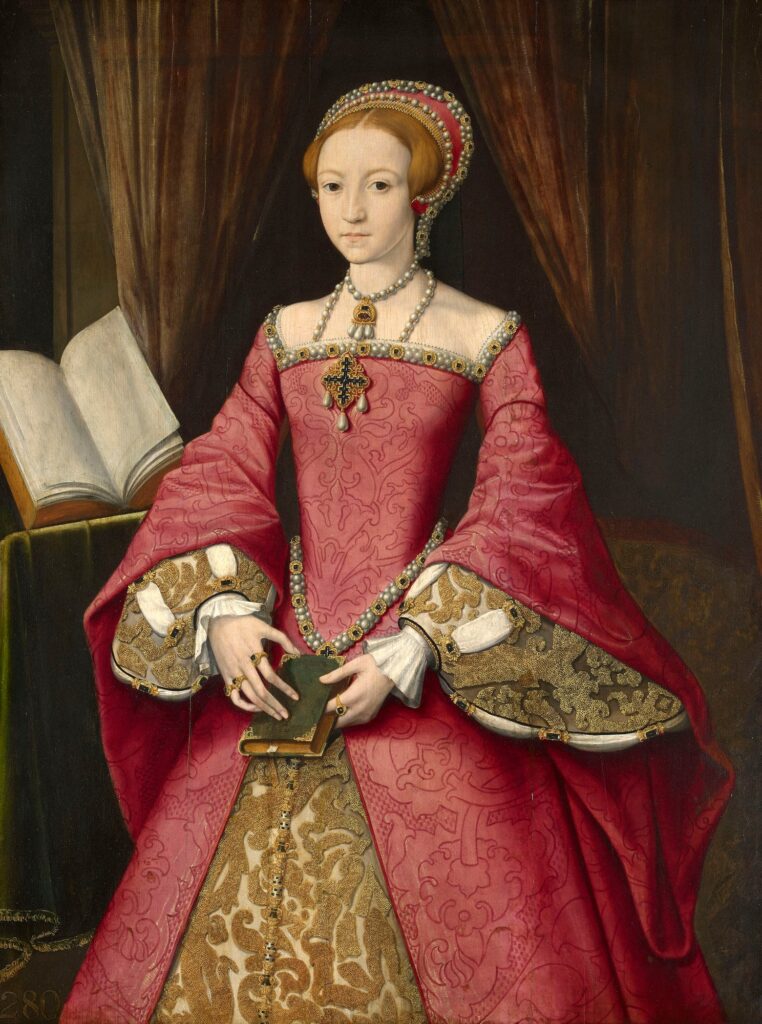
No Time Like the Present: Gift Exchange and the Pre-Accession Experience of Elizabeth I
Olivia Cannings, University of Edinburgh
Olivia Cannings is a final year undergraduate student at the University of Edinburgh studying History and Classics. Her interests lie in the literary and cultural history of Medieval and Early Modern Europe, and especially in its intersection with women’s lives. She also has a keen interest in Ancient Greek and Latin literature and language, and she is the recipient of the Horsliehill-Scott Bursary in Classics and the W.R. Hardie Memorial Prize for Latin Prose Composition. She is currently working on her undergraduate dissertation entitled ‘Imperialism and the Elegiac Puella in Ovid’s Amores.’
This essay will seek to explore the significance of gifting to the pre-accession experience of Elizabeth I, and to analyse what her gifting practices reveal about her status and position in the late Henrician court, as well as about Elizabeth as a person. This will be done primarily through examining three translations that were produced and gifted by Elizabeth. The first translation is of Marguerite of Navarre’s 1531 Le Miroir de L’Ame Pécheresse (The Glass of the Sinful Soul, hereon referred to as The Glass), a text heavily influenced by the principles of Erasmianism, translated from French to English in 1544 as a 1545 New Year’s Day gift for her stepmother, Catherine Parr.1 The final two translations were written in 1545 to be presented as 1546 New Year’s Day gifts: Catherine Parr’s 1545 Prayers or Meditations, another Reformist text, translated from English into Latin, French and Italian for her father, Henry VIII; and the first chapter of John Calvin’s Institutes of the Christian Religion (hereon referred to as Institutes), translated from the 1541 French version for Catherine.2 Historiography has tended to dismiss Elizabeth’s translations as only being evidence of her precocity and intellect, generally focusing on their role as a gift to find parallels with gifting in Elizabeth’s reign.3 This approach ignores the question of why Elizabeth chose to produce and gift these translations, and what they reveal about her position at court in the mid-1540s. This essay hopes to apply frameworks of Early Modern gifting practices and women’s participation in the textual economy of the sixteenth and seventeenth centuries to argue that Elizabeth’s translations, in fact, reflect her keen awareness of her situation from a young age. These final years of Henry VIII’s reign are particularly interesting with respect to Elizabeth’s life, since she was beginning to be reintroduced into her father’s household after his marriage to Catherine Parr in 1543, and had been restored to the succession that same year.4
With this in mind, an analysis of the dedicatory prefaces to Elizabeth’s translations will argue that Elizabeth’s position in this period was unstable, and that she used these gift translations to curry favour with her father and to maintain her position. Then, using Lisa Klein’s theory of the “handwrought” gift, and examining frameworks of female gifting in the Early Modern period, it will be argued that Elizabeth was aware of and exploited existing social structures in order to produce translations and increase the efficacy of her gifts. Finally, a comparison with the translating practices of her half-sister, Mary, whose translations did not enter the gift-exchange system, will show Elizabeth’s unique situation and the special importance of gifting to her.
An examination of Elizabeth’s gift translations uncovers the instability of Elizabeth’s position at the court of Henry VIII in the mid-1540s, highlighted particularly by her dedicatory prefaces, which employ a humble and supplicatory tone to increase her favour with her father and stepmother. It is first useful to establish why Elizabeth’s dedications can provide so much insight into the purpose and context of her gift translations, by applying Gérard Genette’s paratext theory. In his book, Genette argues for the importance of paratexts, broadly defined as anything that does not form part of the text, to the function of books, contending that it is elements of paratext, such as the title, epigraph, and, crucially, dedications, which allow a book to be defined as a book.5 Moreover, he argues that paratexts fundamentally influence how the reader is meant to understand a text, and that a dedication “proclaims a relationship” between the writer and the dedicatee to give a text a certain social standing.6 Though Genette’s argument focuses on nineteenth and twentieth century Western literature, he draws extensively on the classical origins of paratexts, and his framework has been applied to works of the sixteenth century, making it relevant to Elizabeth’s translations.7 Applying this framework to the dedicatory prefaces in Elizabeth’s gift translations suggests that she intended her dedications to alter the interpretation of her translations and highlight the special nature of the translations as gifts.
The dedicatory prefaces to The Glass, Prayers or Meditations, and the Institutes show that Elizabeth designed these gifts in response to the instability of her situation, in order to ingratiate herself with her father and stepmother and thereby secure and maintain her position. The shared goal of each translation is underlined by their similarity, with all three praising the addressee, asking them, with some false modesty, to excuse the poor quality of the translation, and to cherish the translation not for its linguistic merit, but as a personal gift, all underpinned by her humble tone. In all three translations she refers to herself as a “humble daughter,” opting for the superlative “most humble” in her 1545 translations, establishing her tone from the outset and her position as an inferior to Henry and Catherine, thus inviting the reader to interpret the translations as acts of deference and respect.8 Admittedly, this deference could be interpreted as Elizabeth paying due respect to her monarchs and parents, rather than as evidence of Elizabeth’s precarious situation. However, the opening inscription of her half-sister Mary’s 1527 translation Concede mihi, misericors Deus, undertaken at a similar age, which begins with the phrase “I haue sed,” asserting Mary as the most important figure in her translation, suggests that this kind of dedication was unconventional for the daughter of a king, albeit an illegitimate one.9 Moreover, Elizabeth’s use of excessive flattery, praising Catherine’s “excellent witte, and godly lerninge” in the preface to The Glass, addressing her as “the most high, most illustrious and magnanimous” in the preface to the Institutes, and saying that Henry “is of such excellence that none or few are to be compared with you in royal and ample marks of honor [sic]” underlines her intention to ingratiate herself with her father and stepmother by means of her gifts, attempting to capture their good will before they embark upon reading the translation, as well as striking a conciliatory tone.10 Indeed, this theme of conciliation can be applied to her choice of translations. Roger Ellis, focusing on the Institutes in his examination of the influence of Henry VIII’s regime on Elizabeth’s translations, notes the significance of Elizabeth’s choice to translate the first chapter of the Institutes, which was intended to be universally applicable to all Christians, arguing for the presence of God in each individual.11 Ellis’ approach, though it focuses on how Elizabeth’s translations reflect the atmosphere of the late Henrician court, not Elizabeth’s own experience, is useful. It suggests that, by translating a text that emphasised unity, Elizabeth recognised how the instability of the Tudor court, which had become more orthodox in its religious stance after the 1539 Act of Six Articles and the 1543 King’s Book, shaped her own unstable position.12
Another important consideration of the purpose of Elizabeth’s gift translations is how she intended her gifts to be received, and whether they were intended to be private to Henry and Catherine, or to be circulated throughout the court as a public show of loyalty. Elizabeth’s request to Catherine in her preface to The Glass that “no other, (but your highnes onely) shal rede it, or se it, lesse my fauttes be knowen of many” casts doubt on whether she wished for her translation to be circulated.13 Valerie Schutte, in her comparison of the pre-accession translations of Mary and Elizabeth Tudor, takes this claim at face value, arguing that, although Elizabeth’s dedication follows a “typical rhetorical pattern,” her request that it be kept private to Catherine deviates from standard practice, since the purpose of dedications was generally so that a patron would distribute a book and enable it to be published, something that Elizabeth likely did not desire.14 However, although Schutte’s assessment that Elizabeth presumably did not intend for her translation to be published is fair, it seems unlikely that Elizabeth would have intended for this gift to be read only by Catherine, since she produced it to increase her social standing. Indeed, it is probable that Elizabeth’s request was simply an extreme expression of humility, since she had already created a tone of self-abasement, professing her work “in many places to be rude, and nothinge done as it shuld be.”15 Furthermore, Elizabeth clearly exploits literary conventions for dedications, for example referring to her translation as a “lytell boke,” a stock phrase for expressing humility in ancient Roman poetic dedications, as Harm-Jan van Dam notes in his discussion of dedications in classical antiquity.16 Although van Dam also notes that extreme humility in classical dedications was not meant to be taken literally, it should be acknowledged that, in Elizabeth’s case, the humility she expresses, though perhaps exaggerated for literary purposes, is genuine.17 Schutte’s assessment also ignores the public gifting practices of the Tudor court, where Henry displayed gifts on specially constructed buffets in order to show off his gifts and to express favour towards certain courtiers.18 Elizabeth was undoubtedly aware of the publicity of gift exchange at the Tudor court, and likely viewed her gift as a public show of loyalty as much as a private one. This also links to Genette’s emphasis on the importance of the relationship proclaimed in a dedication, with the dedications ultimately acting as public mediums for Elizabeth to express to her readers, perhaps courtiers, her loyalty to her father. To conclude, the purpose of Elizabeth’s gift translations to gain favour with her father and stepmother and to maintain her position speaks to Elizabeth’s unstable position at the Tudor court. Her dedications underline how precarious her situation was by means of their humble tone as well as her eagerness to publicly proclaim her loyalty to Henry and Catherine through the medium of a gift at court.
Having established the instability of Elizabeth’s situation in the late Henrician court and the purpose of her gift translations in maintaining her position, it will now be argued that Elizabeth’s gift translations provide evidence of her keen understanding of her situation and her adeptness at manipulating social dynamics to improve her position. Elizabeth’s choice to influence her father and stepmother by means of a written gift illustrates her awareness of social norms for elite Tudor women, since she acted within permitted spheres of influence. Through an examination of poems written and dedicated to various figures by three women in the Elizabethan period, Jane Donawerth argues that women legitimised and facilitated the circulation of their poetry by presenting it as part of the Tudor gift-exchange system.19 She argues that, by allowing their poetry to function within this system, they exerted agency and influence upon political structures.20 Though Donawerth’s argument applies to original works, rather than translations, it nevertheless extends to Elizabeth’s translations, since she drew upon the frameworks of gifting that were available to her to influence her position. Indeed, she acted within the tradition of Early Modern elite women as translators and authors, such as Marguerite of Navarre, the original author of The Glass, Catherine Parr, and even her sister, Mary. By aligning herself with these women and following a well-established precedent, Elizabeth was able not only to make a public display of loyalty towards Henry and Catherine, but also to assert her own voice and agency to her father and the Tudor court, while acting within the acceptable social parameters for a woman.
Moreover, Elizabeth’s use of “handwrought” gifts further demonstrates her adeptness and awareness of the social outlets available to her and of the value of an appropriate gift, as underlined by Lisa Klein’s framework.21 Klein argues for the efficacy of personal, and particularly “handwrought” gifts through an examination of gifts given and received by Elizabeth throughout her reign.22 Drawing on Marcel Mauss’ observation about gifts being imbued with the spirit of the donor, she argues that a personal gift (one tailored to the giver) forged a special connection between the donor and the recipient, with a particularly special bond being formed between women by “handwrought” gifts.23 She applies this framework to Elizabeth’s gift translations, focusing particularly on the embroidered covers, arguing that, through her gifts to Catherine, Elizabeth positioned herself within the “female community” at the Tudor court and also sought to achieve her own goals.24 Indeed, Elizabeth herself acknowledges the importance of the “handwrought” nature of her translations in her preface to Prayers or Meditations, saying “if it is mediocre, even if it is worthy of no praise at all, nevertheless if it is well received, it will incite me eagerly.”25 Here, Elizabeth recognises that the value of her gift fundamentally lies within the care and effort that she has expended upon it, rather than the skill it displays, and acknowledges that this is what gives the gift its special quality.
Klein’s focus on the gift containing not only textual elements, but also visual elements is notable, and links to the idea of paratext influencing the meaning of a gift. As Mary Lewis notes in her introduction to the application of Genette’s theory to dedications, paratext can fall into four categories: “authorial, organizational, visual, and editorial.”26 The covers of the translations fall into the categories of “visual paratext,” creating a first impression about its purpose and content, since it is the first thing the reader sees. For example, Elizabeth embroidered the cover of The Glass with Catherine Parr’s initials (KP), signalling her relationship with Catherine and amplifying the special connection that the gift creates.27 Moreover, Schutte notes how the translations of 1545 were visibly coordinated, with Prayers or Meditations featuring a red cover with a “blue and silver monogram,” and the Institutes featuring a blue cover with a “red and silver monogram,” so that, when placed together, they would declare to the court Elizabeth’s loyalty and connection to Henry and Catherine.28 This fits with Klein’s thesis and illustrates Elizabeth’s recognition of the importance of the visual quality of her gifts, ensuring that they created a positive first impression on their reader and that the outside mirrored the care and effort put into the inside.
The content of Elizabeth’s gift translations also provides evidence of her ability to appeal to her recipients by personalising her gifts and adapting them to create maximum effect. The genre of the translations appeal to Henry and Catherine individually, with Prayers or Meditations indirectly praising Henry by praising the work of his wife, and with The Glass and the Institutes appealing to Catherine’s reformist tendencies.29 This personalisation even extends to a linguistic level. Nadia Fusini argues that moments regarded as errors in Elizabeth’s translation of The Glass are manifestations of her subconscious feelings surrounding her family’s relationship with incest.30 She draws particularly on a line where Elizabeth translates the word père (father) as mother in her translation “Mother and daughter: O happy kindred,” interpreting this modification as owing to the fact that Elizabeth was unable to conceive of a positive paternal bond.31 This is unconvincing, since Elizabeth was beginning to enjoy more favour with her father, and The Glass was a deliberate attempt to increase and maintain this favour through her stepmother.32 It is more likely that this was Elizabeth tailoring her gift to Catherine, to assert their relationship and their maternal bond. Indeed, it is possible that Elizabeth was mimicking Catherine’s literary style, which manipulated grammatical gender to convey her message, for example de-gendering the speaker in her 1545 Prayers or Meditations to create a more universal message.33 Moreover, this same approach can be detected in Elizabeth’s translation of Prayers or Meditations, where, bound by linguistic gender in French, Italian and Latin, she reinserted gender into her translation, favouring the masculine, thus making the text more appropriate for her father.34 This disproves Fusini’s theory and underlines Elizabeth’s awareness of the importance of the personalised gift, and her attention to detail in crafting it. In summary, Elizabeth’s gift translations underline her adeptness and awareness of the social role in which she was placed as an elite woman, using conventions surrounding gift exchange and writing to her advantage, and of the importance of personalised gifts in forging personal connections.
Finally, examining the use of translations by the future Mary I will underline Elizabeth’s unique situation and how gifting dynamics fundamentally differed for the two, with Elizabeth needing to assert her position through handmade gifts in a way that Mary did not, though both occupied the same legal position as acknowledged illegitimate daughters of the king.35 Schutte argues that Mary included a short inscription instead of a dedicatory preface in her 1527 translation of Thomas Aquinas’ prayer Concede mihi, misericors Deus, owing to the fact that, as a princess at that time, she did not need to legitimise her position.36 Though Mary was still legally a legitimate princess in this period, this translation provides a useful point of comparison with Elizabeth’s, as they were both of similar ages, around eleven, but were in drastically different positions and acted accordingly. To complement Schutte’s argument, it is useful to return to Genette, who notes that the omission of a dedication in a book is equally as conspicuous as featuring one, and means that the author either does not see anyone as worthy of a dedication in their book or does not see their book as worthy to be dedicated to anyone.37 In this case, it seems likely that Mary did not see anybody as worthy of her text, nor did she need to dedicate it to add legitimacy, since her status as a princess was sufficient. Moreover, owing to her status, Mary did not need to offer her translation as part of the gift-exchange system for it to be circulated, unlike Elizabeth, who had to rely on the status of her father and stepmother for her translations to be circulated. The fact that Mary wrote her translation in a book of hours that featured annotations by Henry VII and Elizabeth of York also emphasised her royal status and authority.38
Furthermore, Mary enjoyed more stability than Elizabeth in her position in the 1540s, despite their similar legal statuses. Schutte argues that Mary’s name carried more authority than Elizabeth’s in this period, on the basis of her involvement in Catherine Parr’s project to translate Erasmus’ Paraphrases (published in 1548), and a letter from Catherine to Mary asking Mary to allow her name to be attributed to her translation.39 This is another example of Mary being able to circulate her translations based on her own status, not having to participate in the gift-exchange system in order to legitimise her involvement in the activity. Indeed, even when Mary did give gifts, Schutte notes that these were generally bought, not handmade, underlining how Mary did not have to affirm her position through thoughtful, carefully wrought gifts as Elizabeth did, attesting to Elizabeth’s unique situation.40 Overall, Mary’s ability to produce translations in her youth and as an adult legitimised by her own status, rather than relying on the authority of another, acts in sharp contrast to Elizabeth’s situation. It highlights how unique Elizabeth’s situation was, and thus how personalised gifting fulfilled a special role for her, allowing her to exert influence and forge relationships that would have been easily available to her had she still been a legitimate princess, or even of higher status.
In conclusion, an examination of the three gift translations undertaken by Elizabeth in 1544 and 1545 has shown that gifting was a significant part of Elizabeth I’s pre-accession experience, and illuminates Elizabeth’s unstable and unique situation in the late Henrician court, as well as her capability and ability to recognise the meaning and importance of gifts at a reasonably young age. Examining the dedicatory prefaces to Elizabeth’s gift translations underlines the instability of her situation in her father’s court, with the humble and deferential tone of each suggesting that Elizabeth’s primary purpose in producing these gifts was to improve, or maintain, her favour at court. Indeed, the very fact that Elizabeth included dedicatory prefaces in her translations demonstrated her need to add legitimacy to her work, which was not automatically bestowed by her diminished status, and also to make clear to Henry and Catherine, as well as others at the Tudor court, before they began reading that the translations were acts of devotion and loyalty. Moreover, Elizabeth’s participation within the gift-exchange system and her use of “handwrought” translations provides evidence of her acute awareness of the frameworks she belonged to in Tudor society, what social expectations of her were, and of her ability to make use of these structures to secure her position and strengthen familial ties. Elizabeth’s ability to make use of existing precedents in order to further her own goals is evident in her recognition of the special quality inherent in a handmade gift, which she alludes to herself in her preface to Prayers or Meditations, with her intertwining of the visual and textual mediums in her gift translations. Finally, comparison with Mary’s translations and attitudes to gifting underlines the unique nature of Elizabeth’s position in the Tudor court and the significance of her participation in the gift-exchange system. While Mary was able to rely on her own status to circulate her translations, Elizabeth had to offer her translations as part of the gift-exchange system. Thus, Elizabeth occupied a unique space within the system of gift-exchange in the late Henrician period, relying on existing frameworks surrounding female gifting and writing to exert influence and maintain her position.
Bibliography
van Dam, Harm-Jan. “‘Vobis Pagina Nostra Dedicatur’: Dedication in Classical Antiquity.” In Cui Dono Lepidum Novum Libellum?: Dedicating Latin Works and Motets in the Sixteenth Century, edited by Ignace Bossuyt, Nele Gabriëls, Dirk Sacré, and Demmy Verbeke, 13–34. Leuven University Press, 2008.
Donawerth, Jane. “Women’s Poetry and the Tudor-Stuart System of Gift Exchange.” In Women, Writing, and the Reproduction of Culture in Tudor and Stuart Britain, edited by Mary E Burke, Jane Donawerth, Linda L. Dove and Karen Nelson, 3–18. Syracuse University Press, 2000.
Elizabeth I. Elizabeth I: Translations, 1544–1589. Edited by Janel Mueller and Joshua Scodel. University of Chicago Press, 2009.
Ellis, Roger. “The Juvenile Translations of Elizabeth Tudor.” Translation and Literature 18, no. 2 (2009): 157–80.
Frye, Susan. Pens and Needles: Women’s Textualities in Early Modern England. University of Pennsylvania Press, 2010.
Fusini, Nadia. “What Elizabeth Knew. Language as Mirror and Gift.” In Elizabeth I in Writing: Language, Power and Representation in Early Modern England. Queenship and Power. Edited by Donatella Montini and Iolanda Plescia. Springer International Publishing, 2018. https://doi.org/10.1007/978-3-319-71952-8_10.
Genette, Gérard. Paratexts: Thresholds of Interpretation. Translated by Jane E. Lewin. Cambridge University Press, 1997.
Heal, Felicity. The Power of Gifts: Gift-Exchange in Early Modern England. Oxford University Press, 2014.
King, John, N. “Patronage and Piety: The Influence of Catherine Parr.” In Silent But for the Word: Tudor Women as Patrons, Translators, and Writers of Religious Works, edited by Margaret P. Hannay, 43–60. Kent State University Press, 1985.
Klein, Lisa M. “Your Humble Handmaid: Elizabethan Gifts of Needlework.” Renaissance Quarterly 50, no. 2 (1997): 459–93.
Lewis, Mary, S. “Introduction: The Dedication as Paratext.” In Cui Dono Lepidum Novum Libellum?: Dedicating Latin Works and Motets in the Sixteenth Century, edited by Ignace Bossuyt, Nele Gabriëls, Dirk Sacré, and Demmy Vferbeke. Leuven University Press, 2008.
Mueller, Janel and Joshua Scodel. Introduction to Prayers or Meditations. In Elizabeth I, Elizabeth I: Translations, 1544–1589. Edited by Janel Mueller and Joshua Scodel. University of Chicago Press, 2009.
Richards, Judith M. Elizabeth I. Routledge, 2012.
Schutte, Valerie. Princesses Mary and Elizabeth Tudor and the Gift Book Exchange. ARC Humanities Press, 2021.
Shell, Marc. Elizabeth’s Glass. University of Nebraska Press, 1993.
- Elizabeth I, Elizabeth I: Translations, 1544–1589, ed. Janel Mueller and Joshua Scodel (University of Chicago Press, 2009), 25–7. ↩︎
- Ibid., 129–30, 203. ↩︎
- See Felicity Heal, The Power of Gifts: Gift-Exchange in Early Modern England (Oxford University Press, 2014), 21; Marc Shell, Elizabeth’s Glass (University of Nebraska Press, 1993), 7; Judith M. Richards, Elizabeth I (Routledge, 2012), 18. ↩︎
- Ibid., 19–21. ↩︎
- Gérard Genette, Paratexts: Thresholds of Interpretation, trans. Jane E. Lewin (Cambridge University Press, 1997). ↩︎
- Ibid., 135. ↩︎
- See Mary S. Lewis, “Introduction: The Dedication as Paratext,” in Cui Dono Lepidum Novum Libellum?: Dedicating Latin Works and Motets in the Sixteenth Century, ed. Ignace Bossuyt et al. (Leuven University Press, 2008). ↩︎
- Elizabeth I, Translations, 40, 135, 213. ↩︎
- Rosalind Smith, “Paratextual Economies in Tudor Women’s Translations: Margaret More Roper, Mary Roper Basset and Mary Tudor,” in Trust and Proof: Translators in Renaissance Print Culture, ed. Andrea Rizzi (Brill, 2018), 204. ↩︎
- Elizabeth I, Translations, 42, 136, 213. ↩︎
- Roger Ellis, “The Juvenile Translations of Elizabeth Tudor,” Translation and Literature 18, no. 2 (2009): 167. ↩︎
- Ibid., 160–1. ↩︎
- Elizabeth I, Translations, 42. ↩︎
- Valerie Schutte, Princesses Mary and Elizabeth Tudor and the Gift Book Exchange (ARC Humanities Press, 2021), 37. ↩︎
- Elizabeth I, Translations, 42. ↩︎
- Harm-Jan van Dam, “‘Vobis Pagina Nostra Dedicatur’: Dedication in Classical Antiquity,” in Cui Dono Lepidum Novum Libellum?: Dedicating Latin Works and Motets in the Sixteenth Century, ed. Ignace Bossuyt et al. (Leuven University Press, 2008), 26. ↩︎
- Ibid. ↩︎
- Heal, The Power of Gifts, 96. ↩︎
- Jane Donawerth, “Women’s Poetry and the Tudor-Stuart System of Gift Exchange,” in Women, Writing, and the Reproduction of Culture in Tudor and Stuart Britain, ed. Mary E. Burke et al. (Syracuse University Press, 2000), 10–8. ↩︎
- Ibid., 18. ↩︎
- Lisa M. Klein, “Your Humble Handmaid: Elizabethan Gifts of Needlework,” Renaissance Quarterly 50, no.2 (1997). ↩︎
- Ibid. ↩︎
- Ibid., 471–6. ↩︎
- Ibid., 477–83. ↩︎
- Elizabeth I, Translations, 136. ↩︎
- Lewis, “Introduction,” 3. ↩︎
- Susan Frye, Pens and Needles: Women’s Textualities in Early Modern England (University of Pennsylvania Press, 2010), 33. ↩︎
- Schutte, Princesses, 56. ↩︎
- John N. King, “Patronage and Piety: The Influence of Catherine Parr,” in Silent But for the Word: Tudor Women as Patrons, Translators, and Writers of Religious Works, ed. Margaret P. Hannay (Kent State University Press, 1985), 51. ↩︎
- Nadia Fusini, “What Elizabeth Knew. Language as Mirror and Gift,” in Elizabeth I in Writing: Language, Power, and Representation in Early Modern England, Queenship and Power, ed. Donatella Montini and Iolanda Plescia (Springer International Publishing, 2018), 205. ↩︎
- Fusini, “What Elizabeth Knew,” 207; Shell, Elizabeth’s Glass, 109. ↩︎
- Richards, Elizabeth I, 19. ↩︎
- Janel Mueller and Joshua Scodel, introduction to “Prayers or Meditations,” in Elizabeth I: Translations, 1544–1589, ed. Janel Mueller and Joshua Scodel (University of Chicago Press, 2009), 130. ↩︎
- Ibid., 131. ↩︎
- Richards, Elizabeth I, 20–1. ↩︎
- Schutte, Princesses, 25. ↩︎
- Genette, Paratexts, 135. ↩︎
- Smith, “Paratextual Economies,” 206–27. ↩︎
- Schutte, Princesses, 29–34. ↩︎
- Ibid., 59–60. ↩︎