In the classic Chinese epic Journey to the West, monsters usually leave no trace behind; they appear, they are defeated, and then they are forgotten. While audiences remember the glorious victories of the heroes, they rarely pay attention to the existence of those who were eliminated. As one of the most iconic mythological novels in Chinese literature, Journey to the West has long established a stable narrative structure where the four pilgrims represent righteousness while the monsters which are also called Yao in Chinese culture are merely obstacles to be overcome. Within this framework, monsters exist as functional tools that serve the development of the plot rather than as independent individuals to be understood. This aligns with the scholarly view of Andrew Hock Soon Ng, who argues that the monster in the original epic functions as an “ethical mirror” (159). This mirror is meant to reveal the “blind spots” in our own value systems, which are the prejudices and unfair rules that we often choose to ignore (161). By labeling the Yao as a monster, the system uses their “evil” to prove its own moral superiority, while intentionally ignoring the individual suffering and survival of those at the bottom.
However, as a student navigating an increasingly competitive and achievement-oriented society, I find that the perspective of the grand hero is becoming harder to relate to. While we are taught to admire the Monkey King, our daily reality often feels much closer to the “nobody” at the bottom of a rigid system. This personal connection forms the basis of my class-based analysis of the 2023 animated series Yao-Chinese Folktales. This collection includes my favorite film, Nobody. Although the Chinese title literally translates to The Summer of a Little Yao, the series was thoughtfully retitled Nobody for its international English release. This central change in naming poses a critical question: what would happen if those who were never remembered or seen were placed at the very center of the narrative? By shifting the perspective, reshaping the image of the monster, and rewriting the logic of the ending, this work places a nobody at the heart of the story to perform a deep remix of the Journey to the West mythology.
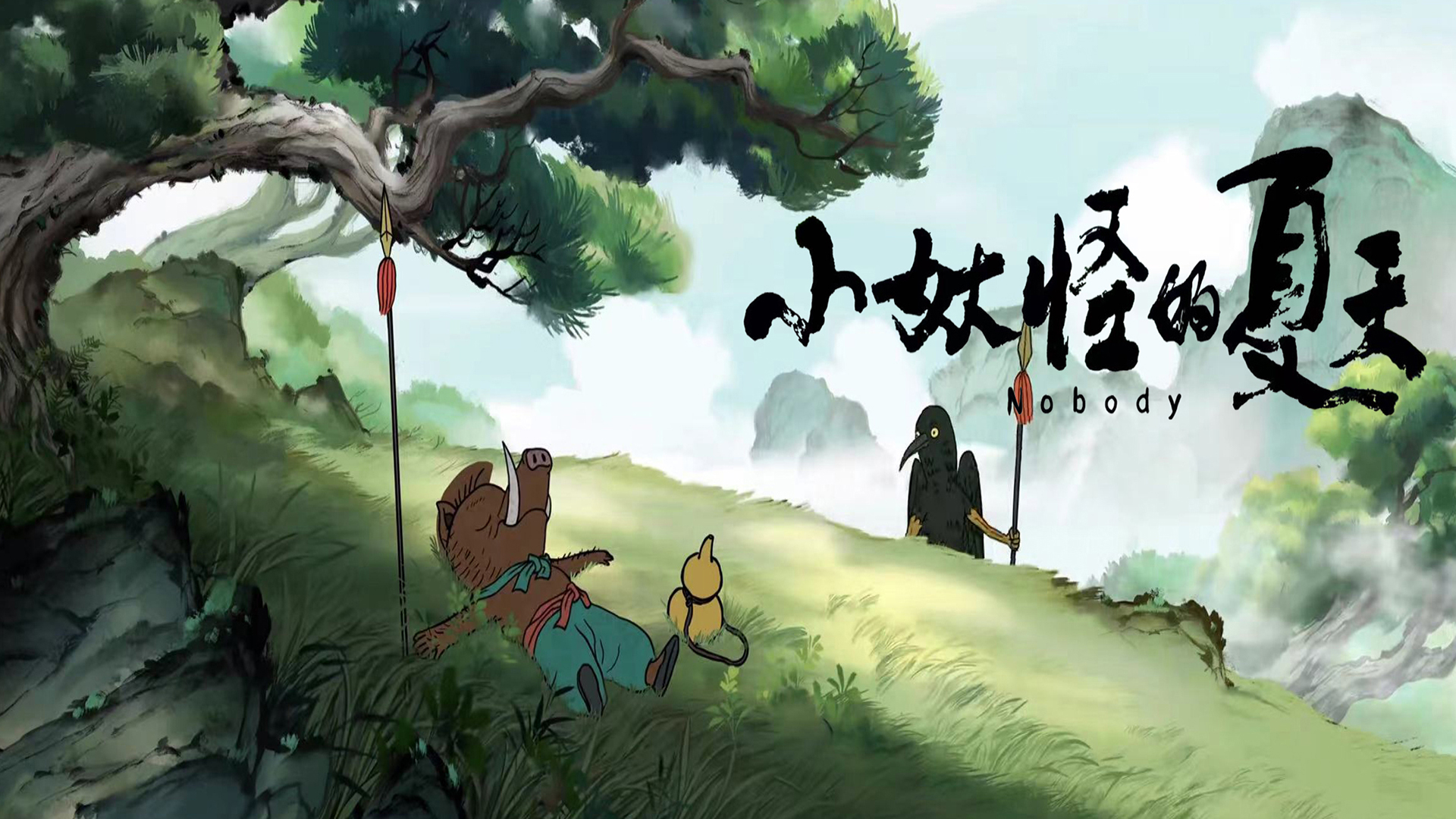
First, the film redefines who occupies the center of the narrative by shifting the perspective from the four pilgrims to an anonymous minor demon. In this short film, the story no longer revolves around Tang Sanzang or the Monkey King but focuses on the daily life and vulnerable situation of the little pig Yao as the core content. This change is not just a visual adjustment but a redistribution of narrative power. The audience no longer watches from the height of the hero but enters a neglected living space to see how a monster actually survives and exists. In this sense, this remix first occurs at the level of who can become the subject of the story, allowing an originally marginalized existence to gain the right to be told. However, this narrative innovation is achieved through a visual preservation of the old. The film highly retains the aesthetic essence of traditional Chinese animation, particularly the “national style” that Wenhai Zhou describes as a tradition established by the Shanghai Animation Film Studio to celebrate Chinese heritage (15). According to Sun Lijun, this approach gave Chinese animation “distinctive characteristics” that defined its identity on the world stage (272). These ink-wash backgrounds and folk-style character designs pull the audience back into a familiar cultural world. In traditional animation, this prestigious artistic style was reserved for grand heroes and divine myths. By using this same poetic language to depict the pig Yao’s ordinary life, the film uplifts this marginalized character and gives his quiet struggle a sense of visual importance. This aesthetic choice suggests that the survival of a “nobody” has a place in the world of fine art just as much as a hero’s journey. This creates a powerful tension with the story’s rebellion against traditional hero narratives.
Second, the film transforms the Yao from a flat, functional villain into a concrete individual whose struggles mirror the modern labor condition. In the original Journey to the West, a Yao’s value is primarily functional; they are merely hurdles to be overcome. However, Nobody redirects this focus toward the pig Yao, whose life is so insignificant that it wouldn’t even count as one of the eighty-one tribulations in the original story Journey to the West. Instead of a monster driven by evil, we see a common worker toiling for his superiors and surviving under constant pressure. As scholar Wenhai Zhou notes, contemporary Chinese animation has shifted from simple moral expressions toward the presentation of individual experience and reality (1). By depicting mundane tasks like the pig Yao’s exhausted efforts to prepare for the ambush, the film shifts the focus from a grand moral battle to the lived experience of a minor character. These details show that he is no longer just a functional monster tasked with helping his boss capture the monk, but an ordinary being whose survival is constantly at risk. Because the audience sees his life through these specific hardships, his personal struggle becomes more important than the hero’s traditional victory. Ultimately, this remix changes the monster’s very purpose in the story: he is no longer a tool used to drive the hero’s plot, but a person whose own survival has become the heart of the narrative.
The ending of the film fundamentally destabilizes the traditional definition of a Yao. In the original Journey to the West, a monster’s fate is predetermined by its identity: being born a Yao means being classified as evil and marked for elimination. However, Nobody performs what Wang and Whyke call a “transcoding” of traditional narratives, using familiar symbols to connect with the contemporary audience’s identity (68). By reinterpreting the old logic, the film transforms the traditional monster into a complex, relatable individual. This change happens when the pig Yao finally wakes up and realizes his “boss” is evil, which only wants to eat the monk and get the ability to live forever. Then the pig Yao decides to risk everything to run toward the pilgrims, shouting a warning about the ambush. Although the Monkey King appears to strike him down at first, it is actually a trick to help the pig Yao fake his death and escape his cruel leaders. Crucially, the Monkey King grants him three golden hairs, which serve as a literal and symbolic lifeline. Without this gift, the pig Yao would have been crushed by the very system he tried to escape; these hairs represent the only reason he survives an otherwise certain death. This is not just simple mercy, but a judgment based on actually “seeing” the person underneath the label. As research suggests, this update “revitalizes” the myth by proving that when a “nobody” is seen for who they are, the original classification system fails. The basis of judgment shifts from what you are to what you have done. By being truly seen, the pig Yao gains a possibility of survival that was never permitted in the traditional epic.
Some people might argue that Nobody does not really change the old rules because the Monkey King remains the powerful hero while the pig Yao is still a helpless victim. However, the ending where the Monkey King helps the pig Yao fake his death shows a big change in the logic of the story. In the traditional version of Journey to the West, a monster’s fate is decided by their identity. If you are born a monster, you are expected to be destroyed no matter who you are as a person. By choosing to save the pig Yao, the Monkey King breaks this old rule. He sees that the pig Yao is not just another enemy, but a person who chose to do the right thing by warning the pilgrims. Also, when the Monkey King gives him the three golden hairs, he is giving a “nobody” the actual power to protect himself from a cruel system. This change shows that your life is no longer a fixed result of being born a monster. It proves that even a small person can change their destiny through the choices they make, rather than being trapped in the role society assigned to them. By rewarding the pig Yao’s courage instead of punishing his identity, the story suggests that individual actions are more important than birth or status. This shift allows a marginalized character to break away from a cruel system and finally gain the right to decide his own future. Once a nobody is truly seen as an individual with his own choices, he finally has a chance to survive.
In other words, the film does not try to overturn the original world but opens a new possibility within it: even within a given structure, nobody can still be understood. This change may be small, but because it happens within the most solid rules, it appears even more important. In conclusion, Nobody performs a systematic remix of the Journey to the West mythology by rewriting the perspective, the character, and the ending. The title Nobody points this toward a deeper question: in a narrative accustomed to being hero-centered, have those existences that were never remembered always been misunderstood? Perhaps this change is moving because it touches upon a familiar experience. We are used to identifying ourselves with the Monkey King and believing we will eventually become the person in control. But at some point, we realize that more often, we are like that nameless pig Yao—struggling to survive and rarely being truly seen. Nobody is different because it does not try to turn a nobody into a hero; it only allows him to be seen for a short time. When we begin to understand this, the question is no longer whether a monster should be eliminated, but how many nobodies remain outside the stories we know that are still waiting to be told.
Annotated Bibliography
Ng, Andrew Hock Soon. “The Monster as Ethical Mirror: The Example of Monkey from Journey to the West.” Listening: Journal of Communication Ethics, Religion, and Culture, vol. 52, no. 3, 2017, pp. 153–63. EBSCOhos.
This article discusses the role of Sun Wukong in Journey to the West as an “ethical mirror”. Ng argues that monsters are not just villains meant to be defeated by heroes, but instead act as reflections of our society’s own value system. The author points out that by defining and punishing monsters, a society maintains its own sense of being “good”. However, this often causes people to ignore the prejudices and unfairness within their own system, which Ng calls “blind spots”. By looking at the relationship between the monk and his disciple, the article reveals how this system excludes others to hide its own flaws. Ultimately, the author encourages readers to use this mirror to think about the social roots that create these monsters in the first place.
I chose to use the concepts of the “ethical mirror” and “blind spots” as evidence because they perfectly explain the meaning behind the perspective shift in Nobody. Ng’s theory about the mirror helps me show why traditional hero stories always have to sacrifice characters like the Little Pig Yao: the system needs his “badness” to make the hero look better. Additionally, the idea of “blind spots” supports my analysis of the workplace in Langlang Mountain. It shows that this strict hierarchy only works because it intentionally ignores the basic dignity and value of ordinary individuals like the protagonist. By using these two points, I can better prove that the film is a deep critique of traditional hero logic, changing the monster from a simple tool into a real person with feelings.
Sun, Lijun, and Routledge EBA. The History of Chinese Animation. I. / Edited by Lijun Sun ; Translated by Shi Yi and Li Junting. Routledge, Taylor and Francis Group, 2020. EBSCOhost, https://doi.org/10.4324/9780367854867.
This book records the development of Chinese animation over many decades. Sun Lijun explains that Chinese animation has its own identity because of its unique artistic features that are rooted in national culture. He believes these features do more than just show high-quality work. They act as a symbol of identity that helps people around the world recognize Chinese animation and its cultural roots.
I am using Sun’s ideas to show that the look of Nobody is more than just a choice for nostalgia; it is a way to claim a cultural identity. My point is that because the film perfectly follows these recognized artistic traditions, its rebellion against the old rules in the story feels much more powerful. This contrast between the classic, official look and the modern, rebellious message is a key part of my essay, as it shows how the film uses a familiar style to challenge traditional ideas.
Wang, Aiqing, and Thomas William Whyke. “From Ancient Zhiguai Tales to Contemporary Animation: A Study of Visual Rhetoric in Yao-Chinese Folktales (2023).” Animation: An Interdisciplinary Journal, vol. 19, no. 1, 2024, pp. 58–75. SAGE Journals, https://doi.org/10.1177/17468477241236129.
This article examines how the animated series Yao-Chinese Folktales reinterprets ancient Chinese stories for today’s viewers. The authors focus on a process called transcoding, which means taking old symbols and traditional art styles and giving them new meanings that modern people can relate to. The study argues that by using these visual strategies, the animation transforms classic myths into stories that reflect contemporary social issues and personal identities.
I used the concept of transcoding from Wang and Whyke to explain why the ending of Nobody is so important. In my essay, this idea helps me show how the film takes the traditional image of a monster and changes it into someone we can care about. Instead of following the old rules where every monster must be killed, the film uses this transcoding process on page 68 to connect the story to the feelings of modern workers. I am using this evidence to prove that the film redefines what a monster is by showing that an individual’s choices and kindness are more important than their birth or social label.
Zhou, Wenhai, and SpringerLink (Online service). Chinese Independent Animation : Renegotiating Identity in Modern China / by Wenhai Zhou. 1st ed. 2020., Springer International Publishing, 2020. EBSCOhost, https://doi.org/10.1007/978-3-030-40697-4
This article discusses how Chinese animation finds its cultural identity. The author, Wenhai Zhou, talks about the national style created by the Shanghai Animation Film Studio. He defines this as an artistic tradition that builds a sense of belonging by honoring traditional culture. He believes this style is more than just a visual choice because it acts like a bridge that connects past artistic traditions with modern animation.
I used Zhou’s ideas about the national style to show which original elements were kept in the remix of Nobody. I am using this evidence to prove that the film intentionally keeps these familiar visual styles to pull the audience back into a traditional world, which makes the story’s rebellion against traditional hero narratives feel much more powerful. Additionally, I used his point about focusing on individual reality to explain why the film focuses on the pig Yao’s daily life instead of just his label as a monster. This helps me prove that the pig Yao is no longer just a tool used to drive the plot, but a real person whose own survival has become the heart of the story.