Ziyou Zoey Xu
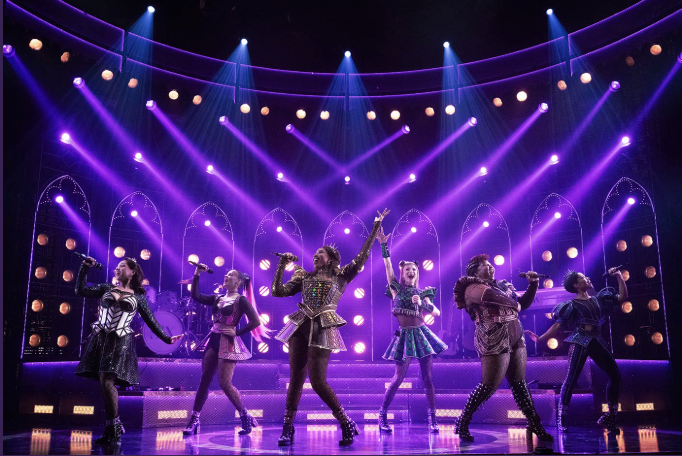
In her article, Fantasy Echo: History and the Construction of Identity, Joan W. Scott draws on the concept of primal fantasies of sexual difference, introduced by Jean Laplanche and Jean-Bertrand Pontalis, to explain how contemporary feminism gains social support and extends its influence. Regarding this strategy for strengthening feminist discourse, Scott does not express disagreement but rather suggests a perspective she considers equally important: the emphasis on individual differences among women (Fantasy Echo 288). Scott argues that even though the primal fantasies of sexual difference do help to reinforce feminist power, the ignorance of individual differences in women’s social positions, personal achievements, or points of view will instead perpetuate inequality. As she points out, artificially created and relative social norms are structured around how men and women should behave, which limits women’s developmental potential (Gender 1055). Six: The Musical, a pop-style musical centered on the personal expressions of the six wives of Henry VIII, written by Toby Marlow and Lucy Moss, serves as a bridge between conventional feminist works of art and the increasing attention to individuality. This makes it not only a successful work that consolidates feminism but also a practice of Scott’s suggested way to use gender as a category of historical analysis—one that “implies not only a new history of women, but also a new history” (Scott, Gender 1054). Six thus resolves the tension Scott identifies between collective political identity and individual difference.
To begin with, Six presents the collective political identity of women in the past and reframes it through contemporary feminist perspectives, allowing modern audiences to gain a sense of inclusiveness and solidarity, and therefore “reconciles illicit desire with the law” (Scott, Fantasy Echo 289). This musical starts with a generalized feminist narrative—it introduces the six protagonists with the slogan-like lyrics:
“Divorced
Beheaded
Died
Divorced
Beheaded
Survived”
(Six: The Musical),
—which catches the audience’s attention by outlining the oppression experienced by these historically famous women. Accordingly, the empathy of the audience to these women reinforces the feminist advocacy related to existing gender inequality, thereby calling for women’s resistance and solidarity to fight against the patriarchal laws enacted in the past and the remaining problematic regulations. At the same time, Six promotes inclusiveness by constructing a “we-versus-they” perspective (Scott, Fantasy Echo 289), which, as Scott claims, “articulates a longing for enjoyment that is beyond the ability of any ideological system to provide” (Fantasy Echo 289). Six successfully builds a transition between “oppressed women” and“women whose lives would be significantly improved by the power of modern feminism,”and therefore invites the audience to share a sense of satisfaction from fantasizing about the women’s survival and thriving under a completely different historical background, ultimately raising a stronger desire to be part of contemporary feminism. It achieves this goal by articulating the change in the mindsets of all six protagonists. For example, in “No Way,” Catherine of Aragon, who was considered tolerant in her marriage to Henry VIII, declares:
“I’ve never lost control
No matter how many times
I knew you lied
I didn’t say a word, no, baby
But now it’s time to shh
And listen when I say,”
showing a transition from passively accepting oppression from Henry VIII and restrictive social norms that silence her emotional expression, to gaining the courage to reclaim her agency and speak out. This transformation represents not only a spirit of resistance shaped by contemporary feminism, but also a form of empowerment that resonates with, moves, and engages the audience, calling for the collective engagement of feminist activists.
Moreover, corresponding to Scott’s assertion that gender, as a socially constructed identity, constrains the socially accepted behavioral standards for women and men (Gender 1056), Six uses the stories of its six protagonists to illustrate the harmful consequences of judging and viewing all women by the same set of limited and dehumanizing criteria to determine their worth. Six satirizes the patriarchal marriage market of the past, in which women were treated as objects of consumption and valued merely according to their appearance and reproductive worth. In “Haus of Holbein,” a sequence of lyrics states:
“No one wants a waist over nine inches
So what, the makeup contains lead poison
At least your complexion will bring all the boys in,”
which reflects Anne of Cleves’s experience of being forced to conform to rigid beauty standards in order to demonstrate her value in serving the interests of male rulers at that time, at the cost of her health and well-being. Similarly, in “All I Wanna Do,” Katherine Howard states that “I think we can all agree / I’m the ten amongst these threes,” which exemplifies how personal worth is defined through socially constructed standards. Even more critically, these standards generate conflict among the women themselves, weakening their solidarity through competition to be recognized as the socially defined “real,” “true,” or “most” woman.
Additionally, Six enacts what Joan W. Scott describes as genuinely “writing women into history,” which “necessarily involves redefining and enlarging traditional notions of historical significance to encompass personal, subjective experience as well as public and political activities” (Gender 1054). By achieving this goal—adding women into history as a category of analysis—the musical illuminates the life aspirations of all six protagonists, no longer reducing their identities to attachments to Henry VIII or to their ultimately dismissed marriages. To be specific, in “I Don’t Need Your Love,” Catherine Parr declares:
“Been a wife twice before, just to survive…
I’m fixed as one of six,
And without him
I disappear,”
hereby challenging a characterization that defines women through marital status and belonging. Instead, she asserts her individuality and highlights her overlooked achievements:
“Remember that I was a writer…
Fought for female education…
Why can’t I tell that story?”
This, in turn, calls attention to women who were overlooked not because of a “lack of political participation” (Scott, Fantasy Echo 286), but because of the systematic underestimation of their contributions and their intentional erasure from history. At the same time, Six presents a woman whose identity is not defined by romantic love, but by a deeply affectionate maternal bond. In “Heart of Stone,” Jane Seymour sings:
“Soon I’ll have to go…
But I hope my son will know
He’ll never be alone…
’Cause my love is set in stone,”
thereby expressing maternal radiance and emotional devotion that extend beyond her role as a wife. Moreover, once the label of Henry VIII’s wives is removed, each woman reclaims her own identity. Catherine Parr emerges as a feminist advocate; Jane Seymour as a devoted mother; and Anne Boleyn as a young woman seeking love rather than power. As she sings in “Don’t Lose Your Head”:
“I wanna dance and sing…
Politics? Not my thing…
But then I met the king…”
her narrative reveals not ambition, but a desire for romance shaped by external pressures, thereby dismantling the historical portrayal of her as a purely power-driven figure.
People may disagree with Scott’s criticism of primal fantasies, arguing that this attempt to construct coherence between the oppressed and revolutionary movements has been historically successful in class struggles. This strategy can indeed be politically effective because it creates unity and strengthens collective resistance. However, this is not the case for gender because, unlike class—a concept that builds on Marx’s economic theories—gender lacks a clear and unified theoretical definition (Scott, Gender 1055). Scott argues that applying the same logic to gender is problematic because women do not share a unified social position in the same way that class groups do. Instead, this lack of coherence makes it problematic to define gender through a fixed or finite definition of what a woman should be, as such a definition risks overlooking the diversity of women’s experiences (Gender 1055). Therefore, individual differences among women should not be overlooked, but instead should be regarded as a fundamental component of historical analysis.
To conclude, by inviting the audience to recognize their role in the advancement of feminism, warning of the potential risks of relying solely on primal fantasies, and exemplifying a more effective way of incorporating women into history as a category, in which individual differences are appreciated, Six emerges as a model for uniting feminists while also demonstrating the value of individual differences. This work of art fulfills Scott’s expectation by advocating for the inclusion of women’s individual stories into history, regardless of their differences in achievements or social positions, and instead emphasizing that they are worthy of being recorded simply by virtue of their existence.
Works Cited
Scott, Joan W. “Fantasy Echo: History and the Construction of Identity.” Critical Inquiry, vol. 27, no. 2, Winter 2001, pp. 284–304.
Joan Scott, a historian and gender theorist with a particular focus on women’s history, is the author of influential articles whose ideas inform this essay. Her work is widely cited in gender history and provides a theoretical foundation for analyzing identity construction. In Fantasy Echo, she argues that the identity of women is historically constructed through what she calls “fantasy”—the imagined consistency among individuals despite their different personalities, historical contexts, and social positions—rather than naturally formed. Scott does not treat fantasy as false, but rather as a mechanism through which collective identities are produced and an approach to consolidate the power of narrative. This idea is particularly helpful in explaining the creativity of Six: The Musical, which reframe the queens as individuals by highlighting their childhood experiences, emotional lives, and personal desires—dimensions of identity that are often compressed or erased when women are viewed collectively through the lens of a shared condition of lack of power or social subordination. Scott’s discussion of narrative participation also helps explain why the musical resonates with contemporary audiences, as it allows viewers to see themselves as participants in feminist history rather than passive observers.
Scott, Joan W. “Gender: A Useful Category of Historical Analysis.” The American Historical Review, vol. 91, no. 5, 1986, pp. 1053–1075.
In this earlier article, Scott argues that incorporating women into historical analysis is not simply a matter of adding new subjects, but of redefining what counts as historically significant. She emphasizes that the inclusion of women requires historians to reconsider traditional standards of historical importance, including aspects of everyday life that were often ignored in conventional historical narratives. This source is particularly useful for my analysis of Six: The Musical because it provides a theoretical framework for understanding how the musical reinterprets the queens not only through their political roles or marriages, but also through their personal lives, emotions, and individual experiences. Scott’s argument also suggests a broader implication for historical study: rather than focusing only on men and a few exceptional women, historians should consider the experiences of ordinary women as historically meaningful. This idea helps contextualize how Six encourages audiences to reconsider whose stories are considered worthy of being remembered and provide space for imagining what kinds of musicals might emerge after Six.