How “Untitled” (Portrait of Ross in L.A) Shows the Importance of Form and Symbolism in Tandem
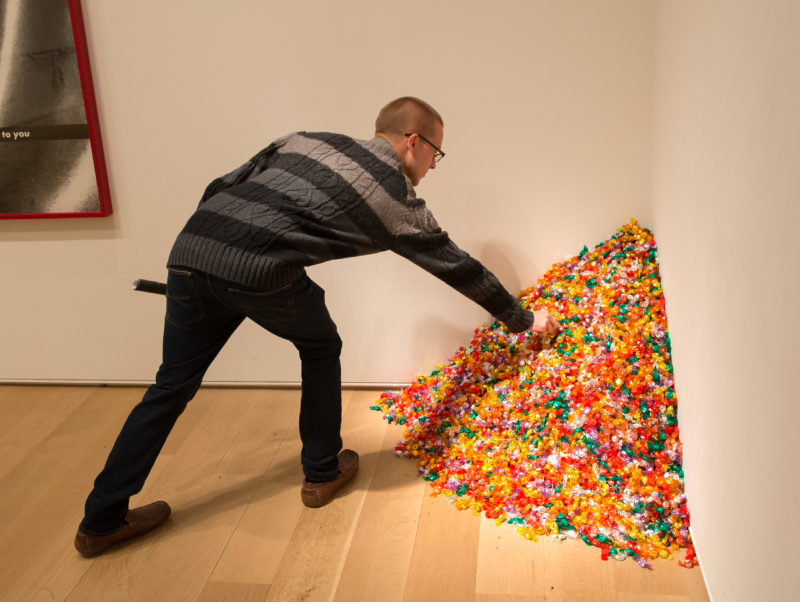
If you took a piece of candy from a pile sitting on the floor, would you think about the absence of your partner? Would you taste the candy and see the inherent value and sweetness in life and love? Would you see others doing the same and think about the fragility of existence? Susan Sontag encourages the prioritization of the form of an artwork, dismissing the idea of art as representation in her essay, “Against Interpretation”. Sontag argues that this idea, referred to as mimesis, leads to the valuation of art becoming reliant on its closeness to reality. While Sontag calls for an emphasis on the form of an artwork rather than its representation, symbolism along with its presentation is what provides the full effect. The importance of joining the two is illustrated by artist Félix González-Torres’s work, “Untitled” (Portrait of Ross in L.A). Torres blends format and meaning through his unique presentation and heartbreaking symbolism by use of candy to demonstrate his partners’ deteriorating health. While in Sontag’s, “Against Interpretation”, she asserts that form should be prioritized over content, the work “Untitled” (Portrait of Ross in L.A) by Félix González-Torres shows the value in harmony between the two elements in its ability to express meaning through both its form and content.
“Untitled” (Portrait of Ross in L.A) is a contemporary work of art created by Félix González-Torres in 1991. The work involves a pile of multicolored candies with a combined ideal weight of 175 pounds lying in a corner or against a wall at its current place of installation. It is not a static piece, with the ability to be shown in different forms in many locations. Viewers are encouraged to take pieces of the candy, diminishing the pile overtime. The candies are replaced at the beginning of the day, returning to their ideal weight and configuration. The specific number, 175 pounds, is representative of Torres’s partner, Ross, and his weight prior to his AIDS diagnosis. The constant diminishing of the pile mirrors the consistent deterioration of Ross health and its impact on those around (Woodley). The piece works to demonstrate the “emotional and physical toll” (Meyer) taken on through the AIDS epidemic, with Torres “merging personal narratives and universal themes” (Meyer) through “Untitled” (Portrait of Ross in LA).
Both González-Torres’ use of unconventional material like candy in his artwork and encouragement of viewers to interact with the piece supports Sontag’s emphasis on the importance of form. In “Against Interpretation” Sontag calls for “more attention to form in art” (Sontag 7) and highlights the need for “more extended and more thorough descriptions of form” (Sontag 7) amidst a culture focused on interpretation. González-Torres’s work “Untitled” (Portrait of Ross in LA) is recognized for its unconventionality, designed precisely to invite viewers to interact with the piece. This allows the audience to form personal experiences with the work, encouraging viewers to have their own involvement and relationship with the artwork. González-Torres explicitly shares this intention with his piece, as he says, “I wanted people to have my work…. In a way this “letting go” of the work, this refusal to make a static form, a monolithic sculpture, in favor of a disappearing, changing, unstable, and fragile form…” (Félix González-Torres, Interview with Tom Rollins, 1993). González-Torres’s intentionality towards the piece’s form works in agreement with Sontag and her assertions, shown as the piece has no clear explicit content. The work is completely mobile, with the ability to be displayed in different shapes at different locations. In fact, the content, the candy, is being consistently taken away from the piece. This lack of concrete content and emphasis on form is precisely what Sontag argues for in her essay, with González-Torres appealing to her encouragement of experience through observation as the audience can physically remove the candy.
The piece’s impact on viewers is only aided by the additional understanding of Gonzales Torres’s intention and its come to fruition in, “Untitled” (portrait of Ross in L.A). Sontag simultaneously diminishes the importance of interpretation and the symbolism behind a piece, writing, “Interpretation makes art manageable, comformable” (Sontag 5). However, “Untitled” (Portrait of Ross in L.A) and it’s connection of form and content proves deeper meaning can make a work more thought provoking, less easily absorbed. Without knowledge of the intention behind the piece, the viewer can easily dismiss it as a mere pile of candy on the floor. A very possible and typical reaction to the piece is described by the blogger Felix Jung, who writes, “My first thought on seeing the pile of candy was dismissive. But then I read the placard, and that completely changed my attitude and point of view in a matter of moments” (Jung). Jung’s experience is shared by many, as the piece is often easily disregarded as an example of derivative modern art. Becoming aware of the experience leading González-Torres to create the piece and its representation provides the audience with an expanded perspective, an ability to consider the piece in a vastly different light. Unlike Sontag suggests, added perspective does not make the work more manageable; it rather brings out discomfort in the audience upon the realization that the colorful work was inspired by tragedy. Even if viewers do not come to the same conclusions or exact intention of Torres and the pieces’ commentary (on the transient nature of life and loss), this added viewpoint forces viewers to confront their initial experience and promotes a deeper thought process. Ultimately, interpretation does not make the piece more manageable but rather allows the audience to see the work as more than its presentation. An understanding of what lies behind the pile gives viewers the opportunity to take more away from the piece than a simple candy, but a new perspective on the fleeting nature of life and love.
Ultimately, though meaning can be found in the work through the fleeting nature of its form and the tragic symbolism behind the work, it is the combination of both that the artwork reaches its full ability to create meaning. Though Sontag states that interpretation eventually leads to art’s valuation being determined by its closeness to reality, Félix González-Torres’s work challenges her conviction. His creation of a unique form evokes feelings surrounding the concepts of love and loss without any resemblance to realism, proving it possible to implement meaning without placing the value on realism. Torres’s use of form and encouragement of audience participation directly appeals to Sontag’s argument of the importance of presentation and experience. This is especially illustrated by the fleeting and flexible nature of the piece, not only through its ability to be displayed in different structures and settings but by the physical removal of the content itself, the candy. However, the erasure of the representation behind the piece hinders its ability to convey Torres’s full message. While the artist’s creation of form carries meaning through its provided opportunity of experience, without González-Torres’s portrayal behind the piece, the form would not exist. Essentially, without the symbolism and representation behind the work, it would be a simple pile of candy. This is why “Untitled” (Portrait of Ross in L.A) perfectly exemplifies the importance of the inclusion of both form and interpretation when discussing a work of art. González-Torres’s portrayal of his partners decaying health and its commentary on life’s unsure and fleeting nature brings about this unconventional form of candies in an interactive pile. With the inclusion of both the form and it’s representation the piece’s capacity to produce meaning is fulfilled.
The artwork, “Untitled” (Portrait of Ross in L.A), by Félix González-Torres both supports Sontag’s assertions about the importance of form and challenges her dismissal of interpretation. Sontag implores an emphasis on the physicality and sensory nature of art in “Against Interpretation”. González-Torres answers this call with his inclusion of the audience in the sensory experience of taking the candy from its pile. However, his creation of this work as experience is not its singular purpose, with González-Torres doing so to communicate the fragility of human life. Without his use of representation and commentary through the piece, the artwork would undoubtedly be dismissed as candy only, removing its value as art. At the same time, without the presentation of the work as a physical form and experience, its message and portrayal of Torres’s partner would not be able to be conveyed as the artist intended. As “Untitled” (Portrait of Ross in L.A) shows, both content and form are necessary to illustrate the entirety of an artworks goal. Only when the two work in tandem can a piece fully achieve its ability to create and convey meaning.