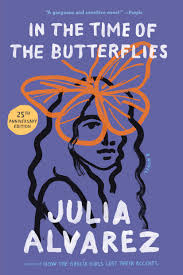
The most dangerous thing a woman can do is make history, because someone will always try to write her out of it. For centuries history has mostly been written by people in power, which often meant women, especially Latina women, were always left out. “In the Time of the Butterflies”, written by Julia Alvarez, tells us the story of the Mirabal sisters. These four Dominican sisters who risked everything to take a stand against the dictatorship of Rafael Trujillo. Unfortunately, all heroes have their own endings, they were assassinated in 1960. For decades, their legacy was buried, it was ignored like a book sitting on a shelf, collecting dust. However, Alvarez brought them back to life through historical fiction. It’s a fact that’s blurred, traditional historical novels have always been focused on male voices and the wonders they have done, leaving women like the Mirabal sisters unheard and in the shadows, but it’s time for their voices to echo farther. In the Time of the Butterflies flips the script of the traditional historical novel by using a feminist lens to recover the voices of four Dominican women, whose legacies were erased, Alvarez proves that literature is one of the most powerful tools that Latina women have to fight back against a world that was not meant to include them.
If you ever recall reading a traditional historical novel, you might have noticed a pattern in the way many of the stories are told. The pattern of male voices, who manipulate how history is written and interpreted. Another very well-known pattern is the exclusion of women, especially Latina women. Alvarez’s remixing of the genre was not an accident, but it was a necessary choice to bring their voices to life. This pattern is what Garcia Avello addresses in her research, she argues that Latina literature must fight against a literary world dominated by white male voices that consistently overlook women’s voices and stories. Garcia expresses, “became particularly successful at creating a discursive space for the construction of subjectivities that had previously been silenced” (Garcia Avello 71). This means that Latina writers like Alvarez have succeeded at enabling the voices of the sisters who were silenced, whose identities were hidden. This suppression wasn’t a literary trend but a political choice made by the Trujillo regime to keep the Mirabal sisters’ resistance hidden. This is what Rivera writes about the “mechanism of resistance.” Rivera expresses how women like Venezuelan Teresa de la Parra “used writing as a mechanism of resistance from which to question the limitations of the gendered experience, exemplifying the way that literature can be both political and philosophical” (Rivera Berruz). For the Mirabals, whose lives were restricted by a dictatorship and gender roles, Alvarez’s novel acts like a mechanism that allows them to finally exist as people who fought back rather than just victims. This remix of history is a response to how history has traditionally been told, leaving out women. Barbour argues that there is “pressure to bury the history of rebellious, revolutionary, and visionary women” (Barbour 1). There are doors closed to some people, which also means “they are also closed to our stories” (Barbour 2). So by choosing to write historical fiction, Alvarez refuses to let those doors be slammed shut. She proves that literature is a tool for those who are being silenced, it helps fill the gaps and helps the sisters’ voices be heard from the shadows.
Alvarez successfully remixes the genre by giving the sisters control of history rather than a male dictator, using a “displaced narrative” to demonstrate that the sisters are real people rather than names in a book. In most history books about dictatorships, the story is focused on the man. However, Alvarez moves Trujillo as a background character and focuses more on the sisters’ lives, giving each sister their own voice and personality. This connects to Garcia’s ideas, who expresses how Latina writers use stories to show that “ alternative possibilities, along with alternative selves, can be imagined and projected” (Garcia Avello 77). By giving each sister their own chapter, Alvarez creates “alternative selves,” giving the readers the idea that they are real women with lives. And this is what Barbour argues women’s historical fiction is supposed to do, she expresses how women writers use the genre because of “how fiction can become a way for women writers to reclaim ancestral pasts and write back into history overlooked and oppressed subjectivities”(Barbour 6). When Barbour claims an ancestral past, she means taking back the stories that were stolen, which is what each chapter Alvarez writes does for the sisters. Rivera adds to this idea, expressing that Latin American feminist ideas and thoughts are so rooted in the experiences they have. She illustrates that literature and testimonial narratives are essential because they “ concretely reflects the feminist maxim ‘the personal is political’” (Rivera Berruz). Alvarez does just that; she shifts, focusing the spotlight from Trujillo to the sisters. It was to challenge the system that has always been used to showcase his story more than theirs. The remix succeeds because it demonstrates that the important story was about the sisters and not his.
Those around her shaped Alvarez’s novel; it is part of a movement of Latina writers who are all fighting for the same thing, the right to be heard. Garcia Avello argues that Latina literature has grown into its own field, fighting back against a world where women of color weren’t meant to be heard; it was driven by “a shared preoccupation with the multiple forms of discrimination suffered by Latina women”(Garcia Avello 77). Alvarez isn’t writing alone; she is adding her voice to the growing wave of authors who have refused to let their stories be forgotten and silenced. Alvarez’s novel is special because of how powerful it was that she used fiction to rebuild the sisters. This connects back to the idea that writing has become this process, a tool to overcome the past, the voices that have been silenced for centuries. Barbour explains how this type of storytelling matters beyond the book Alvarez wrote. Still, she expresses how historical fiction “provokes readers to rethink official histories by acknowledging women who have been, in the words of Jane Ohlmeyer, ‘hiding in plain sight’” (Barbour 7). The notable sisters were not hidden; they were just pushed to the sidelines. Alvarez worked effectively to pull the sisters back into the conversation where they have always belonged, she brought them back to life. When she published the book, people began to remember the sisters and their contribution, and the United Nations recognized the assassination of the sisters on November 25 as the International Day for the Elimination of Violence Against Women. The sisters went from nothing to a symbol of feminist resistance. Rivera reminds us that this is what literature is capable of. She explains that Latin American feminism is often “grounded in the material lives of people” (Rivera Berruz). And that, by focusing on their experiences, writers can challenge a system that has been in charge of who is erased. Alvarez demonstrated that how a story is told and written can significantly change how history is told.
Some might argue that because Alvarez took a creative approach in telling the sisters’ story, the novel doesn’t accurately represent history, so it shouldn’t have any meaning in actually trying to help tell the sisters’ story. However, Alvarez never claims to be writing a history book. She used fiction because a history book wouldn’t have allowed the changes to bring humanity back to the sisters. Before Alvarez wrote the book, the facts of the sisters were just facts that didn’t highlight who they were, it was about their deaths. But Alvarez filling in the gaps of their private thoughts and feelings isn’t her lying about history instead, she is bringing the sisters’ lives back. This is a creative choice because it allows readers to see the sisters as real people rather than just names in a history book. Others might claim that because Alvarez wrote this in the United States and didn’t live in the Trujillo dictatorship, she isn’t able to tell and write the story correctly. But this fact forgets to include that Alvarez has a connection with the tragedy of the sisters because her own family had to flee the Dominican Republic because of the violence Trujillo was bringing. Alvarez didn’t just find their story, but she has had this story with her all along. Her novel was meant to be the beginning of telling and remembering the sisters. Alvarez isn’t alone in this, she’s a part of a larger community of Latina writers who are working together to break the cycle of stories that have been buried.
Erasing women from history doesn’t just blur the view of the past, but it also impacts how women see themselves today. When we don’t see our stories reflected in history, we become so easily influenced that we aren’t able to pursue a certain path because it’s closed off to us because of the systemic barriers that still exist. For too long, the narrative of history has been gated, it has left Latina women to fight for a seat in this world. If we continue to choose writing that has failed to help generations of Latina women grow, we won’t actually be telling history. Alvarez showed that literature is more than just reading, but it’s a form of activism to help change the world. By telling the sisters’ story from their perspective as the center, it has inspired many other writers to continue this genre and prove that women can make history and will.