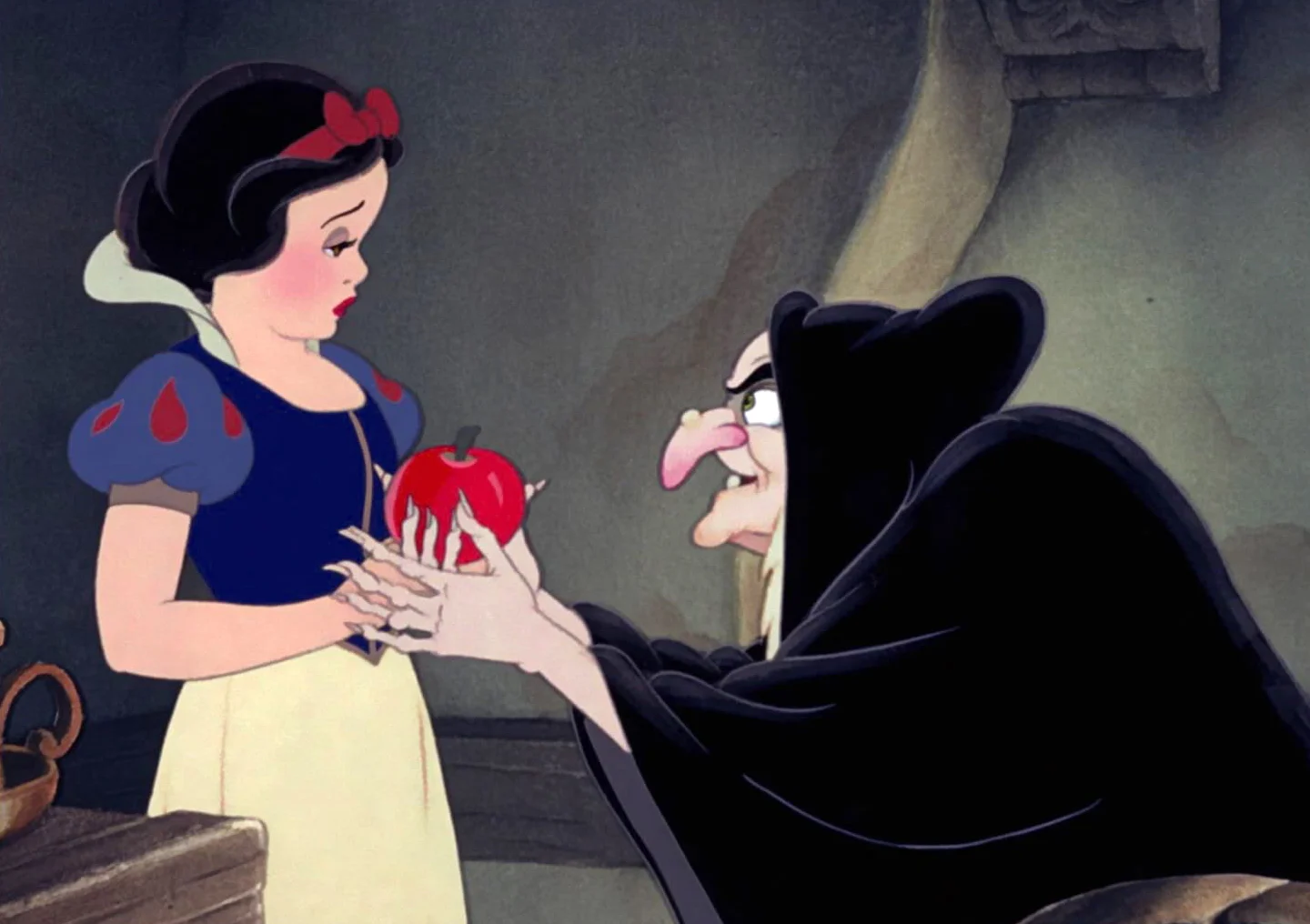
The classic Disney movie Snow White and the Seven Dwarfs was produced by Walt Disney Productions in 1937, becoming the first Disney Princess movie. It tells the story of a young maiden, Snow White, named after the light shade of her skin, being hunted by her jealous stepmother who wants to kill her for being more physically attractive than her. The innocent little princess gets lost in the woods and naively eats a poisoned apple that a stranger gives her which puts her into a deep sleep. She is then saved by a prince who gives her a “true love’s” kiss to wake her up. As wonderful as this fairytale ends, the representation of what it means to be a man or a woman in this movie is outdated and fails to support the way gender roles are defined in society now.
Film has the power to influence social norms on gender through the innocence of a children’s movie. The Disney princess movies are a series created to entertain young girls and give them fictional characters to admire. The creators of these movies are adults who already had a formed ideology of what gender roles are, insinuating the gender roles children were expected to grow into. In David Whitley’s analysis of Theories of Innocence in Film he argues that, “[…] the hybridization of genres so characteristic of film’s development within modern popular culture, he suggests, that these narratives speak to audiences’ disquiets, as well as their desires” (Whitley 78). Suggesting that when a movie is catered to children, their “innocence” is influenced by the ideas set in the movie. He goes on to explain that “innocence” is only recognized by adults because they carry life altering responsibilities, but a child has not reached that level of understanding yet. It is apparent that by using a child’s clean slates, adults implement their beliefs of what a woman is supposed to be like. Evidently, throughout the film, Snow White faced several hardships that she could not resolve without help from others, specifically men. First, when she was cluelessly picking flowers and the huntsman tells her to run away before he changes his mind to kill her as requested by the Evil Queen. Then, when she needed a safe place to stay, the Seven Dwarfs housed her in their home. And finally, when the prince saves her from her deep sleep with a kiss. In all these situations Snow White’s character portrays women as helpless people always in need of saving, and the male characters present the idea that the role of a man is to be the savior in every situation. This demonstrates that even though the creators did not directly say these were the designated gender roles, it is implied through the characters’ actions and appearances.
The way gender roles are defined varies among people because it is an ideology that can be taught. We can see the impact of stereotypical gender roles through the results of a study done (Parks-Stamm) on children, from ages 9 to 13 years old, that collected data on how likely a child was to choose stereotypical occupations or be comfortable in a position that goes against the stereotype. The female stereotypical choices would be among types of caretakers: nurses, daycare teachers, and florists. As for the male choices they would be among construction, engineering, and banking. The results of the third study revealed:
“[…]strong and significant interaction effect F (1, 44) =62.17, p <.001, η2 p= .586, controlling for general willingness to take part in the staged play. Girls indicated greater willingness to play the character with a stereotypically feminine occupation (EMM=4.92, SE=0.27) than the masculine occupation (EMM=3.43, SE=0.24), p< .001. Boys were more willing to play the character with the stereotypically masculine occupation (EMM=4.47, SE=0.24) than the feminine occupation” (Parks-Stamm 12).
Given these outcomes, we can clearly see the correlation between gender roles and the position people are willing to take in society. In order for Snow White to be permitted to stay with the Seven Dwarfs she shows them all the ways she can contribute, which happens to be maintaining the house. For instance, she offers to wash the clothes, clean the dishes, cook the meals, and sweep the floors. In another scene she is teaching the dwarfs how to clean themselves before having a meal, teaching young children that women’s best contribution to a community is taking care of others. It ties back to stereotypical roles women have played in society where they are stay at home wives with their only responsibility being a caretaker while men go to work.
The Evil Queen is a representation of what it meant to not fit into stereotypical gender roles of the time period in which the movie was released. In a course focused on the cultural influence Disney princesses had on students, Joyce Inman’s students wrote about the ways in which they might have identified themselves with the movies or the characters. One of their students constantly wrote about relating to the disney villains highlighting Gaston, from Beauty and the Beast, as:
“…not the villain he appears to be. Instead, she understands him to be a misunderstood figure who, by striving to conform to society’s definitions of the ‘ideal man,’ turned to a life of wickedness. If he is wicked, she claims, it is because society has reinforced masculine ideals” (Dilemma 46).
Similarly, the Evil Queen is displayed as a cruel and jealous woman because she is not as nurturing or has soft features the way Snow White does. Because she lacks these traits, she does not fit into what society deemed to be a feminine woman. Moreover, this impacts the way their relationship is perceived beyond the difficulty of being step family because it gives the audience the idea that women in general should be in competition with each other. In fact, when the Evil Queen asks the magic mirror, “Who is the fairest of them all?,” the mirror uses the descriptive language of “gentle grace” and “she is more fair than thee”, implying Snow White. Constant comparison of their behaviors and appearances makes it clear that to be the “good woman” we must be soft and tender like Snow White rather than having confidence and power like the Evil Queen. This teaches the audience that above all, the most important trait about themselves is their physical appearance. Furthermore, the ending of the film creates the idea that if women are more like Snow White then they will win the game and the reward is a husband. The Evil Queen not having a husband adds to this idea that if women are anything like her, relationships will not come easily to us. And by making relationships the end goal, the stereotype that a woman’s role in a relationship is to stand behind the husband is reinforced.
This version of the Snow White movie was released in 1937, almost a century ago when the roles that gender played in the movies followed the stereotypes. In light of the obvious that women now are choosing to be more independent and are decentering men, a new version of the movie was made. Last year, in March of 2025, Disney released a live-action version of the Snow White movie making several changes to all of the characters and the plot of the film. A few examples of these changes are: Snow White being named after the day she was born rather than the complexion of her skin, constantly reminding the audience about her priority to save the kingdom, teaching the dwarves to clean instead of doing it for them, and the man who saves her from the trance is a rebel not a prince. Eventually, these details build Snow White’s character to be a raging feminist with selfless goals, which is an example of a modern woman that a young girl could admire. In order to achieve this, the changes made in the live-action had to be drastic, which emphasizes how outdated the original movie was. However, the structure of the new version failed to complete the enchanting aspect that Disney usually strives for in their movies. This is significant because for princess movies there is an imaginative element that compliments the feminist values woven into the character. In an attempt to wipe out the idea that Snow White is a damsel in distress, the movie lacked the magical component of “true love” whether that be in romance, family, or friendships. Consequently, the plot of the movie was too predictable and unamusing to the audience that this time it failed as a film in its entirety.
Snow White is not a terrible character for being a ditzy Disney princess. Some people can identify themselves with her through her love for animals or her ability to see the best in strangers. This does not mean everyone though and it makes her an outdated example of what it means to be a woman. The original movie fails to keep up with how far women have managed to contribute in not only their personal spaces but professional work areas. Even after attempting to make her character a more modern woman in the 2025 remake, the changes do not heavily impact how she is being perceived because the new live-action version lacks the emotional fantasy. In sum, the gender roles assigned in Snow White and the Seven Dwarfs through behaviors, descriptions, and relationships no longer apply to the 21st century.

Works Cited
Parks-Stamm, Elizabeth J., et al. “Playing the part: Children’s willingness and embarrassment to play gender stereotype-violating roles.” British Journal of Developmental Psychology, 2025, p. 20. Wiley Online Library, https://bpspsychub.onlinelibrary.wiley.com/doi/epdf/10.1111/bjdp.70025.
The authors of this article performed three studies on how children respond or choose when given the choices between stereotypical gender roles. To answer their question, they based the first two studies on how likely a child would have chosen their supposed corresponding stereotypical gender role and how likely the child would have chosen a broader role outside of the stereotype. The third study is similar to the previous ones with the difference that it is focused on a population within the United States. This one gave children choices among professional occupations and academic subjects.
I can use the third study and the results generally drawn from the studies to analyze the roles played in a classic Disney movie such as Snow White and the Seven Dwarfs. Since the film was produced by an American company, the third study being on a population in the United States is fitting for this analysis. The occupations in the movie are as simple as princess and prince, so I can compare the results from the third study to how children view occupations with the simple occupations presented in the movie because that is the basic mystical roles children learn.
INMAN, JOYCE OLEWSKI, and KELLI M. SELLERS. “CHAPTER THREE: The Disney Princess Dilemma: Constructing, Composing, and Combatting Gendered Narratives.” Counterpoints, vol. 477, 2016, pp. 39–50. JSTOR, http://www.jstor.org/stable/45157185. Accessed 7 Apr. 2026.
Joyce Olewski Inman and Kelli M. Sellers composed a course based on the text “The Mouse That Roared: Disney and the End of Innocence” to explore how their students perceived the influence Disney movies had on their lives. Several of the students argued that they do not believe the Disney princess movies had an impact on their lives because it was obvious that the movies are pure fantasy. The students were tasked with writing an essay defining their relationship with the Disney Princess movies to find the narrative it has played in their lives.
This chapter of The Disney Princess Dilemma can be used in my essay to support my claim about the connection between the Snow White movie and the influence it has on gender roles based on the essays the students wrote. One of the students wrote about how she identifies with Snow White because of her pale skin, which I can use to argue how the film’s emphasis on appearance has influence. Another student focuses on the gender roles that are placed on a Disney villain, and explains how these societal norms are what create villains. This can be related back to the Evil Queen’s desire to kill Snow White for being deemed more beautiful.
Whitley, David. “Learning with Disney: Children’s Animation and the Politics of Innocence.” Journal of Educational Media, Memory & Society, vol. 5, no. 2, 2013, pp. 75–91. JSTOR, http://www.jstor.org/stable/43049666. Accessed 7 Apr. 2026.
In this article, the authors break down how children’s movies display their innocence and use it in a way to influence their behaviors. Adults associate innocence with children because they do not carry the adult responsibilities or have to face the realities of the real world. The author uses this idea to demonstrate how the lack of innocence in adults impacts the films produced for children because there is an idea that led to it.
I can use the section “Innocence as Passive Goodness in Disney’s Snow White” to demonstrate how Snow White’s character creates a stereotypical definition of what traits of a woman define femininity. This section also provides an explanation of how women are pitted against each other, and the role the Evil Queen plays in the movie is to give the audience an example of what kind of woman they should not be according to social norms. And the authors provide a comparison to a Dreamworks princess, who is the complete opposite of Snow White, and has a greater audience than her.