In modern media, the cultural shift between what is considered appropriate for children’s games versus games marketed towards adolescents and beyond has begun to highlight the ramifications of the hyper-sexualization of society. This idealization of specific traits can enforce detrimental forms of objectification of women and harmful societal expectations on younger players during a period of development. The Sims™, released in 2000, allows you to create Sim (aka people) households and explore different livelihoods by making choices for your Sim creations. Some drawbacks of the character creation process can highlight the internalization of female sexualization and unfair beauty standards impressed by society, especially considering that around 60% of The Sims players are women, and the game is marketed towards teens with a fairly young player base (Haskins).
Video game culture has a history of prioritizing western beauty standards for female characters, reinforced by society’s success in profiting off of sex appeal. Life simulation games aimed towards adolescents and young adults, such as The Sims, can normalize unrealistic societal standards of beauty and perpetuate expectations of compulsory sexuality that can have detrimental effects, especially in female players.
Generally, the video game community is one that has been known for its appreciation of marketing off of unrealistic character designs. Countless games across platforms capitalize on sex-appeal to attract their popular demographic, men, which results in a disproportionate amount of hypersexualized female characters. There are depictions of stereotypical female character archetypes and lack of clothing throughout countless video games. Continuous representations of stereotypical female tropes in online communities can lead to the normalization of treating women like sex objects, or marketing female characters as only profitable when it suits the ‘male gaze,’ especially when done in an explicit manner. Two conclusions surround these dangers of gaming culture brought forward by university professors Edward Downs and Stacy Smith in a journal of research exploring sex roles, include reinforcing the expectation of unrealistic body standards on women, which when unattainable for the player to achieve, may result in unhealthy habits and promote harmful behaviors such as eating disorders. Additionally, Downs and Smith raise the concern that unrealistic depictions of women in these games “send a message to male gamers of what women should look like,” further reinforcing these unrealistic ideals of how women should present themselves, especially at the risk of male harassment. This ultimately supports the degradation of women in gaming communities, and acknowledges that these game designs have impacts of offline behavior which place unrealistic standards on female gamers who can’t meet the expectations of societal body standards (Downs and Smith).
The Sims life-simulation game play reinforces societal issues of hyper-sexualization, as well as mature themes and compulsory sexuality that adolescents and young adults are already exposed to in gaming culture. In life simulation games, the player is typically able to customize their characters, design a home, and create a life. In this way, the game has many options to move in a more family oriented direction. Specific aspirations and life goals that sims can adopt will encourage a player to start a family, the Family aspiration has three possible pathways, all of which would require the player to create a family that lasts multiple generations. This opens doors to more mature themes, and can also result in heteronormativity due to direct lineage stemming from sexual intercourse between a male and a female sim, ultimately mirroring societal expectations for women including compulsory sexuality.
Compulsory sexuality is a term developed in response to an ever growing sex-driven western society, that is described by Kristina Gupta, professor of women, gender and sexuality studies, as “the assumption that all people are sexual; the norms and practices that compel people to experience themselves as desiring subjects…and engage in sexual activity” (134). For adolescents and young adults in developmental stages of their life, compulsory sexuality encompasses both the unspoken understanding that everybody should want sex, and in order to achieve this goal–as is reinforced within gaming culture–you must be sexually appealing. This is applicable to The Sims 4 experience in various ways, as there are multiple mechanics that may introduce an idea of sexuality to younger consumers in ways they had not previously considered. Apart from encouragement of familial relations by certain sim aspirations and life goals, there is also the fact that teen and adult sims have different interaction options with other characters. In order to have a household the sim must be an adult, therefore all sim experiences by definition have to include some adult featured gameplay even if the player themselves is underage. This includes the capability for risque flirting interactions and (censored) sexual intercourse, called “WooHoo” with an icon of a heart ‘burning with desire’ drawing the eye of any player. The Sims aims to be realistic in this area where many games marketed towards teens and young adults would not include overt representations to intercourse; therefore, introducing sexual concepts to a wider, premature age pool.
Digital Avatars, represented in media such as The Sims, can perpetuate harmful beauty standards that reflect features of an “idealized” western body type. Many games are moving towards a more hyper-realistic design, simulating the real world in certain aspects of game play. This is especially true among slice of life games, due to the nature of certain game designs, the possibilities of diversifying or realistic features can be diminished. In a quantitative analysis of the overlap between digital avatars and western beauty standards by Victoria Harding Bradley, a digital avatar’s default face structure is more likely to be based on the “Golden Ratio” than allowing for detailed proportion tailoring to every face (Bradley). This leads to complications when attempting self-recreation within games with these structures, as even when a character is designed to be a virtual representation of the player. Bradley writes that “avatars do indeed increase conformance to Western beauty standards encoded in the Golden Ratio” compared to the average conformance to these standards in the average natural face (Bradley). In line with this data, 55% of participants in this study reported believing that avatars are more attractive than the person they are supposed to represent (Bradley). Additionally, within The Sims it is more likely that players are creating more than just self-insert characters. As with most life-simulation games, there is an underlying goal of creating the most idealized life for your avatars, to live out your personal aspirations and dreams. This ultimately increases the likelihood of customization being used to further unrealistic body types and conventionally attractive features, as that is what is reflected as a valuable trait for a woman in society. It is with this context that the normalization of digital avatars in games marketed towards adolescents or young adults is dangerous, especially in terms of previously mentioned negative behavioral patterns surrounding self-perception.
It is arguable that full customization of a digital avatar doesn’t mean that all players will find themselves creating stereotypical, sexualized female sims. There are still plenty of sims that have been made and documented through the official Sim’s 4 Gallery that represent more inclusive body types and features that are more realistic to everyday life. The content of the game is also working to become more inclusive to LGBT+ communities, with new updates that include more androgynous hairstyles, body types, and most progressively gender neutral pronouns for sims (Rowe). However, if female hypersexualization in media is what people are being exposed to from a young age, along with sexist stereotypes, and pressure of compulsory sexuality within western culture, then these standards are likely to be internalized and reflected when given the tools to create avatars unrestricted. This is not seen as problematic, but is instead becoming increasingly normalized. The Sims 4 Gallery also exemplifies which physical attributes of sims are preferred by the player community, highlighting the value in sexually appealing female characters. For example, when searching the gallery database for the households with the largest amount of downloads within the community, a pattern of similar features emerges.

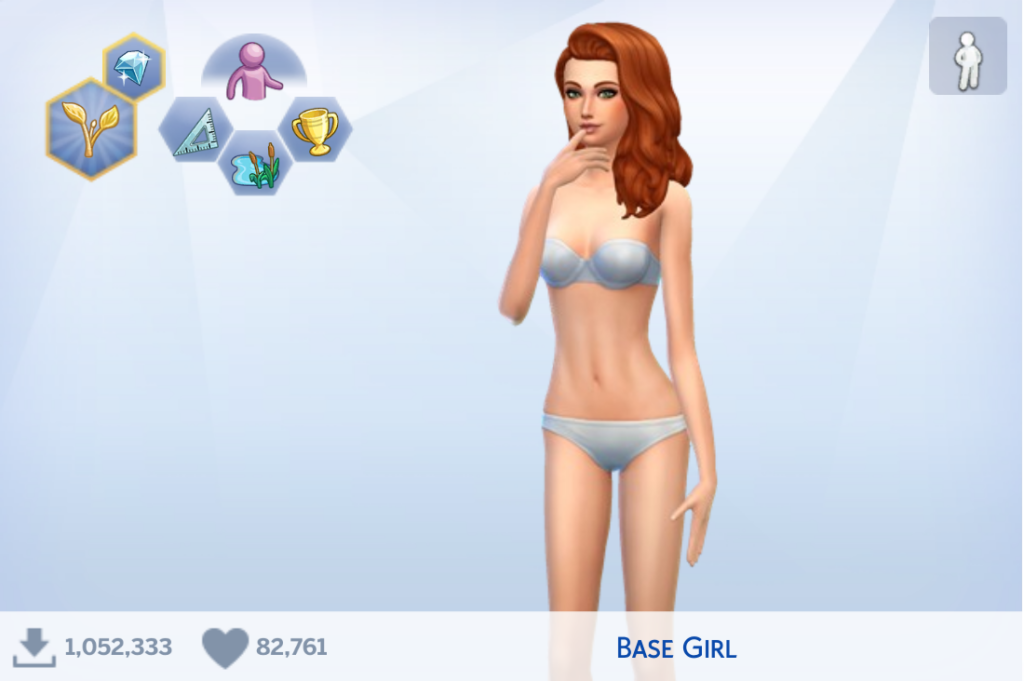
These two sims above represent a very stereotypical image of female beauty, and have been downloaded over 1,000,000 times.One sim with the name “Pretty Charlotte” has very symmetrically perfect features, a thin body, and is wearing a full face of makeup and feminine attire. She represents a physically ideal of women to these players. The second sim named “Beautiful Base Girl <3” further exemplifies the degrading language that is used to objectify and categorize women. In addition to the obvious unrealistic body type, the creator advertises her–like an object–in the nude, unnecessarily sexualizing her further. Additionally, whileThe Sims 4 continues to receive high praise for its inclusiveness for the LGBT+ community, it is still notoriously lacking racially inclusive content. This inherently results in less sim designs that include people of color as there are less inclusive skin tones and textured hair options that accurately reflect diverse features (“EA’s Reckoning”). As the content that is available to people of color is lacking, it is still telling that The Sims 4 Gallery’s most downloaded content is predominantly white, reflecting discriminatory racial standards of western culture as well.
Other examples of sim designs include similarly stereotypical representations of “perfect” women, while also displaying another common pattern of advertising Sims by putting female avatars in suggestive and sexual positions.


It is also worth noting that a lot of these designs with the greatest numbers of downloads on The Sims 4 Gallery are created using coded mods (modification; user-created alterations to existing game mechanics) in order to create hyperrealistic faces and introduce unconventional positioning graphics in order to create more attractive sims. Meaning that creators are going out of their way to create this type of extreme content based on sex appeal. This perpetuates compulsory sexuality as it leads to normalization of women “accept[ing] the idea that a modern woman should enjoy sex” and therefore wish to present herself in a way desirable for men (Gupta 135). Obsession with physical features is also apparent in gameplay challenges such as ‘Breed out the ugly’ where a player makes their household sim as unattractive as possible and continuously breeds younger generations of sims from the original until it is no longer ‘ugly.’ However, what is considered ugly in many cases not only includes unrealistic skin colors (ex. green) and exaggerated features but also overweight character designs. Contrastingly, streamers consider the ‘ugly’ bred out when the sim has symmetrical–golden ratio–features and a slim figure.
This presentation of life within The Sims aligns with an increase in sexualized marketing towards younger consumers that normalizes sex culture and in certain cases even encourages it, ultimately teaching children compulsory sexuality and detrimentally impacting behavior. A classic example of sexually charged advertisement of children’s toys can be seen by Bratz™ which is a doll line by MGA Entertainment and is described by Minjue Wu in an article titled “All About Sex: Global Childhood Sexualization and Education” as, “taget[ing] six-year-olds with fishnet stocking and miniskirts, and padded bras on bikinis sold for seven-year-olds” (Wu 1). This idea of children’s media using mature clothing to introduce enforced societal expectations on women is not new. For the next age range up there are also apps such as Episode, that ingrained the idea of skimpier clothing being more valuable by associating it as a reward for spending in-game gems. The Sims similarly supports what Wu describes as encouraging girls “to portray their identities using sexual items,” by providing a stage for this internalized self-objectification of women by women, through character creation that reflects these standards (Wu 1). As shown above, female Sims players are involved in perpetuating hypersexualization themselves due to this cultural obsession with western beauty standards, despite having adverse effects on mental health and self-perception. This is supported by Wu who has found that young girl’s “self-esteem is drastically lowered when they feel validated only by expressing themselves through sexualized means” (Wu 2). This internalization isn’t just ingrained into female players; growing sex culture throughout so many forms of media leads to the normalization of many harmful female stereotypes within male players, and can start young. Wu notes how “boys develop strong expectations of appearance and obligatory social behavior based on perceived expectations of the male sex drive in and out of the bedroom,” impacting the way that they may view women due to repeated exposure to objectification (Wu 2). The more that boys interact with one-dimensional hyper-sexualized female characters, the more it normalizes female bodies being objects for male satisfaction, all while sex culture puts pressure on men to seek out this attention in order to prove their masculinity.
Ultimately, the normalization of objectification of women among male gamers, and self-objectification and lower self-esteem in female players reflects the impact that these environments breed in adolescents. And despite any intention otherwise, it’s arguable that having open ended customization of digital avatars, in games such as The Sims, will enforce these social norms, leading female gamers to unconsciously prefer creating avatars with conventionally attractive traits at the expense of their self-perception as objectification becomes more and more ingrained in our society.
Works Cited
Bradley, Victoria. “Are Digital Avatars Perpetuating Traditional Beauty Standards in the Online World? A Quantitative Analysis.” The Nation High School Journal of Science, 2 Mar. 2026, nhsjs.com/2026/are-digital-avatars-perpetuating-traditional-beauty-standards-in-the-online-world-a-quantitative-analysis.
Bradley provides a quantitative analysis on data surrounding the developments within digital avatars generally, not specific to The Sims. This allows for a different perspective on the effects that digital avatars alone have on concepts of self-appearance and the appearance of others. Bradley found that digital avatars often reflect western beauty standards in a way that does not accurately represent realistic features or the features of the reference the avatar was designed from. This conformity to beauty standards was seen to be much higher among female avatars than male ones, supporting this ingrained body standard and featuring expectations of women that sexualize them within western culture. This was valuable because it supports the idea that this sort of misrepresentation of realistic features is a result of external pressure and can have a negative impact on self-representation among women.
Downs, Edward, and Stacy L. Smith. “Keeping Abreast of Hypersexuality: A Video Game Character Content Analysis.” Sex Roles, vol. 62, no. 11–12, Sept. 2009, pp. 721–33. https://doi.org/10.1007/s11199-009-9637-1.
Downs and Smith conducted a study that analyzed almost 500 video game characters based on their gender and the subsequent sexualization of their character designs. They found evidence that supported the idea that a majority of female characters within video games are sexualized, and implications this had on marketability within the gaming community. This resource was valuable as in the discussion sections Downs and Smith acknowledge many possible dangers of this representation of women within influential media. The two researchers mentioned the relationship between sexualization of women and the impacts that it could have on female players’ self-esteem by setting unrealistic expectations for female bodies and could promote unhealthy habits and self-objectification. Additionally, it’s valuable because it mentions the detrimental effect this has on male development. Many male gamers may internalize hypersexualized representation of women and reinforce unrealistic standards for women through toxic masculinity.
Gupta, Kristina. “Compulsory Sexuality: Evaluating an Emerging Concept.” Signs, vol. 41, no. 1, 2015, pp. 131–54. JSTOR, https://doi.org/10.1086/681774. Accessed 20 Apr. 2026.
Kristina Gupta is a professor of women, gender and sexuality studies, the article was a part of Signs, a journal published by the University of Chicago Press. Gupta explores the concepts of compulsory sexuality and how the term came to be more widely used after originating from concepts of heteronormativity and growing representations of asexuality. My investigation focused on the section of this article that discusses the history of sexuality in culture and how it has evolved within certain groups, including but not limited to, female and male expectations of sexuality in western culture. Gupta included the detrimental effects that compulsory sexuality has on both men and women: how it reinforces harmful masculinity and shames women. The applications of this concept in today’s society, which is in many ways more sex-driven than ever before, is very important to the connection between the pressure of sexualization within many forms of media, including video games.
Haskins, Walaika. “New Sims Games Target Younger Women.” TechNewsWorld, 17 Jan. 2007, www.technewsworld.com/story/new-sims-games-target-younger-women-55221.html.
Walaika Haskins, a writer of TechNewsWorld published this article only seven years after the launch of The Sims in 2000, discussing how the game developers of the franchise saw the opportunity to have greater success among a younger consumer audience. Haskins describes how the developers would attempt to accomplish this by releasing more expansion packs targeted towards adolescent interest, or including content that would be more relevant to a younger audience. This is valuable because it connects to the claim being made that the target audience of The Sims franchise is not exclusively older players who would be mature enough to navigate adult themes of sexuality. Which shows that the developers have historically–and continue to today–advertise this game to young audiences, possibly introducing sexual themes to children or adolescents in a way they had not previously considered.
Indiegameatlas. “EA’s Reckoning: Racism in the Sims 4.” Indie Game Atlas, 17 Aug. 2020, www.indiegameatlas.com/post/ea-s-reckoning-racism-in-the-sims-4.
Indiegameatlas is a blog that posts critiques, editorials, and guides on various types of indie games. This particular article details Black gamers’ historical experience with The Sims franchise, providing perspective on the ways The Sims has failed to deliver on promises of inclusion for ethnic minorities group representation within character customization. Though this essay does not go into depth about the struggles of racial representation in The Sims, the blog post includes great information highlighting the history of injustice and lack of accountability from EA, with a range of sources to support the Black gamers’ personal experiences.
Rowe, Willa. “‘The Sims 4’ Pronouns Update Proves This Is Gaming’s Most Inclusive Series.” Inverse, 25 May 2022, www.inverse.com/gaming/the-sims-4-pronouns-update-most-inclusive-franchise#:~:text=This%20Sims%20customizable%20pronouns%20update,in%20the%20language%20we%20use.
Willa Rowe discusses the new update that was added to The Sims 4 which allows for nonbinary pronouns for sim characters, allowing for a more inclusive gameplay environment which she argues makes it one of the most inclusive game series. Rowe gives a background to The Sims 4’s history of inclusivity within the LGBT community with the game mechanics allowing for same sex relations since the games conception. This source provided a slightly alternative approach to sexuality within The Sims. The main point being argued within the essay criticizes video game environments and western sex culture for impacting hyper-sexualization within the The Sims customization process. However, Rowe offers an example of how sexuality being represented in The Sims can also make it more of an inclusive game play for different modality of characters. This was valuable in seeing the ways in which The Sims has tried to adapt gameplay to support its gamer demographic, it was also valuable to provide contrast between the progress within the LGBT community, and the failure of improvement of ethnic inclusivity within customization, despite efforts from Black gamers.
Wu, Minjue. “ALL ABOUT SEX: GLOBAL CHILDHOOD SEXUALIZATION AND EDUCATION.” Harvard International Review, vol. 40, no. 1, 2019, pp. 22–23. JSTOR, https://www.jstor.org/stable/26617389. Accessed 30 Mar. 2026.
Minjue Wu is a Harvard graduate, who published an article with the Harvard International Review, that aimed at providing international perspectives on youth experiences. Wu introduces the ways the idea of sexualization has shifted, including the different ways countries are handling more modern issues of child sexualization, especially in the growing digital age. Notably, the article mentions the gendered effects of sexual expectations for girls and boys that are internalized early in sexual development. This was helpful in providing a modern description of how these expectations of different forms of sexuality could lead to compulsory sexuality in a society that is highly digital, which allows for much easier communication between two people. And how that possibly justifies fears of children consuming sexual content or engaging in sending and receiving possibly harmful explicit sexual materials at a young age.