Have you ever wondered what makes someone a hero? Is it their power or their strength? Or is it their charisma and ability to bring people together? What does your choice say about you? Heroes play a pivotal role in shaping childhood ideals and influencing the development of personality traits. The media we consume directly affects the values we adopt throughout life. Many content creators use this influence to promote their vision of the ideal person—heroes—who embody cultural values. While different societies offer unique interpretations of heroism, shaping their appearance and, more importantly, their behavior and core values, there is a key distinction in the values they emphasize. This is especially clear when we compare heroes created mainly by U.S.-based companies such as Marvel and DC with Japan’s heroes featured in shonen manga. Heroes from Western media represent an outdated culture of individualism that encourages a divided society, whereas Japanese manga heroes, such as those in One Piece by Eiichiro, embody collective and progressive values that strongly benefit their audience.
Western media portrays heroism through an outdated individualistic lens, leading its audience to avoid seeking community. Though the idea of superpowers exists in both manga and DC alike, the portrayal of isolation as almost an inevitable side effect of power gives children a bad foundation for the idea of power. If we look at Batman, he is seen by many as “a lonely and hunted man” (2). Someone who lives in the shadows and also works in the shadows, Batman often has to hide a part of himself, his work as a hero, even though it is something very important to him that is crucial to understanding him. Because of this, he finds himself with few friends, as he cannot risk revealing too much of himself. His work conveys to children the message that being powerful means not only having powers beyond reach but also distancing oneself, working alone in the shadows, leaving out a crucial part of what gives ordinary people immense power: community. This rampant culture of individualism in the U.S is one that originated with the Protestant Reformation, which switched religion from a centralized authority and emphasized a personal relationship with God and personal interpretations of scripture. (5) This culture has changed over time and has been formed into a culture of chasing personal success, and with the creation of the idea of the American dream, according to Tocqueville in Democracy in America, “They are in the habit of always considering themselves in isolation, and they willingly fancy that their destiny is in their hands”(4) . This culture is a very toxic one and one that leads to things like authoritarian regimes, where individuals who are leaders do not care about the people they are leading, but only their own personal gain. Batman, in pursuit of and prioritizing his personal freedom and the ability to work as he wants, chooses to live an isolated life, driven by the same toxic culture of individualism. This is the toxic lifestyle that the audience of Western media is fed.
On the other hand, Japan’s incorporation of media like One Piece that popularizes an idea of power in which outreach and cooperation are key to advancing its culture of collectivism and, in turn, the development of its country. The main character in One Piece is named Luffy. He is from a poor town in what they call the East Blue in One Piece. He has powers that stem from eating a devil fruit. A devil fruit can give you a diverse range of powers depending on which one you have eaten. Luffy is one of the select few in that universe who have been encouraged and accidentally ate an evil fruit that gave him the ability to be a rubber man. This is a seemingly useless power that Luffy has to learn to live with and work with to become strong and become the King of the Pirates. His superhuman power, seemingly useless, is what makes Luffy such a great hero. He cannot rely on raw power to beat all his opponents because he is not magically strong or possesses any special intelligence; quite the opposite. The special thing about Luffy is his ability to attract people to him. He is open and honest about his dislike of power, but is shameless in his pursuit of freedom. He recruits people for his crew seemingly at random, but they always say yes because, through his boldness and honesty, they see deep determination and loyalty, and they trust him. As is described by Hiroko Sasada, “Luffy is successful at leading his crew not only because of his power but also because of his broad-mindedness.”(3) This type of hero is also something that has a deep history. Post-World War II, the people of Japan were working hard to rebuild their country, so the stories of shonen heroes, much like One Piece, that showed that with hard work and collaboration, anything could be accomplished, were stories they enjoyed reading. (3) Luffy is a great example of a hero because he does not rely on his superhuman power, which makes him more relatable to the general public who have no powers. His powers lie in the people around him; he is not too proud to admit he needs help, a valuable lesson for both adults and kids. Luffy is like this because of the values of his creator, and, given that One Piece is the best-selling manga of all time, it seems people really resonate with those values and deem them important and worth adopting.
On top of being beautiful, One Piece, with its message encouraging teamwork and society building, also helps foster personal development and move away from typical male hero stereotypes. Despite Luffy having the ability to be made of rubber, he never really knew how to use his ability. This put him in many tough situations, one of which led to him losing all his crew members. Because of this, Luffy realized he needed training; he looked for guidance and trained in a dangerous jungle for 2 years. This was not because he just wanted to get stronger for himself or to be the most powerful; he trained for his friends, to protect them and not lose them again. This goes towards proving the point that being superhuman enough to be the most powerful, as Michel Foucault describes, “‘power is something which is performed, something more like a strategy”. Luffy’s tremendous work towards mastering his powers and unique talents to make the best version of himself teaches the value that it is not about what you have, but indeed how you use it. Luffy’s dedication towards his friends and allies also serves as a tool to break the stereotype of the usual emotionless male hero trope. In a study in which children were asked about their personal heroes and how they ranked in different categories, it was found that most male children chose a hero of the same gender and described their hero as less expressive than their female counterparts did. It is very common for the Western media to portray male characters that way, but One Piece moves away from that stereotype. Luffy is not afraid of his emotions. After his brother’s death in the manga, we see his grief and the steps he takes to deal with it, rather than something he just pushes to the back of his mind. We see Luffy cry, smile, care, grieve, and show possibly all emotions during this manga series, and that is really important in a society that undermines male mental health.
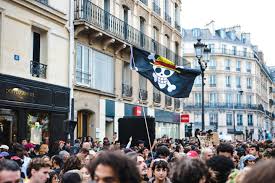
It is very easy to say that childhood heroes and the content we consume as we grow up have little impact on us compared to the environment we grow up in or the education we receive. While all those are things that hugely impact how one comes to be and what values and behaviors we adopt as adults, the type of people we look up to also has a huge impact. This is especially represented by the impact we see one piece have; August 2025, hundreds marched to a paramilitary armed base in Jakarta, Indonesia, in protest for Justice for a 21-year-old delivery driver who was run over by a military vehicle . When pictures of this demonstration surfaced, one of the most prominent flags present was of the Jolly Roger of Luffy’s pirate crew in One Piece. This was also the case during the massive Hong Kong protests in 2019-2020, when people took to the streets to oppose the Anti-Extradition Bill. (1) According to a Professor of Asian studies at Yonsei University in South Korea, the use of this flag and many more symbols from popular comics is because these protestors are fighting the powerful on behalf of the weak. They are taking the messages that these prominent characters in their childhood give, the message of standing up for each other, the message to never conform to what is wrong, and are using them to inspire and lead prominent political movements. Inspirational stories like One Piece are what give many young people the drive to be involved and present in the situations around them, no matter how disconnected those situations are from the actual stories. Works like One Piece inspire collaboration and power through numbers. A typical comic that represents the typical lonely hero could never bring this many people together to cause change because their stories were just stories, they didn’t inspire, they didn’t leave a message, they just portrayed an idealized person that media companies pushed onto all of us. They can not bring change in numbers because they push the idea of every man for themselves.
While some might dismiss childhood heroes and shows as fleeting sources of entertainment meant to simply occupy children for the time being till they eventually grow out of their hero phase. These shows have a real impact on children that lasts well beyond childhood, and the ideals they convey to them as children linger and manifest in their values and behavior as adults. From one culture to another, the heroes of a people reflect the deep history of each society, a mirror of their struggles and hopes, and are used by some to convey the ideal member of society. Understanding the history behind why our heroes are the way they are and the extent of the influence these figures have on us is extremely important. It helps us get a sense of why our morals are the way they are, and why we see certain things as right or wrong, or why we normalize certain things. Becoming aware of those things helps us be more thoughtful about the heroes we look up to, the kind of heroes we want to be for future generations, the kind of content we want to feed the next generation, and the values we want to carry forward.
,
Works Cited
- Brinkhof, Tom. “How Japanese Anime Became a Global Protest Language.” New Lines Magazine, 16 Sept. 2025, newlinesmag.com/spotlight/how-japanese-anime-became-a-global-protest-language/#:~:text=Why%20have%20anime%20and%20manga,inhabitants%20from%20their%20tyrannical%20rulers.
This text was authored by Tom Brinkhof a Dutch U.S- based journalist who is interested in the intersection of national politics and popular culture. In this text he explores different situations where anime and japanese comics of those sorts were used in a climate of protest and were used as a sign of rebellion and a force that pushed change. He delves into why these manifestations are happening and the power that anime and comics has and its influence in politics. In my essay I used this text to showcase how childhood shows and heroes can influence our behaviors and morals as adults. People who watched inspirational shows like one piece are now the ones leading political rebellions.
(2) Joseph. “Rugged Individualism: Nietzsche, Superman, and America.” Thousand Mile Walk, 1 June 2013, thousandmilewalk.wordpress.com/2013/05/21/rugged-individualism-nietzsche-superman-and-america/.
Joseph is a Blog writer and is very interested in the intersection between heroes and societal values. This text delves into how infamous American heroes such as Batman and Superman portray a sense of individualism that is very prominent in American society and pushes for that sort of culture. In my text I used this as a description of the typical American Hero, they used good words to describe how these heroes behave in their society and so it gave me more information about who these heroes are.
(3) Sasada, Hiroko. (2011). The Otherness of Heroes: The Shonen as Outsider and Altruist in Oda Eiichiro’s One Piece. International Research in Children’s Literature. 4. 192-207. 10.3366/ircl.2011.0026.
Hiroko Sasada is a professor in the english and english literature Department at seisin University Tokyo. Her interests are in fantasy, picture books, manga and films.Her most recent books are a Japanese version of The Complete Christie: An Agatha Christie Encyclopedia (2010), co-translated with Roger Prior, and Children’s Literature in English-Speaking Countries (2011), co-written with several other members of Japan Society for Children’s Literature in English. Hiroko is currently working on a new book on children’s culture in English-speaking countries with her co-editor, Sumiko Shirai. In this text I used this to further show how one piece goes about portraying heroes and how Luffy is different from the typical hero.
(4) Holub, Shayla, et al. “Gender Differences in Children’s Hero Attributions: Personal Hero Choices and Evaluations of Typical Male and Female Heroes.” Sex Roles, vol. 58, no. 7–8, Apr. 2008, pp. 567–78. EBSCOhost, https://doi.org/10.1007/s11199-007-9358-2.
This is a study of how children see heroes and what attributes they associate with their heroes. It delves into gendered stereotypes and explores how these stereotypes affect how children choose who their heroes are and also how they see their heroes. I used this text to further portray why the conversation surrounding the type of heroes we are feeding to the next generations, they see certain values attached to their heroes and because they want to be those heroes, they internalize it and so what they see matters.
(5) Raney, Erika Leigh. “Lonesome Heroes: Individualism and Individuation in America.” Order No. 32280988 Pacifica Graduate Institute, 2025. United States — California: ProQuest. Web. 7 Apr. 2026
This article is by Erika Leigh, she delves deeper into the history of why America is an individualised society and also how this affects how we behave as a society. She places a definition on individualism and paints a picture of how and why. In my text I used this to explain the history of America and where its values stemmed.