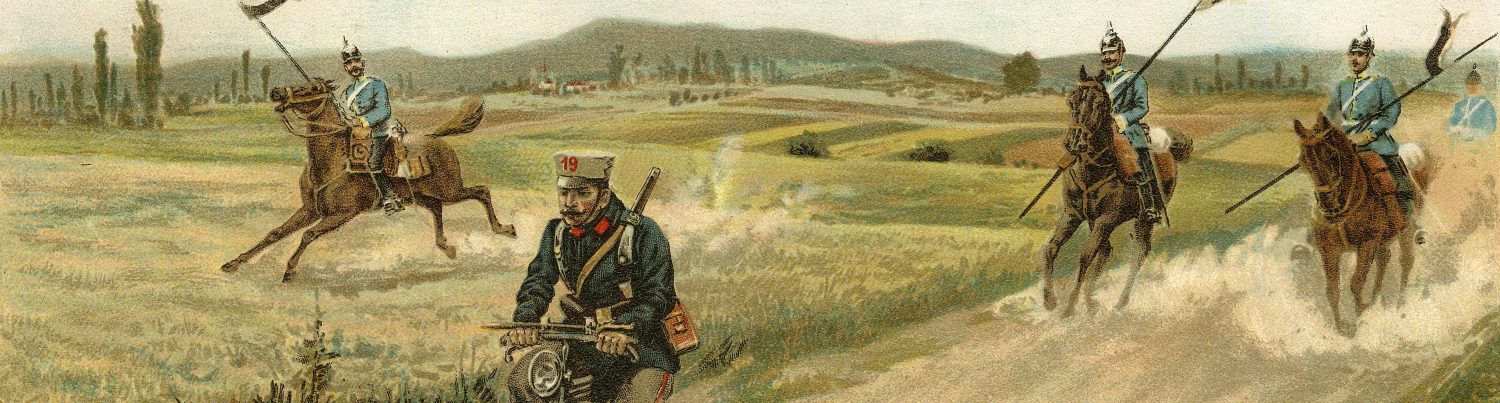
Morgenrot….Morgenrot

This postcard is part of a set that shows a Prussian cavalryman wounded in battle, probably set in the Franco-Prussian War (1870-71).

The poem at the top of the picture, entitled “Sunrise … Sunrise”, romanticizes the soldier’s encounter with death. It reads:

“Lie still, lie still
And accept the fate God wills!
I will fight bravely
And if death is my fate
I will die a valiant cavalryman.”

Morgenrot….Morgenrot

This postcard is part of a set showing a Prussian cavalryman who has been wounded in the fighting, probably during the Franco-Prussian War (1870-1871).

The poem at the top of the picture, entitled “Sunrise … Sunrise”, romanticizes the soldier’s encounter with death. It reads:

“Oh, how quickly, how quickly
Does beauty and stature fade away!
One moment you boast of looks so fine,
Cheeks white as milk with crimson hue,
Oh, but every rose will wilt in time.”

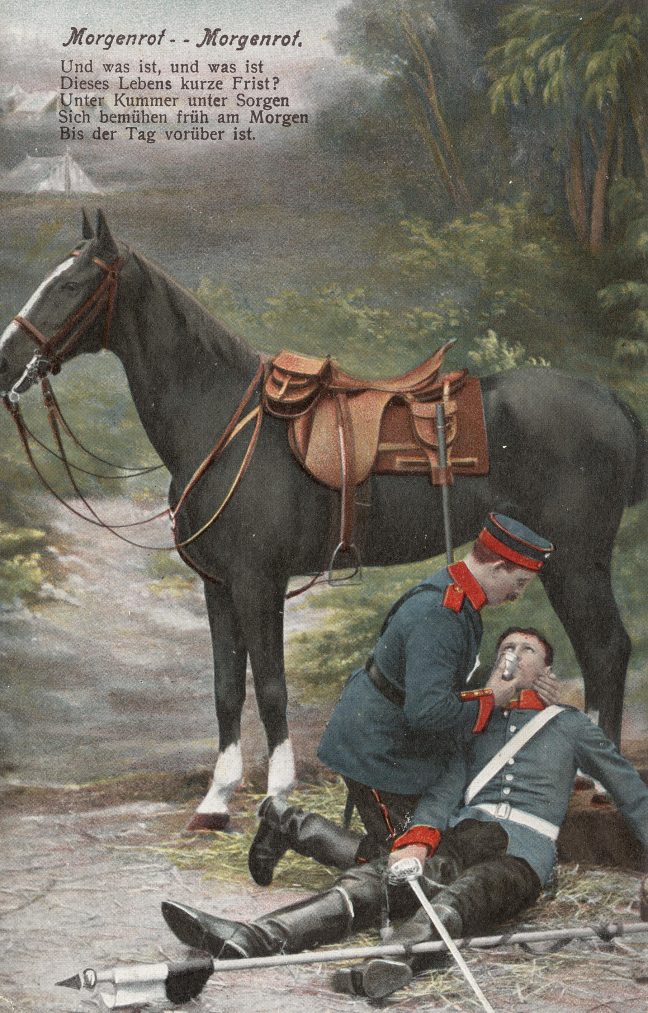
Morgenrot….Morgenrot

This postcard is part of a set showing a Prussian cavalryman wounded in battle, probably during the Franco-Prussian War (1870-1871).

The poem at the top of the card, entitled “Sunrise … Sunrise”, romanticizes the soldier’s encounter with death. It reads:

“So what is, what is
This short time that we are given?
Only troubles, only worries
Follow us through the day,
Until that day is done.”

Morgenrot….Morgenrot

This postcard is part of a set showing a Prussian cavalryman who has been wounded in the fighting, probably during the Franco-Prussian War (1870-1871).

The poem at the top of the picture, entitled “Sunrise … Sunrise”, romanticizes the soldier’s encounter with death. It reads:

“Oh, how quickly, how quickly
Does beauty and stature fade away!
One moment you boast of looks so fine,
Cheeks white as milk with crimson hue,
Oh, but every rose will wilt in time.”

Morgenrot….Morgenrot

This postcard is part of a set showing a Prussian cavalryman wounded in battle, probably during the Franco-Prussian War (1870-71).

The poem at the top of the card, entitled “Sunrise … Sunrise”, romanticizes the soldier’s encounter with death. It reads:

“Soon the trumpet will sound,
Then I will have to depart this life,
Both I and many a comrade in arms.”