Vision

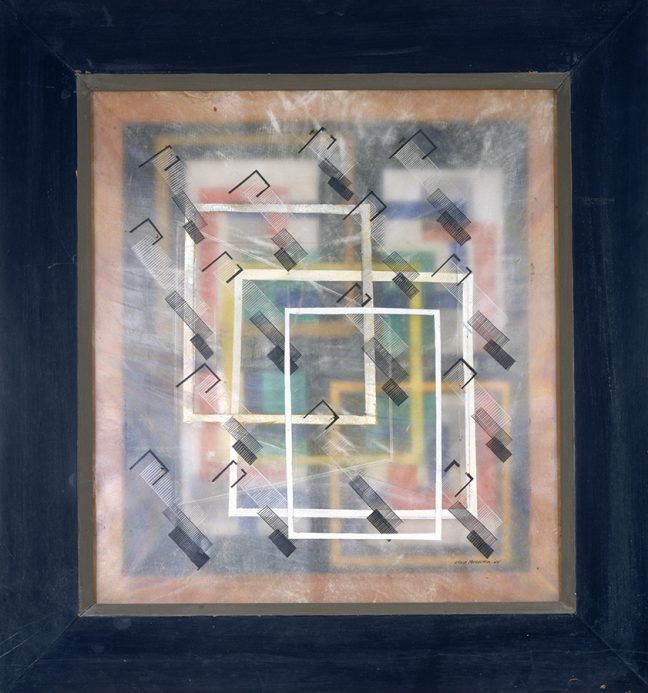
multicolored rectangular shapes visible through parchment on which diagonal two cream and one white rectangle have been painted along with rows of diagonal rectangles in white, grey and black; abstract

Irene Rice Pereira cared deeply about light, space, and vision. She was a poet and a philosopher as well as an artist. Influenced by the Bauhaus, the German art school active between 1919 and 1933 that sought to integrate art and life, Pereira experimented with a variety of less common materials and was an early adopter of acrylic—sometimes called plastic—paint. She defined her approach to abstraction as a search for “plastic equivalents for the revolutionary discoveries in mathematics, physics, biochemistry and radioactivity.”

Vision combines the familiar media of oil and parchment with Masonite, a kind of malleable, mass-produced board first patented in 1924 and made out of compressing wood fibers. The translucent parchment plays with the eye’s perception of depth. Painstakingly painted grey, white, and black ladder-like shapes sit on the surface of the work and hover over painted squares outlined in bright primary colors.

Pereira’s work was shown in ten different exhibitions between 1948 and 1957 at Barnett Aden, the Washington, D.C., gallery that Alma Thomas helped found.
Keep the Aspidistra Flying

Abstract painting

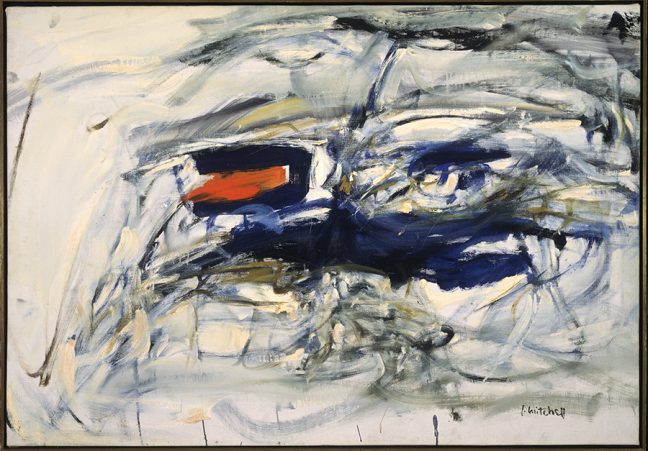
Gestural strokes and decisive mark-making swirl around the central anchoring and thickly applied colors of rust and deep blue. Painted by the Abstract Expressionist artist Joan Mitchell, the work dates to Mitchell’s early career in New York, after she attended Smith College (194244) and the Art Institute of Chicago (1944–47) and before she moved her studio to France in 1959.

Mitchell compared painting to poetry. Like Alma Thomas, she often began with an image or memory rooted in the natural world around her, describing her paintings as “remembered landscapes which involve my feelings.” Here, the title may refer to George Orwell’s 1936 novel of the same name. Aspidistra are hardy plants that were popular among the middle class in Victorian London because they grew well indoors, despite minimal sunlight and the poor air quality created by oil and gas lamps.

The collection of the Botanic Garden of Smith College includes several examples of aspidistra.

Where Are We Going?

Abstract painting, tryptic

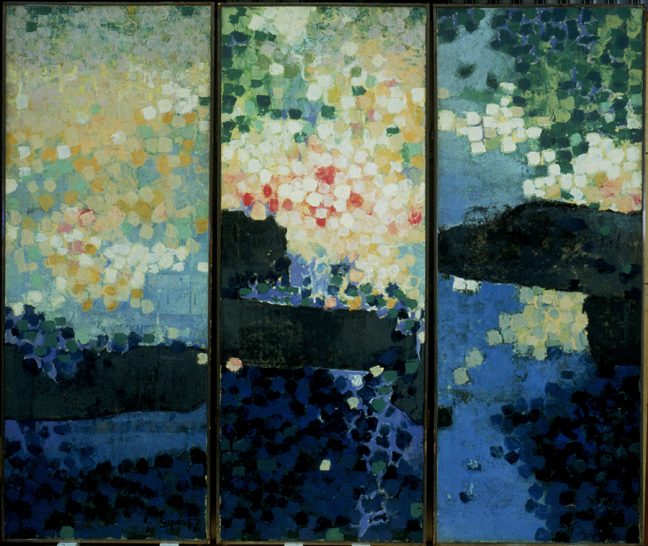
James Hiroshi Suzuki completed the triptych, Where Are We Going? in 1957, when he was 24. With its bright, shimmering upper register and horizontal orientation, Where Are We Going? evokes a history of landscape painting and suggests an interest in the colors and shapes found in nature. The rich blues, soft brushwork, and triptych format of Where Are We Going? recall Alma Thomas’s Morning in the Bowl of Night, also on view in the gallery.

The year after making Where Are We Going? Suzuki participated in four museum exhibitions, including at the Whitney Museum of American Art in New York and the Institute of Contemporary Art in Boston. He also had a solo exhibition at Barnett Aden, the Washington, D.C., gallery that Alma Thomas helped found.
Suzuki studied art with Yoshio Makino (romanized as Markino) in Japan before moving in 1952 to the U.S. He continued his education at the Portland School of Fine Arts in Maine and the Corcoran School of Art in Washington. A lifelong teacher, he retired from Sacramento State University in 1999.

Eighteen Rows

Stones on canvas

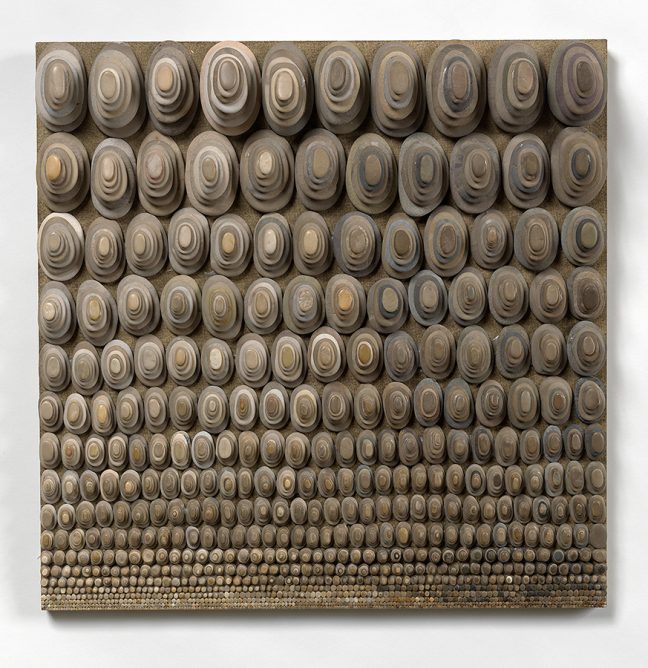
A member of an avant-garde circle of musicians, artists, and intellectuals in postwar Germany, Mary Bauermeister came to the United States in 1962 and spent a decade working in New York. Interested since childhood in the mathematical principles behind natural processes, Bauermeister used natural materials such as sand, stones, or honeycombs.

Bauermeister’s “stone pictures” are an example of how chance shapes artmaking. Fascinated by the shapes and colors of flat stones she first discovered on a beach in Sicily in 1962, the artist began collecting and experimenting with them, stacking the stones in “towers” of graduated sizes on panels.

As the artist has said of her work:

I am not beautifying or celebrating matter even if I work with stones. Of course I let them express themselves as material, but it is always a principle of order which they follow, a principle of geometry or cosmic order along which, for example, the growth of plants or minerals happens. These are thought-forms in matter.

Mrs. Lichtenstein

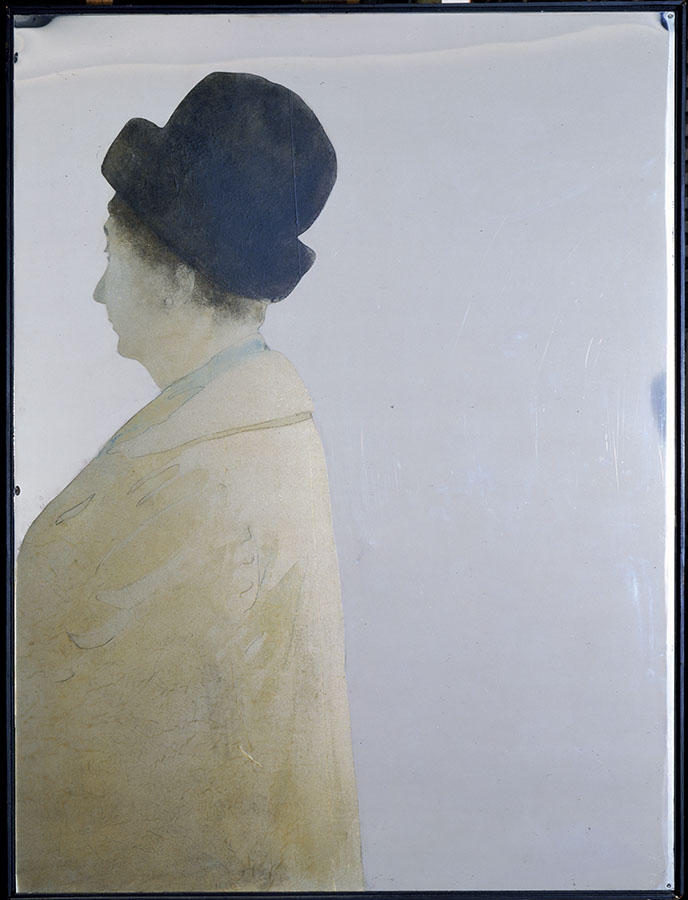
In Mrs. Lichtenstein, the mother of American Pop artist Roy Lichtenstein both shares space with, and turns away from, the viewer’s reflection. The viewer’s appearance in the mirror-painting is essential because for artist Michelangelo Pistoletto, it is the audience, not the artist, who completes the artwork. Every encounter is different.

A key figure in the Italian art movement Arte Povera (literally “poor art,” a reference to art made with everyday materials), Pistoletto is best known for works like Mrs. Lichtenstein. He called this body of works his “mirror-paintings” (quadri specchianti) and first exhibited them in 1961. Made by adhering a figure traced from a photograph and painted on tissue, the mirror-paintings combine photography, drawing, painting, and collage as well as industrially produced and highly polished stainless steel.