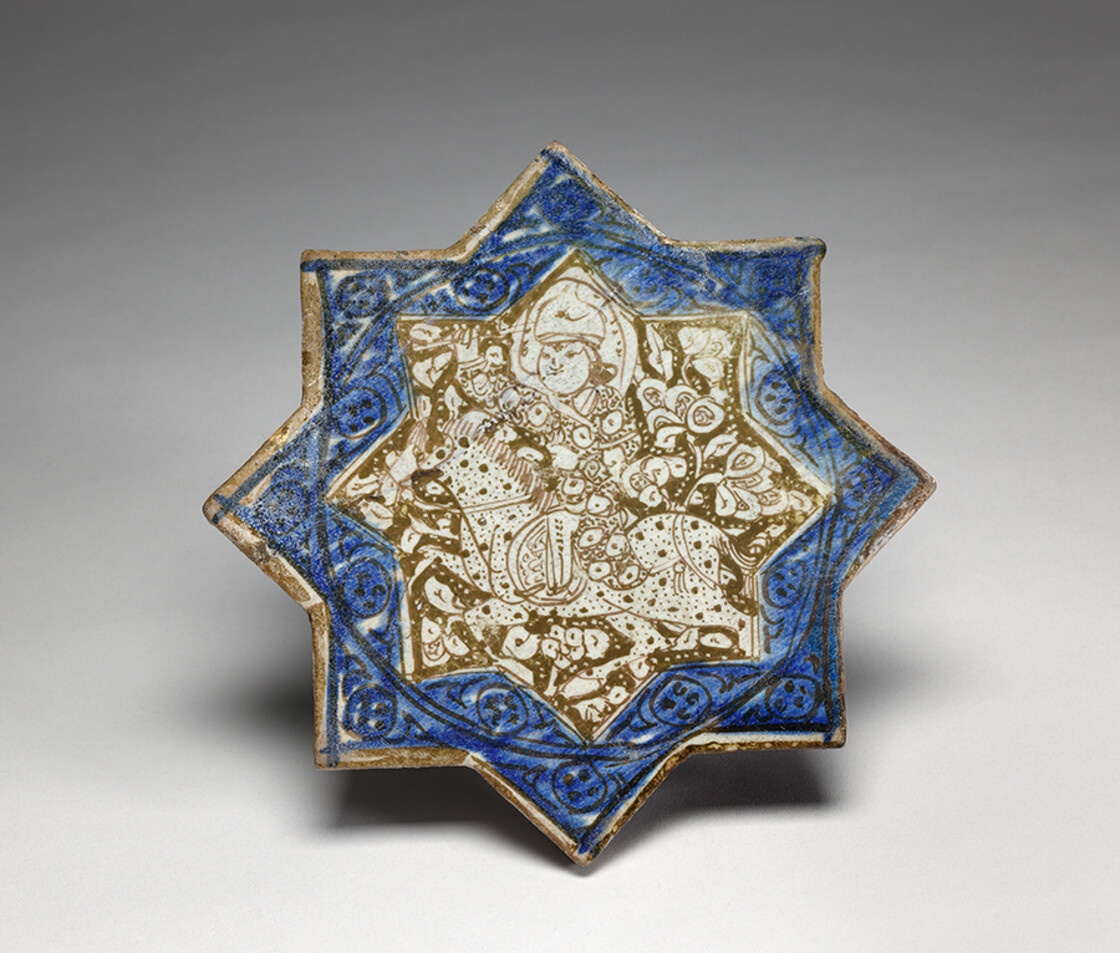
Maker: Once Known Maker
Culture: Iranian, Seljuk
Date Made: 14th century
Material: Ceramic
Measurements: 8 5/8 x 8 5/8 x 5/8 in. (21.91 x 21.91 x 1.59 cm)
Collection: Smith College Museum of Art SC 2016.29.64
Extra Information:
- Eight-pointed tiles, or khatam, were extremely popular and were often found in Iranian mosques
- They rarely existed as a singular tile – there were typically found in sets to create larger geometric wall art
- The number 8 is incredibly powerful in Islamic cultures it represents a multitude of things1
- Eight levels of paradise or the eight doors of paradise
- Eight is tied to the presence of a hero returning to renew the world and kill all evil
- Shabani, Zahra, Fataneh Mahmoudi, and Gholamreza Hassani. 2018. “THE 8-POINTED STAR (OCTAGRAM) SYMBOLOGY FROM THE PERSPECTIVE OF KARL GUSTAV JUNG.” Вісник Національної Академії Керівних Кадрів Культури і Мистецтв, no. 1. https://doi.org/10.32461/2226-3209.1.2018.178784. ↩︎